
December 04, 2025
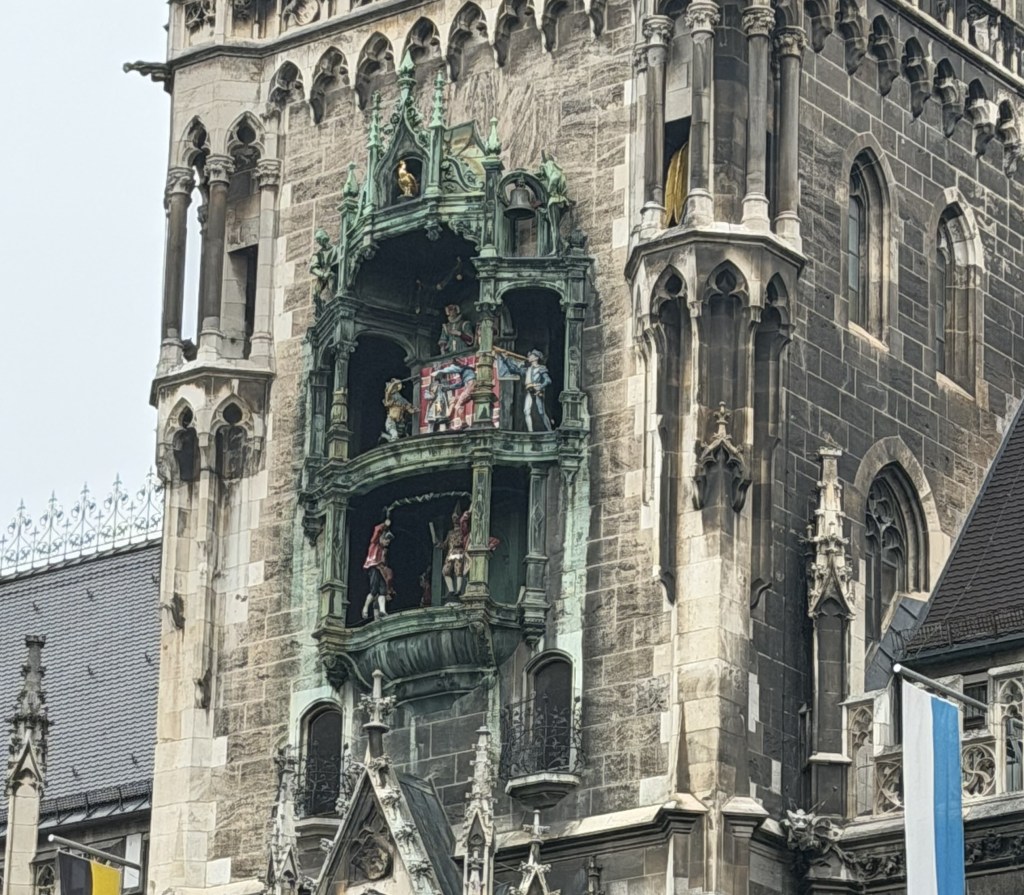
Our walking tour of Munich was timed so the first section of our walking tour would arrive in the city center in time for the sounding of the bells at noon. On arrival our guide asked if we had seen the bells of the Ankeruhr clock in Vienna (what?? must have missed it). This unusual Art Nouveau work was created by Franz von Matsch in the period between 1911 to 1914, and Franz Morawetz the court clockmaker had made the clockwork mechanism. Although the city square was the site for the largest Christmas market in Munich, the bells had nothing to do with the markets. The bells and figures were added to the town hall in 1908 and consist of 43 bells and 32 life-sized figures. The mechanism is powered by solar power and is only semi-automatic, as it needs a player to turn the levers at the exact right times 364 days a year. The glockenspiel at Munich is the largest in Germany and the fourth largest in Europe.
When I went online, I found glockenspiel is a percussion instrument that originally consisted of a set of graduated bells, and later a set of tuned steel bars (a metallophone). These are struck with wood, ebonite, or even metal hammers. The bars are arranged in two rows, the second corresponding to the black keys of the piano. The name glockenspiel is German (“bell play”) and refers to the sound of small bells. The very first instruments to carry this name did indeed consist of a set of small bells which were played either by a group of musicians or struck by means of a complex mechanism. At the end of the 17th century steel bars began to replace the bells. Initially they were only a substitute for real bells, but this arrangement of metal bars soon developed into a musical instrument of its own and retained the name “glockenspiel”. Like the xylophone, the glockenspiel is a great favorite with children. Carl Orff used it from the 1930’s for his Method. The children’s instruments have a smaller range, are tuned diatonically, and have bars resting over a frame like a trough. Lower-pitched glockenspiels have short resonators and are generally known as metallophones.
The glockenspiel of the Munich New Town Hall (Neues Rathaus) on the central square (Marienplatz) attract huge crowds every day for reenactments of two events from Munich’s city history. The first is the wedding of Duke Wilhelm V and Renate of Lorraine, in February 1568 when a jousting match in honor of the bride and groom took place on the square. The Bavarian knight (of course) triumphed over his opponent from Lorraine. The lower floor shows the famous Coopers’ Dance (Schäfflertanz) is a guild dance of the coopers (Barrel makers) originally started in Munich. Early documented cases of Schäfflertanz are dated by 1702 when the Münich magistrate approved the performance of the dance as a well-established tradition. For a long time the date 1517 was prevalent in the literature originating the legend that the tradition started after the 1517 plague to revive the spirits of the people “to lure them out of their houses”. There are no records of any plague in Münich at this period. Still, the 500th anniversary was celebrated in 2017. There is no clear indication of the origin of the seven-year cycle, but since the early 1800’s the custom has spread, and it is now a common tradition over the region of Old Bavaria.
THOUGHTS: We waited in the city square to see the glockenspiel along with a select group of 3000 of our closest friends. We had been told the figures did not move until the third song. First came the church bells (always the priority) followed by a introductory number. The third number set the first group of jousters in motion and the fourth featured the dancing coopers. The finally was the cock crowing three times. Our guide had warned us that time had not been good on the crow mechanism and he was right. It sounded more like the honking of a goose. It felt good to join others in a century-old tradition. Act for all. Change is coming and it starts with you.
 A travelers odyssey