Acropolis

February 13, 2025

One of the reasons we decided to take our Greek Cruise was because it marked off so many of my bucket list items.  That included the Mycenean Palace of Knossos and the isle of Santorini.  Regrettably we were not able to see the island because of the current earthquakes.  Our follow up tour includes two more of my bucket lists, the Oracle of Delphi (tomorrow) and the Acropolis of Athens (today).  Melissa knew that our visit to the Acropolis meant a good hike uphill, and she was tentative at the least.  On arrival by bus, we began the slow assent that wound from the parking lot to the entrance gate.  By the time we reached the entrance we could see the Parthenon towering 490 feet (150 m) above us.  Melissa looked at the steps up to the Acropolis and then looked at me and said, “Well that ain’t going to happen is it”.

When I looked online, I found the Acropolis of Athens is an ancient citadel located on a rocky outcrop above the city of Athens, Greece.  During ancient times this acropolis was more properly known as Cecropia, after the legendary serpent-man Cecrops, the supposed first Athenian king.  The word Acropolis is from Greek ἄκρον (akron – “highest point” and πόλις (polis – “city”).  The term is generic and there are many other acropolises in Greece.  The site contains the remains of several ancient buildings of great architectural and historical significance, including the Parthenon.  The entrance to the Acropolis was a monumental gateway (the Propylaea) and to the south of the entrance is the tiny Temple of Athena Nike.  The Parthenon or Temple of Athena Parthenos (Athena the Virgin) stands at the center of the Acropolis.  East of the entrance and north of the Parthenon is the temple known as the Erechtheum.  South of the platform that forms the top of the Acropolis there are the remains of the ancient (remodeled) Theatre of Dionysus.  A few hundred meters (320+ yards) away, there is the partially reconstructed Odeon of Herodes Atticus.  All the valuable ancient artifacts are situated in the Acropolis Museum, which resides on the southern slope of the same rock.

Despite her trepidation, Melissa decided to attempt the climb up the steps to the Acropolis.  Our tour guide took off for the top, dragging the climbers along with her.  The program guide stayed behind with the rest of us stragglers.  She told us not to worry, the others would have to wait for us because she was the one who had all the tickets.  We were able to wind our way up to the top, past the huge gateway (Propylaea), and then up the final steps to the top of the Acropolis.  The Acropolis towered over the city of Athens down below and the Parthenon stood dwarfing everything else on the site.  As we marveled at both the size and magnificence of the building, Melissa told me the effort to reach the top had been worth it.

THOUGHTS: The trip to the Acropolis of Athens checked off another of my bucket list items and became an instant favorite for Melissa.  I know when looking back on this day, the struggle will become an integral part of the story for why the trip was worthwhile.  Like most worthwhile things, it required determination and effort to achieve the goal.  Our world faces a monumental struggle to overcome the effects of both climate change and indifference.  The result of our (continued) indifference results in the wild swings in weather patterns (wildfires and record snowstorms, hurricanes and floods along with draughts).  Hopefully we will be able to look back and say the struggle was worth it.  Act for all.  Change is coming and it starts with you.
Medieval

February 09, 2025

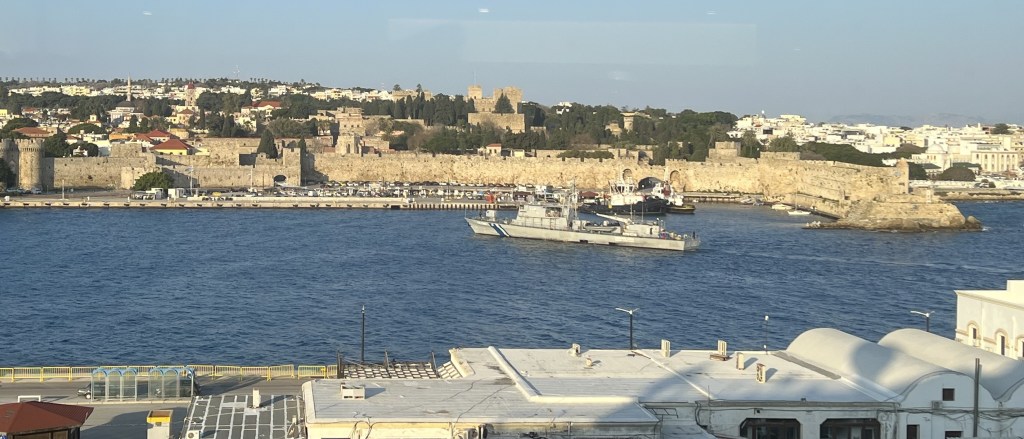
When we arrived in Rhodes I was not prepared for the abrupt shift in focus (time and culture).  The Greek sites we had been touring dated from the Classical – Hellenistic – Roman eras, or the 1000-year period from 600 BCE to 400 CE.  Rhodes seemed to jump forward another 1000 years to concentrate on the later times of the Crusaders (14th and 16th centuries CE) and the Ottomans who controlled the island and city until the early 20th century.  Our tour of Rhodes featured this Medieval history. 

When I looked online, I found the history of Europe known as the medieval period, or Middle Ages, lasted from the 5th to the late 15th centuries, and was similar to the post-classical period for global history.  The medieval period began with the fall of the Western Roman Empire and transitioned into the Renaissance (Age of European Discovery).  The period is marked by population decline, counter-urbanization, the collapse of centralized authority, invasions, and mass migrations of tribes, which began in late antiquity and continued into the Early Middle Ages.  The large-scale movements of the Migration Period, including various Germanic peoples, formed new kingdoms in what remained of the Western Roman Empire.  Although there were substantial changes in society and political structures, the break with classical antiquity was incomplete. The Byzantine Empire (Eastern Roman) survived in the Eastern Mediterranean and remained a major power.  The Roman Empire’s law code (Corpus Juris Civilis) was rediscovered in Northern Italy in the 11th century and most western kingdoms incorporated the few extant Roman institutions.  Monasteries were founded as campaigns to Christianize the remaining pagans across Europe continued.  The Franks, under the Carolingian dynasty, briefly established the Carolingian Empire during the latter 8th and early 9th centuries. I The medieval period covered much of Western Europe but later succumbed to the pressures of internal civil wars combined with external invasions from the Vikings (north), Magyars (east), and Saracens (south).

The island of Rhodes stands at a crossroads between Europe, the Middle East, and Africa, which has given the city and the island many different identities and cultures.  The island itself has been inhabited since the Neolithic (stone) Period (4000 BCE), but Rhodes became an important trading post for shipping between Constantinople and Alexandria during the Byzantine Period and the European Crusades to the Holy Land.  The Knights Hospitallers captured and established their headquarters on Rhodes when they left Cyprus in 1307 and remained on the island for the next two centuries.  The Ottoman Empire expanded rapidly after the fall of Constantinople in 1453, and the Knights defense of the island in 1480 halted Sultan Mehmed the Conqueror from the invasion of the Italian peninsula by Ottoman forces.  Sultan Suleiman the Magnificent led a second Ottoman Siege of Rhodes in 1522 but after a spirited defense the Knights were allowed to depart on January 1, 1523.  New buildings were constructed during the Ottoman era, including mosques, public baths, and mansions, while the Greeks were forced to abandon the fortified city and move to new suburbs outside its walls.  The tours of Rhodes were not like the ruins we had visited, but of intact buildings for continuous occupation for the last 1000 years.  A different tour, but very interesting.

Thoughts: Disembarking our ship, we approached the Medieval city through one of the smaller side gates.  We then wound our way up hill from the harbor to the Palace of the Grand Masters(fortress) at the top of the citadel.  The stone-lined streets were the same as the crusaders and Ottomans trod for the last 1000 years as they wound toward the top.  You find a sense of longevity and continuity in Europe that does not exist in the US.  This also illustrates the transitory nature of human rulers and kingdoms.  Both are good reminders.  Act for all.  Change is coming and it starts with you.
Aigai

February 07, 2025

Yesterday we docked early in the port of Thessaloniki (Greek: Θεσσαλονίκη), also known as Thessalonica, Saloniki, Salonika, or Salonica.  Thessaloniki is the second-largest city in Greece (just over one million inhabitants) and the capital of the geographic region of Macedonia.  In Greek, the city is also known as Symprotévousa (literally “the co-capital”), a reference to its historical status as the “co-reigning” city (Symvasilévousa) of the Byzantine Empire alongside Constantinople.  From there we caught an early bus for a 1-1/2-hour ride to visit the royal tombs in Vergina.  The small town of Vergina (Greek: Βεργίνα) is in Northern Greece, part of the Veria municipality in Imathia, Central Macedonia.  Vergina was established in 1922 in the aftermath of the population exchanges after the Treaty of Lausanne which officially resolved the conflict that had arisen between the Ottoman Empire and the Allied nations after World War I.  Vergina is best known as the site of ancient Aigai (Ancient Greek: Αἰγαί,), the first capital of Macedon.

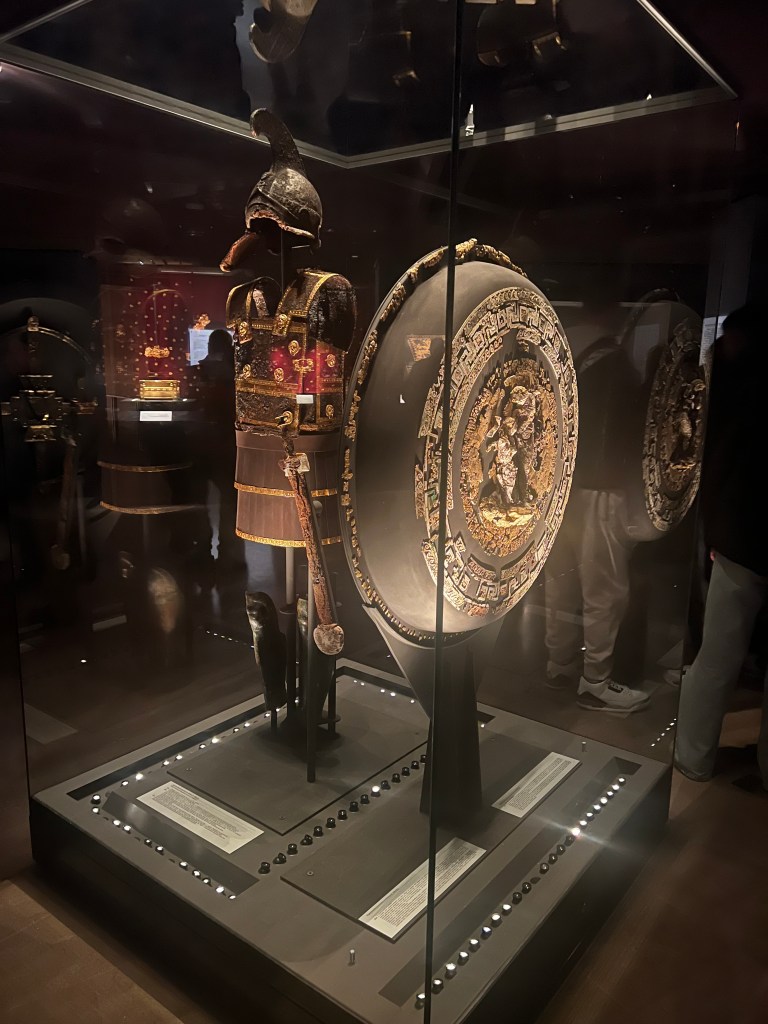
When I looked online, I found the capital of Macedonia was moved from Aigia (Vergina) to Pella in the 5th Century BCE, and Pella was the birthplace of Alexander the Great, but Vergina (Aigia) still served as the royal burial grounds.  The town became internationally famous in 1977 when the Greek archaeologist Manolis Andronikos unearthed what he claimed was the burial site of the kings of Macedonia, including the tomb of Philip II.  In 336 BCE Philip II was assassinated in Aigai’s theatre and his son, Alexander the Great, was proclaimed king.  Researchers uncovered three tombs at Vergina in 1977.  Tomb I contained Philip II, Alexander’s father, tomb II belonged to Philip III of Macedon, Alexander’s half-brother, while tomb III contained Alexander IV, Alexander’s son.  While Tomb I had been looted, Tombs II and III were intact and contained an array of burial goods.  Aigai was also the site of an extensive royal palace and the current town of Vergina sits atop a vast burial acropolis which has only been partially excavated.  The new archaeological museum of Vergina was built to house the artifacts found at Aigai (completed in 2022) and is one of the most important museums in Greece.  The first museum at the site of the tombs contains artifacts excavated there.  Aigai has been awarded UNESCO World Heritage Site status as “a significant development in European civilization, at the transition from classical city-state to the imperial structure of the Hellenistic and Roman periods”. 

Our tour of Aigia was designed to take us to the new museum located 10 minutes outside of Vergina, and then to the tombs located within the village.  I struggled with this placement as I had no context for the artifacts on display.  The new museum began with an overview of Alexander and his conquest of the known world and a replica of the second floor of the royal palace (in grand detail).  This led to the funerary stones and monuments, some of the pottery and goods from the burials, and closed with the decorative adornments from the cluster of the “queen’s burials”.  Little made sense to me until we visited the village where the excavations took place.  The tombs were the most impressive excavation and had their own museum, but I would have liked to have taken less time at the new museum and more time exploring the other excavations.  Maybe it is just me.

Thoughts: As we traveled to Aigai, our tour guide was from Thessaloniki and her pride was obvious concerning the role of this second capital of Greece and the importance of the region of Macedonia in the development of the “entire world” (read, Western World).  I cannot say much, as I made sure to bring my Chiefs shirt to wear this Sunday during the Super Bowl to claim my own association.  We take pride in who we are and where we are from.  This is true around the world.  The trick is to take pride in one without disparaging others.  Act for all.  Change is coming and it starts with you.