Trails

October 10, 2025

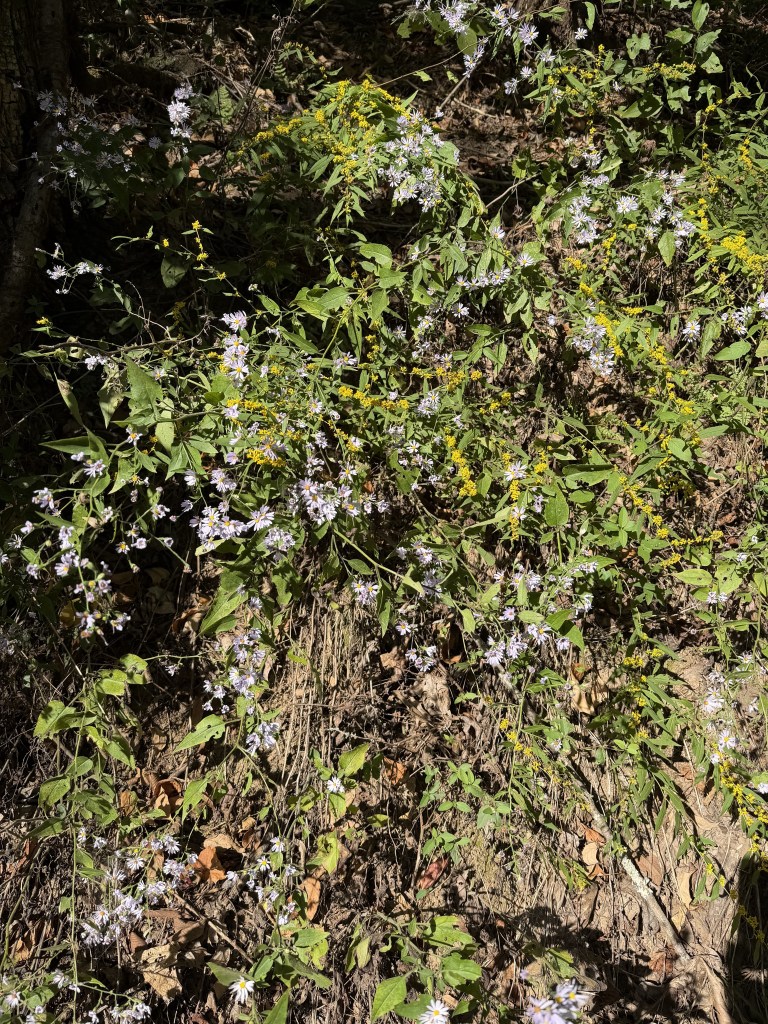
We had decided to take our second trip out in our newly acquired RV just as the US government decided it was not in their (our?) best interest in keeping the government operational.  While many of the National Parks are at least partially open, we learned the Corp of Engineers location we planned to visit was shut down.  We have some neighbors who were also planning on the same trip and learned they had booked a private location about an hour away.  We already had two events scheduled for the week and thankfully these were both centrally located to the RV Park.  Melissa made reservations and we took off Tuesday morning.  The park described itself as “rustic”, and when our neighbors arrived, they called to make sure we were comfortable with what that meant.  Melissa and I both thought the unpaved location along the Mulberry River was going to be perfect.  There was even a trail/road that led back along the river that was perfect (and away from other campers) for walking the kids.  The trail provided a moderate walk that wound through the trees and wildflowers.

When I went online, I found a trail, also known as a path or track, is an unpaved lane or small paved road generally not intended for usage by motorized vehicles, and usually passing through a natural area.  However, it is sometimes applied to highways in North America.  In the UK and Ireland, a path or footpath is the preferred term for a pedestrian lane or hiking trail.  In the US historically, the term was used for a route into or through wild territory used by explorers and migrants (i.e., the Oregon Trail).  A “trace” is sometimes used as a synonym for trail (i.e., the Natchez Trace).  Some trails are restricted to only walkers, or cyclists, or horses (equestrians).  During the winter these same trails can be used for snowshoeing or cross-country skiing.  Others, like the bridleways in the UK, are shared and are jointly used by walkers, cyclists, and equestrians.  Although most trails ban motorized use, there are unpaved trails used by dirt bikes, quad bikes, and other off-road ehicles.  This is especially true for extreme sports and rally races.  In places like the mountainous Europe (Alps), trails are also used by alpine agrarian communities for moving cattle and other livestock.

Over the last several days I have been walking the trail along the river marveling at the amazing views.  The track passes above the river and in places rises on the bluffs that overlook the water.  Being an avid fisherperson, this has given me pause to dream of climbing down the slope and fishing the fast water and pools that dot the river’s course.  Several days I did exactly that, although I did so by following the rocks at th e water’s edge.  My other pleasure has been seeing the patches of Tatarian Aster (Aster tararicus) and goldenrod (genus, Solidago) that line the trail.  This is the freedom and escape we had hoped to find when we decided to start RVing.

THOUGHTS: Following most modern-day trails is a far cry from the trails that cut through the thick forests and lush grassland that filled North America when the European explorers and settlers first arrived.  These trails possessed unseen dangers (animals and nature) along with the impressive beauty.  Still, I can get a glimpse of the wonder of days gone by.  We need to work hard, an together, to preserve those areas that still exist for future generations to enjoy.  Act for all.  Change is coming and it starts with you.
Catchments

June 09, 2025

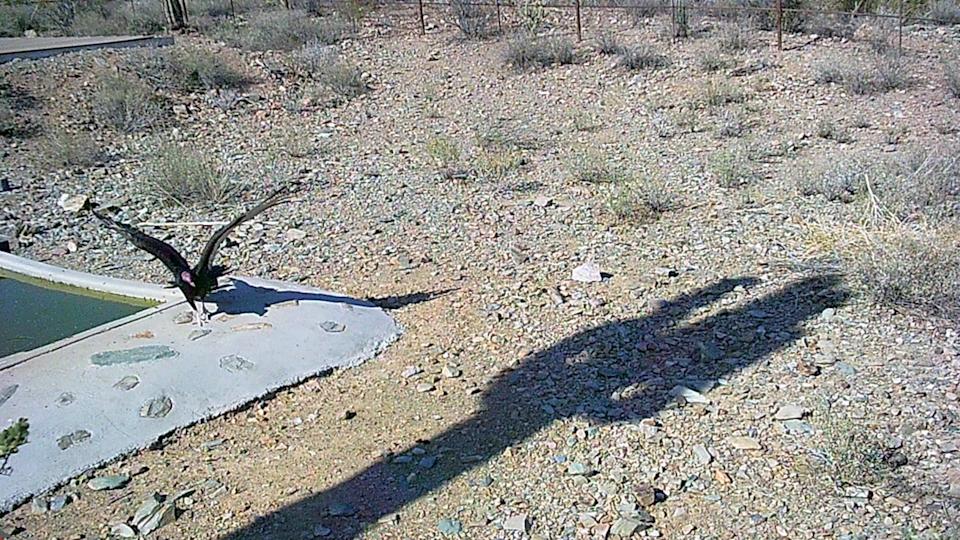
I found it fitting after blogging last month about the wildlife structures in Southern Colorado that allow animals to safely cross highways to come across an article in Sunday’s paper addressing the drought wildlife faces in the Arizona desert.  The article began with the parade of animals coming to the human-made watering hole on a night in May.  First a coyote (Canis latrans), then a gray fox (Urocyon cinereoargenteus), followed by a great horned owl (Bubo virginianus), and finally a herd of mule deer (Odocoileus hemionus).  As dawn broke the watering hole began to serve its daytime visitors.  These were the scaled quail (Callipepla squamata), ravens (Corvus corax principalis), vultures (Cathartes aura), doves (genus Streptopelia), and the occasional lizard (genus Tupinambis).  This activity was recorded at the “Teddy Bear” water catchment, nicknamed for the teddy bear cholla (Cylindropuntia bigelovii) that grows around it.  This is one of the thousands of catchments managed by Arizona Game and Fish (AGF) built to boost game numbers for hunting and compensate for habitat fragmentation.  The catchments have satisfied thirsty animals since the 1940’s.

When I went online, I found Teddy Bear (catchment No. 436) was built to draw deer away from the Central Arizona Project (CAP) Canal.  The site has a large sheet of metal that directs rainwater into a gutter and feeds it into an underground tank.  The water resurfaces a few yards away as a square of slick green in the arid desert.  A fence surrounds the catchment to keep livestock out yet allows wild animals in.  Joe Currie, AGF habitat planning program manager, said the catchments are a great support for creatures who live in Arizona’s unforgiving deserts.  Many animals can only live a few days without water or the water-rich food the catchments provide.  When they were built, many of these watering holes thrived on the more consistent rain.  Now, state officials say the drought has forced them to use trucks, and even helicopters, to keep the catchments full.  Each year AGF hauls more than 1 million gallons of water to nearly 3,000 catchments.  As severe drought deepened in Arizona in 2024, hauling has picked up.

After decades of long-term drought throughout the Southwest, Arizona suffered its hottest summer on record in 2024 and a near-record dry spell back-to-back.  These short-term drought conditions persisted through the first half of 2025.  Every region of Arizona has been under an official drought designation since January.  The Forest Service and Bureau of Land Management own two-thirds of the catchments.  Those departments used to have robust wildlife management programs but now have no budget to maintain the sites.  Arizona has taken responsibility for the entire network, spending roughly US$1 million each year maintaining the catchments.  Helicopter deliveries, with the same equipment used to dump water on wildfires, cost more than US$10,000 each.  The AGF maintains a donation program where donors have contributed US$1.3 million since 2018.

THOUGHTS: Along with the catchments, Arizona has invested in wildlife structures for animals crossing highways and neighborhoods.  Both allow animals to reach the water and food they need in dry times.  The CAP also has 30 crossings dispersed along the canal system.  These linkages also support genetic diversity in animal populations and allow wildlife to adjust to the effects of climate change.  Deer are ruminants (like cows) and cud-chewing animals in dry areas struggle to digest the vegetation.  Deer stuck in dry areas might also give birth to fewer fawns.  The same goes for a range of other species.  While hunting may provide emphasis (and funding) for the structures and the catchments, like most conservation projects they serve the entire ecosystem.  If showing how such projects provide for human interests works, I say, “make it so #1!”  Act for all.  Change is coming and it starts with you.
Traction

January 14, 2025

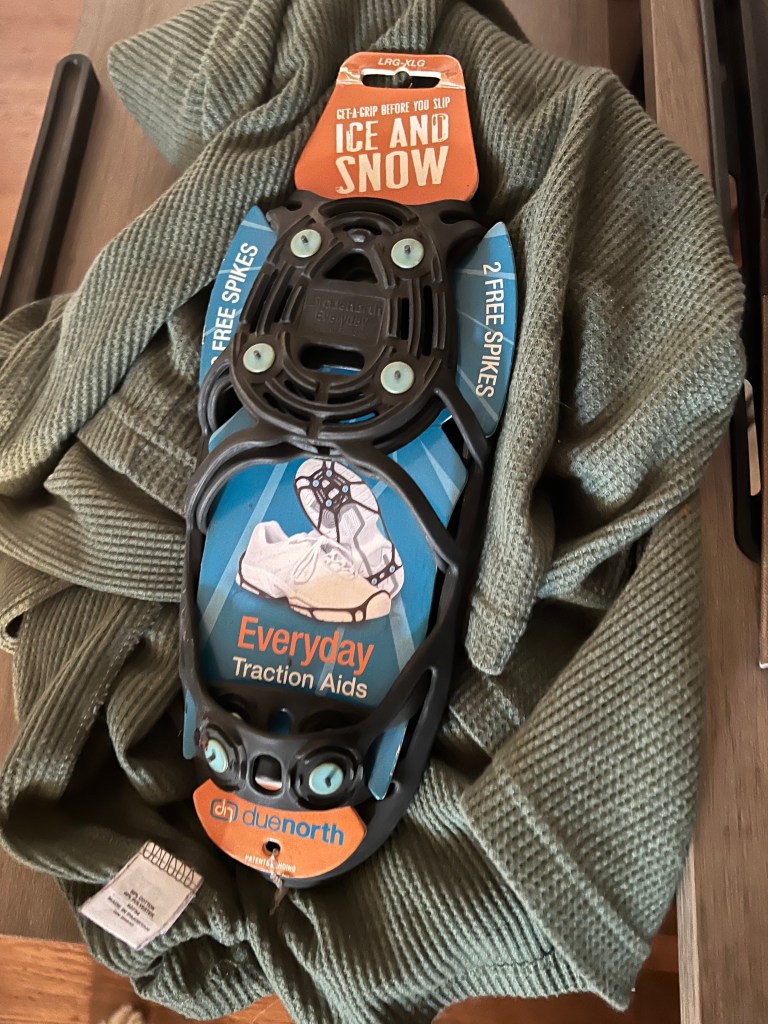
Yesterday I decided it was time to get out into the weather and take the kids for a walk.  I decided to go to the lake as it was more open and had a better probability for the parking lot to be cleared by road crews.  The temperatures in the morning were below freezing (-0C) but were set to warm up to 40F (4.5C) by the afternoon.  I did have two concerns.  The first was the possibility for windchill which would negate any increase in temperature.  I decided to dress for the cold.  That meant a pair of long johns under my sweatpants.  Then a tee shirt, a long sleeve undershirt, and a long-sleeved thermal undershirt.  I topped this off with a light ski jacket.  The first concern was covered.  The second concern was the potential for ice and snow on the spits we walk at the lake.  The kids have been romping in the snow in the side yard, and I knew this would not be their concern.  That is different for me and was my reason to shovel over the weekend.  Melissa was a runner when we met and one of her first Christmas presents was cold weather gear for running in Kansas.  That meant running gloves, hand and foot warmers, and a set of spikes in a rubber harness.  The spikes were billed as “everyday traction aids”.  The spikes should provide the traction I needed to walk the kids.   

When I looked online, I found Merriam-Webster defines traction in several ways.  The first definition (and applicable for me) is “the adhesive friction of a body on a surface on which it moves”.  A variation of this meaning says traction can refer to “a pulling force exerted on a skeletal structure (as in a fracture) by means of a special device” (splint).  A second definition is “the force exerted in the act of drawing or being drawn”.  The third meaning took a different approach with “the support or interest that is needed for something to make progress or succeed”.  This indicates something “gains traction” as people begin to accept and/or adopt an idea or methodology.  Finally, traction refers to “the drawing of a vehicle by motive power”.  Here a tractor is something that pulls something else.  This is often a piece of farm machinery or the part of a big truck that includes the engine and the cab.  The word tractor comes from the Medieval Latin “traction”, or from the Latin “trahere”.  The first known use of traction in English occurred in 1608, in the meaning defined by the second sense.

I was intrigued by the spikes guarantee to provide traction as I walked the kids.  After I bought them, Melissa had never had an occasion to use them.  They sat (in the original package) in my closet along with our shoes for 15 years.  When we pulled into the lake for our walk, I found the parking lot was generally clear of ice and snow.  Even the roads leading out to the end of the spits were clear, even though the grass on either side was snow covered.  I left the traction spikes (still in their packaging) in the car and started on our hike.  The temperature was higher than forecast at 45F (7C) and my decision to bundle against the cold seemed unnecessary.  Neither of my concerns were warranted.  I was toasty in my layers and the snow and ice were gone.  However, I was not anticipating the mud.  The ground was mostly frozen, but my four-wheeler buddies had been taking laps in the snow and over the roads.  As we walked the spits, Loki’s legs and underbelly quickly became covered in mud.  We took most of our laps circling the parking lot.  Luckily there was enough snow on the grass to wash Loki off before I let him back into the car.

Thoughts: This was one of the (rare) occasions where I over planned for the cold and loss of traction.  Even though I did not need all the extra layers, it was nice to be warm and snug while we walked.  The traction aid I bought for Melissa went back into the closet next to my shoes to wait for another day.  I do not know if my over planning can be accredited to experience or unwarranted caution as I age.  As a Boy Scout our motto was “Be Prepared”.  That is still a good motto for hiking, camping, and even for life in general.  Act for all.  Change is coming and it starts with you.
Mud Tracks

November 06, 2024

We have received heavy rain over the last two days, and I tried to keep the kids out of the side yard. I monitor them when I do let them out to make sure they are not mischievous (Loki is a digger and Zena is a roller) and end up covered in mud. Today the rain stopped, and I decided to brave our walk site at the lake. A portion of the walk is on a paved parking lot, but the majority covers packed dirt tracks that lead out to the end of two spits. We were the only ones there when we arrived to begin our walk. We walked to the end of the first spit and while it was wet, we were able to pick our way through the puddles without getting our paws muddy. As we were coming off the spit two 4-wheel drive pickups pulled out onto the other spit and began to cut mud tracks through the vegetation. As we walked around the paved lot on the trail the trucks moved to the area we had just left. This had a wider area that had been torn up by previous off-road activity. It did not take long for one of the trucks to get stuck axel deep in the mud. This was obviously why they had come in the first place. After extricating the truck, they drove to the boat ramp and took selfies of the mud covered truck to share with their friends. Teenagers in pickups are not the only ones that leave mud tracks.

When I looked online, I found one of the more famous mud tracks is located at Racetrack Playa in Death Valley. Racetrack playa is approximately 3 miles (4.8 km) long and 1.2 miles (1.9 km) wide and is located at a height of 3708 feet in a north-south valley east of the Panamint Range within Death Valley National Park. The playa receives only 3 inches of annual precipitation and is bounded on all sides by north-south ranges rising 1500 to 2000 feet (457 to 610 m). The surface of the playa is mainly dried clay and provides a hard, smooth, and level pavement. The sailing stones, also called sliding or walking rocks, move and inscribe long tracks along a smooth valley floor without animal intervention. The movement of the rocks occurs when large, thin sheets of ice floating on a brief winter pond break up in the sun. Rocks weighing up to 705.5 pounds (320 kg) travel across the playa and leave mud tracks. Stones with rough bottoms leave straight striated tracks, while those with smooth bottoms tend to wander. The mud trails differ in both direction and length. Rocks that start next to each other may travel parallel for a time and then one abruptly changes direction to the left, right, or even back to the direction from which it came. This phenomenon has been documented since 1948 and is not unique to Racetrack Playa. Tracks in the mud have been observed around the world.

Traditionally, these rocks were considered to be pushed by wind over a wet and slippery playa surface but observations from 2014 called this assumption into question and several aspects of the mud tracks remain a mystery. A thorough system was put up to investigate the rock movement that included a weather station near the playa, time-lapse cameras centered on the southeast corner, and 15 GPS-equipped boulders on the surface. The researchers went to the location for maintenance and data retrieval 5-8 times per year and from November to March of each year the time-lapse camera recorded hourly conditions. Interwoof GPS loggers were also installed in limestone blocks northeast of natural stones and captured GPS and temperature data every 60 minutes. The GPS trackers began recording constantly at one-second intervals after being triggered. The shape of the shallow lake named Ontario Lacus on Saturn’s moon Titan has been compared to that of Racetrack Playa.

THOUGHTS: Despite the signs and barriers forbidding driving on the surface and making mud tracks posted along parts of the playa, park rangers still find new tire tracks on it every couple of years. The walking rocks will not slide if the surface is defaced. Destruction of such natural wonders takes decades to repair. Act for all. Change is coming and it starts with you.