Glockenspiel

December 04, 2025

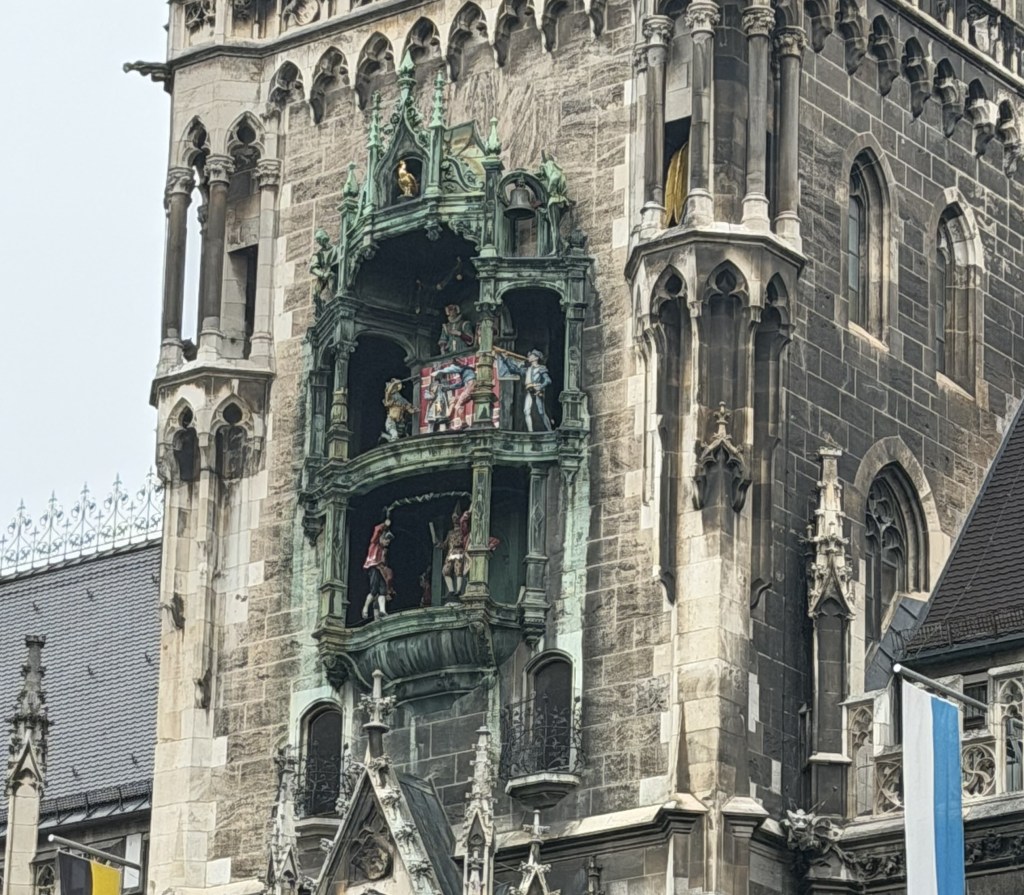
Our walking tour of Munich was timed so the first section of our walking tour would arrive in the city center in time for the sounding of the bells at noon.  On arrival our guide asked if we had seen the bells of the Ankeruhr clock in Vienna (what?? must have missed it).  This unusual Art Nouveau work was created by Franz von Matsch in the period between 1911 to 1914, and Franz Morawetz the court clockmaker had made the clockwork mechanism.  Although the city square was the site for the largest Christmas market in Munich, the bells had nothing to do with the markets.  The bells and figures were added to the town hall in 1908 and consist of 43 bells and 32 life-sized figures.  The mechanism is powered by solar power and is only semi-automatic, as it needs a player to turn the levers at the exact right times 364 days a year.  The glockenspiel at Munich is the largest in Germany and the fourth largest in Europe.

When I went online, I found glockenspiel is a percussion instrument that originally consisted of a set of graduated bells, and later a set of tuned steel bars (a metallophone).  These are struck with wood, ebonite, or even metal hammers.  The bars are arranged in two rows, the second corresponding to the black keys of the piano.  The name glockenspiel is German (“bell play”) and refers to the sound of small bells.  The very first instruments to carry this name did indeed consist of a set of small bells which were played either by a group of musicians or struck by means of a complex mechanism.  At the end of the 17th century steel bars began to replace the bells.  Initially they were only a substitute for real bells, but this arrangement of metal bars soon developed into a musical instrument of its own and retained the name “glockenspiel”.  Like the xylophone, the glockenspiel is a great favorite with children.  Carl Orff used it from the 1930’s for his Method.  The children’s instruments have a smaller range, are tuned diatonically, and have bars resting over a frame like a trough.  Lower-pitched glockenspiels have short resonators and are generally known as metallophones.

The glockenspiel of the Munich New Town Hall (Neues Rathaus) on the central square (Marienplatz) attract huge crowds every day for reenactments of two events from Munich’s city history.  The first is the wedding of Duke Wilhelm V and Renate of Lorraine, in February 1568 when a jousting match in honor of the bride and groom took place on the square.  The Bavarian knight (of course) triumphed over his opponent from Lorraine.  The lower floor shows the famous Coopers’ Dance (Schäfflertanz) is a guild dance of the coopers (Barrel makers) originally started in Munich.  Early documented cases of Schäfflertanz are dated by 1702 when the Münich magistrate approved the performance of the dance as a well-established tradition.  For a long time the date 1517 was prevalent in the literature originating the legend that the tradition started after the 1517 plague to revive the spirits of the people “to lure them out of their houses”.  There are no records of any plague in Münich at this period.  Still, the 500th anniversary was celebrated in 2017.  There is no clear indication of the origin of the seven-year cycle, but since the early 1800’s the custom has spread, and it is now a common tradition over the region of Old Bavaria.

THOUGHTS: We waited in the city square to see the glockenspiel along with a select group of 3000 of our closest friends.  We had been told the figures did not move until the third song.  First came the church bells (always the priority) followed by a introductory number.  The third number set the first group of jousters in motion and the fourth featured the dancing coopers.  The finally was the cock crowing three times.  Our guide had warned us that time had not been good on the crow mechanism and he was right.  It sounded more like the honking of a goose.  It felt good to join others in a century-old tradition.  Act for all.  Change is coming and it starts with you.
Concentration

December 01, 2025

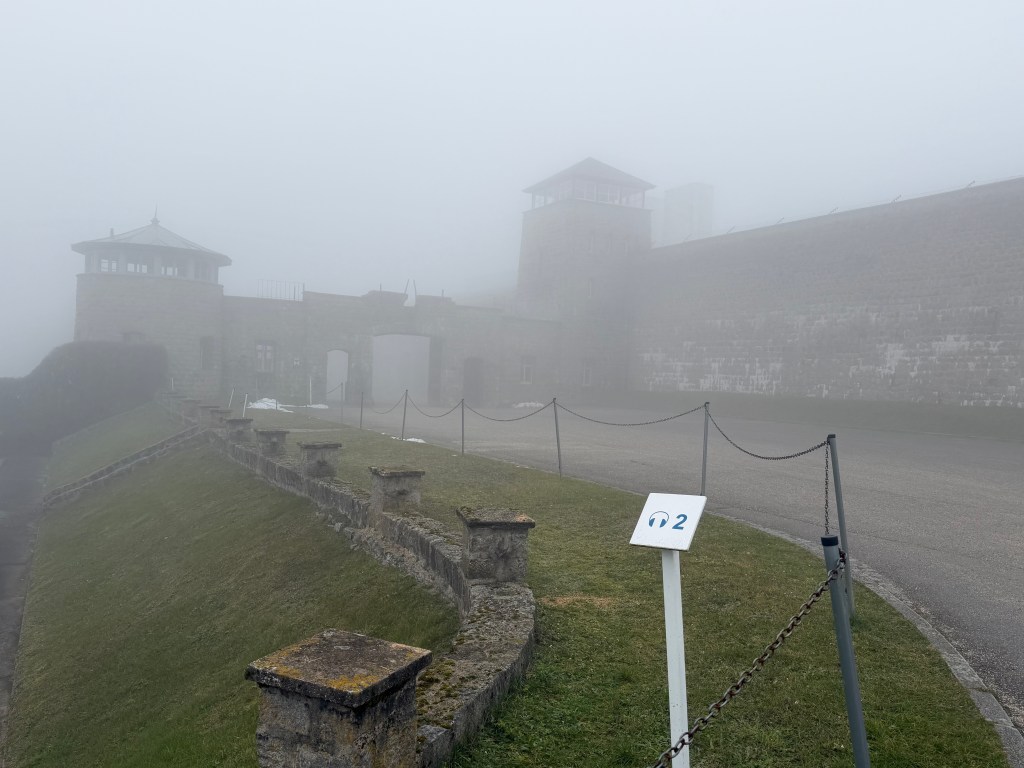
We began yesterday with a panoramic tour of Linz, Austria.  While the city was nice, a “panoramic” tour meant we rode a tram to see important buildings.  Even bundled up it was cold (30F/-1C) and the fog made it difficult to see anything more than a few hundred feet (60 m) away.  The river port was a 20-minute walk from the main city and the Christmas market (our reason for the tour) did not open until it was time to return to the ship.  While several stayed, we had scheduled a bus trip that afternoon that left us just enough time to eat a fast lunch.  We piled into the bus, and our guide took us for a tour of Mauthausen, Hungary.  Mauthausen is a small market town in the Austrian state of Upper Austria located about 12 miles (20 km) east of Linz.  I had not paid much attention when we had signed up for the tour but was aware this was the site of one of the many German work camps established from 1933 to 1945.   Our guide informed us the difference between a prison and a concentration camp was there was never a trial for the people detained there.

When I went online, I found the Nazis had no plan for concentration camps prior to their seizure of power in the German government on January 30, 1933.  The concentration camp system arose in the following months due to the desire to suppress tens of thousands of Nazi opponents in Germany.  The Nazis used the arson attack on the German parliament building on February 27, 1933 (Reichstag fire) to consolidate power and as the pretext for mass arrests.  The Reichstag Fire Decree eliminated the right to personal freedom enshrined in the Weimar Constitution and provided a legal basis for detention without trial.  Historian Jane Caplan estimated the number of prisoners in 1933 to1934 at 50,000, with arrests perhaps exceeding 100,000.  Eighty per cent of prisoners were members of the Communist Party of Germany and ten per cent members of the Social Democratic Party of Germany.  About 70 camps were established in 1933, in any convenient structure that could hold prisoners, including vacant factories, prisons, country estates, schools, workhouses, and castles.  The early camps were heterogeneous and fundamentally differed from the post-1935 concentration camps in organization, conditions, and the groups imprisoned.

From 1938 to 1945, the Mauthausen concentration camp was at the center of a system of over 40 subcamps and was the main site of political, social, and racist persecution by the National Socialist regime on Austrian territory.  Mauthausen was originally intended as a work camp to extract the granite blocks from the associated quarry.  These blocks were used to build camp buildings as well as building material for the surrounding towns.  The outbreak of the war shifted the workers’ emphasis to forced labor in the surrounding industries.  The tone of the group was hushed as we toured the site.  The dense fog was thicker as we rose above the city and many of the locations were pointed out with, “if you could see, down there was . . .”   The fog seemed appropriate as much of the site’s history had been shrouded in secret.  Like many of the camps, as the allies got closer the emphasis shifted toward cleaning up the evidence of atrocities.  Of a total of around 190,000 people imprisoned here, at least 90,000 were murdered.

THOUGHTS: Rather than denying the concentration camps past or trying to make it more palatable, the Mauthausen Memorial is maintained as a site of political and historical education.  Its task is to ensure public awareness of the history of the Mauthausen concentration camp and its subcamps, the memory of its victims, and the responsibility borne by the perpetrators and onlookers.  At the same time, it seeks to promote critical public engagement with this history in the context of its significance for the present and future.  George Santayana wrote, “Those who cannot remember the past are condemned to repeat it”.  The same still holds.  Act for all.  Change is coming and it starts with you.
Anoka

November 03, 2025

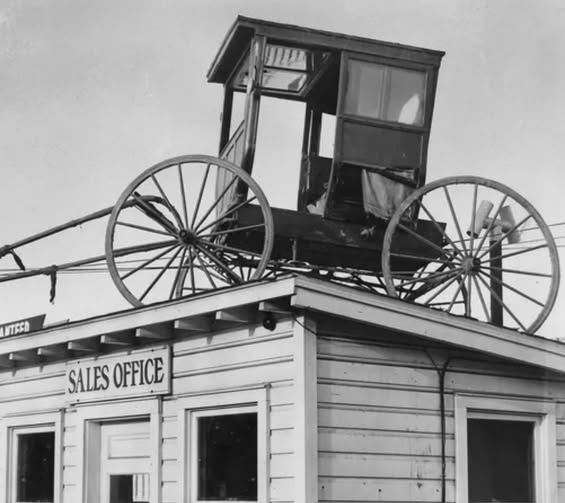
Last Friday my local newspaper printed a USA Today article on the pranks that sparked a Halloween tradition in Minnesota.  The tradition began in the aftermath of particularly bad pranks in 1919.  Residents would wake the next day to find windows soaped, cows roaming the streets, outhouses set afire or tipped over, and carriages taken apart and reassembled on the rooftops of buildings.  This was not new, and many cities and towns were considering banning Halloween celebrations because the pranks had turned to outright vandalism.  The city leaders took another approach and rather than forbidding celebration, they organized a night parade as part of civic celebrations to keep the young troublemakers busy.  More than a century later Anoka, Minnesota has dubbed itself the “Halloween Capital of the World”.

When I went online, I found Anoka is believed to be the first city in the US to put on a Halloween celebration to divert its youngsters from Halloween pranks.  In 1920, George Green and other Anoka civic leaders suggested the idea of a giant celebration.  The idea was adopted by the Anoka Kiwanis Club and Anoka Commercial Club, which both gave their full support and a Halloween committee was organized.  Teachers from the public and parochial schools partnered with the businessmen, parents, and students.  More than a thousand Anoka school children made plans and costumes for the big event.  The evening opened with a parade with bands, the police and fire departments, National Guard, and 500 costumed marchers.  That was followed by a give-away of hundreds of bags of popcorn, candy, peanuts, and other treats to the children who had marched in the parade.  The celebrations have been held every year since 1920, except for 1942 and 1943 when the festivities were canceled because of World War II.  The “Anoka Halloween Capital of the World” celebration has grown to include units from all over the Midwest.

Anoka was not the only city to be plagued by Halloween tricks.  The Celtic traditions of All Saints Day (Alholowmesse in Middle English) and All Hallow’s Eve the night before to become known as Halloween.  The night grew in popularity in the US during the 1840’s with the immigration of Scottish and Irish to America.  They also brought a love of prank playing and carving a gourd with a glowing face.  By the early 1900’s the pranks morphed into leaving manure on the front porch or making frightening noises with a spool-and-stick (tick tack) to make noises on neighbors’ windows.  As America urbanized the pranks became more destructive.  Nine boys were detained in Kansas City in 1919 for waxing the streetcar tracks and causing a crash.  Trick or Treat took on a new meaning. 

THOUGHTS: While it did not have the longevity of the Anoka celebration, my High School football team had a tradition of bringing our line coach’s car into the gym lobby.  The lobby had a mosaic of the team mascot which the seniors “polished” with the bodies of anyone who accidentally stepped on it (unsuspecting Sophomores).  The car was brought inside around Halloween by the large linemen under the tutelage of the coach.  The coach drove a VW beetle (which made it doable) which was literally picked up and carried through the gym to rest on the logo.  Both these traditions went away during my Senior year when the administration had enough and placed a short metal fence around mosaic.  In 1920, the Anoka celebration included the release of chickens into the crowd for revelers to capture and take home.  The Anoka County Union declared, “We don’t know if the chickens enjoyed the sport, but the crowd did.”  The chicken release of Anoka, the bodily polishing at my High School, and the Halloween pranks were seen as fun until someone stepped in to control the mayhem.  Anoka showed control does not have to mean exclusion of liberties.  We should revisit that revelation.  Act for all.  Change is coming and it starts with you.

Conjunction

September 18, 2025

Image credit: Matt Champlin via Getty Images

A USA Today article toward the back of the front section of my local newspaper reported on the celestial event taking place on September 19th (tomorrow).  Three celestial bodies are preparing to meet for one night that should be widely visible in the sky.  The Earth’s moon and the planet Venus of Sol’s solar system will be briefly joined by the star Regulus.  This event follows the close appearance of Venus and Jupiter during much of August.  This moon-planet-star combination involves three of the brightest objects in our solar system and should make it easy for amateur astronomers to spot.  This coming together, or conjunction, presents a special opportunity for even casual stargazers to see multiple celestial bodies at the same time.

When I went online, I found an astronomical conjunction occurs when two objects or spacecraft appear to be close to each other in the sky.  This means they have either the same angular distance of a particular point measured eastward along the celestial equator (right ascension) or the same apparent positions, orbits, and pole orientations (ecliptic longitude).  This closeness phenomenon is caused by the observer’s perspective, and the objects are not actually close to one another in space.  Conjunctions between two bright objects close to the ecliptic, such as two bright planets, can be seen with the naked eye.  More generally, it means they have the same right ascension.  A conjunction seen by an observer on Earth involves two (or more) astronomical bodies and the times and details depend only slightly on the observer’s location on the Earth’s surface.  The differences are greatest for conjunctions involving the Moon because of its relative closeness, but even for the Moon the time of the observed conjunction never differs by more than a few hours.

Conjunctions occur as the various paths of celestial objects traveling at varying speeds are brought together on the same side of the sun (from Earth’s perspective).  The moon orbits around the Earth as our only satellite.  Venus orbits as the sun’s second planet and is often referred to as “the Earth’s twin” as both are rocky (rather than gaseous) and have a similar orbit.  Regulus is the brightest star in the constellation Leo.  This trio should be visible in the sky tomorrow night.  Those who are in the Northern Hemisphere (North America, Europe, Asia) should be able to spot the conjunction easily by looking for the moon.  Chelsea Gohd, science communicator at NASA’s Jet Propulsion Laboratory in California, explained attention should be directed east in the early pre-dawn toward the waning crescent moon as it sets in the sky.  Pre-dawn may be a stretch for me as I generally do not stay up that late or rise that early.  We will see.

THOUGHTS: Conjunction is one of the words that stuck in my mind in high school as I was a cartoon connoisseur and often did stay up late enough to catch the pre-dawn shows that aired.  This was the 70’s and evils of television were being countered by short educational promos offered by educational media like “Schoolhouse Rock!”.  One segment in the series was titled “Conjunction Junction” and addressed the grammatical use of a conjunction.   It was presented as a catchy song that is running through my head as I blog.  The phrase “conjunction junction what’s your function” draws its meaning as a “junction” that connects things, and its “function” is to join words, phrases, and clauses together to form more complex sentences.  The song uses the analogy of railroad “boxcars” hooked up by the conjunctions (i.e., “and,” “but,” “or”) to help viewers understand their grammatical role (analogical reasoning).  This cognitive process uses prior knowledge of a known situation (“base domain”) to understand or solve a new, similar problem (“target domain”) by identifying shared structures and relationships between them.  In human relationships, such analogies may create positive or negative responses.  Act for all.  Change is coming and it starts with you.
Miniature

July 16, 2025

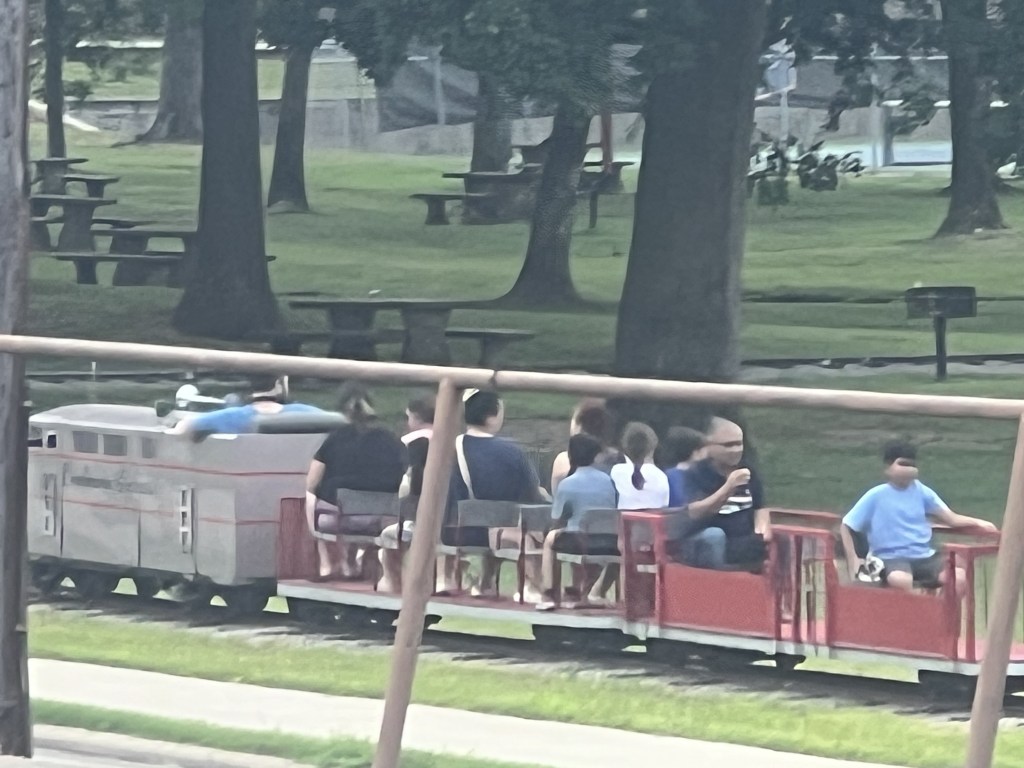
The “big town” near us operates 29 parks and recreation areas scattered around the city.  These include everything from historic and nature trails, playgrounds and green space, aquatic and recreation centers, performing arts, and even two dog parks.  The parks include three stocked fishing lakes that I frequent as often as possible.  Another annual favorite is the light display located at Creekmore Park.  This is an expansive venture that provided inspiration for the light displays I put up when I was director of a camp and conference center in Kansas.  This summer, Creekmore has been undergoing needed improvements throughout the park.  The pool’s bathhouse (built 1948) was demolished, and a new facility and diving pool were finished in June, just in time to host the state swim meet.  The 18-hole mini-golf course (built 1959) was refurbished by volunteer labor from local businesses Graphic Packaging and IT Logistics and includes a little semi-trailer truck obstacle.  The city said it is also resurfacing and expanding the parking lot.  Sara Deuster, director of Fort Smith Parks and Recreation, said the upgrades are necessary to accommodate the growing number of families visiting the parks.  One project waiting for funding is the miniature train that circles the park in summer and tours the Christmas lights.

When I went online, I found A ridable miniature railway, or in the US a riding railroad or grand scale railroad, is a large scale, usually ground-level railway that hauls passengers using locomotives that are often models of full-sized railway locomotives powered by diesel or gas engines, live steam, or electric motors.  These miniature railways have a rail track gauge between 5 inches (127 mm) and under 15 inches (381 mm), though both larger and smaller gauges are used.  With gauges of 5 inches (127 mm) and less, the track is commonly raised above ground level.  Flat cars are arranged with foot boards so that a driver and passengers sit astride the track.  The smaller gauges of miniature railway track can be portable.  Portable track is used to carry passengers at temporary events such as festivals and summer fairs.  These miniature lines are frequently operated by nonprofit organizations, and often model engineering societies, though some are in private grounds and others run commercially. 

There are several national organizations representing and providing guidance on miniature railway operations including the Australian Association of Live Steamers, the Southern Federation of Model Engineering Societies (UK), and the National Model Railroad Association (NMRA).  The NMRA is a large, international organization focused on the hobby and business of model railroading.  It provides education, advocacy, standards, and social interaction for its members. The NMRA has a strong presence in the US and operates in Canada, Australia, the UK, and the Netherlands.  Deuster said the miniature railway at Creekmore is a favorite of park-goers of all ages.  There are three miniature trains housed at the park.  The #200 Electric Steam Engine was manufactured by Western Train Company out of Temecula, California.  There is also a standard diesel train named the Creekmore Express.  The steam engine is currently waiting for funding for its restoration.

THOUGHTS: I frequent a coffee shop across the street from Creekmore and last week saw the miniature train chugging by with a full load of passengers.  It reminded me of George Bailey’s comment from the movie, “It’s a Wonderful Life”.  George declares, “You know what the three most exciting sounds in the world are?  Anchor chains, plane motors, and train whistles.”  Travel blogs say many are like George and share a love for travel and adventure, associating these sounds with freedom and the allure of the unknown.  That is also the original impetus for this blog.  While content has expanded, the blog still tries to express the joy (and irony) of life.  Act for all.  Change is coming and it starts with you.
Caissons

May 28, 2025

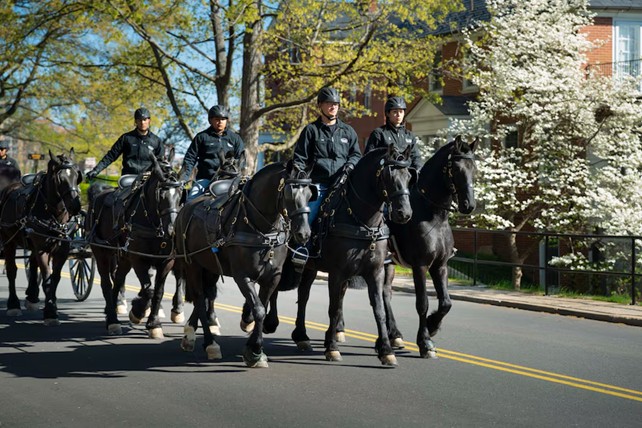
Inside the front section of my local newspaper was a USA Today article on funerals conducted at Arlington.  For more than seven decades, the Caisson Platoon of the 3rd US Infantry Regiment (“The Old Guard”) has provided horse-drawn caisson funeral services at Arlington National Cemetery, Virginia.  The tradition was formalized in 1948 and rooted in 19th-century military honors.  These operations were paused in May 2023 after two horses died from intestinal impaction.  A 2022 Army report detailing living conditions contributed to the halt.  The report showed 4 equine deaths within a year, an aging herd averaging 15-20 years old, and a training system using soldier-to-soldier instruction.  “We were doing things the historical way we’ve always done them, a practice common in The Old Guard,” said Army Major Wes Strickland, 3rd Infantry Regiment public affairs officer.  The suspension triggered a comprehensive overhaul and rebranding the unit as the Caisson Detachment.  The caissons were no longer rolling.

When I went online, I found caissons are a two-wheeled cart designed to carry artillery ammunition.  Caissons were used in conjunction with a limber, the two-wheeled cart designed to support the trail of an artillery piece allowing it to be towed.  The trail is the hinder end of the stock of a gun carriage, which rests or slides on the ground when the carriage is unlimbered.  Six horses harnessed in pairs on either side of the limber pole were the preferred team for a field artillery piece.  A driver rode on each left-hand (“near”) horse and held reins for both the horse he rode and the horse to his right (the “off horse”).  After the end of WWII horses were replaced by trucks or artillery tractors to move artillery and the need for limbers and caissons died out.  Caissons are also used to bear the casket of the deceased in some state and military funerals in certain Western cultures, including the US.  Caissons are used for burials at Arlington National Cemetery for service members killed in action, Medal of Honor or Prisoner of War Medal recipients, senior noncommissioned and senior officers, and for state funerals for government dignitaries, including the President.

Upgrades were made to both the facilities and the caissons pulled to make horse health a priority.  The 10 x 10 feet (3 x 3 m) stalls are expanded to 14 x 14 feet (4-1/4 x 4-1/4 m) with rubberized flooring and sloped designs for sanitation.  The Fort Belvoir pasture was closed and replaced by a partnership with an equestrian center in Northern Virginia which offers 50 acres (20 ha) of pasture, along with rehabilitation tools like aqua treadmills.  Herd management received a US$5 million budget increase which lowers the average horse age to 8-10 years.  A veteran 14-year-old is now paired with a 6-year-old to allow the veterans to mentor the young.  Equipment upgrades include replacing the wooden saddles with lightweight, custom fitted leather saddles specific to each horse.  The caissons weight was reduced by 1,205 pounds (546.5 kg) and added rubber wheels and articulating limber poles to reduce strain on the animals.  Training also shifted from impromptu to a 12-week Basic Horsemanship Course at a private stable, followed by a 6-week boot camp at a large climate-controlled equestrian sports facility in Ocala, Florida.  On April 8, 2025, the Army announced caisson services would resume during the week of June 2, limited to two funerals daily and up to 10 a week.  The caissons are ready to roll again.

THOUGHTS: “The Caissons Go Rolling Along” refers to these ammunition carts.  The version adopted as the US Army’s official song replaced the word caissons with Army.  The song is adapted from a 1908 work entitled “The Caissons Go Rolling Along”, which was in turn incorporated into John Philip Sousa’s “U.S. Field Artillery March” in 1917.  While caissons are no longer a staple for the Army, they are still used to honor the fallen.  Act for all.  Change is coming and it starts with you.
Crossings

May 27, 2025

My NY Times feed highlighted an article by Catrin Einhorn that told of an attempt to save both motorists and animals from deadly highway collisions.  Aran Johnson, a wildlife biologist for the Southern Ute Indian Tribe in Colorado, has been working for the last 15 years to provide a way for large animals to avoid being hit while maneuvering road crossings.  Now entire herds of mule deer (Odocoileus hemionus) and elk (Cervus canadensis) use the structures, as well as black bears (Ursus americanus), mountain lions (Puma concolor), bobcats (Lynx rufus), coyotes (Canis latrans), and red foxes (Vulpes vulpes).  They are expensive, but research has shown they can save money when installed on stretches of highway with at least an average of three collisions between motorists and deer per mile per year.  For collisions with elk and moose (Alces alces), which are bigger and cause more damage to vehicles and people (let alone the animal), that threshold goes down to less than one collision per mile per year.  Johnson started collaring mule deer to better understand how they moved around the reservation and superimposed his findings on state records of wildlife-vehicle collisions.  “It couldn’t be more perfect,” he said. “These things line up so precisely.”

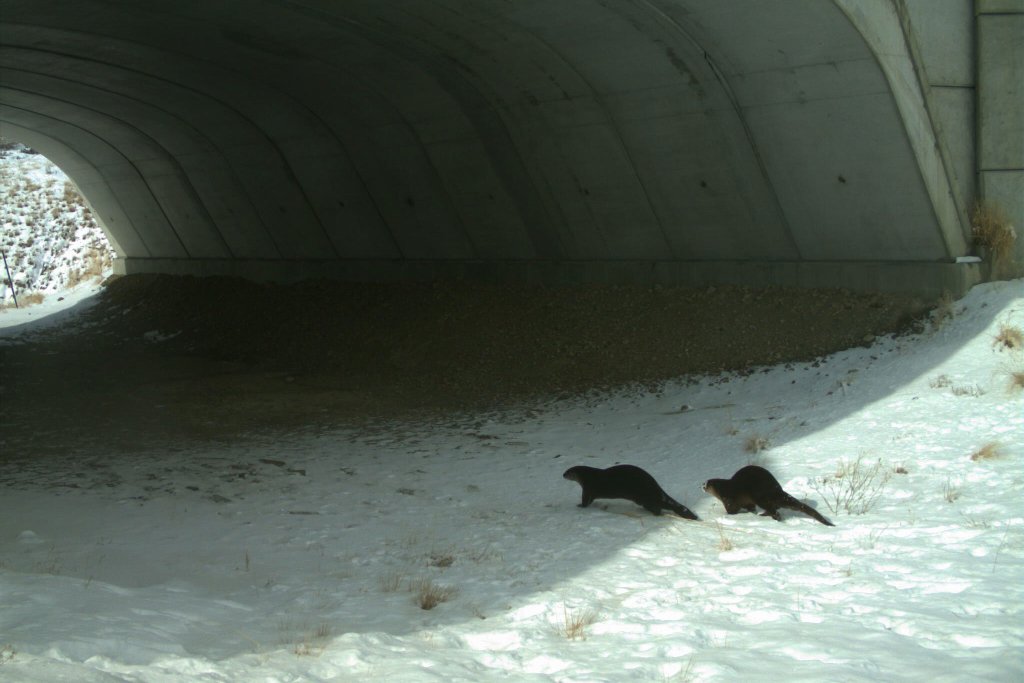
When I went online, I found wildlife crossings are structures that allow animals to cross human-made barriers safely.  Wildlife crossings include underpasses or wildlife tunnels, viaducts, and overpasses or green bridges for large or herd-type animals.  The crossings also provide for smaller animals with amphibian tunnels, fish ladders, canopy bridges (monkeys and squirrels), culverts for otters (Lutra lutra), hedgehogs (subfamily Erinaceinae), and badgers (Taxidea taxus), and green roofs for butterflies and birds.  Wildlife crossings are a practice in habitat conservation, allowing connections or reconnections between habitats to combat habitat fragmentation.  Crossings also assist in avoiding collisions between vehicles and animals, which in addition to killing or injuring wildlife may cause injury or death to humans and property damage.  Similar structures can be used for domesticated animals, such as cattle creeps.

Wildlife crossings are growing in popularity across the country, and Colorado has emerged as a leader building 28 large game crossing structures since 2015, according to the state Transportation Department.  Many of the species which use the structures travel from higher elevations in the summer to lower ones in the winter and are often forced to cross existing highways.  The Colorado General Assembly passed a law in 2022 creating a cash fund for the department to use for animal crossings and the state has evaluated its highways to create a priority list for future projects.  Wildlife crossings are combined with long stretches of fencing to funnel animals to the right location and have been found to reduce vehicle collisions with large animals by more than 80 percent.  The Colorado Department of Transportation covered most of the cost for wildlife crossings.  The tribe came up with US$1.3 million from the Bureau of Indian Affairs and an additional US $12 million for the project came from the state department of wildlife, nonprofit groups, and a private donor.  A bonus of wildlife crossings is the photos from trail cameras which bring attention to the programs.

THOUGHTS: Wildlife crossings transcend political divisions and have bipartisan support.  The crossings also fit in with the cultural importance of being stewards of the land for the Southern Ute.  As the current administration cuts federal spending the grant program that helps states and tribes pay for wildlife crossings in collision hot spots is now in doubt.  A chainsaw is effective if you want to remove the whole tree.  Pruning is effective if you want to save the tree and remove unwanted parts.  Act for all.  Change is coming and it starts with you.
Fools

April 04, 2025

When I was growing up my dad had a running joke that occurred every April 1st.  As the boys would come sleepily downstairs and sit around the breakfast table, dad would rush in and exclaim, “There is a big brown dog outside!”  This would cause the three of us to jump up and run to the window hoping to get a glimpse of this large dog.  Later, dad was forced to change the joke as we owned a large brown boxer dog (Canis lupus familiaris) named Lucky.  Instead, dad would exclaim there was a large black dog outside.  The joke still worked and went on for years.  After we had looked expectantly out of the window for several seconds the punch line was delivered.  April Fools!  

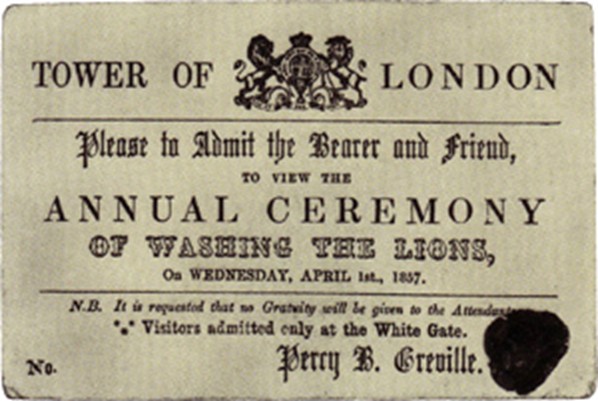
When I looked online, I found April Fools’ Day, or April Fool’s Day, is an annual custom on April 1st consisting of practical jokes and hoaxes.  Participants often complete their prank by shouting “April Fools!” at the recipient.  Mass media can be involved with these pranks, which are often revealed the following day.  The custom of setting aside a day for playing harmless pranks on one’s neighbor has been relatively common historically throughout the world.  While many theories have been proposed for the origin of April Fools’ Day, it is not exactly known.  A disputed association between April 1st and foolishness is found in Geoffrey Chaucer’s The Canterbury Tales (1392) when in the “Nun’s Priest’s Tale”, a vain cock (Chauntecleer) is tricked by a fox on the first of April.  In 1508, French poet Eloy d’Amerval referred to a poisson d’avril (April fool, literally “April’s fish”), possibly the first reference to the celebration in France.  Some historians suggest April Fools originated because during the Middle Ages New Year’s Day was celebrated on March 25th in most European towns, and the festivities continued until April 1st.  Those who celebrated New Year’s Day on January 1st made fun of those who celebrated on other dates by the invention of April Fools’ Day.  The first British reference came from John Aubrey in 1686 who referred to the celebration as “Fooles holy day”.  

My best April Fool’s joke happened when I was working for the Division of State History in Utah.  I was monitoring a particular thorny case where a pipeline installation was running roughshod over the archeological resources that stood in the way.  I sent a scathing memo to my boss on April 1st that detailed a new set of offenses and demanding he do something about this clear breach of contract.  When he received the memo, he immediately took it to his boss and demanded something be done.  His boss calmly read the memo and began to laugh.  My boss had failed to read the complete memo, as the last line said, April Fool’s!”  Both his boss and I thought the joke was extremely funny.  My boss did not think it was funny.

THOUGHTS: Most can attest to the fact that if you are around someone long enough, they will repeat the same joke time and again.  My dad’s April Fool’s joke was done purposefully (and as it always worked).  Dad also had the reputation for telling a joke and either forgetting or screwing up the punchline.  The black dog did not have that issue.  Repetitive storytelling is such a widespread phenomenon across age groups that a group of researchers at the University of Waterloo in Ontario studied both short-term and long-term memory and discovered there is a particular kind of memory (destination memory) where humans do not excel.  Destination memory is the inability to remember to whom we have told our stories.  Another reason for repetition is when you hear (or live) a good story you want to share it with others, even if it is again and again.  Laughter is used to ease tension, to amuse, or to introduce yourself.  Knowing what another finds funny can tell a lot about their thoughts and values, but only if you listen.  Act for all.  Change is coming and it starts with you.
Medieval

February 09, 2025

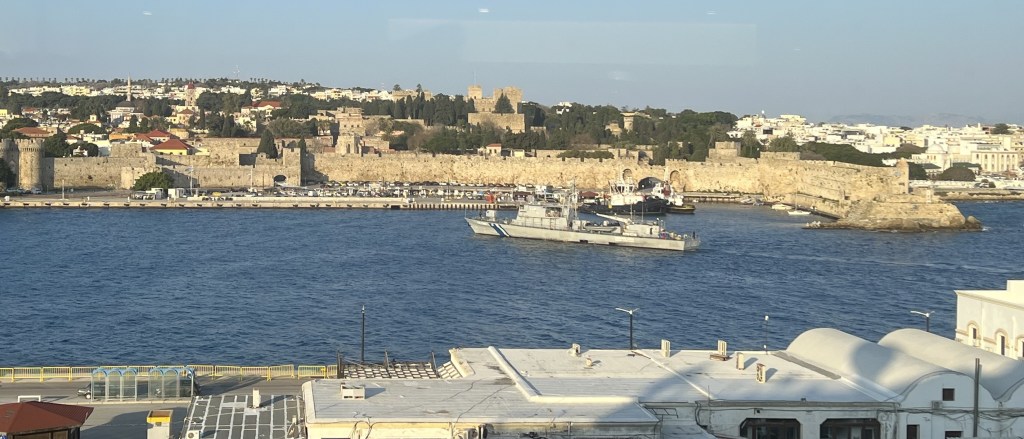
When we arrived in Rhodes I was not prepared for the abrupt shift in focus (time and culture).  The Greek sites we had been touring dated from the Classical – Hellenistic – Roman eras, or the 1000-year period from 600 BCE to 400 CE.  Rhodes seemed to jump forward another 1000 years to concentrate on the later times of the Crusaders (14th and 16th centuries CE) and the Ottomans who controlled the island and city until the early 20th century.  Our tour of Rhodes featured this Medieval history. 

When I looked online, I found the history of Europe known as the medieval period, or Middle Ages, lasted from the 5th to the late 15th centuries, and was similar to the post-classical period for global history.  The medieval period began with the fall of the Western Roman Empire and transitioned into the Renaissance (Age of European Discovery).  The period is marked by population decline, counter-urbanization, the collapse of centralized authority, invasions, and mass migrations of tribes, which began in late antiquity and continued into the Early Middle Ages.  The large-scale movements of the Migration Period, including various Germanic peoples, formed new kingdoms in what remained of the Western Roman Empire.  Although there were substantial changes in society and political structures, the break with classical antiquity was incomplete. The Byzantine Empire (Eastern Roman) survived in the Eastern Mediterranean and remained a major power.  The Roman Empire’s law code (Corpus Juris Civilis) was rediscovered in Northern Italy in the 11th century and most western kingdoms incorporated the few extant Roman institutions.  Monasteries were founded as campaigns to Christianize the remaining pagans across Europe continued.  The Franks, under the Carolingian dynasty, briefly established the Carolingian Empire during the latter 8th and early 9th centuries. I The medieval period covered much of Western Europe but later succumbed to the pressures of internal civil wars combined with external invasions from the Vikings (north), Magyars (east), and Saracens (south).

The island of Rhodes stands at a crossroads between Europe, the Middle East, and Africa, which has given the city and the island many different identities and cultures.  The island itself has been inhabited since the Neolithic (stone) Period (4000 BCE), but Rhodes became an important trading post for shipping between Constantinople and Alexandria during the Byzantine Period and the European Crusades to the Holy Land.  The Knights Hospitallers captured and established their headquarters on Rhodes when they left Cyprus in 1307 and remained on the island for the next two centuries.  The Ottoman Empire expanded rapidly after the fall of Constantinople in 1453, and the Knights defense of the island in 1480 halted Sultan Mehmed the Conqueror from the invasion of the Italian peninsula by Ottoman forces.  Sultan Suleiman the Magnificent led a second Ottoman Siege of Rhodes in 1522 but after a spirited defense the Knights were allowed to depart on January 1, 1523.  New buildings were constructed during the Ottoman era, including mosques, public baths, and mansions, while the Greeks were forced to abandon the fortified city and move to new suburbs outside its walls.  The tours of Rhodes were not like the ruins we had visited, but of intact buildings for continuous occupation for the last 1000 years.  A different tour, but very interesting.

Thoughts: Disembarking our ship, we approached the Medieval city through one of the smaller side gates.  We then wound our way up hill from the harbor to the Palace of the Grand Masters(fortress) at the top of the citadel.  The stone-lined streets were the same as the crusaders and Ottomans trod for the last 1000 years as they wound toward the top.  You find a sense of longevity and continuity in Europe that does not exist in the US.  This also illustrates the transitory nature of human rulers and kingdoms.  Both are good reminders.  Act for all.  Change is coming and it starts with you.
Aigai

February 07, 2025

Yesterday we docked early in the port of Thessaloniki (Greek: Θεσσαλονίκη), also known as Thessalonica, Saloniki, Salonika, or Salonica.  Thessaloniki is the second-largest city in Greece (just over one million inhabitants) and the capital of the geographic region of Macedonia.  In Greek, the city is also known as Symprotévousa (literally “the co-capital”), a reference to its historical status as the “co-reigning” city (Symvasilévousa) of the Byzantine Empire alongside Constantinople.  From there we caught an early bus for a 1-1/2-hour ride to visit the royal tombs in Vergina.  The small town of Vergina (Greek: Βεργίνα) is in Northern Greece, part of the Veria municipality in Imathia, Central Macedonia.  Vergina was established in 1922 in the aftermath of the population exchanges after the Treaty of Lausanne which officially resolved the conflict that had arisen between the Ottoman Empire and the Allied nations after World War I.  Vergina is best known as the site of ancient Aigai (Ancient Greek: Αἰγαί,), the first capital of Macedon.

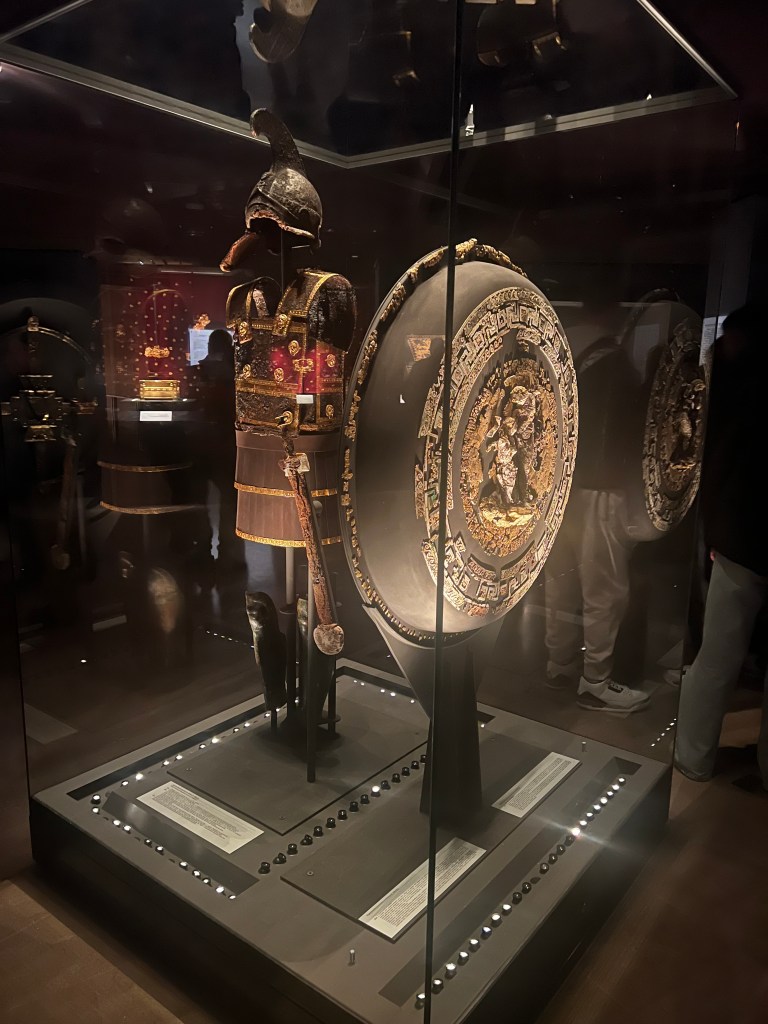
When I looked online, I found the capital of Macedonia was moved from Aigia (Vergina) to Pella in the 5th Century BCE, and Pella was the birthplace of Alexander the Great, but Vergina (Aigia) still served as the royal burial grounds.  The town became internationally famous in 1977 when the Greek archaeologist Manolis Andronikos unearthed what he claimed was the burial site of the kings of Macedonia, including the tomb of Philip II.  In 336 BCE Philip II was assassinated in Aigai’s theatre and his son, Alexander the Great, was proclaimed king.  Researchers uncovered three tombs at Vergina in 1977.  Tomb I contained Philip II, Alexander’s father, tomb II belonged to Philip III of Macedon, Alexander’s half-brother, while tomb III contained Alexander IV, Alexander’s son.  While Tomb I had been looted, Tombs II and III were intact and contained an array of burial goods.  Aigai was also the site of an extensive royal palace and the current town of Vergina sits atop a vast burial acropolis which has only been partially excavated.  The new archaeological museum of Vergina was built to house the artifacts found at Aigai (completed in 2022) and is one of the most important museums in Greece.  The first museum at the site of the tombs contains artifacts excavated there.  Aigai has been awarded UNESCO World Heritage Site status as “a significant development in European civilization, at the transition from classical city-state to the imperial structure of the Hellenistic and Roman periods”. 

Our tour of Aigia was designed to take us to the new museum located 10 minutes outside of Vergina, and then to the tombs located within the village.  I struggled with this placement as I had no context for the artifacts on display.  The new museum began with an overview of Alexander and his conquest of the known world and a replica of the second floor of the royal palace (in grand detail).  This led to the funerary stones and monuments, some of the pottery and goods from the burials, and closed with the decorative adornments from the cluster of the “queen’s burials”.  Little made sense to me until we visited the village where the excavations took place.  The tombs were the most impressive excavation and had their own museum, but I would have liked to have taken less time at the new museum and more time exploring the other excavations.  Maybe it is just me.

Thoughts: As we traveled to Aigai, our tour guide was from Thessaloniki and her pride was obvious concerning the role of this second capital of Greece and the importance of the region of Macedonia in the development of the “entire world” (read, Western World).  I cannot say much, as I made sure to bring my Chiefs shirt to wear this Sunday during the Super Bowl to claim my own association.  We take pride in who we are and where we are from.  This is true around the world.  The trick is to take pride in one without disparaging others.  Act for all.  Change is coming and it starts with you.