
December 05, 2025
After a nearly two-hour bus ride our tour arrived at Neuschwanstein Castle today. The castle is a 19th-century palace on a rugged hill of the foothills of the Alps in the south of Germany above the incorporated village of Hohenschwangau and the narrow gorge of the Pöllat stream. Since 2025, the castle has been part of the UNESCO World Heritage Site, “The Palaces of King Ludwig II of Bavaria”. According to Guinness World Records, it is the tallest castle in the world at 213 feet (65 meters). Walt Disney used this castle as a model for Disneyland. When we arrived on site there was snow on the ground and the castle was shrouded in fog. The walk to the castle began with a 30-degree incline that took me 30 minutes to navigate. After a brief rest we began the last 15 minutes of the walk that shifted to a 45-degree incline. When our appointed 5-minute entry slot arrived we began a 25-minute tour that took us to the top (fourth) floor. Although the trip was tiring, it was well worthwhile. As our tour continued to Oberammergau our guide told us of one of the Christmas traditions celebrated by her family while growing up, the hiding of the Christmas Pickle.
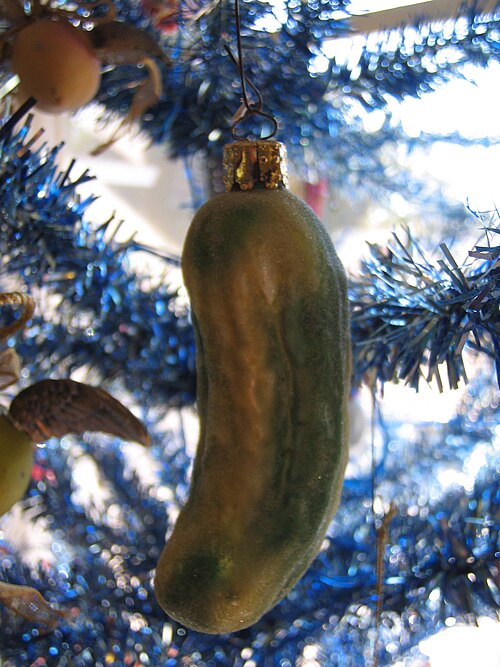
When I went online, I found Christmas pickle (Weihnachtsgurke) is a game of hiding a pickle shaped Christmas ornament among the branches of the tree. While supposedly a centuries-old German Christmas tradition, most Germans have never heard of it, but it is beloved by many families in the US and UK. After decorating their tree on Christmas Eve, the parents hide a pickle ornament among the branches. The first child to find the pickle on Christmas Day receives an extra present or good fortune for the coming year. In some stories, the pickle-hiding game is a centuries-old German tradition that has been passed down through generations. In others, a captured German-American soldier was saved from starvation on Christmas Eve during the Civil War by eating a pickle. Other people believe the tradition is related to St Nicholas resurrecting three boys who had been murdered and hidden in a barrel of pickles. Anyone familiar with traditional German Christmas will see some flaws in the story. Germany celebrates the arrival of St. Nicholas on December 6 rather than Christmas Eve and children open their presents on December 24, not Christmas Day. The biggest problem is that few in Germany have ever heard of it. A December 2016 survey by YouGov found only 7% of Germans had heard of Weihnachtsgurke, and only 6% of families practice the custom.
Our guide pointed out a souvenir store where we could buy a Christmas Pickle. I toured the other shops before deciding to get a Christmas Pickle for my son and his family as a nice way of sharing a German tradition as we are of German descent. When I asked the cashier where I could find a Christmas Pickle, her response was, “Was is pickle, I do not know this word.” I broke out the translator on my phone and typed in my request, which was displayed on my screen in German. “Ah, gerken!” Then she showed me a wooden pickle for 24 Euro. She saw the look on my face and told me to wait while she found a cheaper version upstairs. While I waited, I Goggled “Christmas pickle” and found this was not a German tradition, but an American tradition that has only recently spread to Germany. When I shared this information with the clerk, she told me she only keeps the Christmas pickle for tourists. I did not buy a Christmas pickle for my son and his family.
THOUGHTS: When my guide asked if I found a Christmas pickle I just laughed and said I had. I knew nothing would be gained by telling her what I had learned. I have found that traditions come from all sorts of origins, and the origin is not as important as the joint celebration it brings to a family or community. Sometimes it is better to just keep your traditions alive (no matter where they come from) to bind us together in a shared belief. Act for all. Change is coming and it starts with you.

 A travelers odyssey