
December 01, 2025
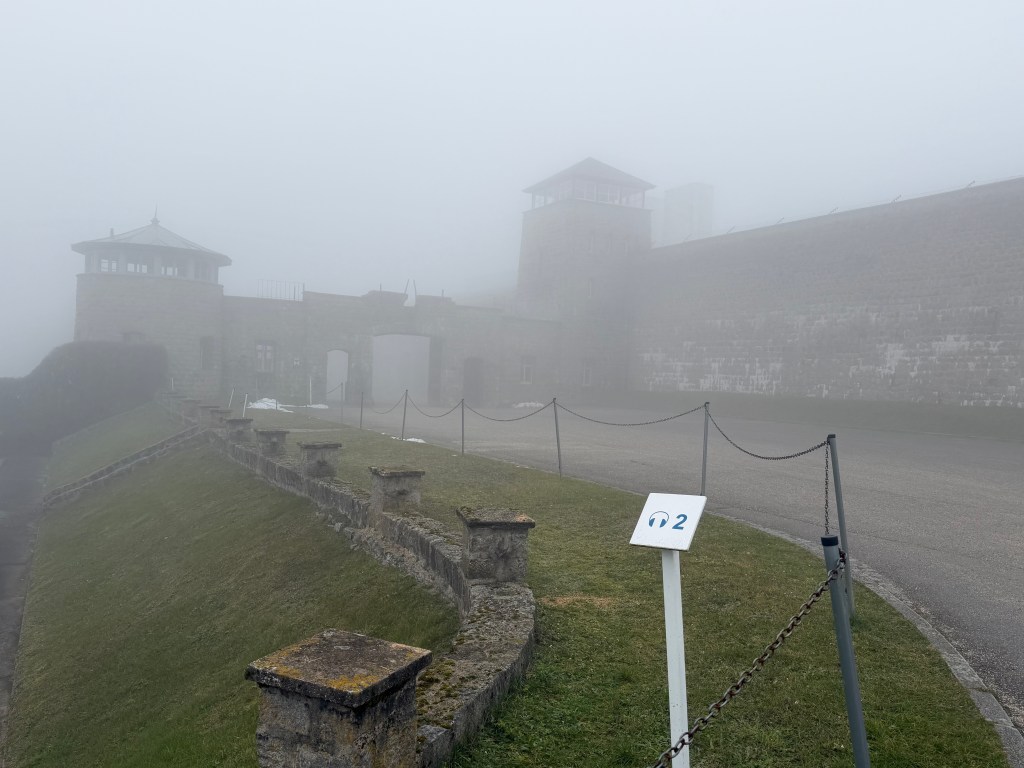
We began yesterday with a panoramic tour of Linz, Austria. While the city was nice, a “panoramic” tour meant we rode a tram to see important buildings. Even bundled up it was cold (30F/-1C) and the fog made it difficult to see anything more than a few hundred feet (60 m) away. The river port was a 20-minute walk from the main city and the Christmas market (our reason for the tour) did not open until it was time to return to the ship. While several stayed, we had scheduled a bus trip that afternoon that left us just enough time to eat a fast lunch. We piled into the bus, and our guide took us for a tour of Mauthausen, Hungary. Mauthausen is a small market town in the Austrian state of Upper Austria located about 12 miles (20 km) east of Linz. I had not paid much attention when we had signed up for the tour but was aware this was the site of one of the many German work camps established from 1933 to 1945. Our guide informed us the difference between a prison and a concentration camp was there was never a trial for the people detained there.
When I went online, I found the Nazis had no plan for concentration camps prior to their seizure of power in the German government on January 30, 1933. The concentration camp system arose in the following months due to the desire to suppress tens of thousands of Nazi opponents in Germany. The Nazis used the arson attack on the German parliament building on February 27, 1933 (Reichstag fire) to consolidate power and as the pretext for mass arrests. The Reichstag Fire Decree eliminated the right to personal freedom enshrined in the Weimar Constitution and provided a legal basis for detention without trial. Historian Jane Caplan estimated the number of prisoners in 1933 to1934 at 50,000, with arrests perhaps exceeding 100,000. Eighty per cent of prisoners were members of the Communist Party of Germany and ten per cent members of the Social Democratic Party of Germany. About 70 camps were established in 1933, in any convenient structure that could hold prisoners, including vacant factories, prisons, country estates, schools, workhouses, and castles. The early camps were heterogeneous and fundamentally differed from the post-1935 concentration camps in organization, conditions, and the groups imprisoned.
From 1938 to 1945, the Mauthausen concentration camp was at the center of a system of over 40 subcamps and was the main site of political, social, and racist persecution by the National Socialist regime on Austrian territory. Mauthausen was originally intended as a work camp to extract the granite blocks from the associated quarry. These blocks were used to build camp buildings as well as building material for the surrounding towns. The outbreak of the war shifted the workers’ emphasis to forced labor in the surrounding industries. The tone of the group was hushed as we toured the site. The dense fog was thicker as we rose above the city and many of the locations were pointed out with, “if you could see, down there was . . .” The fog seemed appropriate as much of the site’s history had been shrouded in secret. Like many of the camps, as the allies got closer the emphasis shifted toward cleaning up the evidence of atrocities. Of a total of around 190,000 people imprisoned here, at least 90,000 were murdered.
THOUGHTS: Rather than denying the concentration camps past or trying to make it more palatable, the Mauthausen Memorial is maintained as a site of political and historical education. Its task is to ensure public awareness of the history of the Mauthausen concentration camp and its subcamps, the memory of its victims, and the responsibility borne by the perpetrators and onlookers. At the same time, it seeks to promote critical public engagement with this history in the context of its significance for the present and future. George Santayana wrote, “Those who cannot remember the past are condemned to repeat it”. The same still holds. Act for all. Change is coming and it starts with you.
 A travelers odyssey