2nd Crop

August 27, 2025

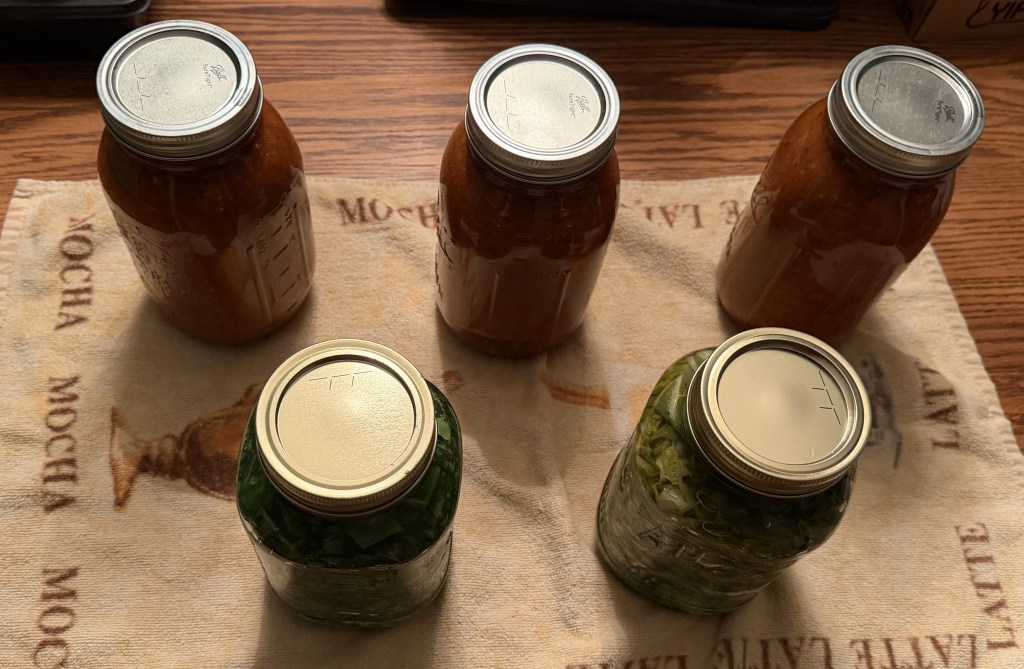
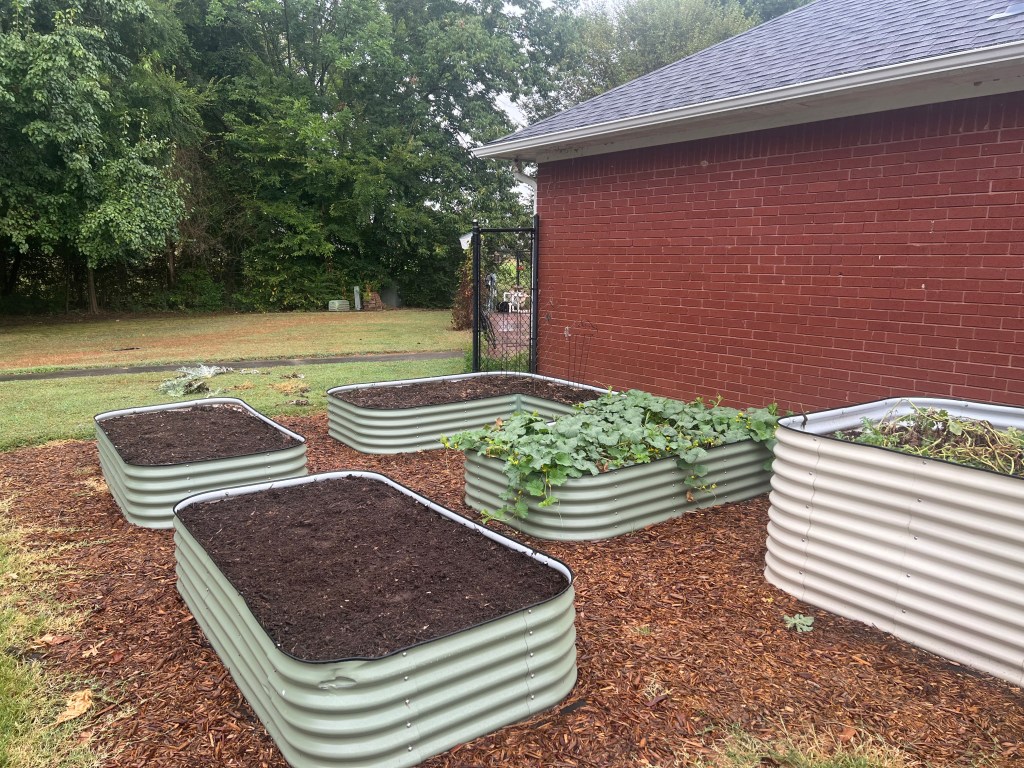
While I considered replanting my raised beds last year, I never got around to doing it.  When I planted my vegetables in April I noted when (and if) I could replant another round of the same vegetables.  After the initial harvest I also considered which vegetables I wanted more of.  I already had way too many pickles (Cucumis sativus) with 12 pints (5.7 liters) than I could use over the next year, and the same was true for the six pints (2.8 liters) of canned carrots (Daucus carota).  I had eaten through the radishes (Raphanus sativus) and only had 2 pints of beets (Beta vulgaris) left, so these were a good choice.  I also decided to replant cauliflower (Brassica oleracea) and cabbage (Brassica oleracea).  We enjoyed the two quarts (1.9 liters) of sauerkraut last year and I had not planted a new crop this year.  I rounded out the raised beds with a few vegetables that had not grown well along the patio; lettuce (Lactuca sativa), spinach (Spinacia oleracea), and peas (Pisum sativum).  Now that my 2nd crop is planted, I just need to wait and see what will produce.

When I went online, I found a second crop is either the second growth of a crop that regrows after an initial harvest, or, more commonly, a different crop planted on the same land within the same year after a previous crop has been harvested.  This is known as double cropping and allows farmers to maximize land use and harvest two yields from the same acreage in a single growing season.  This requires sufficient time for the crop to mature and resources like water to support the second planting.  There are two main types of second crop.  The first is a regrowth after the initial harvest where the stump/roots of a crop resprouts after it has been cut for its first harvest (example, broomcorn).  The second is to plant a follow-on crop of a new and different crop on the same piece of land within the same year after the first has been harvested.  This utilizes land that might otherwise lay idle or unproductive.  Double cropping requires adequate time for the second crop to mature and sufficient moisture from rainfall or irrigation to support both plantings.  This process can boost the overall farm revenue and potentially improve ecological services.

There are several benefits to succession planting or planting a 2nd crop in your vegetable garden.  First is that it allows you to enjoy the vegetables you love for a longer period.  This also allows for more yield in the same amount of space.  This is especially so for smaller gardens with limited space.  If you plant a 2nd crop from a different plant family, it can improve the soil structure and replenish nutrients depleted by the 1st crop.  Finally, rotating different types of plants helps disrupt the life cycles of pests that had fed on the 1st crop and reduce the spread of diseases.  Critical considerations for a 2nd crop are the first frost date in your growing area (mine is 7b).  That means planting fast maturing varieties and vegetables that thrive in cool weather.  You will also need to amend your soil with new compost or fertilizer to ensure a good result.  I did not fertilize when I planted yesterday.  This just gives me something to do today (ha ha).

THOUGHTS: Planting a 2nd crop is the next step toward my goal of sustainability.  Admittedly, I should have allowed several plants to go to seed and then replanted those.  Instead, I used what was left in the heirloom seed packages I had left.  Maybe next year.  As the weather cools, I am looking forward to finally getting some production from the tomatoes (Solanum lycopersicum) and bell (Capsicum annuum) and jalapeno (Capsicum annuum) peppers I planted last April along with the new produce from my 2nd crop.  While the time and expense of growing my garden may not cover the costs, the crispness of the produce makes it worthwhile.  Sustainability is a process that is its own reward.  Act for all.  Change is coming and it starts with you.
It’s In

April 14, 2025

It has been an odd planting season (month) this year, to say the least.  It started four weeks ago when I went to the soil and mulch supply I had used for the Hügelkultur raised beds last year.  I had read that the limbs and wood on the bottom layer would decay over several years and as it does, the soil will sink.  At least I did not get the dreaded sink holes that can result when you do not compact the soil into the limbs well enough.  I ordered two skid scoops of topsoil but could only get one in my 8×5 foot (2.4×1.5 m) trailer.  I realized too late I wanted raised bed soil (a topsoil/compost mix) rather than topsoil.  I put the entire scoop into the four raised beds and when I went back for the second load, I changed my order to raised bed soil.  I used this to top off the raised beds and put a layer over two additional beds.  Melissa is going to scatter a wildflower mix in the bed in front of the house and I was going to put squash and lettuce in the back bed I had used for last year’s three sisters (corn, beans, squash).  I misjudged the amount of work this was going to take.  After two long afternoons the soil was finally laid down.  I breathed a sigh of relief and said, “It’s In”.

When I looked online, I found the Old Farmer’s Almanac says the average last frost date for USDA hardiness zone 7a is between March 22 and April 3.  It is Generally safe to plant most garden vegetables after this period, but you need to check local weather forecasts for potential late frosts.  We got excited and went to the plant nursery during the last weekend of March and got some great deals on six packs of peppers (Capsicum annuum), tomatoes (Solanum lycopersicum), and squash (Cucurbita pepo).  I was prepared to put them in the following Monday, but the weather person said there was a “possibility” of one of two frost days (they were right).  We put the plants on the porch with Melissa’s succulents where they could get sun and be out of the cold.  Melissa was countering the humidity for her succulents, so the fan was running 24/7.  The veggies did not like the fan and dried out quickly.  We brought them into the house and Melissa babied them.  Finally last week I was ready to take the risk and put them all in the ground along with the radish (Raphanus sativus), carrot (Daucus carota), beet (Beta vulgaris) seeds, and a hill each of cantaloupe (Cucumis melo) and watermelon (Citrullus lanatus).  I breathed a sigh of relief and said, “It’s In”.

I had worried as I planted the veggies last Monday as several were looking poorly.  I mulched and watered them for several days before I bought replacements and replanted five.  As the week went on several more withered and died.  I removed the store plants and planted seed for several straight necked squash and cucumbers (Cucumis sativus).  As I watered this morning, I faced the dilemma of what to do with three tomatoes and two bell peppers that were struggling.  It was iffy whether they would survive and if I waited to act it would probably be too late for seed before the summer heat.  I went back to the co-op and found a six pack of Cherokee purple tomatoes and two single peppers.  That meant I had more plants than planters, but the six pack was the same price as one single (I needed two).  I ended up placing two of the tomatoes in the back bed with the squash and found another container for the third.  I breathed a sigh of relief and said, “It’s In”.        

THOUGHTS: Each time I said, “It’s In, I thought the job was over.  While I could have left the empty containers and garden spaces I was unwilling to do so.  I had already invested too much time and energy to quit when I was so close to completing my planting.   I did tell Melissa after finishing today that I was not going to buy any more plants.  If any fail now their spaces will be reserved for my summer/fall planting.  In gardening and life, you need to be willing to overcome initial setbacks.  You also need to know when it is time to change strategies and tactics.  Doing the same thing and expecting different results rarely works.  Act for all.  Change is coming and it starts with you.

Carrots

October 10, 2024

Only a few plants remain in my raised beds as we approach the end of the growing season.  I have two bell peppers (Capsicum annuum) that had been overshadowed by the cutleaf ground cherry (Physalis angulata) that had self-propagate and taken over three of my raised beds.  After I ripped the plants out of the bed these two scrawny plants were hidden underneath.  I had no idea what they were but decided to let them grow.  They are now producing fruit, while the peppers in my containers have stopped producing and the wilted stems have been removed.  The 2 red burgundy okra (Abelmoschus esculentus) are still going strong at over six feet (2 m) with new blossoms daily.  If only I liked okra.  I am thinking I might try and pickle some smaller fruits as it is the only way I can eat them.  The watermelons are still trying to produce, with five new melons on the vine.  Then there are the five cabbage plants (Brassica oleracea) struggling to survive.  I did not pay close enough attention and most of my leafy vegetables were eaten by insects.  I never saw them, but the holes in the leaves gave away their presence.  The only other crop is the carrots I had planted at the end of April.

When I looked online, I found the carrot (Daucus carota subsp. sativus) is a root vegetable, typically orange in color and is a biennial plant in the umbellifer family (Apiaceae).  Heirloom variations can be purple, black, red, white, and yellow.  All of the subspecies are domesticated forms of the wild carrot which is native to Europe and Southwestern Asia.  The plant probably originated in Iran and was originally cultivated for its leaves and seeds, but the most common part of the plant now eaten is the taproot.  The domestic carrot has been selectively bred to have a larger, more palatable, and less woody-textured taproot.  Carrots are commonly consumed raw or cooked in various dishes and are a rich source of the provitamin A compound (beta-carotene), which converts to vitamin A as it is digested.  Fast-growing cultivars mature within about 90 days of sowing the seed, while slower-maturing cultivars need 120 days.  World production of carrots (combined with turnips) for 2022 was 42 million tons, with China producing 44% of the total.

I do not know if I planted a fast growing or slow growing variety of carrots, but my carrots have been in the ground for over 160 days.  When I planted them, I made a single slit in the ground and shook the tiny seeds into the ground.  I had planted them too close together and when they sprouted none of the seedlings had enough room to flourish.  I tried thinning them several times but never seemed to get them far enough away from each other to give them room to grow.  Every time I checked or thinned them, they were still needle thin.  Several of the tops had become larger recently and today I decided it was time to quit messing with them and harvested the batch.  I did have one descent sized carrot, and a lot of smaller (but passable) ones.  I tried one and gave another small one to Melissa.  While they may not have grown large, they did taste good.           

THOUGHTS: The carrots suffered the same fate as all my root vegetables.  I did not space them enough and even thinning them did not give them enough room to grow.  I watched a YouTube video suggesting I plant them in squares to make sure there was proper spacing to grow.  More knowledge to save for the future.  I did not do a second planting of any of my vegetables (in August).  I had grown weary and was not paying enough attention to the plants I already had in the ground.  I guess sustainability is still a long way off.  Overcrowding has the same effect on humans as it does carrots.  Human overpopulation suggests we may become too large to be sustained by the environment or the Earth’s resources.  Estimates of the world’s carrying capacity predict a maximum of 7.7 billion.  We now stand at over 8 billion and rising.  Unless this is addressed, like my carrots the world will self-correct itself.  Act for all.  Change is coming and it starts with you.