Wheel Bug

May 14, 2025

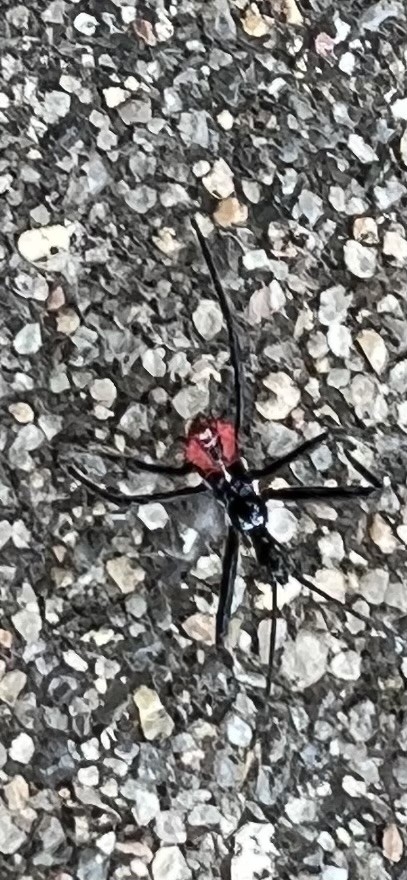
Last weekend I decided to weed the succulent bed beside the drive.  Melissa planted the bed with white stonecrops (Sedum album) mats placed around the 4-foot by 3-foot (1.2 m by .9 m) bed.  The bed sits under the Bradford pear (Pyrus calleryana) tree I had trimmed for the limbs and branches that made up the base layer of my hügelkultur raised beds made last year.  The problem was the bed was filled with dead leaves and the invasive Bermuda grass (Cynodon dactylon) from the surrounding yard.  After an hour of concentrated effort, I amassed a large pile of grass, leaves, and weeds on the driveway.  I raked the debris into a pile and scooped it up to place in the trash bin (I do not have a large compost pile, yet).  When I came back to blow the remaining debris onto the yard, I noticed a small insect with a red back scurrying across the drive.  At first, I thought it was a Black widow (Latrodectus hesperus) spider dislodged from the debris.  A closer look showed the creature had 6 legs, meaning it was an insect rather than a spider.  I took a picture and googled the bug, and it was identified as an assassin bug, or more specifically a North American wheel bug.

When I went online, I found the North American wheel bug (Arilus cristatus), or simply wheel bug, is a species of large assassin bug in the family Reduviidae and the only species of wheel bug found in the US.  It was described in 1763 by Carl Linnaeus.  It is one of the largest terrestrial true bugs in North America and reaches up to 1.5 inches (38 mm) in length in its adult stage.  It is sexually dimorphic with males slightly smaller than females.  The characteristic feature of the species is the wheel-shaped armor on the first segment of the thorax which also bears the first set of legs.  Adults are gray to brownish gray in color and black shortly after molting, but the nymphs (which have not developed the wheel-shaped structure) have bright red or orange abdomens.  Wheel bugs prey on caterpillars and beetles by piercing them with their beak to inject salivary fluids that dissolve soft tissue.  Wheel bugs are the most active in daylight but may feed at night in areas illuminated by lights.  A wheel bug uses camouflage and hides in leafy areas (like my overgrown bed) whenever possible.  Despite the prevalence of the wheel bug in many habitats, the information on the species is haphazard and incomplete.  Most of its prey are pests, so the wheel bug is considered beneficial.

The wheel bug I found scurried off and I did not think any more about it until I noticed another one on my rake 20 minutes later.  My app initially identified the insect as an assassin bug, but this refers to over 7,000 species of Reduviidae, a large wide-ranging (cosmopolitan) family of the suborder Heteroptera of the order Hemiptera (true bugs).  Scanning pictures of the 5 different types of assassin bug, I determined it was a wheel bug, which also had 5 species.  I narrowed this to the North American wheel bug because it was the only one native to North America.  North American wheel bugs are highly regarded by organic gardeners because they consume a variety of insects, and their presence indicates a healthy, pesticide-free ecosystem.  “They are the lion or the eagle of your food web,” according to Michael J. Raupp, an entomologist at the University of Maryland.  I was glad I had left it alone.

THOUGHTS: The pictures of wheel bugs all showed a large black or gray adult, unlike the tiny (.25 inch/6 mm) insect I found.  This was a nymph version of the wheel bug that hatches at the beginning of May and matures (after 5 molts) in July.  That explains the second individual on my rake.  I had disturbed a group of hatchlings hidden in the leaves.  When I saw the wheel bug my first reaction was to squash it because it was unknown.  Taking time to know, I found it was beneficial.  Taking time to know (things or people) can often change our understanding.  We just need to be willing to spend the time.  Act for all.  Change is coming and it starts with you.
Beetle

October 30, 2024

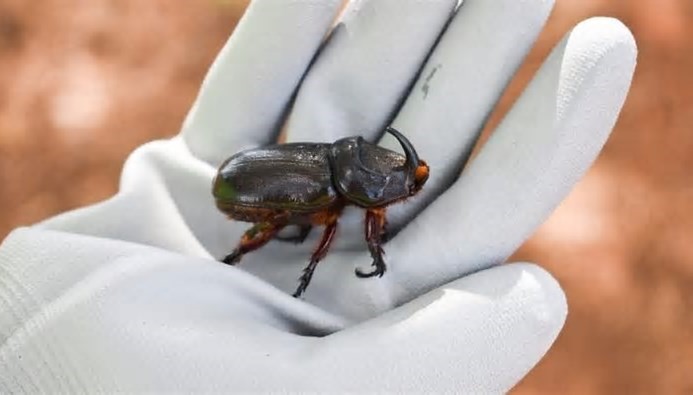
Hidden in the back of the front section in yesterday’s newspaper was a USA Today article about Hawaii’s attempts to stop an invasive insect.  According to the Hawaii Invasive Species Council, the invader “jeopardizes the economy, the entire ecosystem, agriculture and food security.”  This species feeds by biting and boring into emerging palm fronds, creating holes in the top of the tree.  While they prefer to feed on coconut, royal, date, and fan palms, they will also feed on hala, taro, banana, pineapple, and sugarcane if the palm trees are unavailable.  The insects are nocturnal and can fly up to two miles if they are looking for food.  The insect attacks a palm at the base of the fronds (leaves) where they are attached to the trunk, bore through the base of the fronds into the center of the crown (the palm heart), and feed on the undeveloped white fronds.  Attacks cause a reduction in leaf area on the damaged fronds and results in a reduction in the number of nuts produced.  Newly planted palms can have their growth point destroyed resulting in the palms death and even mature palms may die after extremely heavy attacks by the coconut rhinoceros beetle.

When I looked online, I found the coconut rhinoceros beetle (Oryctes rhinoceros), also known as Asiatic rhinoceros beetle, is a large species of beetle belonging to the subfamily Dynastinae.  This dynastid beetle has a length of 1.4 to 2 inches (3.5 to 5 cm) and is a dark brown to black color.  The head has a horn which is more prominently developed in males and in larger specimens. The first segment of the thorax (pronotum) has a large central depression with two humps at the hind margin and the tibia of the foreleg has three large teeth.  Male beetles can be reliably distinguished from females as the tip of the abdomen is rounded, shiny, and hairless.  In females the tip is more pointed and densely covered with hair.  The larvae are C-shaped white grubs typical of other scarab beetles.  The beetle breeds in decaying palm trunks or other organic matter (sawdust or compost heaps).  The native distribution of this beetle covers most parts of tropical Asia, but human activity accidentally introduced the beetle to a large number of tropical islands throughout the Pacific.   The beetle has most recently invaded Guam, Hawaii, the Solomon Islands, and Vanuatu.

A virus disease of coconut rhinoceros beetle (Oryctes rhinoceros nudivirus) has turned out to be the most effective natural control agent.  This virus was discovered by Alois Huger in Malaysia in 1963 and was later found to occur naturally in other countries within the native range of the beetle.  The introduced beetle populations in the Pacific and in the Maldives were found to be virus-free.  The virus was introduced into the virus-free populations and caused a significant decline in the beetle population.  The virus mainly effects the adult population and spreads easily, reducing their life span and the fertility of females.  During replanting of palms more breeding sites become available and transmission of the virus is often interrupted, and outbreaks still occur.  There is also evidence of resistance to the virus in some coconut rhinoceros beetle populations.  A fungus (Metarhizium majus) is also effective in controlling the beetles in breeding sites, but it does not spread well by itself.  The fungus does have the advantage that it survives for some time outside its host (as conidia).

THOUGHTS: Use of a virus to control the coconut rhinoceros beetle population is common, and natural biological controls include predators, parasitoids, pathogens, and competitors.  Biological control can have side-effects on biodiversity through attacks on non-target species by any of these mechanisms, especially when a new species is introduced without an understanding of the possible consequences.  Viruses being transmitted to other species (and humans) may cause greater harm than the original problem.  Alexander Pope’s proverbial phrase in 1711 was, “To err is human”.  Even without forgiveness, this is more than an adage.  Act for all.  Change is coming and it starts with you.
Tiger Moth

October 22, 2024

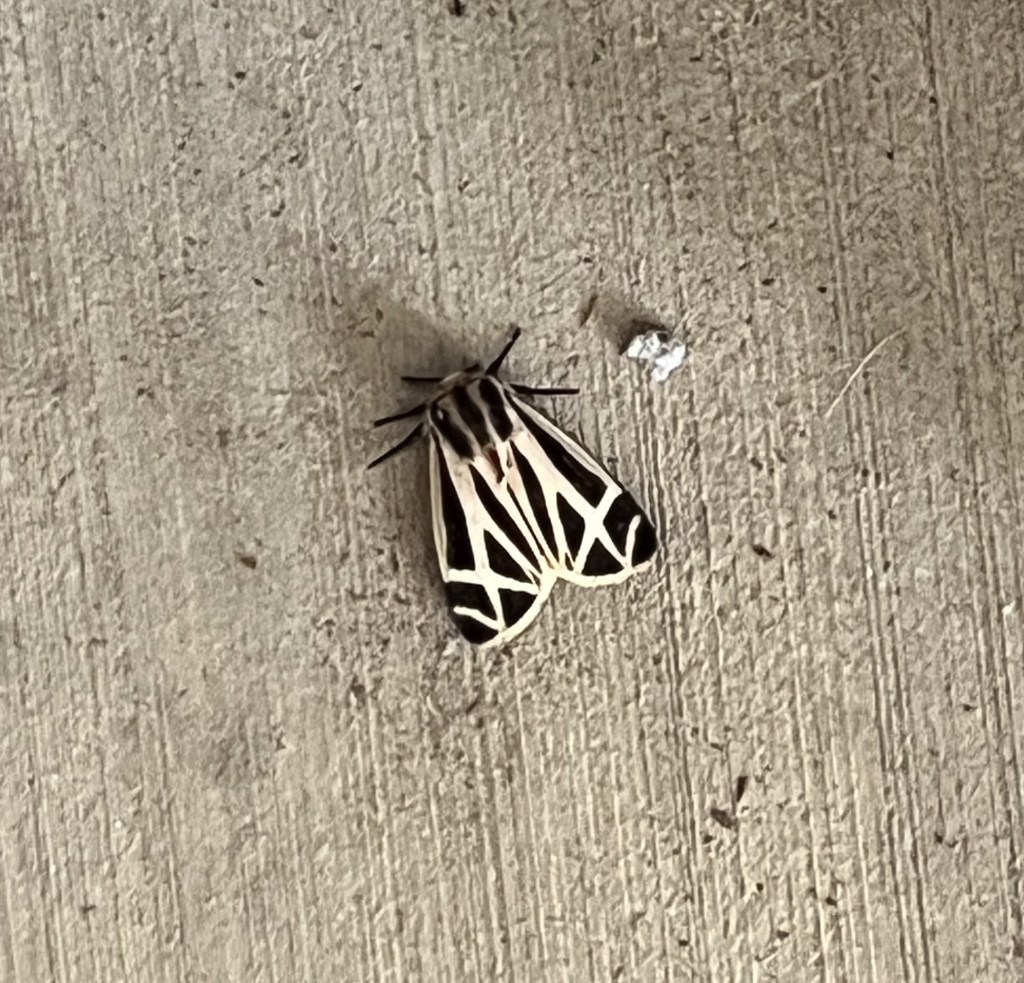
Our enclosed porch serves as a greenhouse for both Melissa’s succulents and a rack during late winter for my vegetable seedlings.  The area is also used to store Melissa’s supplies and the seeds I use to feed the birds.  When I started feeding birds several years ago, I set the bags on the floor.  This worked for several months, but as the weather got colder the rodents that thrived in the tall grass of the lot behind our house were more intent on seeking food and shelter.  While I never saw a house mouse (Mus musculus) or brown rat (Rattus norvegicus), I did have several instances of “something” chewing through the seed bags and spilling the contents onto the floor.  I now have a large 20 gallon (76 l) tub for the larger bags and 3 smaller 5 gallon (15 l) buckets to hold the daily dispersal.  The containers are large enough to contain the seed and have a lid which keeps out the (hopefully) mice.  While cleaning behind the “supplies” behind the feed buckets I found more evidence of mice, but again no actual critters.  What I did find beneath several of the buckets was a brightly colored moth.  When I checked my phone identification it said this was a harnessed tiger moth.

When I looked online, I found the harnessed tiger moth (Apantesis phalerata) is a species of moth within the Erebidae family, first described by Thaddeus William Harris in 1841.  The harnessed tiger moth’s subfamily (Arctiinae) has about 11,000 species of tiger moths divided globally across three tribes.  The harnessed tiger moth is indigenous to North America, with a geographical distribution from Ontario, Quebec, and Maine in the north, to the west in South Dakota, and stretching south to Florida and Texas.  The adult moth has a wingspan ranging from 1.2 to 1.7 inches (30 to 42 mm), and their distinctive black and orange wing patterns earned them the name “tiger” moth.  The tiger moth has a grooved exoskeletal structure (tymbals) on the posterior three segments of the thorax (metathorax) which they use to produce high frequency cicada (superfamily, Cicadoidea) like clicks.  The clicks are a defensive mechanism against predation and for communication during mating.  The lifespan of a harnessed tiger moth ranges from 5 to 10 days after mating.  The moth’s activity period varies regionally, being active from April to September in the southern parts of its range, and from May to August in the northern areas.  My tiger moth was active (at least alive) in mid-October. 

The harnessed tiger moth uses its vibrant colors to serve as a visual deterrent, signaling to potential predators that they are distasteful.  Despite their warning colors, harnessed tiger moths are preyed upon by bats, which rely on echolocation (not sight) to hunt.  This tiger moth is not poisonous, but adults do secrete a liquid to ward off predators that can cause allergic reactions in humans.  The furry body of the caterpillar can also cause rashes and irritation if touched with bare hands.  There are many spiritual meanings attached to the various species of tiger moth and different types of tiger moths hold different gravity in various cultures worldwide.  White-colored tiger moths are seen as a sign of peace and innocence as white is often considered the color of peace. 

THOUGHTS: Two common spiritual meanings are attached to all tiger moth species around their attraction to light.  Some believe spotting a tiger moth is an indication that the person must leave the dark and start embracing the light in their soul.  For other cultures this is a warning that means not to be easily lured by charming deals or things and think rationally before making decisions.  Human decisions are fraught with a similar dichotomy of good and bad.  Roman Emperor Marcus Aurelius, in his Meditations said, “You have power over your mind – not outside events.”  Nietzsche takes the same perspective, affirming the agency of the individual goes beyond good and evil and declares what is “good” and “bad” by what is serving and hindering their own goals.  There are not absolutes, only your reaction to events.  Act for all.  Change is coming and it starts with you.