
February 07, 2025
Yesterday we docked early in the port of Thessaloniki (Greek: Θεσσαλονίκη), also known as Thessalonica, Saloniki, Salonika, or Salonica. Thessaloniki is the second-largest city in Greece (just over one million inhabitants) and the capital of the geographic region of Macedonia. In Greek, the city is also known as Symprotévousa (literally “the co-capital”), a reference to its historical status as the “co-reigning” city (Symvasilévousa) of the Byzantine Empire alongside Constantinople. From there we caught an early bus for a 1-1/2-hour ride to visit the royal tombs in Vergina. The small town of Vergina (Greek: Βεργίνα) is in Northern Greece, part of the Veria municipality in Imathia, Central Macedonia. Vergina was established in 1922 in the aftermath of the population exchanges after the Treaty of Lausanne which officially resolved the conflict that had arisen between the Ottoman Empire and the Allied nations after World War I. Vergina is best known as the site of ancient Aigai (Ancient Greek: Αἰγαί,), the first capital of Macedon.
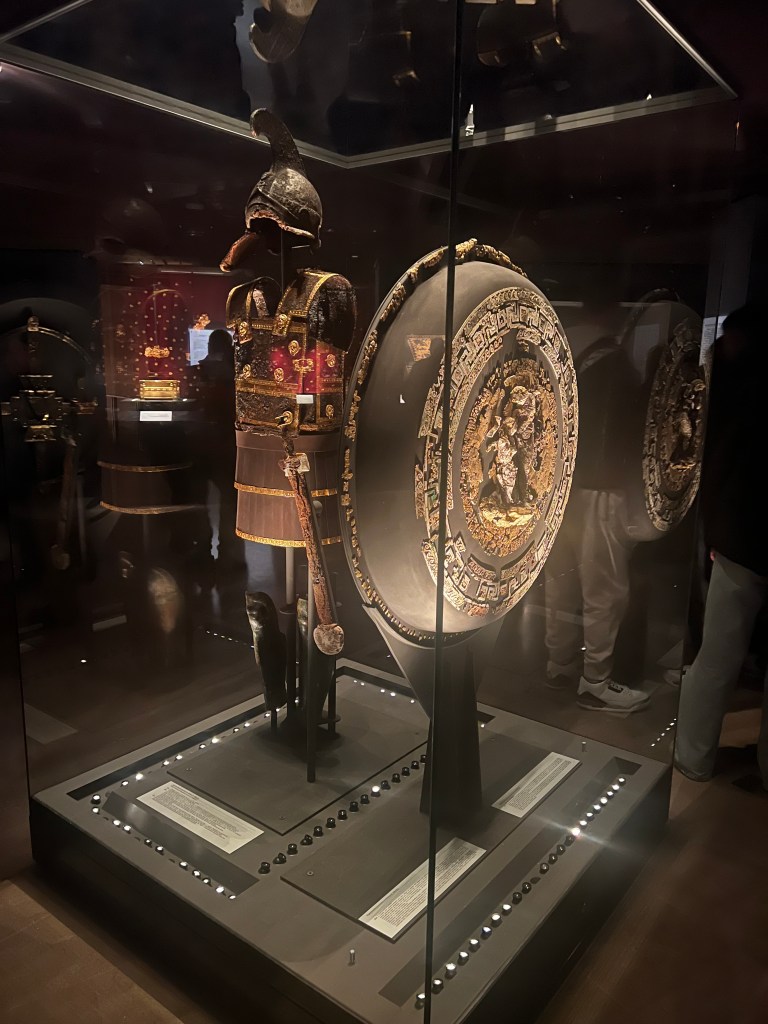
When I looked online, I found the capital of Macedonia was moved from Aigia (Vergina) to Pella in the 5th Century BCE, and Pella was the birthplace of Alexander the Great, but Vergina (Aigia) still served as the royal burial grounds. The town became internationally famous in 1977 when the Greek archaeologist Manolis Andronikos unearthed what he claimed was the burial site of the kings of Macedonia, including the tomb of Philip II. In 336 BCE Philip II was assassinated in Aigai’s theatre and his son, Alexander the Great, was proclaimed king. Researchers uncovered three tombs at Vergina in 1977. Tomb I contained Philip II, Alexander’s father, tomb II belonged to Philip III of Macedon, Alexander’s half-brother, while tomb III contained Alexander IV, Alexander’s son. While Tomb I had been looted, Tombs II and III were intact and contained an array of burial goods. Aigai was also the site of an extensive royal palace and the current town of Vergina sits atop a vast burial acropolis which has only been partially excavated. The new archaeological museum of Vergina was built to house the artifacts found at Aigai (completed in 2022) and is one of the most important museums in Greece. The first museum at the site of the tombs contains artifacts excavated there. Aigai has been awarded UNESCO World Heritage Site status as “a significant development in European civilization, at the transition from classical city-state to the imperial structure of the Hellenistic and Roman periods”.
Our tour of Aigia was designed to take us to the new museum located 10 minutes outside of Vergina, and then to the tombs located within the village. I struggled with this placement as I had no context for the artifacts on display. The new museum began with an overview of Alexander and his conquest of the known world and a replica of the second floor of the royal palace (in grand detail). This led to the funerary stones and monuments, some of the pottery and goods from the burials, and closed with the decorative adornments from the cluster of the “queen’s burials”. Little made sense to me until we visited the village where the excavations took place. The tombs were the most impressive excavation and had their own museum, but I would have liked to have taken less time at the new museum and more time exploring the other excavations. Maybe it is just me.
Thoughts: As we traveled to Aigai, our tour guide was from Thessaloniki and her pride was obvious concerning the role of this second capital of Greece and the importance of the region of Macedonia in the development of the “entire world” (read, Western World). I cannot say much, as I made sure to bring my Chiefs shirt to wear this Sunday during the Super Bowl to claim my own association. We take pride in who we are and where we are from. This is true around the world. The trick is to take pride in one without disparaging others. Act for all. Change is coming and it starts with you.
 A travelers odyssey