
October 22, 2025
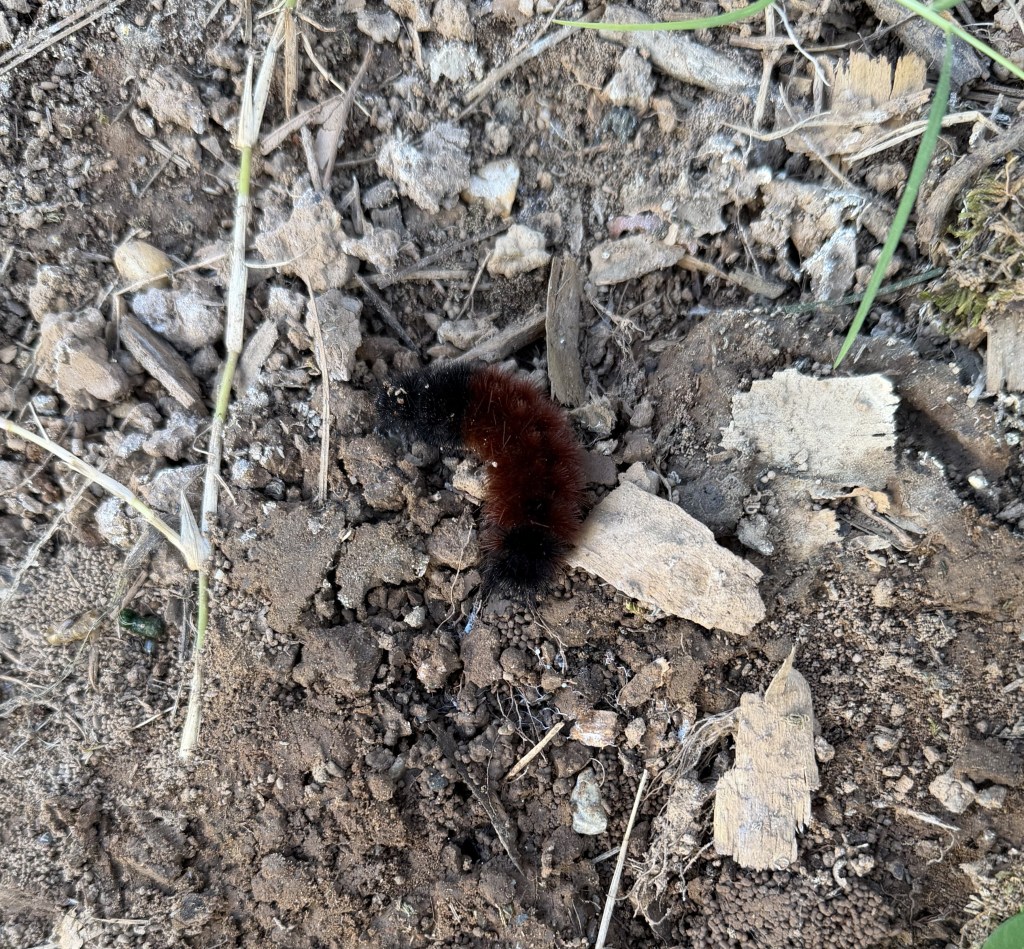
Even though the cooler temps have slowed the grass in my yards the weeds in the flower beds seem to be doing fine. Yesterday I got out and performed (I hope) my last weeding before fall. I usually just throw the weeds into the lawn and run my mower over them to mulch them into the sod. I had just mowed last week, and it really did not need to be mown again. I just raked the weeds up and threw them away. It seems I can never do just one part of yard work and doing one thing always seems to bring on other tasks. Mowing, weed eating, weeding the beds, and blowing off the sidewalks have become interchangeable. While I may put one or the other off for a day or two, once I start, I know I am committed to the long haul. I also have the wood pile stacked at the edge of the drive from the tree I had cut down. I had it stacked for firewood, but I know I still need to split and season the wood for a minimum of six months or preferably a year. While cleaning up around the pile I moved several pieces of cardboard and we greated by two guests who had taken up residence, a 12-inch (30.5 cm) Texas brown snake (Storeria dekayi texana) and a banded woolly bear caterpillar.
When I went online, I found the Isabella tiger moth (Pyrrharctia Isabella), whose larval form is called the banded woolly bear, woolly bear, or woolly worm, occurs throughout the US and Canada. It was first formally named by James Edward Smith in 1797. The thirteen-segment larvae are usually covered with brown hair (setae) in their mid-regions and black hair in their front (anterior) and back (posterior) areas. In direct sunlight, the brown hair looks bright reddish brown. Adult moths are generally dull yellowish through orangish and have robust and scaly midsection (thoraces), small heads, bright reddish-orange forelegs, and sparse black spotting on the wings. Each abdominal segment bears three black dots. The Isabella larva emerges from the egg in the fall and overwinters in its caterpillar form by allowing most of its mass to freeze solid. First its heart stops beating, then its gut freezes, then its blood, followed by the rest of the body. The larva survives being frozen by producing a cryoprotectant in its tissues that keeps the inside of the cells from freezing. In the spring, it thaws, and the cycle begins again.
Folklore in both Canada and the US holds that the relative amounts of brown and black hair on a woolly bear larva indicate the severity of the coming winter. If the brown band is wide, winter weather will be mild. If the brown band is narrow, the winter weather will be severe. A variation of this story says the color of the stripes predicts winter weather, with darker stripes indicating a harsher winter. Another version of this belief is that the direction the Isabella crawls indicates the winter weather, with the caterpillar crawling south to escape colder weather. There is no scientific evidence for weather prediction and hatchlings from the same clutch of eggs can display considerable variation in their color banding. The larva’s brown band tends to widen with age as it molts. Since the 1970’s, several locations in the US hold woolly bear festivals in the fall.
THOUGHTS: The wooly bear Caterpillar is not the only creature that can withstand being frozen. Amphibians like the wood frog (Lithobates sylvaticus) and American toad (Anaxyrus americanus), reptiles like the alligator (Alligator mississippiensis) and green iguana (Iguana iguana), certain types of carp (family Cyprinidae), and microscopic animals like the tardigrades (Phylum, Tardigrada) and rotifers (Phylum, Rotifera) all survive freezing. While the technology for freezing a human and bringing them back to life does not yet exist, cryonics involve preserving legally deceased bodies at extremely low temperatures with the hope of future revival. If an alligator can do it . . . Act for all. Change is coming and it starts with you.
 A travelers odyssey