
June 15, 2026
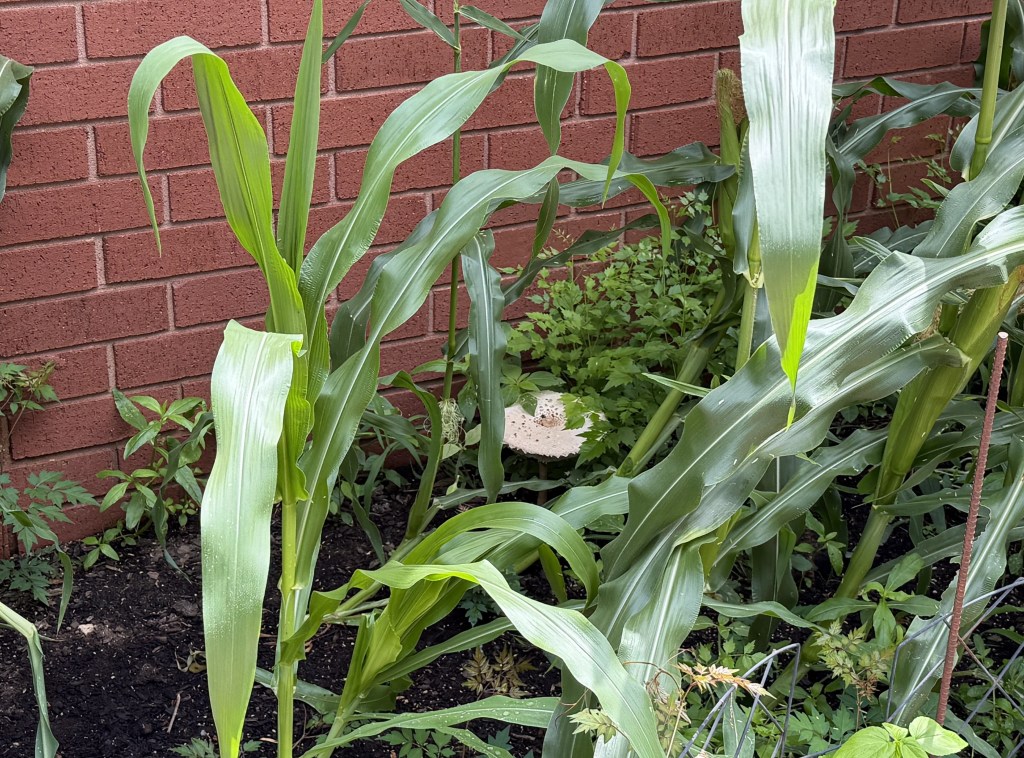
I have grown corn (Zea mays) in the bed along the back of my house for the last three years. The first year I grew corn as part of the “three sisters”, an indigenous method that allows the corn stalks to support the climbing pole beans (Phaseolus vulgaris) with winter squash (genus, Cucurbita) providing ground cover to keep down the weeds. While the corn grew, the cobs had spotty kernels that hardened before I harvested (oops!). The entire crop also suffered “laydown” (common for corn in wind) just after I returned from vacation and I had to stake the stalks to get them to stand. This year I learned about seed expiration (many did not sprout). If you read the packets, it tells the planting year and how long it should remain viable. I bought new seeds to plant this year. The three rows were going well until the kids were “play fighting” and to my horror Loki jumped the fence and landed on top of the small stalks. I added to the height of my fence, reset the plants I could, and replanted the ones that had been snapped, as well as several that had not sprouted. The corn was growing well and began producing tassels (male) and silks (female ears). Then two weekends ago a tornado cell passed over town and the winds caused another “laydown”. I again staked what I could and hoped for the best. When I checked the corn last week there was a large mushroom (false parasol) growing among the stalks.
When I went online, I found the false parasol (Chlorophyllum molybdites), commonly known as the green-spored or green-gill parasol, and vomiter, is a common species of mushroom found in temperate and subtropical meadows and lawns. The species is poisonous and causes serious vomiting and diarrhea. The cap (pileus) ranges from 3.1 to 12 inches (8 to 30 cm) in diameter and is hemispherical with a flattened top. The cap is whitish in color with coarse brownish scales, with white gills that turn dark and green with maturity. The stem (stipe) ranges from 2.0 to 12 inches (5 to 30 cm) tall and bears a double-edged ring and lacks the snakeskin pattern generally present on the edible parasol mushroom (Macrolepiota procera). The flesh is thick and initially firm, although it softens with age. The false parasol is the most consumed poisonous mushroom in North America as it is often misidentified as an edible species like the shaggy parasol (Chlorophyllum rhacodes) and parasol mushroom. Fruiting bodies generally appear after summer and autumn rain.
The summer rains did bring out the large mushroom among my corn, as well as another in my next-door neighbor’s yard. When I used Google identification it said the mushroom was a giant puffball (Calvatia gigantea) which is said to be very tasty. I love mushrooms and I had visions of sauteing the firm flesh in butter and garlic. As the round cap matured it flattened and the edible giant puffball morphed into a poisonous false parasol. The large white puffball mushrooms are edible when young, as are all true puffballs, but even they can cause digestive issues if the spores have begun to form, as indicated when the pure white flesh begins to turn yellowish or greenish-brown. An overripe puffball will fall apart and release spores when touched or if cut open and should be discarded. I was glad I waited or I may have been another victim of mistaken identity.
THOUGHTS: False parasol mushrooms are sometimes called fairy ring mushrooms as they often form fairy rings, a naturally occurring ring or arc of mushrooms. Fairy rings are the subject of much folklore and myth worldwide, particularly in Western Europe, and are alternately seen as hazardous or dangerous places linked with witches or the Devil, or as a sign of good fortune. Mine was a single mushroom so I will have neither good nor bad luck. I am two days out from the maturation date on the package suggested for my corn. Since I already had the laydown (bad luck), I am hoping for a good harvest (good luck). Farming is not easy. Act for all. Change will come and it starts with you.

