Extraterrestrial

July 23, 2026

Toward the back of Tuesday’s local newspaper was a USA Today article about a meteorite that crashed into a New Jersey house two years ago.  This became today’s news when researchers published their findings about the meteorite in the journal Science Advances on July 15th.  Peter Jenniskens, the lead author and a meteor astronomer from the SETI Institute and NASA’s Ames Research Center in California’s Silicon Valley, said, “A forensic study of the fragments revealed that they contained preserved bits from near the surface of a primitive asteroid where it experienced concentrated salty fluids – a process not previously known from this type of proto planet world.”  The study looked at the meteorite, which weighed more than two pounds when it shot through the roof of a house in Hillsborough, New Jersey, 48 miles southwest of New York.  Mike Zolensky, the papers’ coauthor and a meteoriticist at NASA’s Johnson Space Center in Houston, and his colleague, JangMi Han, found small, salt-rich fragments of the meteor, suggesting it originated from an area near the asteroid’s surface where water evaporated and caused salt to concentrate in the area.  The discovery is not definite proof of extraterrestrial life, but it could bring researchers closer to finding how life originated on Earth.

When I went online, I found extraterrestrial life, or alien life (colloquially aliens), is life that originates from another world rather than on Earth.  No extraterrestrial life has yet been detected.  Such life might range from simple forms such as microbes to intelligent beings, possibly bringing forth civilizations that might be far more, or far less, advanced than humans.  The Drake equation is a probabilistic argument used to estimate the number of active, communicative extraterrestrial civilizations in the Milky Way Galaxy and speculates about the existence of sapient life elsewhere in the universe.  The science of extraterrestrial life is known as astrobiology.  Speculation about inhabited worlds beyond Earth dates to antiquity.  Early Christian writers discussed ideas from thinkers like Democritus and Epicurus about countless worlds in the vast universe and pre-modern writers typically assumed extraterrestrial “worlds” were inhabited by living beings.  Descartes wrote that there was no means to prove the stars were not inhabited by “intelligent creatures”, but their existence was a matter of speculation. 

While the researchers never found any form of extraterrestrial life on the meteorite, they did say the highly concentrated salt brines found can “create molecules crucial to life on Earth,” and this could provide researchers with new insight into how asteroid chemistry shaped life on Earth.  A meteorite is a rock that survives entry into the Earth’s atmosphere and hits the ground.  This rock was traveling at 32,000 mph (51499 kph) when it entered Earth’s atmosphere on July 16, 2024.  The owner of the home where the meteorite crashed said he collected pieces of it while wearing disposable gloves and using aluminum foil to place fragments of the meteorite into glass jars.  The owner said, “I was at home at the time, heard a loud crash and found a hole in the ceiling of the master bedroom.  I smelled a strong sulfur-like odor and saw many black fragments along with debris and black dust that covered my bed, carpet and surrounding areas.”

THOUGHTS: The man deciding it was a good idea to pick up the pieces of meteorite obviously never saw the 1958 extraterrestrial movie The Blob, starring Steve McQueen in his first leading role. The film concerns a carnivorous amoeboid alien that crashes to Earth from outer space inside a meteorite.  The extraterrestrial envelops living beings to grow larger.  It is finally stopped by freezing it with CO2 fire extinguishers.  Perhaps the homeowner kept a fire extinguisher next to him while he picked up the pieces.  Act for all.  Change will come and it starts with you.
Artemis II

January 28, 2026

I have mentioned that I have an on-line subscription to our local paper that is sent instead as hard copy.  They no longer have carriers and instead deliver via USPS.  With the bad weather last Saturday, the Sunday paper did not arrive (I know, how do they get Sunday’s news by Friday night?) until the Post office restarted delivery yesterday.  Inside the front section was a USA Today article on how to take a trip to the moon.  The launch is scheduled to occur between February and April of this year at the Kennedy Space Center in Florida.  The Orion capsule will carry four astronauts on the lunar journey.  While there may not be enough seats for everyone to ride along, NASA has provided a way to punch your ticket virtually.  When you sign up on the Artemis II site you will be included on an SD card that will fly inside Orion when the Artemis II mission launches.

When I went online, I found Artemis II will build on the success of the uncrewed Artemis I in 2022 and will demonstrate a broad range of capabilities needed on deep space missions.  Artemis II will be NASA’s first mission with crew aboard the SLS (Space Launch System) rocket and Orion spacecraft.  NASA is sending astronauts to explore the Moon for scientific discovery, economic benefits, and to build the foundation for the first crewed missions to Mars.  The flight is designed as a test of NASA’s deep space capabilities, as humans fly on the SLS rocket and Orion spacecraft for the first time.  

The crew will perform initial checkouts of Orion’s systems and manually test the spacecraft’s handling near Earth over the first two days of the mission, before heading toward the Moon.  Orion’s service module will provide the push needed to break free from Earth orbit as a translunar injection burn will send the astronauts on a four-day outbound journey around the far side of the Moon.  The approximately 10-day mission will launch from Launch Complex 39 at NASA’s Kennedy Space Center in Florida no later than April 2026.

The figure eight flight pattern for Artemis II will extend more than 230,000 miles (370149 km) from Earth and fly 4,600 miles (7403 km) beyond the Moon, making it the furthest humans have traveled from Earth.  The flight will allow the astronauts to evaluate spacecraft systems along the way and test how they behave will direct human interaction.  Several payloads will fly aboard the craft to expand our knowledge of space radiation, human health and behavior, and space communications.  These tests are designed to help advance future exploration efforts.  After completing its journey, Orion will undergo high-speed reentry through Earth’s atmosphere before safely splashing down in the Pacific Ocean off the coast of San Diego.  NASA and a Department of Defense recovery team will retrieve the four-person international crew (three American, one Canadian) and spacecraft.  Signing up for the virtual flight (https://www.nasa.gov/mission/artemis-ii/) will provide mission updates and information about the launch.  You can also sign up for the NASA newsletter to receive updates in your inbox.

THOUGHTS: I was intrigued when I read about the Artemis II launch date as we are scheduled to be in a campground across from Kennedy Space Center during February.  If conditions are right, we might be able to watch the launch and then accompany the astronauts on the virtual ride.  I grew up in the Apollo era of moon trips that sparked my imagination (and desire) for space flight.  While I may not be able to afford the 2026 Virgin Galactic commercial flights (priced around US$600,000) or enlist in NASA’s astronaut training program (age), I will be traveling to the moon virtually within the next few months.  The Artemis ventures will take humanity to the moon and on to Mars.  Lest we forget, this is another journey made possible through international cooperation.  Act for all.  Change is coming and it starts with you.

Blue Ghost

March 07, 2025

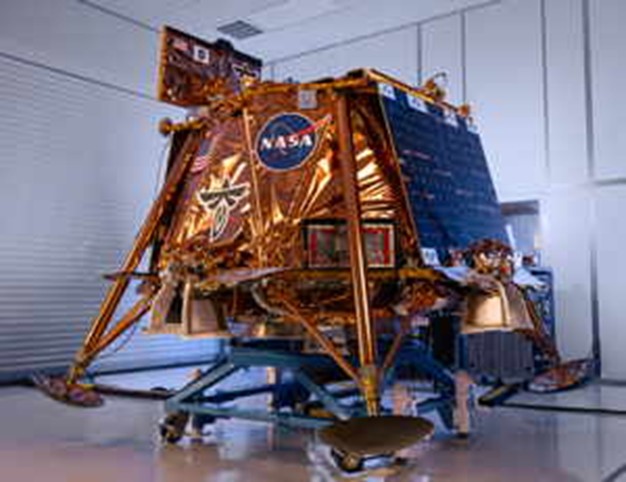
Inside the back section of Thursday’s newspaper was a USA Today article on the lunar lander that touched down early Sunday morning, March 2nd.  NASA’s Janet Petro said, “This incredible achievement demonstrates how NASA and American companies are leading the way in space exploration for the benefit of all.”  The Texas based Firefly Aerospace was hired by NASA to carry scientific instruments to the moon’s Earth-facing side to study its environment ahead of a manned return.  The 10 instruments will be used for lunar subsurface drilling, sample collection, X-ray imaging, and dust mitigation.  The craft has already sent striking images of the moon since it arrived in Lunar Orbit on February 10th.  Firefly has named this class of lunar lander the Blue Ghost.

When I looked online, I found the Firefly Aerospace Blue Ghost, or simply Blue Ghost, is a class of lunar landers designed and manufactured by the private American company Firefly Aerospace designed to deliver small payloads to the surface of the Moon.  The first Blue Ghost mission was launched January 15, 2025, at 1:11 a.m. EST and successfully landed on the Moon on March 2, 2025.  The landers are named after the firefly (Phausis reticulata) known as the Blue Ghost.  Firefly is the prime contractor for lunar delivery services using Blue Ghost landers which provide payload integration, launch from Earth, landing on the Moon, and mission operations.  Blue Ghost has four landing legs and is designed and built to be easily adapted to each customer’s needs between the earth and moon or in the moon’s orbit (cislunar).  Blue Ghost can be customized to support larger, more complex missions and is compatible with multiple launch providers. NASA awarded Firefly the first Blue Ghost lunar delivery task order in February 2021 as part of the Commercial Lunar Payload Services (CLPS) initiative.

The lander’s blue ghost namesake is a species of firefly found in the eastern and central US and is common in the southern Appalachians.  Adults are found in a variety of habitats, including dry and moist woods, near water, and along high, dry ridges.  The male of the beetle species is all-brown and about 0.2 to 0.4 inches (6 to 9 mm) long with large eyes.  The female is smaller, measuring 0.2 to 0.4 (4 to 9 mm) long.  Female blue ghosts are wingless, are yellow. and remain in larval form through adulthood (paedomorphic).  The females glow continuously from 4 to 9 spots on her body so they can be spotted by the males.  Once a female lays her clutch of 20 to 30 eggs, she guards them until she dies in one to two weeks.  The eggs hatch approximately 4 to 5 weeks after the mother dies. The larvae are extremely tiny, approximately 0.05 in (1 – 2 mm) and are bioluminescent.  Unlike many firefly species in the US, the blue ghost displays a steady glow rather than the typical flashing pattern.  The light emitted appears (to humans) as blueish-white when seen from a distance, but bright green when examined at close range.

THOUGHTS: The discrepancy in the observed color of the blue ghost is likely due to the Purkinje effect.  While the effect is often described from the perspective of the human eye, it occurs in other animals under the same name.  This effect describes the general shifting of spectral sensitivity due to pooling of rod and cone output signals as a part of dark/light adaptation.  The colors seen by different animals vary greatly depending on the makeup of those rod and cone features.  Humans seem to be in the middle of both color detection and acuity.  This is also true about our ability to make observations and gain understanding.  “Not like us” means different, not better or worse.  That is true for other animals and other humans.  Act for all.  Change is coming and it starts with you.

SMBH

September 26, 2024

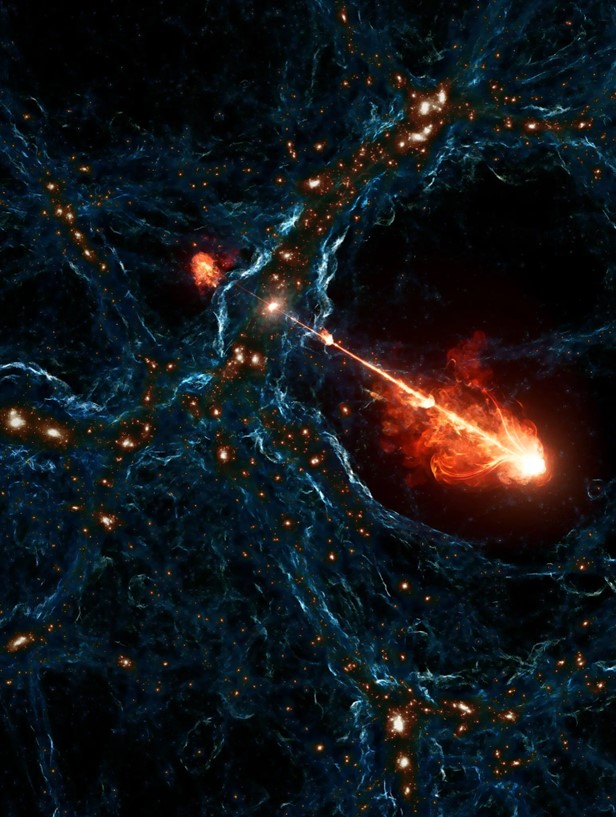
Today’s NY Times feed reported on the massive pair of jets releasing from a supermassive black hole (SMBH) 7.5 billion light-years from Earth.  The megastructure spans 23 million light-years in length, making these black hole jets the largest ever seen, according to new research.  While Black holes gobble up nearly everything that comes close to them, a fraction of material is ejected before an object falls in, forming a jet on either side of the black hole, said Martijn Oei, a postdoctoral scholar at the California Institute of Technology and the lead author of a new study describing the discovery published September 18 in the journal Nature.  The jets have a power output equivalent to trillions of suns and are so massive that researchers have nicknamed the megastructure Porphyrion after a giant from Greek mythology.  The discovery is causing astronomers to rethink their understanding of how massive black hole jets can be as well as how these giant features can affect their surroundings and the structure of the universe.  

When I looked online, I found a supermassive black hole (SMBH or SBH) is a black hole more than one hundred thousand times the mass of the Sun.  Solar mass (M☉) is a standard unit of mass used in astronomy equal to approximately 2×1030 kg, or the approximate mass of the Earth’s Sun.  It is often used to indicate the masses of other stars, as well as stellar clusters, nebulae, galaxies and black holes.  Black holes are a class of astronomical objects that have undergone gravitational collapse, leaving behind spheroidal regions of space from which nothing can escape, including light.  The discovery of SMBH was a consequence of the investigation of quasars in the mid-20th century.  Nearly every large galaxy has a SMBH at its center.  Active galactic nuclei, such as Seyfert galaxies and quasars, are powered by supermassive black holes.  The largest SMBH is in the galaxy cluster Abell 1201 and has a mass thirty billion times that of the Sun.  The SMBH at the center of the Milky Way Galaxy (Sagittarius A*) has a mass four million times that of the Sun.  Two supermassive black holes have been directly imaged by the Event Horizon Telescope: the black hole in the giant elliptical galaxy Messier 87 and Sagittarius A* at the Milky Way’s center.

When sustained for mega years, high-power jets from SMBH become the largest galaxy-made structures in the Universe.  “This pair is not just the size of a solar system, or a Milky Way; we are talking about 140 Milky Way diameters in total.  The Milky Way would be a little dot in these two giant eruptions” Oei said.  The structure consists of a northern lobe, a northern jet, a core, a southern jet with an inner hotspot, and a southern outer hotspot with a backflow.  This system demonstrates that jets can avoid destruction by magnetohydrodynamical instabilities over cosmological distances.  How jets can retain such long-lived coherence is unknown at present.  The haunting question is what Porphyrion is doing to the rest of the universe.  Cosmologists have found that the visible features of the universe are structured in a weblike manner, with galaxies clumped in giant clusters and connected by thin filaments that span dark voids of tens to hundreds of millions of light-years.  In Porphyrion’s day, this cosmic web was half the size it is now, and these jets would have been big enough to affect the overall web. 

THOUGHTS:  In total, the team spotted 10,000 new black hole jet pairs.  Like many discoveries, the researchers were not looking for jets from the SMBH but were trying to observe the cosmic web.  Research (and exploration) often mistakenly makes discoveries that expand our understanding of the universe, the Earth, and even humanity.  The quest for understanding is one aspect that (we think) sets humans apart from other animals.  Act for all.  Change is coming and it starts with you.