Variegated

November 05, 2025

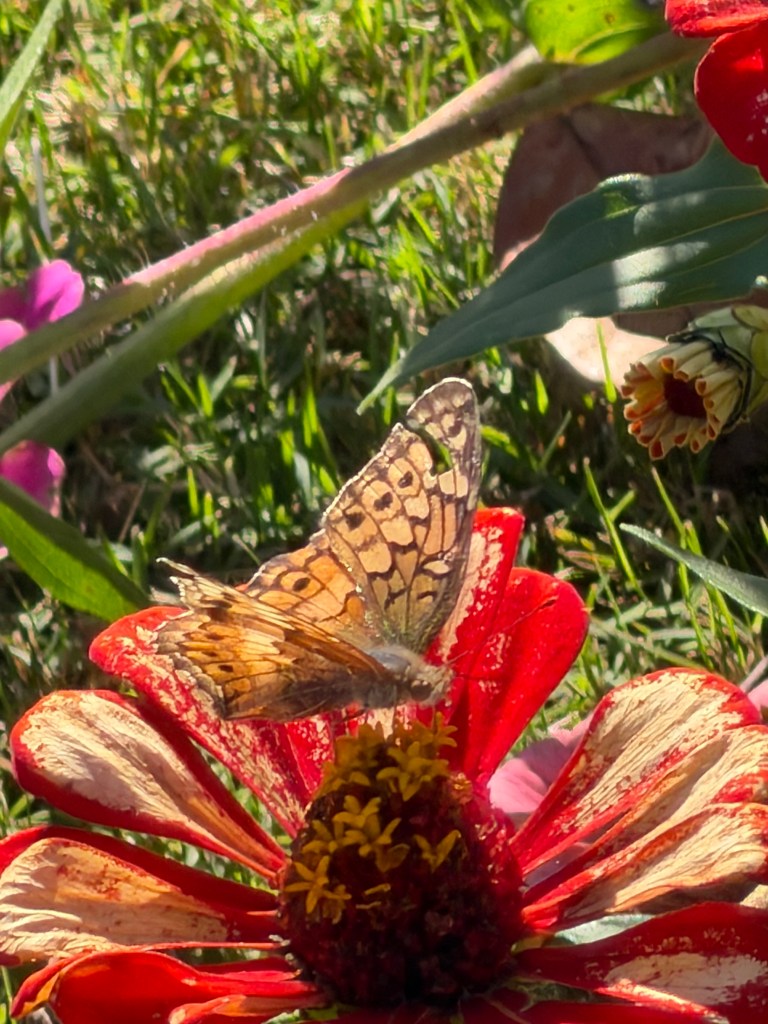
As Fall stretched into late October, I was amazed by the dozens of pollinators which still flocked to the wildflower bed in front of our house.  My guess is they are still stocking up for a flight south or survival during the long winter.  We have several coneflowers (family, Asteraceae) along with a proliferation of orange sulfur cosmos (Cosmos sulphureus).  Yesterday afternoon was bright, sunny, and in the mid-70 F’s (24 C’s) and they were still out in full force.  There were several late traveling monarch butterflies (Danaus plexippus) along with dozens of bumblebees (Genus, Bombus) flitting from flower to flower.  There was also a new arrival (at least I had not noticed) with several smaller brightly colored butterflies.  Two characteristics struck me about these Lepidoptera.  First was the speed they were traveling as they drew nectar from around the bed, the second was variegated wings.

When I went online, I found the variegated fritillary (Euptoieta claudia) is a North and South American butterfly in the family Nymphalidae.  The variegated flight is low and swift and even when collecting nectar, the species is extremely difficult to approach.  This has earned the genus name which taken from the Greek “euptoietos” meaning “easily scared”.  The wingspan of the adult variegated measures 1.75 to 2.25 inches (44 to 57 mm).  The upper side of the wings is checkered with orange and black, and both the fore and hind wings have a row of submarginal black spots and black median lines running across them.  The underside of the forewing is orange with a pale orange spot rimmed in black in the forewing cell.  The underside of the hindwing is mottled with browns and grays with a pale postmedian band.  The variegated fritillary has three very different characteristics that distinguish them from the genus of greater fritillaries (Speyeria fritillaries), but it is still closely related to them.  Variegated fritillaries have two or three broods per year (Speyeria one), are nomadic (Speyeria sedentary), and use a wide variety of host plants (Speyeria only violets). 

While the variegated fritillary is nomadic, it is not (officially) migratory like the monarch.  Instead, it overwinters in its caterpillar stage in the leaf litter, seeking shelter and entering a dormant state (diapause).  In warmer climates, adult butterflies may also overwinter.  In Arkansas the adults need to either migrate south or they will die (freeze).  Caterpillars can survive Arkansas’ winter temperatures and will emerge from their hibernation to form cocoons (pupate) in the spring.  The survival of the caterpillars (or adults farther South) depends on factors like predation, temperature, and the amount of insulation provided by leaf litter.  When weather conditions improve in the Spring the caterpillars emerge from their winter hibernation to continue their life cycle.  While I was planning on clearing the bed and scattering the seed, perhaps I should wait until new life emerges in Spring.

THOUGHTS: I can attest to the “euptoietos” nature of the variegated fritillary.  It took me 10 minutes for one to wait long enough on a flower to get a picture.  The butterflies would fly up to 30 feet (10 m) away and then dart back to seek out another flower or two before repeating the maneuver.  I find it interesting how different species have adapted to survival during the cold months of winter.  This also explains how a warm day can bring out a swam of flying insects as they emerge from their sheltered refuge.  Humans do not naturally go dormant (hibernate) because our bodies lack the necessary biological adaptations to enter a state of deep sleep with a significantly lower body temperature and metabolic rate.  The earliest evidence of controlled use of fire dates back at least 1.8 million years ago, but evidence for habitual or widespread use of fire does not become clear until around 400,000 years ago.  We rely on protective structure, clothes, or sources of heat to achieve what nature has given other species.  Act for all.  Change is coming and it starts with you.
Hornet

September 22, 2025

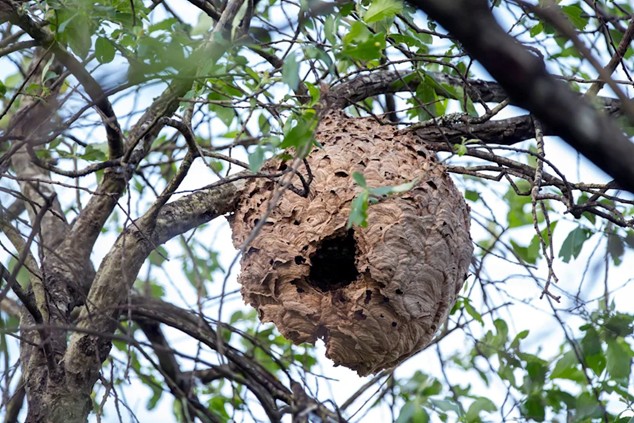
I found an article on yahoo!news about an innovative approach toward eradicating an invasive species in England.  British scientists are attaching miniature tracking devices to the invasive insects which allow teams to locate and destroy their hidden nests within an hour instead of several days.  Time is critical as the nest can reproduce within seven days.  Inspectors capture individuals near bait stations, secure hair-thin transmitters around their bodies, and follow them straight to their colonies.  According to The Guardian, Britain’s Animal and Plant Health Agency found 64 nests through August 2025, setting a seasonal record.  Public participation drives much of the success for the eradication program.  Citizens use the Asian Hornet Watch app to submit thousands of sightings and enabling rapid response teams to investigate reports near ports where the species often arrive hidden in shipments of wine, produce, or building materials.  The invasion started when a single Asian Hornet female likely arrived in France aboard a pottery shipment from China back in 2004.

When I went online, I found the Asian hornet (Vespa velutina), also known as the yellow-legged hornet, Asian predatory wasp, or murder hornet, is a species indigenous to Southeast Asia.  This is significantly smaller than the European hornet, with queens 1.2 inches (30 mm), males about 0.94 inches (24 mm), and workers about 0.79 inches (20 mm) in length.  The species has distinctive yellow legs (tarsi), a velvety brown or black mid-section (thorax), and a brown abdomen.  Each abdominal segment has a narrow posterior yellow border, except for an orange fourth segment.  The hornet has a black head and a yellow face.  The coloration of the species can vary regionally which causes difficulty in classification and resulted in several subspecies to have been identified and later rejected.  The most recent taxonomic revision of the genus treats all subspecific names in the genus Vespa as synonyms, effectively relegating them to no more than informal names for regional color forms.  The Asian hornet is an invasive species of concern in most of Europe.

The Guardian reported the Asian hornet feasts on honeybees (genus, Apis) and other pollinators that enable the production of approximately one-third of the crop humans consume.  A single colony of hornets consumes about 24 pounds (10.9 kg) of insects during one season, putting pressure on the bee populations already struggling with habitat loss.  Testing shows Britain has prevented permanent colonies from establishing, with only three of 24 nests last year originating from females that survived winter in England.  While government teams fight Asian hornets with high-tech solutions, homeowners can help in their own yards with intelligent landscaping choices.  Replacing portions of traditional lawns with native plants can create a refuge for local pollinators.  Native plants also demand less water and maintenance than non-native species, which cuts both utility bills and maintenance.  These plants support local bee populations naturally by providing the nectar and pollen sources these insects evolved to use.

THOUGHTS: The Asian hornet was declared eradicated by the US Department of Agriculture in December of 2024.  Eradicated means there has not been a sighting in three years.  Even without the threat of this hornet, we have taken two steps to assist pollinators in our yard.  The wildflower bed in the front draws both bees and butterflies while also providing cover from any predators.  The side yard has a bird bath that I fill every time I water the vegetables.  This has a half brick in the middle to allow bees to cling to the brick and take a drink.  It took little effort for either of these features and the result has provided food and water for countless pollinators.  Act for all.  Change is coming and it starts with you.
Crayfish

September 10, 2025

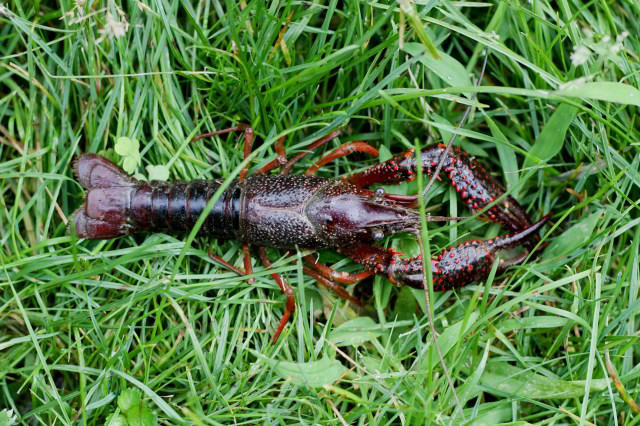
An article in my MSN browser referenced a report published by the Michigan State University Extension by Michigan Sea Grant (MSG).  MSG is a cooperative program focused on conservation and use of resources in the Great Lakes.  The Grant makes the case that foraging could help reduce the negative impact of invasive species on the environment and perhaps prevent the need for harmful chemical methods of pest control.  Plants and animals introduced to new areas often become problems to the ecosystem by outcompeting native species that keep things balanced.  One study found invasives cause nearly US$20 billion in damage in the US every year, with agriculture being the most severely impacted sector.  One solution comes from programs to bring these species to our menus.  Some restaurants have been introducing wild boar to Americans with the help of their providers and with the inspection facilities of the Department of Agriculture to ensure the safety of the product.  MSG calls out red swamp crayfish for their aggressiveness and role in potentially spreading disease and parasites to other creatures but also notes they are a delicious component in recipes such as gumbo and bisque.

When I went online, I found the red swamp crayfish (Procambarus clarkii), also called the Louisiana crawfish or mudbug, is a species of the cambarid family of crayfish native to freshwater bodies of northern Mexico, and southern and southeastern US.  It has also been introduced elsewhere in both North America and other continents where it is often an invasive pest.  The red swamp is typically dark red, with long claws and head, small or no spines on the sides of its upper section of the shell (carapace) just below the head, and rows of bright red bumps on the front and side of the first leg.  The native range is from northern Mexico and far southeastern New Mexico, through the Gulf States to the Florida Panhandle, as well as inland north through the Mississippi Basin to southern Illinois.  It has also been introduced outside its natural range to countries in Asia, Africa, Europe, and the Americas.  Individuals are reported to cross many miles of relatively dry ground, especially in wet seasons, although the aquarium trade and anglers may have hastened the spread in some areas.

The red swamp crayfish is eaten in China, Cambodia, Thailand, Europe, Africa, the US, Canada, Australia, New Zealand, and the Caribbean.  In the US, crayfish are particularly popular in Louisiana, where crawfish boils are popular social gatherings centered around eating the crustaceans.  Louisiana crawfish are usually boiled in a large pot with heavy seasoning (salt, cayenne pepper, lemon, garlic, bay leaf, etc. – I usually use Old Bay Crawfish Boil) along with items such as potatoes and corn on the cob.  In 1990, Louisiana produced 90% of the crayfish in the world and consumed 70% locally.  As early as 2003, Asian fish farms and fisheries produced more and continued to outpace production in any other part of the world.  By 2018, crayfish production in the Americas represented just 4% of total global supply and 93% of the US crayfish farms were in Louisiana. 

THOUGHTS: As a boy in Kansas, I would use a seine to catch the abundant crayfish to use as an inexpensive fish bait.  I never considered these crustaceans more than bait until I went to the Crawdad Festival in Isleton, California.  The red swamp crayfish has invaded the California waters and the three native species of crayfish (sooty crayfish – Pacifastacus nigrescens, Pilose crayfish – Pacufastacys gambelii, and Shasta crayfish – Pacifastacus fortis) have nearly disappeared.  Isleton is in the Sacramento delta and was forced to fly in mudbugs from Louisiana.  Crayfish is an acquired taste but once I got beyond the bait aspect, I found I loved them.  “Pinch the tail and suck the heads!”  Act for all.  Change is coming and it starts with you.
Wildflower Bed

July 07, 2025

Five years ago, I blogged about my stint as director of a conference center in Kansas.  The camp was located on 63 acres (25.5 ha) of mixed trees and (originally) prairie grass that was now mostly seeded with Bermuda grass (Cynodon dactylon) for lawns.  During the summer we spent 5 to 6 days a week on the mower cutting grass.  Part of our mission was to provide opportunities for education, so I decided to let the prairie grass return.  The first year we let most of the camp return to natural grass to evaluate where the prairie grass was still abundant.  The second year we selected about 12 acres (4.5 ha) to return to native prairie.  We also reseeded those acres with the Big Five grasses prominent in the Tall Grass Prairie that used to dominate Kansas.  This provided lawn for camp activities and nature trails with identification signage for eco-visitors.  To complete the prairie’s restoration, we seeded a variety of prairie wildflowers in prominent locations along the roads.  Being on the flyway of the Monarch butterfly, I transplanted 20 milkweeds (Asclepias syriacaplants) from the lawns into a wildflower bed near the entrance of the camp.

When I went online, I found a wildflower is a flower that grows in the wild, rather than being intentionally seeded or planted.  The term implies that the plant is neither a hybrid nor a selected cultivar that is any different from the native plant, even if it is growing where it would not naturally be found.  This can refer to the whole plant, even when not in bloom, and not just the flower.  The term “Wildflower” is imprecise, and more exact terms refer to specific types of flowers including native species naturally occurring in the area, exotic or introduced species not native to the area, invasive species that outcompete other plants (introduced deliberately or accidentally), and plants that have become naturalized (imported but considered native by the public).  Wildflowers can be annual (germinates from seed, live one year), perennial (live multiple years, return each growing season), or biennial (two-year life cycle, blooming in the second year).  In recent years, wildflower gardening has gained popularity.  A planted wildflower bed not only looks attractive but has the advantage of supporting pollinators, reducing maintenance, and conserving water. 

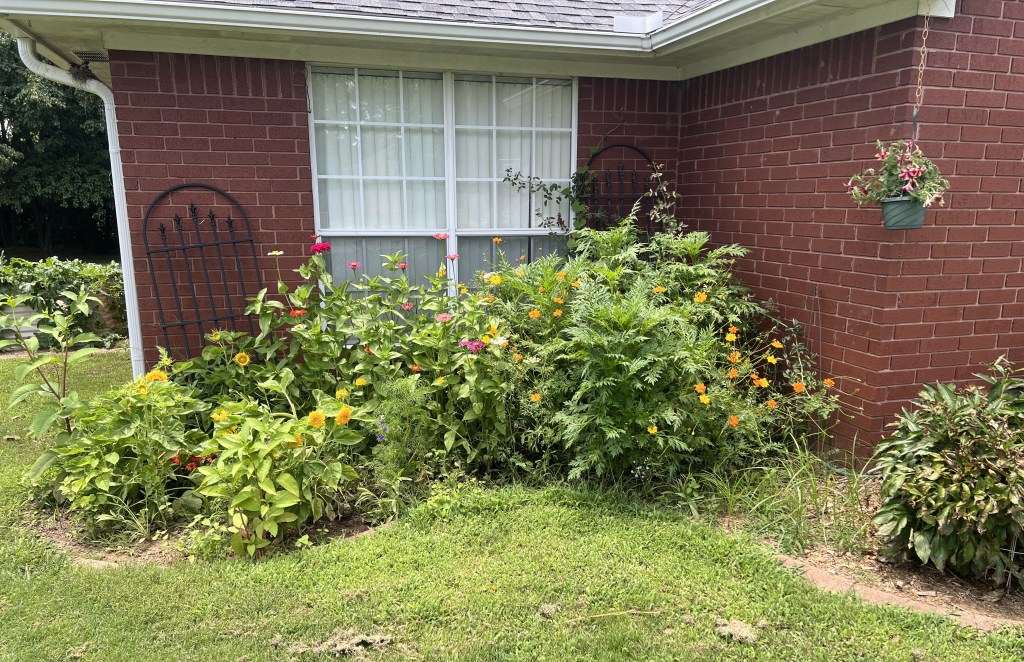
I wanted to duplicate my conference center experience when we moved to Arkansas, but I could never decide where to plant the wildflowers.  Melissa’s mom established several flower beds that I thought Melissa wanted me to maintain.  Melissa likes the look of a green lawn and symmetrical flower beds more than the asymmetrical look of a wildflower bed.  I was also interested in expanding my garden into the front beds to replace the roses neither of us liked.  Indecision meant we did nothing for five years.  Last year we did decide to place wildflowers in one of the beds in front of the house but never got around to doing so.  When Melissa retired this year, she decided she would plant a wildflower bed.  We sprayed to kill all the grass that had taken over the beds, spaded the soil and weeded the bed to prepare it, Melissa sowed the seed, and then we waited.  The first thing that grew was more grass and weeds, so I weeded the bed again.  The wildflowers finally began to grow.  Now we have a wildflower bed in the front of the house.

THOUGHTS: One of the problems with weeding the wildflower bed was knowing what to pull and what to leave.  Removing the grass was obvious, but how do you tell the difference between the wildflowers Melissa planted and the weeds that grew naturally?  In essence, all wildflowers are weeds if they are intruding in the vegetables or “planted” flowers.  I decided to leave any plants I could not identify.  If it grew a flower it was supposed to be there, whether Melissa sowed the seed or not.  The same could be said for people.  If they flourish in a new location they are meant to be there, no matter how they arrive.  Act for all.  Change is coming and it starts with you.