House Finch

November 05, 2024

Melissa received a window box bird feeder as a gift from our son and family earlier this year. The feeder has suction cups on the back that allow it to attach directly to the glass. I placed the feeder in the bay window in the breakfast nook that serves as her home office so she can enjoy the bird activity while working. I fill the two sections of the feeder with different seeds to make it more attractive to the small birds willing to approach the window. One side has always had black sunflower seed (Helianthus annuus). I have varied the seed on the other side, but it currently has cracked safflower seed (Carthamus tinctorius). This feeder has become a preference for the eastern bluebirds (Sialia sialis), the sparrows (Genus, Zonotrichia), and purple finches (Haemorhous purpureus) that frequent our back yard. On Sunday I noticed what seemed to be a new species at the feeder. This was similar to the finches I have been watching but somehow seemed different. When I checked my bird ID this turned out to be a house finch.

When I looked online, I found the house finch (Haemorhous mexicanus) is a North American bird in the finch family. The species is native to Mexico and southwestern US but has been introduced to the eastern part of North America and Hawaii and is now found year-round throughout the US and most of Mexico. The house finch is a moderate-sized bird at 5 to 6 inches (12.5 to 15 cm) long, with a wingspan of 8 to 10 inches (20 to 25 cm). Body mass can vary from 9⁄16 to 15⁄16 ounces (16 to 27 g) with an average weight of 3⁄4 ounces (21 g). Adults have a long, square-tipped brown tail and are a brown or dull-brown color across the back with some shading into deep gray on the wing feathers. Breast and belly feathers may be streaked, and the flanks usually are. Most adult males have reddish heads, necks, and shoulders, and the color can extend to the belly and down the back as well. Male coloration varies in intensity with the seasons as it is derived from a diet of berries and fruits. Adult females have brown upperparts and streaked underparts. There are around 40 million house finches across North America, making it the second-most populous finch behind the American goldfinch.

The house finch and purple finch are closely related species and can be hard to identify. The main difference between the two species is the amount of red on the bird and the pattern on the face. They have similar body shapes, but the bill of the purple finch is a bit bigger, more conical, and deeper, while that of the House Finch has a more rounded shape. Both species get along with other small birds except during breeding season when they become protective of their territory. The other big difference comes with habitat. The house finch prefers a wide range of arid, open, and semi-open habitats, and will live in oak-juniper woodlands, open coniferous forests, and shrubby, and desert habitats from sea level to more than 11,000 feet, the house finch avoids dense forest of the purple finch. A small flock of house finch in Long Island, NY, escaped captivity in 1939 and has become the common bird of the eastern US and southern Canada. Their population has grown and expanded to millions of birds that thrive in urban and suburban places, preferring parks and urban settings with conifers and ornamental trees. Their songs are similar, but the purple finch sings a more melodious and “warbling” song, while the house finch incorporates chattering and trilled sounds.

THOUGHTS: Another similarity between the house finch and purple finch is they are both attracted to bird feeders. This explains why I have seen both species (and probably not realized it until now) in our backyard. Neither species is rare, but the house seems more urban and the purple more forest. Nature tells us that when the same species spend enough time separated and/or refusing to interact they grow apart and eventually become distinct. While humans have not yet reached that point as a species, it is a good lesson to be learned. Act for all. Change is coming and it starts with you.
Beetle

October 30, 2024

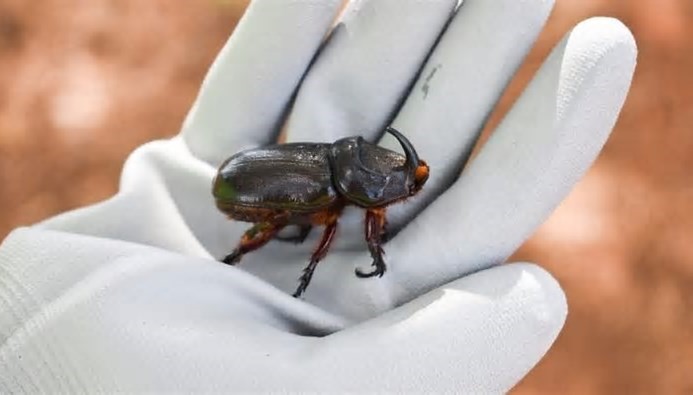
Hidden in the back of the front section in yesterday’s newspaper was a USA Today article about Hawaii’s attempts to stop an invasive insect.  According to the Hawaii Invasive Species Council, the invader “jeopardizes the economy, the entire ecosystem, agriculture and food security.”  This species feeds by biting and boring into emerging palm fronds, creating holes in the top of the tree.  While they prefer to feed on coconut, royal, date, and fan palms, they will also feed on hala, taro, banana, pineapple, and sugarcane if the palm trees are unavailable.  The insects are nocturnal and can fly up to two miles if they are looking for food.  The insect attacks a palm at the base of the fronds (leaves) where they are attached to the trunk, bore through the base of the fronds into the center of the crown (the palm heart), and feed on the undeveloped white fronds.  Attacks cause a reduction in leaf area on the damaged fronds and results in a reduction in the number of nuts produced.  Newly planted palms can have their growth point destroyed resulting in the palms death and even mature palms may die after extremely heavy attacks by the coconut rhinoceros beetle.

When I looked online, I found the coconut rhinoceros beetle (Oryctes rhinoceros), also known as Asiatic rhinoceros beetle, is a large species of beetle belonging to the subfamily Dynastinae.  This dynastid beetle has a length of 1.4 to 2 inches (3.5 to 5 cm) and is a dark brown to black color.  The head has a horn which is more prominently developed in males and in larger specimens. The first segment of the thorax (pronotum) has a large central depression with two humps at the hind margin and the tibia of the foreleg has three large teeth.  Male beetles can be reliably distinguished from females as the tip of the abdomen is rounded, shiny, and hairless.  In females the tip is more pointed and densely covered with hair.  The larvae are C-shaped white grubs typical of other scarab beetles.  The beetle breeds in decaying palm trunks or other organic matter (sawdust or compost heaps).  The native distribution of this beetle covers most parts of tropical Asia, but human activity accidentally introduced the beetle to a large number of tropical islands throughout the Pacific.   The beetle has most recently invaded Guam, Hawaii, the Solomon Islands, and Vanuatu.

A virus disease of coconut rhinoceros beetle (Oryctes rhinoceros nudivirus) has turned out to be the most effective natural control agent.  This virus was discovered by Alois Huger in Malaysia in 1963 and was later found to occur naturally in other countries within the native range of the beetle.  The introduced beetle populations in the Pacific and in the Maldives were found to be virus-free.  The virus was introduced into the virus-free populations and caused a significant decline in the beetle population.  The virus mainly effects the adult population and spreads easily, reducing their life span and the fertility of females.  During replanting of palms more breeding sites become available and transmission of the virus is often interrupted, and outbreaks still occur.  There is also evidence of resistance to the virus in some coconut rhinoceros beetle populations.  A fungus (Metarhizium majus) is also effective in controlling the beetles in breeding sites, but it does not spread well by itself.  The fungus does have the advantage that it survives for some time outside its host (as conidia).

THOUGHTS: Use of a virus to control the coconut rhinoceros beetle population is common, and natural biological controls include predators, parasitoids, pathogens, and competitors.  Biological control can have side-effects on biodiversity through attacks on non-target species by any of these mechanisms, especially when a new species is introduced without an understanding of the possible consequences.  Viruses being transmitted to other species (and humans) may cause greater harm than the original problem.  Alexander Pope’s proverbial phrase in 1711 was, “To err is human”.  Even without forgiveness, this is more than an adage.  Act for all.  Change is coming and it starts with you.
Tiger Moth

October 22, 2024

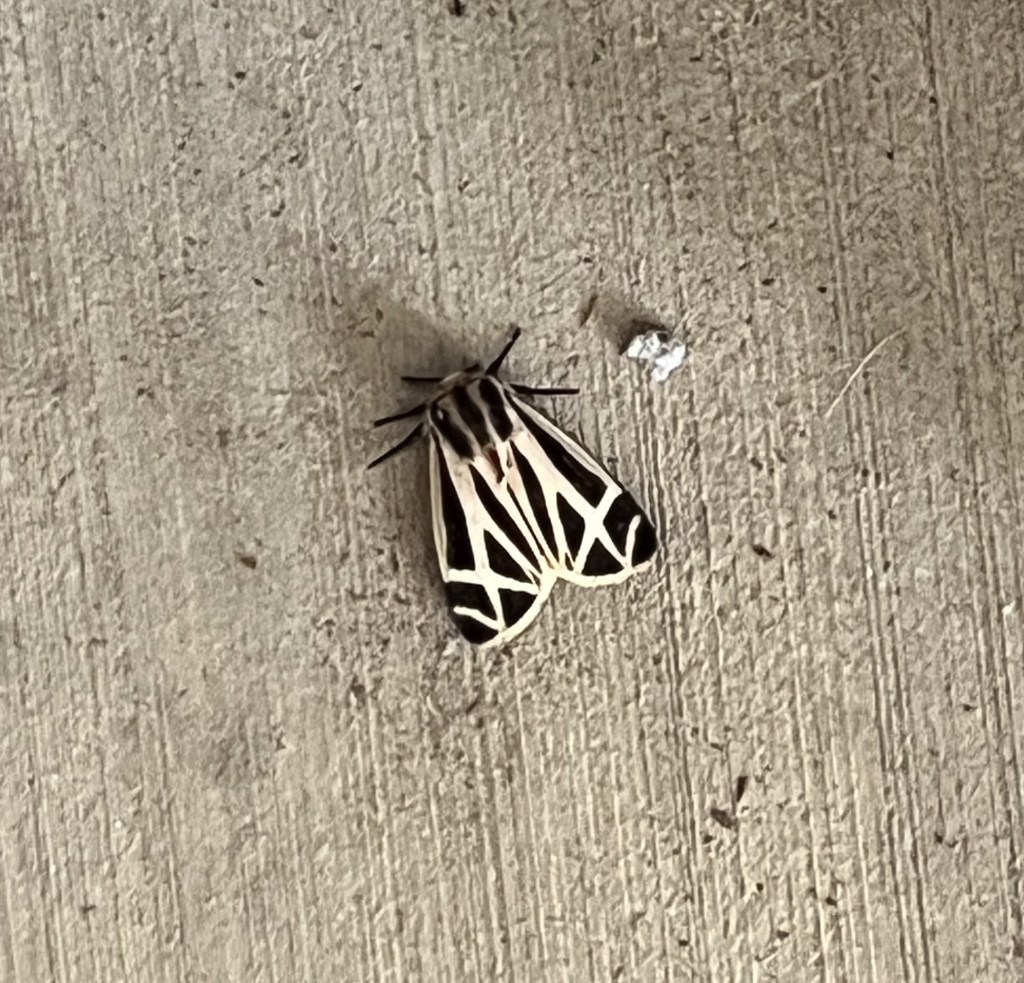
Our enclosed porch serves as a greenhouse for both Melissa’s succulents and a rack during late winter for my vegetable seedlings.  The area is also used to store Melissa’s supplies and the seeds I use to feed the birds.  When I started feeding birds several years ago, I set the bags on the floor.  This worked for several months, but as the weather got colder the rodents that thrived in the tall grass of the lot behind our house were more intent on seeking food and shelter.  While I never saw a house mouse (Mus musculus) or brown rat (Rattus norvegicus), I did have several instances of “something” chewing through the seed bags and spilling the contents onto the floor.  I now have a large 20 gallon (76 l) tub for the larger bags and 3 smaller 5 gallon (15 l) buckets to hold the daily dispersal.  The containers are large enough to contain the seed and have a lid which keeps out the (hopefully) mice.  While cleaning behind the “supplies” behind the feed buckets I found more evidence of mice, but again no actual critters.  What I did find beneath several of the buckets was a brightly colored moth.  When I checked my phone identification it said this was a harnessed tiger moth.

When I looked online, I found the harnessed tiger moth (Apantesis phalerata) is a species of moth within the Erebidae family, first described by Thaddeus William Harris in 1841.  The harnessed tiger moth’s subfamily (Arctiinae) has about 11,000 species of tiger moths divided globally across three tribes.  The harnessed tiger moth is indigenous to North America, with a geographical distribution from Ontario, Quebec, and Maine in the north, to the west in South Dakota, and stretching south to Florida and Texas.  The adult moth has a wingspan ranging from 1.2 to 1.7 inches (30 to 42 mm), and their distinctive black and orange wing patterns earned them the name “tiger” moth.  The tiger moth has a grooved exoskeletal structure (tymbals) on the posterior three segments of the thorax (metathorax) which they use to produce high frequency cicada (superfamily, Cicadoidea) like clicks.  The clicks are a defensive mechanism against predation and for communication during mating.  The lifespan of a harnessed tiger moth ranges from 5 to 10 days after mating.  The moth’s activity period varies regionally, being active from April to September in the southern parts of its range, and from May to August in the northern areas.  My tiger moth was active (at least alive) in mid-October. 

The harnessed tiger moth uses its vibrant colors to serve as a visual deterrent, signaling to potential predators that they are distasteful.  Despite their warning colors, harnessed tiger moths are preyed upon by bats, which rely on echolocation (not sight) to hunt.  This tiger moth is not poisonous, but adults do secrete a liquid to ward off predators that can cause allergic reactions in humans.  The furry body of the caterpillar can also cause rashes and irritation if touched with bare hands.  There are many spiritual meanings attached to the various species of tiger moth and different types of tiger moths hold different gravity in various cultures worldwide.  White-colored tiger moths are seen as a sign of peace and innocence as white is often considered the color of peace. 

THOUGHTS: Two common spiritual meanings are attached to all tiger moth species around their attraction to light.  Some believe spotting a tiger moth is an indication that the person must leave the dark and start embracing the light in their soul.  For other cultures this is a warning that means not to be easily lured by charming deals or things and think rationally before making decisions.  Human decisions are fraught with a similar dichotomy of good and bad.  Roman Emperor Marcus Aurelius, in his Meditations said, “You have power over your mind – not outside events.”  Nietzsche takes the same perspective, affirming the agency of the individual goes beyond good and evil and declares what is “good” and “bad” by what is serving and hindering their own goals.  There are not absolutes, only your reaction to events.  Act for all.  Change is coming and it starts with you.

Habitat

October 03, 2024

Melissa and I have been trying to revamp the furniture in our living room since the day we moved into her house in Arkansas.  Knowing we had a house full of furniture in Arkansas, we donated most of our furniture to the Conference Center where I had been working.  While our Kansas furniture was in good shape, it was the first furniture I purchased 20 years earlier and I was ready for a change.  When we moved to Arkansas the furniture was not much newer and was a style neither of us liked.  We tried buying an inexpensive living room set two years ago, but it turned out to be inexpensive.  Over the weekend Melissa visited a friend in northwest Arkansas and was impressed with the style and utility of the furniture she had.  Needless to say, we went shopping over the weekend and came away with a sofa and chair as a replacement.  That left one question, what are we going to do with the items we no longer need?  We decided on repurpose by donating to Habitat for Humanity.

When I looked online, I found Habitat for Humanity International, also referred to as Habitat for Humanity or Habitat, is a US non-governmental, and tax-exempt 501(C)(3) Christian nonprofit which seeks to build affordable housing.  It was founded in 1976 by Millard and Linda Fuller.  The operational headquarters are located in Americus, Georgia, and the administrative headquarters are located in Atlanta.  In 2023, Habitat for Humanity operated in more than 70 countries and works to help build and improve homes for low-income or disadvantaged families.  Homes are built using volunteer labor, including the practice of sweat equity from the future homeowners, along with paid contractors for certain construction or infrastructure activities.  Habitat makes no profit from the home sales and instead operates with financial support from individuals, philanthropic foundations, corporations, government entities, and mass media companies.  While Melissa and I have worked on several houses, it is probably better known that President Jimmy Carter and Rosaland worked many more volunteer hours building Habitat houses.

Along with building houses, Habitat ReStores accept small and large donations of new or gently used furniture, appliances, housewares, and building materials.  The sale proceeds then help Habitat’s work in the local community and around the world.  Items can be donated in person, and many Habitat ReStores offer free pickup of large items.  We were able to donate 2 sofas, 1 recliner, and a love seat to our local ReStore.  I made an appointment, and they picked up the items this morning.  Unfortunately, 1 recliner did not make the cut (worn).  The EPA estimates that 9 million tons of furniture are tossed every single year, or roughly 5% of everything brought to landfills.  Most of the furniture going to the land fill was made within the last 10 to 15 years, according to Ashlee Piper, sustainability expert and author.  Part of the problem is that today’s fast furniture is more challenging to repair because of its materials.  Unlike grandma’s, these pieces are not meant to last a lifetime.

THOUGHTS:  While in Berkeley I was living across the street from the Cal dorms.  The students obviously did not know about Habitat and each spring term as they were kicked out for the summer their fast furniture ended up in my building’s dumpster, allowing me to upgrade every year.  The price or where the item of furniture was made can be a red flag for new items.  Shopping locally can increase your odds of something being made with a thoughtful production process, rather than something where the emphasis is put on producing goods as cheaply as possible.  There are often good finds in secondhand stores (like Habitat) that with some minor repairs or refurbishing will make the piece feel fresh.  We are not all blessed with an overflowing dumpster.  Act for all.  Change is coming and it starts with you.
Sea Robins

September 30, 2024

David Kingsley, the Rudy J. and Daphne Donohue Munzer Professor in the department of developmental biology at Stanford University’s School of Medicine, first came across an odd looking fish in 2016 when he stopped into a small public aquarium in Woods Hole, Massachusetts.  “The fish on display completely spun my head around because they had the body of a fish, the wings of a bird, and multiple legs like a crab,” Kingsley said.  Kingsley and his colleagues decided to study the fish in the lab and found differences between the sea robin species and the genetics responsible for their unusual traits.  The findings of the study team’s new research show how evolution leads to complex adaptations in specific environments, such as the ability of sea robins to be able to “taste” prey using their highly sensitive appendages.  According to their research, some types of the bottom-dwelling ocean fish use taste bud-covered legs to sense and dig up prey along the seafloor.  Sea robins are so adept at rooting out prey on the ocean floor with their leglike appendages that other fish follow them around hoping to snag some of the freshly uncovered prey themselves.

When I looked online, I found sea robins (order, Triglidae), commonly known as gurnards, are a family of bottom-feeding scorpaeniform ray-finned fish.  Triglidae is one of the five largest orders of bony fishes and is divided into 3 subfamilies and 8 genera that include 125 species distributed in temperate and tropical seas worldwide.  Most species are around 12 to 16 inches (30 to 40 cm) in length with the females typically being larger than the males.  They have an unusually solid skull, and many species possess armored plates on their bodies.  Another distinctive feature is the presence of a “drumming muscle” that makes sounds by beating against the swim bladder.  Sea robins have three “walking rays” on each side of their body that are derived from the supportive structures in the pectoral fins (fin-rays).  During development, the fin-rays separate from the rest of the pectoral fin and develop into walking rays.  These walking rays have specialized muscle divisions and unique anatomy that differ from typical fin-rays to allow them to be used as supportive structures during underwater locomotion.  The rays are used for locomotion and prey detection on the seafloor via tasting (chemoreception) and are highly sensitive to the amino acids in marine invertebrates.

While all sea robins have leglike appendages, only some have the macroscopic sensory organs that allow them to taste the environment.  Research revealed digging sea robins depend on a regulatory gene called tbx3a not only to develop their specialized fin adaptations but also to form the papillae that cause them to dig. Tbx3 also plays a role in limb development in humans, chickens, mice, and other fish species.  The fish grew legs using the same genes that contribute to the growth of our limbs and then repurposed these legs to find prey using the same genes our tongues use to taste food.  Sea robins stand out among other walking fishes because their pectoral fins (walking fin rays) are highly jointed and their skeletal and muscular anatomy showcase unique modifications that enable the sea robins to walk. 

THOUGHTS:  Sea robins have firm white flesh that holds together in cooking, making them well-suited to soups and stews such as the French bouillabaisse.  They were often caught in British waters as a bycatch and discarded, but as other species became less sustainable and more expensive, they became more popular.  Sea robins (gurnards) are used as bait by lobster fishers but are also now appearing in fish markets in the US.  As desirable species are overfished or become scarce humans turn to the “next one up” to meet our food needs.  We need to find ways to make fishing sustainable, or even the rough (trash) fish will be in short supply.  Act for all.  Change is coming and it starts with you.
Moo Deng

September 28, 2024

Moo Deng is a pygmy hippopotamus living in Khao Kheow Open Zoo in Si Racha, Chonburi province, Thailand, born on 10 July 2024.  Her name was chosen through a public poll with over 20,000 people voting for “Moo Deng”, translating to “bouncy pig”.  The zoo posted images of her on its Facebook page and Moo Deng quickly became a fan favorite for her playful and energetic romps.  Her popularity led the zoo to sell clothing and other merchandise featuring designs based on her likeness.  Other companies produced merchandise, including a cake shop (Vetmon Café) which created a realistic cake shaped like her.  Moo Deng’s viral popularity resulted in a doubling of daily visitors in early September.  The zoo is in the process of copyrighting and trademarking “Moo Deng the hippo” to raise funds for the zoo and plans to launch a livestream to allow fans to watch Moo Deng over the Internet.

When I looked online, I found Moo Deng is a pygmy hippopotamus (Choeropsis liberiensis) or pygmy hippo, a small hippopotamid native to the forests and swamps of West Africa.  The pygmy is one of only two extant species in the family Hippopotamidae, the other being the larger common or Nile hippopotamus (Hippopotamus amphibius).  The pygmy hippo was unknown outside West Africa until the 19th century and is a reclusive and nocturnal forest creature difficult to study in the wild.  Like the common hippo, the pygmy hippo displays terrestrial adaptations but is semiaquatic and relies on water to keep its skin moist and its body temperature cool.  Mating and birth may occur in water or on land.  The pygmy is herbivorous and feeds on ferns, broad-leaved plants, grasses, and fruits it finds in the forests.  Current pygmy populations are primarily in Liberia, with small groups in Sierra Leone, Guinea, and Ivory Coast.  It has been extirpated (eradicated) from Nigeria.  Pygmy hippos are primarily threatened by loss of habitat, as forests are logged and converted to farmland.  The Pygmy are also vulnerable to poaching, hunting for bushmeat, natural predators, war, and are illegally hunted for food in Liberia.  The species breed well in captivity and the vast majority of research is derived from zoo specimens.  A 2015 assessment by the International Union for Conservation of Nature estimated that fewer than 2,500 pygmy hippos remain in the wild.

As a viral sensation Moo Deng has prompted a makeup trend popular with beauty influencers.  Moo Deng makeup is in line with what beauty enthusiasts look for, super dewy skin and lots of blush.  The trend is perfect for fall as the skin will be hydrated and glass-like as the drier months approach.  The trend started with influencers trying to recreate her iconic look by achieving the baby pygmy’s glass-like skin with the prettiest shade of blush.  Before applying makeup, you need to ensure the base is nice and dewy to capture the baby hippo’s glistening skin.  The trend incorporates lots of grey hues to represent Moo Deng’s skin color.  An element common among influencers’ is the heavily flushed cheeks.  Any blush shade will do, as long as it has a great color payoff.  Grey eyeshadow or lip gloss, followed by a particular shade of blush create the final makeup look.

THOUGHTS:  While Moo Deng may create viral views, sales, and makeup, she is at risk.  Some visitors harassed Moo Deng by splashing her with water and throwing objects to wake her up, forcing the zoo to install security cameras around her enclosure.  The zoo also implemented a 5-minute time limit for visitors to accommodate the high volume of visitors.  While most marvel at the wonder of nature, there are others who find pleasure in destruction.  Whether it is throwing objects at Moo Deng or toppling 100,000 year old rock formations the seconds of fame being sought are not worth the cost.  “Influence” comes with responsibility.  Act for all.  Change is coming and it starts with you.
Euphorbia Ingens

September 27, 2024

Melissa was working on her succulents over the weekend and called me out to see what was going on with her plants.  We had placed two tables in the flower bed on the north side of the house that we have yet to figure out what to do with.  Melissa decided in the short run this would be a good place to put some of her hardier cacti to take advantage of the outside.  Although these plants are visible through the porch windows, Melissa does not get out to physically check on them more than once a week.  As with most cacti and succulents, a good rule of thumb is to leave them alone and let them thrive on their own.  One of the plants has been growing particularly well over the last two years and is over 3 feet (1 m) tall.  The third section of the plant had developed greenish-yellow buds along its ridges which appeared to be ready to bloom.  When I asked, she told me this was a Euphorbia ingens (I sometimes think she uses the scientific names just to throw me off).   

When I looked online, I found the candelabra tree (Euphorbia ingens), or naboom, is a species of flowering plant in the family Euphorbiaceae native to dry and semi-savanna areas of southern Africa.  This tree is a tall succulent with green round-like branches resembling a balloon that grows to 19.5 to 26 feet (6 to 8m) tall.  The trunk of the candelabra is thick, and the stems have 5 ridges each and are 1-1/3 to 3 inches (3.5 to 7.5 cm) thick.  The segmented stems are dark-green and young sprouts have paired spines 3/16 to 5/64 inches (0.5 to 2 mm) long.  The plant blooms from autumn to winter and the small greenish yellow flowers sit on the ridges of the topmost segment.  A red, round, three-lobed capsule fruit turns purple when ripe.  The plant’s flowers are attractive for butterflies, bees and other insects, which pollinate them when gathering pollen and nectar.  The seeds are edible for birds, who also like to make their nests in the branches of these trees.  The light and solid wood of the main trunk is used in door, plank, and boat production.  The milky latex sap of the tree is highly poisonous and can cause blindness, severe skin irritation, and poisoning (when ingested) in humans and other animals.  The plant has few pests due to the toxic sap.

Euphorbia ingens grows well both indoors and outdoors and has become a popular choice for rock gardens and indoor houseplant collections due to its stately appearance and low maintenance.  In their natural environment, these succulents can grow up to 40 feet (12 m) tall, but they usually top out around 8 to 10 feet (2.5 to 3 m) tall when grown indoors.  Still, even this would take a high ceiling to accommodate a mature plant.  When grown indoors or in containers, it is extremely uncommon for this species of euphorbia to produce blooms.  Since Melissa’s plant has budded, we are waiting to see if it will break into full bloom.

THOUGHTS:  The buds on the Euphorbia ingens are only the latest of Melissa’s accomplishments.  Over the last two years she has repeatedly shown me the flowers that have bloomed on many of the succulents and cacti that are under her care.  In my case, with the exception of the ground cherry (Physalis angulate) that I did not plant and the red burgundy okra (Abelmoschus esculentus) I do not like to eat, I have often struggled with production of my plants (pole beans are another exception).  Melissa’s mom was a prolific gardener whose secret was to spend hours tending her flowers.  The same it true with Melissa who spends hours with her succulents.  I am willing to plant, water, and harvest.  Perhaps there is a lesson there.  When we are willing to put in the work, we can achieve most tasks.  That is true for gardening.  That is also true for creating positive human interaction.  Do the work.  Act for all.  Change is coming and it starts with you.

Leopard Darters

September 25, 2024

Last week the Arkansas Game and Fish Commission (AFGC) released 80 leopard darters into the wild with the help of state and federal partners along with Conservation Fisheries LLC, a private hatchery specializing in propagating rare and threatened species.  According to Chance Garrett, fish ecologist for the AGFC, this release is the first of two scheduled for the Cossatot River in western Arkansas this year and is the first historical reintroduction effort of leopard darters anywhere.  The fish were grown from broodstock taken from the Mountain Fork River which flows from Arkansas into Oklahoma.  Another 250 fish are planned for release in early October.  Garrett said, “They originally thought it was only found in Oklahoma, but some populations were found in the Rolling Fork and Cossatot after its listing.  Those two populations are thought to no longer exist, so this effort to re-establish them is extremely important.”  This is the second year of the project, but the first year saw a low survival rate as the hatchery and were added to the broodstock rather than being released.  The leopard darters measured and an inch or two (2.5 to 5 cm) at stocking size and were transported from the hatchery to their destination in one day.

When I looked online, I found leopard darters (Percina pantherina) are a species of freshwater ray-finned fish, from the subfamily Etheostomatinae.  The family (Percidae) also contains the perches (Genus, Perca), ruffes (Gymnocephalus cernua), and pikeperches (Genus, Sander).  The species is native to the US and is only be found in the Little River drainage in Oklahoma and Arkansas.  A typical habitat is medium to large streams with rubble and boulder substrate.  The leopard darter feeds on small invertebrates on the riverbed and spawns in March and April.  Adults rarely exceed 3 inches (8 cm) in length and have 11 to 14 large, dark spots on their sides, which contrast against a light background that ranges from pale olive on the back to yellowish olive on the underside.  The back of the fish has numerous saddles and bars.  The leopard darter is threatened by impoundment, habitat loss, and runoff from agricultural activity.  It has never been a common species and has been listed as a threatened species in the US since 1978.

Transporting and releasing the leopard darter was a full day affair.  They left the Conservation Fisheries hatchery in Knoxville, Tennessee in the morning, were met by AGFC personnel in Memphis, and driven to the other side of other side of Arkansas by 6:30 p.m. that evening.  Once at the river, the fish had to be tempered to adjust to the river water.  They arrived in bags which were floated to slowly acclimate to the temperature of the river water.  Then some river water was let into the bags to help them adjust slowly to the chemistry of that location.  Finally, they are ready for release.  The staff scanned the release pool the next day and found many of the fish had dispersed.  Garrett said. “Hopefully we’ll see them in future survey efforts . . . Ultimately our goal is to see some spawning activity in spring.”  The leopard darters represent one of the longest-standing members of the Endangered Species Act.

THOUGHTS:  Leopard darters typically live less than two years, but individuals older than three years have been found.  Introduction of these 320 fish (total) could reintroduce a viable population into the Cossatot River, but the fragile species still faces the loss of habitat due to construction of reservoirs and population isolation, along with agricultural and industrial activity, that drove them to decline in the first place.  Species reintroduction and preservation takes the combined efforts of government agencies, business, and individual landowners to be effective.  While it may take a village to raise a child, it takes concerned communities to preserve endangered species.  Act for all.  Change is coming and it starts with you.