Squash

November 12, 2025

Following a second night of hard freeze (28F/-2C or lower for several hours) temps are forecast to be in the 60’sF (15.5+C) and 70’sF (21+C) for the next week or two.  I had removed the sheets covering the last vegetables during the day between the freezes but permanently removed them yesterday as the daytime temps will remain well above freezing until we leave for a trip later in November.  By that time any 2nd crop vegetables that are going to produce fruit will have done so.   I already have a few peas (Pisum sativum), and the cabbage (Brassica oleracea) is beginning to curl into heads.  My garden activity got me motivated to make something with the butternut squash (Cucurbita moschata) I harvested several weeks ago.  The two ways I prefer to eat squash are roasted or in a cream soup.  I had a variety of vegetables in the refrigerator to go along with the squash, so I decided to make both.  

When I went online, I found squash, or Cucurbita (Latin ‘gourd’) is a genus of herbaceous fruits in the gourd family, Cucurbitaceae (also known as cucurbits or cucurbi), native to the Mesoamerica and the Andes.  The five edible species are variously known as squash, pumpkin, or gourd, depending on species, variety, and local jargon.  Other kinds of gourd, called bottle-gourds, are native to Africa and belong to the genus Lagenaria.  These are in the same family and subfamily as Cucurbita but in a different tribe.  The young fruits of bottle gourds are eaten like those of the Cucurbita species while the dried gourds are used as kitchen utensils.  There is debate about the taxonomy of the genus and the number of accepted species varies from 13 to 30.  The five domesticated species are Cucurbita argyrosperma, C. ficifolia, C. maxima, C. moschata, and C. pepo, all of which are called winter squash because the full-grown fruits can be stored for months.  Most squash species are herbaceous vines that grow several meters in length and have tendrils.  The yellow or orange flowers are either female (fruit) or male (pollen).  While botanical fruits, squash are cooked and eaten as vegetables.

I make my squash soup differently than most recipes (surprising, right?).  They suggest roasting squash and onion (Allium cepa) and adding it to a base of chicken broth and cream.  Nutmeg (Myristica fragrans) and sage (Salvia officinalis) then give the soup a sweeter taste.  I begin with roasting but add other vegetables and forego the spices.  Yesterday I roasted a sheet of baby carrots (Daucus carota), green bell peppers (Capsicum annuum), cauliflower (Brassica oleracea), potatoes (Solanum tuberosum), and red onions at 425F (218C) for 20 minutes to let them caramelize.  Next, I placed four small squashes, cut in half and seeded, on a sheet with salt, pepper (Piper nigrum), and olive (Olea europaea) oil.  I added a half cup of water (steam) and roasted them for 45 minutes.  During the last 20 minutes I added the same vegetables (minus the potatoes) to another sheet to roast.  I added the vegetables to the cream and broth base and used a hand mixer to puree the vegetables.  Melissa likes chunkier soup, so I did not make smooth puree.  I tasted the soup, and it seemed bland.  Melissa suggested more salt (tried to be low sodium) and black pepper (Piper nigrum) along with red pepper (Capsicum annuum) flakes.  That made it.

THOUGHTS: Melissa and I enjoyed the squash soup yesterday.  I kept some of the extra in a bowl for later this week and the rest went into a freezer bag, along with the two freezer bags of first batch roasted vegetables.  These went into the freezer for later meals.  Canning and freezing have become my go-to for excess produce and even leftovers.  While I enjoy the dishes I make, they are often too much for the two of us.  I also share as much as I am able with neighbors or the local food bank (produce).  Residential and community gardens can make a difference for those who face food insecurity.  Act for all.  Change is coming and it starts with you.
Food

July 09, 2025

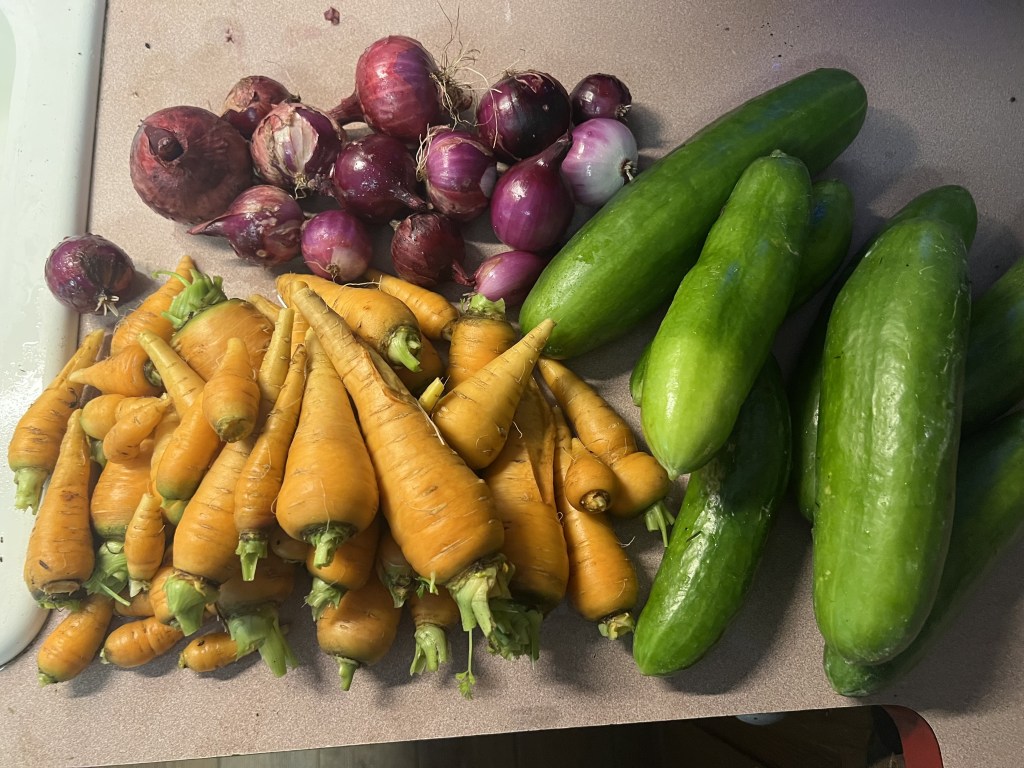
I made some final harvests from my garden today.  That included all my carrots (Daucus carota) and red onions (Allium cepa), along with a continuation of my cucumbers (Cucumis sativus).  I grow enough vegetables to keep our family stocked with fresh produce during the season and have begun to can and freeze my produce for later.  Still, there is a surplus which gives me the opportunity to share with friends and family.  There always seems to be an overabundance of some vegetables.  I have tried to compensate this year by growing a greater variety of produce and even staggering when I plant.  I also planted this year’s crop with the intent of sharing a portion of the produce with our local food bank.

When I went online, I found a food bank or food pantry is a non-profit, charitable organization that distributes food to those who have difficulty purchasing enough to avoid hunger.  This is usually done through food pantries and soup kitchens, but some food banks distribute food directly with their food pantries.  St. Mary’s Food Bank was the world’s first food bank, established in the US in 1967.  Now thousands of food banks have been set up all over the world.  Their numbers grew rapidly in Europe after the global increase in food prices which began in late 2006, and as the 2008 financial crisis began to worsen economic conditions.  The inflation and economic crisis of the 2020’s has exponentially driven low and middle-income consumers to get at least part of their food from a food bank.

Some US cities have organizations that provide dog and cat food for pets whose owners qualify for food assistance.  Daffy’s Pet Soup Kitchen in Lawrenceville, Georgia is considered the largest pet food aid agency in Georgia, distributing over 800,000 pounds (362874 kg) of dog and cat food in 2012.  Daffy’s was started in 1997 by Tom Wargo, a repairman who was working in an elderly woman’s home when he noticed her sharing her Meals On Wheels lunch with her pet cat because she could not afford cat food.  Daffy’s was one of seven non-profit organizations recognized by Barefoot Wine in 2013 through a US$10,000 donation and by being featured on labels of the vintner’s Impression Red Blend wines.  Pet Buddies Food Pantry in Atlanta, Georgia is another establishment that provides food aid for pets.  The St. Augustine Humane Society in St. Augustine, Florida, distributes over 1,600 pounds (726 kg) of pet food each month to families who are experiencing economic hardship and cannot afford to feed their pets.

THOUGHTS: While food banks are a vital resource for those who are food insecure, they have also led to a rise in obesity and diabetes.  Many foods offered to clients in food banks are high in processed sugars and salts and low in vitamin and mineral content.  The low nutritional quality of foods available to clientele at food banks has led to further health effects. A study showed 33% of American households visiting food pantries had diabetes.  When you grow and share locally grown fruits and vegetables you can help alter this trend.  Community gardens are another way to help.  Act for all.  Change is coming and it starts with you.
Marrow

July 08, 2025

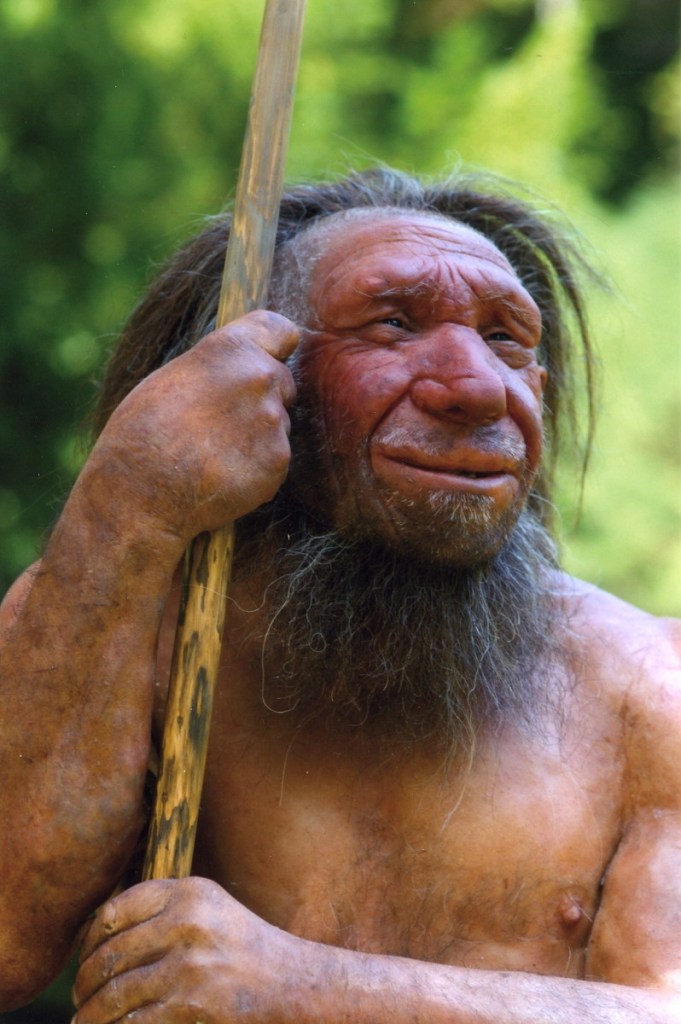
My MSN browser scroll reported on a new study that shows evidence of Neanderthal “fat factories” dating back as far as 125,000 years ago.  The inhabitants of the settlement strategically selected the lakeside location for the factory and harvested bone marrow by breaking open the bones as well as through a process of crushing and heating.  The fat factory suggests Neanderthals were able to understand their environment and plan for hunting and resource-gathering.  The recent research from Leiden University and published in the journal Science Advances adds to decades of previous research at the Neumark-Nord archaeological site near Leipzig, Germany.  According to a press release from Leiden University, there is also evidence of plant use in the area, though it’s rarely preserved.  Additionally, previous studies found proof that inhabitants used fire to manage vegetation.  Needless to say, Neanderthals have long been underestimated, and the new study does nothing to dissuade that notion.  This fat factory was created to extract marrow from bones.

When I went online, I found bone marrow is a semi-solid tissue found within the spongy (cancellous) portions of bones.  In birds and mammals, bone marrow is the primary site of new blood cell production (haematopoiesis).  Marrow is composed of hematopoietic cells, marrow adipose tissue, and supportive stromal cells.  In adult humans, bone marrow is primarily located in the ribs, vertebrae, sternum, and bones of the pelvis.  Bone marrow comprises approximately 5% of total body mass in healthy adult humans.  A person weighing 161 pounds (73 kg) will have around 8 pounds (3.7 kg) of bone marrow.  Human marrow produces approximately 500 billion blood cells per day, which join the systemic circulation via permeable vasculature sinusoids within the medullary cavity.  All types of hematopoietic cells, including both myeloid and lymphoid lineages, are created in bone marrow.  However, lymphoid cells must migrate to other lymphoid organs (like the thymus) to complete maturation.

Archeologists found the Neanderthals intentionally selected the lakeside location to process the bones of at least 172 mammals including deer (genus, Cervus), horses (Equus ferus caballus), and aurochs (Bos primigenius), an extinct species of bovine.  Inhabitants at the site broke open large mammal bones to extract the marrow and ground the bones into fragments and heated them in water to extract calorie-rich bone grease.  This indicates estimates of advanced resource collection began thousands of years earlier than previously thought.  Lutz Kindler, the study’s first author, said, “Neanderthals were clearly managing resources with precision.  They understood both the nutritional value of fat and how to access it efficiently.”  Experts believe Neanderthals understood there was a “fat quota” they had to meet to make the process worthwhile.  The authors emphasized the number of herbivores that Neanderthals at Neumark-Nord must have been hunting and were likely able to plan and use their environment effectively.  Research into marrow extraction at the Neumark-Nord site complex was possible because this was not a single site but an entire landscape and provided the opportunity to investigate how Neanderthals influenced their environment. 

THOUGHTS: The Neanderthals who created the marrow extraction factory at Neumark-Nord present a far different picture than the often-depicted primitive, club-wielding, nonsocial individual driven solely by animal instinct.  Modern humans tend to seek ways to differentiate ourselves from our homo sapiens ancestors as well as extant animals.  The more research done indicates we are often more alike than different.  All creation should be respected for both its similarity and difference.  Act for all.  Change is coming and it starts with you.