Lady Beetle

November 20, 2025

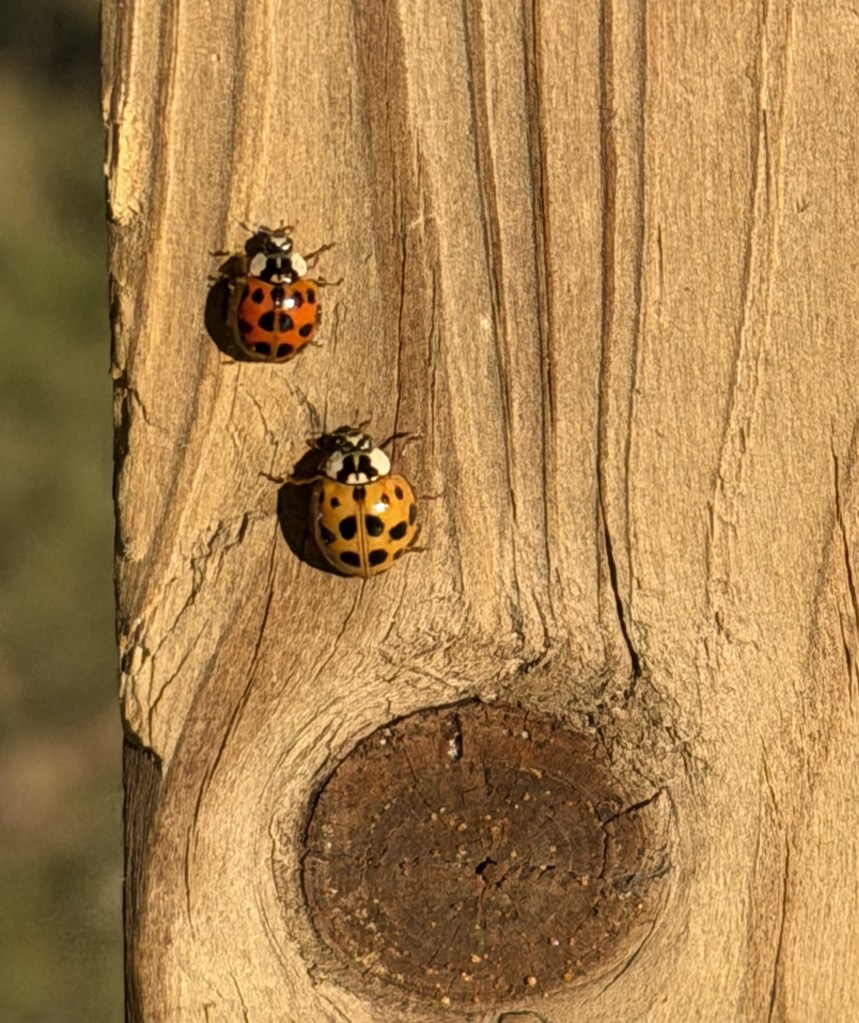
Last week Melissa and I were in a wooded area along the Arkansas River when we were inundated by flying insects.  Many species overwinter as adults sheltering in culverts, under bridges, or cavities in trees.  In the spring they will wake up and get along with starting the next generation.  Other than the short cold snap last week, we have been having nice weather this fall so these fliers may not have even begun the process.  Hibernating adults are also known to come out on unseasonably warm days.  The temperature was uncommonly warm (high 70’sF/25+C) so it would not have surprised me to find some insects buzzing around, these were literally everywhere.  I do not believe I have ever seen so many Asian lady beetle in one place.

When I went online, I found a lady beetle or ladybird (Harmonia axyridis) is a species commonly known as the harlequin, Asian, or multicolored Asian lady beetle.  This is one of the most variable lady beetle species in the world with a wide range of color forms.  The species is native to eastern Asia and has been artificially introduced to North America and Europe to control aphids (family Aphididae) and scale insects (Superfamily, Coccoidea).  It is now common and spreading in those regions and has also been established in Africa and across South America.  Individuals are beetles in shape and structure, being domed and having a “smooth” transition between their wing coverings (elytra), thorax (pronotum), and head.  It ranges from 0.22 to 0.34 inches (5.5 to 8.5 mm) in size.  The common color form is orange or red with 0 to 22 black spots of variable size.  The bright color makes the species conspicuous in North America and may be known locally as the Halloween beetle as they often invade homes during October to overwinter.

The Asian lady beetle is considered one of the world’s most invasive insects, due in part to their tendency to overwinter indoors.  They have an unpleasant odor and stain left by their bodily fluids when frightened or crushed, along with a tendency to bite humans.  In Europe they are increasing to the detriment of indigenous species as its voracious appetite enables it to outcompete (and consume) other ladybugs.  The Asian is highly resistant to diseases and carries a microsporidian parasite (it is immune) that can kill other lady beetle species.  Native ladybug species often experience dramatic declines from the invaders.  They were declared the fastest-invading species in the UK in 2015, spreading throughout the country after the first confirmed sighting in 2004.  The Asian lady beetle has been reported to be a minor agricultural pest that has been inadvertently harvested with crops in Iowa, Ohio, New York State, and Ontario.  This causes a detectable and distinctly unpleasant taste known as “lady beetle taint”.  The contamination of grapes by the beetle has also been found to alter the taste of wine.

THOUGHTS: Various methods of control have been tried where the Asian lady beetle has been introduced, causing a threat to native species, biodiversity, and to the grape industry.  These include insecticides, trapping, removal of beetles, and mechanically preventing entry to buildings.  The best methods for dealing with the Asian lady beetle in private homes involve sealing openings they enter and sweeping or vacuuming if they are inside.  Placing a nylon stocking inside the vacuum cleaner’s hose and securing it with a rubber band keeps the beetles from collecting (and being crushed) inside the machine.  Despite the dozens of beetles that landed on Melissa and me we were not bitten.  I have been bitten before and it was a sharp (but not lasting) pain.  Once again importing a species to get rid of another caused more problems than it solved.  Act for all.  Change is coming and it starts with you.
Iguana

November 11, 2025

Credit…Daniel Mulcahy

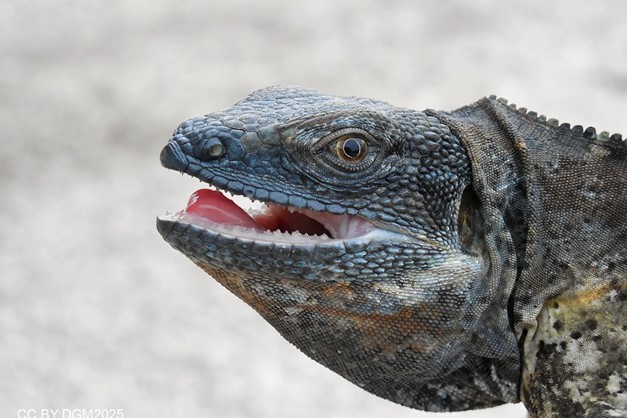
The Morning Read of the NY Times feed included an article on a possible reprieve for a previously invasive reptile species.  Biologists say DNA evidence proves the lizard landed on Clarion Island nearly half a million years ago, long before any humans might have transported them from the mainland.  Researchers reported the discovery last month in the journal Ecology and Evolution, and the finding means that the animals should be able to continue living on Clarion Island, a remote, mostly uninhabited Mexican archipelago in the Pacific Ocean.  There are around 100 iguanas there, and scientists and locals alike assumed that they had been introduced by humans in the late 20th century because they had gone unmentioned in prior accounts of the island’s fauna.  “It was all speculative that they were introduced — no one ever tested it,” said Daniel Mulcahy, an evolutionary biologist at the Museum of Natural History in Berlin who is an author of the new study.  The government was planning to exterminate the invaders to protect island’s delicate ecosystem.  Mulcahy and his colleagues compared mitochondrial DNA, passed down maternally, from the Clarion iguanas and the mainland spiny-tailed iguanas and found a 1.5 % difference in their DNA.  That meant these spiny-tailed iguana are genetically distinct and could not be recent invaders.

When I went online, I found the spiny-tailed iguana (Ctenosaura pectinata) is a species of is a species of iguanid lizard found in eastern Mexico and extreme western Guatemala.  This iguana has distinctive keeled scales on its long tail, to which its common name refers.  It is one of the larger members of the genus Ctenosaura, capable of growing to 4.3 feet (1.3 m) in total length (including tail), with females being slightly smaller than males at 3.3 feet (1.0 m).  It usually has a brown or grey-brown colored back (dorsally), with a yellowish underbelly (ventral surface).  It has a crest of long spines which extend down the center of its back.  Mating generally occurs in spring with the male showing dominance and interest by head bobbing before chasing the female until he can catch her and subdue her.  Within eight to ten weeks, the female will dig a nest and lay clutches of up to 24 eggs which hatch in 90 days with the babies digging their way out of the sand.  Hatchlings are often bright green with no body pattern and juveniles are typically green with brown markings, although all-brown hatchlings have been recorded.

Some wonder how a 4-foot (1.2 m) black-and-yellow lizard went unnoticed on Clarion Island for decades.  Clarion’s landscape has changed dramatically in recent years. The island was covered in prickly pear cactus (genus, Opuntiathat) that made exploration difficult, but was consumed by sheep (Ovis aries) and pigs (Sus domesticus) introduced by thew Mexican Navy in the 1970’s.  Those animals are gone and a shrubland community (chaparral) remains.  The iguanas are wary of humans and hide when approached.  The destruction by sheep and pigs underscores the damage invasive animals can cause.  Island ecosystems are particularly vulnerable.  Rayna Bell, an evolutionary biologist at the California Academy of Sciences said, “This type of work is fundamental to conserving some of the world’s most unique and imperiled diversity.”  Mulcahy’s colleagues are working to spread the news to government officials in Mexico to stop the eradication program.

THOUGHTS: The spiny-tail iguana is a traditional food in Mexico, listed as “Least Concern” by the IUCN Redlist, but the species is listed on the Mexican Red List as threatened and it is illegal to hunt them.  Their presence on Clarion suggests a 700-mile trip on a floating mat of vegetation.  It would be the second-longest known iguana aquatic journey, topped by another species of iguanas traveling 5,000 miles from North America to Fiji.  Humans thought the 1947 Kon-Tiki expedition was amazing.  We are always outdone by nature.  Act for all.  Change is coming and it starts with you.
Woolly Bear

October 22, 2025

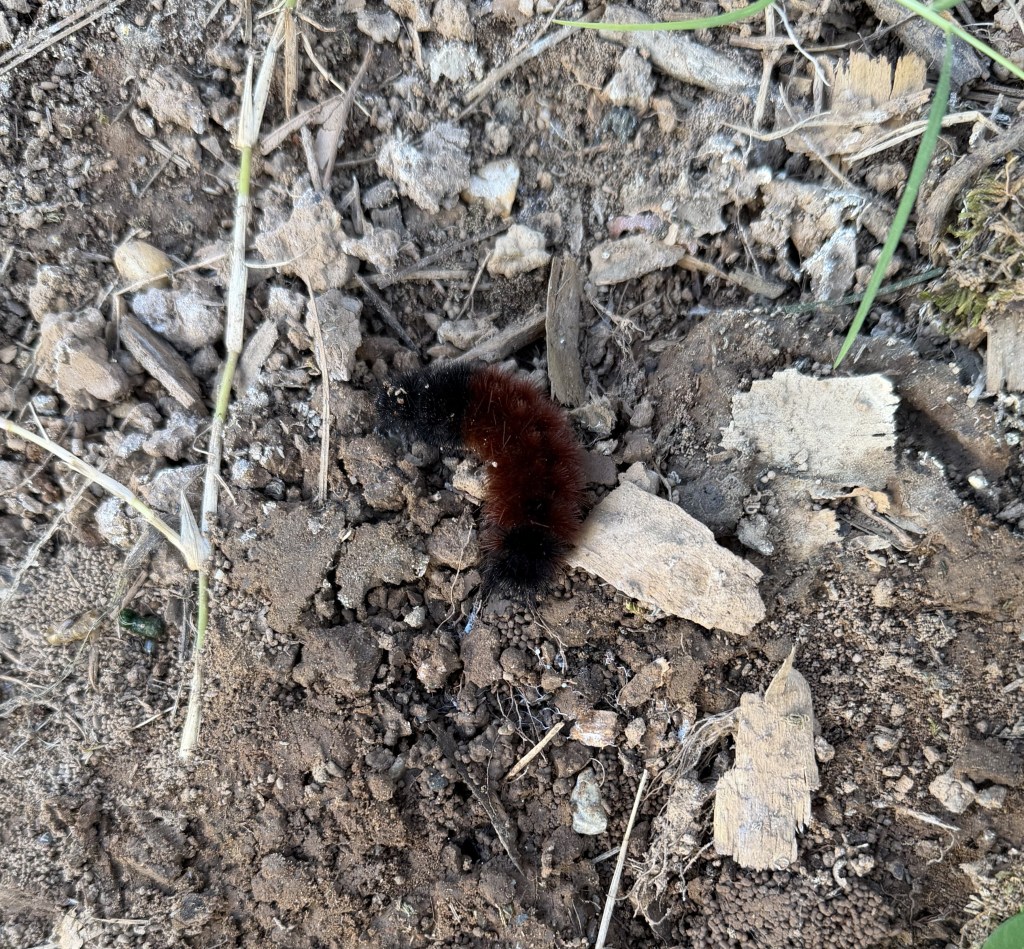
Even though the cooler temps have slowed the grass in my yards the weeds in the flower beds seem to be doing fine.  Yesterday I got out and performed (I hope) my last weeding before fall.  I usually just throw the weeds into the lawn and run my mower over them to mulch them into the sod. I had just mowed last week, and it really did not need to be mown again.   I just raked the weeds up and threw them away.  It seems I can never do just one part of yard work and doing one thing always seems to bring on other tasks.  Mowing, weed eating, weeding the beds, and blowing off the sidewalks have become interchangeable.  While I may put one or the other off for a day or two, once I start, I know I am committed to the long haul.  I also have the wood pile stacked at the edge of the drive from the tree I had cut down.  I had it stacked for firewood, but I know I still need to split and season the wood for a minimum of six months or preferably a year.  While cleaning up around the pile I moved several pieces of cardboard and we greated by two guests who had taken up residence, a 12-inch (30.5 cm) Texas brown snake (Storeria dekayi texana) and a banded woolly bear caterpillar.

When I went online, I found the Isabella tiger moth (Pyrrharctia Isabella), whose larval form is called the banded woolly bear, woolly bear, or woolly worm, occurs throughout the US and Canada.  It was first formally named by James Edward Smith in 1797.  The thirteen-segment larvae are usually covered with brown hair (setae) in their mid-regions and black hair in their front (anterior) and back (posterior) areas.  In direct sunlight, the brown hair looks bright reddish brown.  Adult moths are generally dull yellowish through orangish and have robust and scaly midsection (thoraces), small heads, bright reddish-orange forelegs, and sparse black spotting on the wings.  Each abdominal segment bears three black dots.  The Isabella larva emerges from the egg in the fall and overwinters in its caterpillar form by allowing most of its mass to freeze solid.  First its heart stops beating, then its gut freezes, then its blood, followed by the rest of the body.  The larva survives being frozen by producing a cryoprotectant in its tissues that keeps the inside of the cells from freezing.  In the spring, it thaws, and the cycle begins again.

Folklore in both Canada and the US holds that the relative amounts of brown and black hair on a woolly bear larva indicate the severity of the coming winter.  If the brown band is wide, winter weather will be mild.  If the brown band is narrow, the winter weather will be severe.  A variation of this story says the color of the stripes predicts winter weather, with darker stripes indicating a harsher winter.  Another version of this belief is that the direction the Isabella crawls indicates the winter weather, with the caterpillar crawling south to escape colder weather.  There is no scientific evidence for weather prediction and hatchlings from the same clutch of eggs can display considerable variation in their color banding.  The larva’s brown band tends to widen with age as it molts.  Since the 1970’s, several locations in the US hold woolly bear festivals in the fall.

THOUGHTS: The wooly bear Caterpillar is not the only creature that can withstand being frozen.  Amphibians like the wood frog (Lithobates sylvaticus) and American toad (Anaxyrus americanus), reptiles like the alligator (Alligator mississippiensis) and green iguana (Iguana iguana), certain types of carp (family Cyprinidae), and microscopic animals like the tardigrades (Phylum, Tardigrada) and rotifers (Phylum, Rotifera) all survive freezing.  While the technology for freezing a human and bringing them back to life does not yet exist, cryonics involve preserving legally deceased bodies at extremely low temperatures with the hope of future revival.  If an alligator can do it . . . Act for all.  Change is coming and it starts with you.
Jumper

October 01, 2025

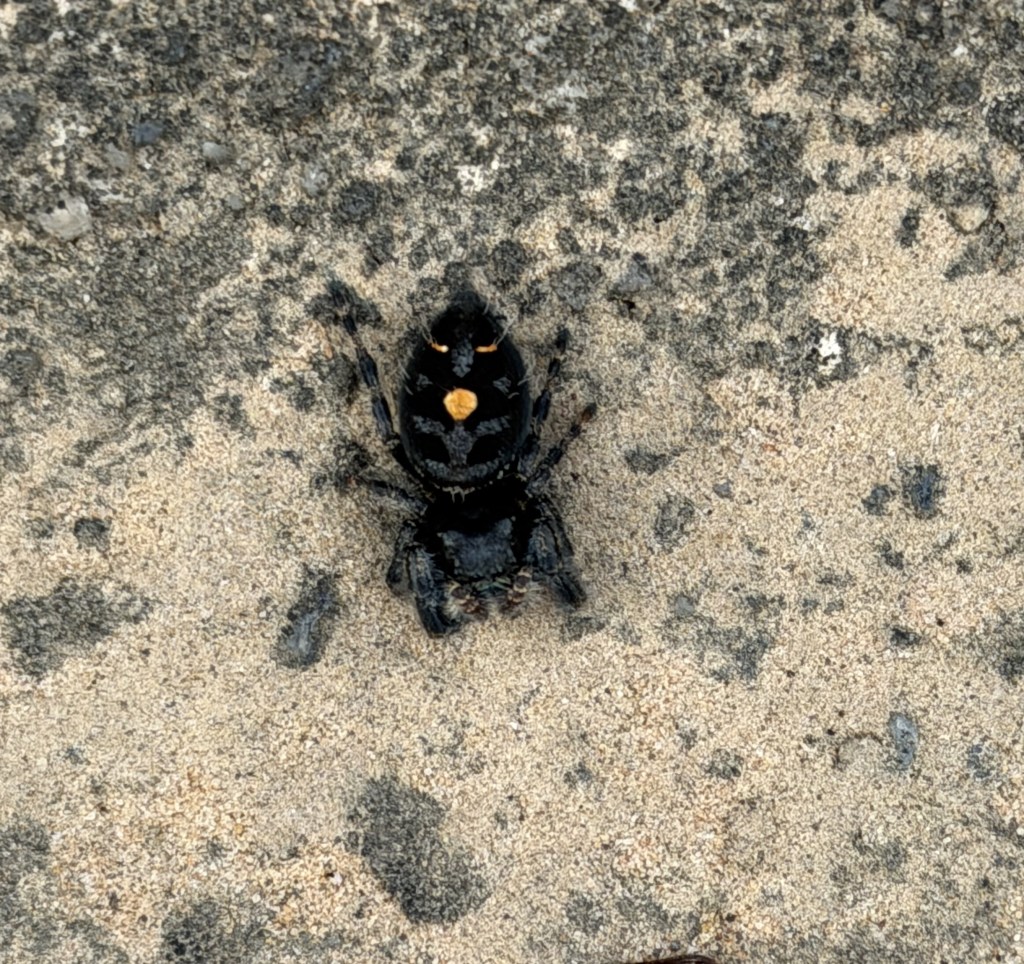
When I opened my mailbox this morning to retrieve my newspaper, I was surprised by something jumping out of the mail.  The mail itself was covered by a fine gauze-like webbing.  I figured this was some sort of spider that had decided to take up residence in the dark confines of my closed mailbox.  This did not strike me as unusual as many spiders are on the move at this time of year seeking a place to overwinter.  I was surprised by the distance the spider had jumped.  It had shot off my paper and onto the ground several feet away.  When I Goggled a picture of the spider, I found it was aptly named a Bold jumper.

When I went online, I found the bold jumper (Phidippus audax), also known as the daring jumping spider, is a common species of spider belonging to the genus Phidippus.  This group of jumping spiders easily identified by their large eyes and their iridescent mouth parts (chelicerae).  They are typically black with a distinct white triangle on their abdomen.  Like all jumping spiders, they have excellent stereoscopic vision that aids them in stalking prey and facilitates visual communication with potential mates during courting.  The species are native to North America and have been introduced to Hawaii, Nicobar Islands, Azores, and the Netherlands.  The Bold jumper is a solitary carnivore that uses their highly specialized eyesight to actively hunt and stalk a variety of insects and non-insect terrestrial arthropods such as caterpillars (order Lepidoptera), dragonflies (infraorder Anisoptera), grasshoppers (suborder Caelifera), and other spiders (order Araneae).  They are one of the most common spiders found in agricultural areas and have been studied to determine their impact on crop pest populations.  New Hampshire Governor Chris Sununu signed the HB 318 bill on June 11, 2021, designating the bold jumper as the state spider following a campaign by a class in Hollis, New Hampshire.

The bold jumper is often found living near humans.  Bites are rare but may occur if they feel threatened or are mishandled.  Bites are often described as mildly painful and are not considered dangerous.  Symptoms often include localized redness, itching, and swelling for one to two days, if at all.  Medical attention is only advised if symptoms worsen or abnormal symptoms arise.  If bitten, you should wash the area with water and a mild soap.  A cold compress may be used to treat swelling and aspirin, and acetaminophen may be used for pain.  As a major predator of crop pests, they have been studied to determine their impact on pest insect populations.  However, in addition to eating pests, they also eat beneficial insects such as pollinators.  My jumper went to the ground and then calmly stayed in place as I maneuvered my camera to take a photo.  It obviously did not consider me a threat and having been around them frequently I did not consider it a threat either.  Unlike most spiders, the bold jumper does not build webs to catch prey.

THOUGHTS: I found it curious that the bold jumper does not build a web to catch prey, yet there was an obvious webbing on my newspaper.  This was the start of the thin sheet of silk that would become the nest for an egg-sac.  This is usually built in hidden areas under rocks, bark, or leaves, but the inside of my mailbox seemed to serve.  The jumper was preparing to create a secluded nest to provide for the next generation in the spring, but my mailbox was not the secluded location she sought.  Humans find similar radical shifts in environment.  A site along the ocean seems perfect, until the storm surge from a hurricane washes out the foundation and sweeps the house into the sea.  Building needs to take potential environmental shifts into account.  Both for weather impact and the impact of encroaching on fragile ecosystems.  Act for all.  Change is coming and it starts with you.
Paddle Tribal

September 19, 2025

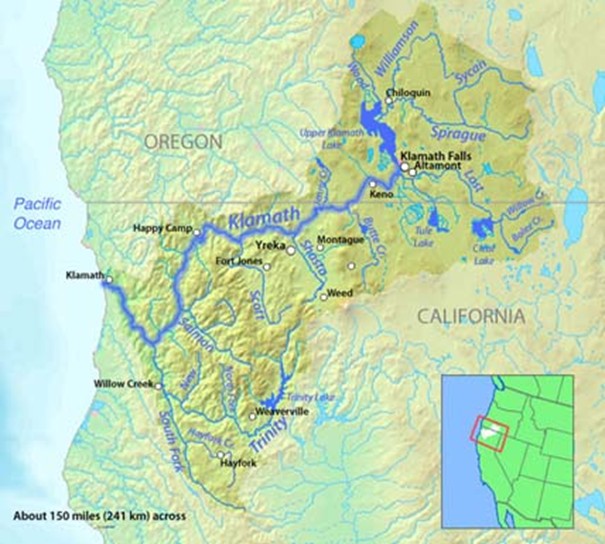
Inside the front section of my local newspaper was a USA Today article following up on a blog I posted a year ago on the dam removal along the Klamath River in California/Oregon.  The Klamath had been pushed to the point of extinction with construction of two hydroelectric and two reservoir dams.  A key tributary was channelized resulting in massive amounts of phosphorus flowing into the lake and lower river.  The dams deprived the Chinook (Oncorhynchus tshawytscha) and threatened coho (Oncorhynchus kisutch) salmon and other fish species from reaching the headwaters to spawn.  Dam removal began in 2024.  This initially released millions of tons of accumulated sediment but began a natural part of the river’s restoration.  The salmon many said would never return appeared upstream almost overnight.  This summer members of the Yurok Tribe were joined by other tribal participants to take a historic 310-mile kayak journey from Klamath Falls to the Pacific Ocean. Central to this trek were the teenage participants in the Paddle Tribal Waters program.   

When I went online, I found the Paddle Tribal Waters program was formed in July of 2022 as a collaboration of the groups Ríos to Rivers and Maqlaqs Paddle.  The program started with a two-and-a-half-week kayak and river advocacy training program for 15 Indigenous youth from the Klamath Basin and continued with weekend kayaking trips and kayak roll training sessions.  The program continued in the summer of 2023 with a second cohort of 15 Native students participating and a third cohort in in the summer of 2024 with 13 participants, for a total number of 43 indigenous youth completing the beginner program.  In January 2024, the first two cohorts combined to participate in a semester-long kayak training and high school program that Ríos to Rivers created in collaboration with World Class Kayak Academy.  The semester-long kayaking and high school program is key to setting these students on the path to truly having the skills needed to make the first descent of the Klamath.  The long-term vision of the Paddle Tribal Waters program is to support the youth who participated in the first descent of the Klamath to go on to create tribally led river programs in their communities.  The descent was completed in September 2025.

Another of the Paddle Tribal Waters programs’ goals is continued restoration and conservation of the entire Klamath Basin.  Wetlands need to be restored to impound the phosphorus and prevent the growth of deadly algae.  Much of this comes from the extinct volcanoes at the head of the Sprague River around Mount Mazuma.  The channeling needs to be replumbed to bring back the meandering stream and water plants to hold back the phosphorus.  Two other dams still bar salmon migration as the fish ladders constructed by the Bureau of Reclamation were not built to accommodate large fish.  Wetland removal from the Upper Klamath Lake and some of its tributaries allow the toxic algae to feast off the phosphorus and suffocate the fish.  Ashia Wilson, member of the Klamath Tribe at the rivers’ headwaters, said the Upper Klamath is still too toxic to touch, even as the kayakers paddled their way to the mouth.  The endemic c’waam (Deltistes luxatus) or lost river sucker, and the koptu (Chasmistes brevirostris) or short nosed sucker, used to feed the tribe but are now endangered. 

THOUGHTS: The arrival of the small Paddle Tribal Waters group of natives and their allies marked a milestone.  Removal of the four dams (all beyond their service life) will make restoration of the rest of the basin possible.  An ending ceremony at Requa and a celebration the next day in Klamath told of the 20-year struggle to restore the river and seemed to suggest anything is possible.  The wetlands of headwaters and river deltas are critical habitat and must be both preserved and restored.  Act for all.  Change is coming and it starts with you.
Crayfish

September 10, 2025

An article in my MSN browser referenced a report published by the Michigan State University Extension by Michigan Sea Grant (MSG).  MSG is a cooperative program focused on conservation and use of resources in the Great Lakes.  The Grant makes the case that foraging could help reduce the negative impact of invasive species on the environment and perhaps prevent the need for harmful chemical methods of pest control.  Plants and animals introduced to new areas often become problems to the ecosystem by outcompeting native species that keep things balanced.  One study found invasives cause nearly US$20 billion in damage in the US every year, with agriculture being the most severely impacted sector.  One solution comes from programs to bring these species to our menus.  Some restaurants have been introducing wild boar to Americans with the help of their providers and with the inspection facilities of the Department of Agriculture to ensure the safety of the product.  MSG calls out red swamp crayfish for their aggressiveness and role in potentially spreading disease and parasites to other creatures but also notes they are a delicious component in recipes such as gumbo and bisque.

When I went online, I found the red swamp crayfish (Procambarus clarkii), also called the Louisiana crawfish or mudbug, is a species of the cambarid family of crayfish native to freshwater bodies of northern Mexico, and southern and southeastern US.  It has also been introduced elsewhere in both North America and other continents where it is often an invasive pest.  The red swamp is typically dark red, with long claws and head, small or no spines on the sides of its upper section of the shell (carapace) just below the head, and rows of bright red bumps on the front and side of the first leg.  The native range is from northern Mexico and far southeastern New Mexico, through the Gulf States to the Florida Panhandle, as well as inland north through the Mississippi Basin to southern Illinois.  It has also been introduced outside its natural range to countries in Asia, Africa, Europe, and the Americas.  Individuals are reported to cross many miles of relatively dry ground, especially in wet seasons, although the aquarium trade and anglers may have hastened the spread in some areas.

The red swamp crayfish is eaten in China, Cambodia, Thailand, Europe, Africa, the US, Canada, Australia, New Zealand, and the Caribbean.  In the US, crayfish are particularly popular in Louisiana, where crawfish boils are popular social gatherings centered around eating the crustaceans.  Louisiana crawfish are usually boiled in a large pot with heavy seasoning (salt, cayenne pepper, lemon, garlic, bay leaf, etc. – I usually use Old Bay Crawfish Boil) along with items such as potatoes and corn on the cob.  In 1990, Louisiana produced 90% of the crayfish in the world and consumed 70% locally.  As early as 2003, Asian fish farms and fisheries produced more and continued to outpace production in any other part of the world.  By 2018, crayfish production in the Americas represented just 4% of total global supply and 93% of the US crayfish farms were in Louisiana. 

THOUGHTS: As a boy in Kansas, I would use a seine to catch the abundant crayfish to use as an inexpensive fish bait.  I never considered these crustaceans more than bait until I went to the Crawdad Festival in Isleton, California.  The red swamp crayfish has invaded the California waters and the three native species of crayfish (sooty crayfish – Pacifastacus nigrescens, Pilose crayfish – Pacufastacys gambelii, and Shasta crayfish – Pacifastacus fortis) have nearly disappeared.  Isleton is in the Sacramento delta and was forced to fly in mudbugs from Louisiana.  Crayfish is an acquired taste but once I got beyond the bait aspect, I found I loved them.  “Pinch the tail and suck the heads!”  Act for all.  Change is coming and it starts with you.
Digger

August 21, 2025

Following my disappointment fishing while at the coast last week I decided to walk through the beach community and see if I could spot some birds that were not yet on my list.  I took the road through the community first to try and spot land birds.  I was able to see two species I already recorded, an American Crow (Corvus brachyrhynchos) and a flock of house sparrows (Passer domesticus).  It was not until I returned along the beach that I picked out several forms of gulls (California gull, Larus californicus; western gull, Larus occidentalis; short-billed gull, Larus brachyrhynchus) and a flock of white-winged scoter (Melanitta deglandi) ducks.  The beaches along the Puget Sound tend to be small well-worn rock rather than the sand I associat with other coasts.  This is harder to walk on, and it took me a while to get back to the house.  When I arrived, my daughter-in-law showed me a picture of the unusual wasp they had encountered on their beach walk (other direction).  It was a large golden digger sand wasp.

When I went online, I found the golden digger sand wasp (Sphex ichneumoneus), or great golden digger wasp or great golden sand digger, is a wasp in the family Sphecidae.  The wasp’s name comes from the Greek word for “tracker,” and is most well-known for its parasitic nesting behavior.  It is identified by the golden pubescence on its head and thorax (chest), its reddish orange legs, and partly reddish orange body.  Golden hairs cover the head and thorax (hence “golden”).  The digger has a long, slender waist (petiole).  Their hind region (metasoma) is black with the first couple of segments a brilliant orange-red that matches their legs.  Size varies from 1/2 to over 1 inch (1-1/4 to 2.5+ cm) long.  This wasp is native to the Western Hemisphere, from Canada to South America, and provisions its young with various types of paralyzed Orthoptera (grasshoppers and crickets). 

From May through August, great golden digger wasp females build their nests in sandy soils.  These consist of a descending shaft and side chambers for the young at right angles.  This makes it difficult to pull prey into a brood chamber without getting stuck and is one possible reason why the wasp always checks to ensure the path is clear before pulling its prey down by its antennae.  Female wasps commonly build their burrows nearby those of other females of their species and may even share a nest.  However, they will fight other wasps if they encounter them inside their burrow during prey retrieval.  By inspecting the unattended nest, the wasp avoids risking an encounter with another wasp while carrying its prey.  The digger will track and hunt their prey (i.e., tracker) and sting it with a paralyzing venom that keeps it alive, then flies (or drags) the prey to the nest.  At the nest the digger wasp lays down their paralyzed prey and enters her tunnel and checks to ensure that all is well.  Then she brings the prey down into a side chamber, lays an egg on the prey, and seals the chamber.  When the egg hatches it feeds on the prey through the winter, and the new wasp emerges from its side chamber in the spring and begins the cycle again. 

THOUGHTS: The golden digger sand wasp is like the cicada killer (Sphecius speciosus) I saw last week in Arkansas.  Both are large, solitary, build nests in the ground, are harmless to humans, and do not defend their nest or behave aggressively.  While they have stingers, they rarely sting humans unless they are stepped on.  The digger is a pollinator that preys on insects that are harmful and are helpful to have around your garden (or beach house!).  These are possibly the only wasps known to be attacked by birds.  House sparrows and American robins (Turdus migratorius) will attack to force the digger to drop its prey for the bird to eat.  I guess both the young and the birds are looking for an easy meal.  Act for all.  Change is coming and it starts with you.
Sea Lion

August 17, 2025

One of the joys of visiting family is being able to spend time on the ocean coast.  My sister lives in Maine and we always take time to visit the ocean for at least one day during the trip.  My son’s family lives near Seattle and has a beach house near the Tulalip Tribe’s reservation.  This weekend we were able to go to Seattle and spend two days on the coast.  The first day my young grandson took me fishing on the rock beach behind their house.  He made two casts and immediately caught a 6-inch (15 cm) sculpin (Hemilepidotus spinosus).  After two more casts, he offered the pole to me.  I took several casts and did not get a bite.  My grandson seemed to get bored and went back to play at the house.  I kept casting for another 10 minutes and did not get a bite the entire time.  I gave up and went to sit on the deck and watch the beautiful sunset.  After several minutes my daughter-in-law noticed a sea lion had ventured into our part of the bay and was bobbing up and down in the channel.

When I went online, I found the California sea lion (Zalophus californianus) is a coastal eared seal native to western North America.  It is one of six species of sea lions.  It has a natural habitat range from southeast Alaska to central Mexico, including the Gulf of California.  California sea lions are sexually dimorphic with the males being larger than females. Males have a thicker neck and a protruding ridge of bone lengthwise along the top of the skull (sagittal crest).  The animals will mainly haul out on sandy or rocky beaches, but they also frequent manmade environments such as marinas and wharves.  Sea lions feed on several species of fish and squid and are preyed on by orcas and great white sharks.  The sea lions have a polygynous (multiple partners) breeding pattern.  Males establish territories from May to August and try to attract females to mate.  Females are free to move between territories and are not coerced by males.  Mothers nurse their pups in between foraging trips.  California sea lions use many vocalizations, but most notably barks and mother-pup contact calls.  Outside breeding season, California sea lions spend much of their time at sea but come to shore to molt.  The International Union for Conservation of Nature (IUCN) lists the species as Least Concern due to its abundance.  Oregon and Washington states engage in annual kill quota to protect the fish.

When I woke up the following morning, I decided I would try my luck with fishing again.  When I fished yesterday it had been high tide (the best time to catch fish on this beach).  Now it was low tide.  Undeterred, I took the poll and strode to the water’s edge and began to cast once more.  I found out why it is best to fish at high tide almost immediately.  On nearly every cast I fouled my hook in the lush beds of eel grass (Zostera marina) that covered the bottom of the channel.  Besides providing excellent forage for the California sea lions, the sea grass meadows provide food and shelter for juvenile fish, Dungeness crabs (Metacarcinus magister), the Pink (Chlamys rubida) and Spiny Scallops (Chlamys hastata). and other marine life.  They serve as a food source for herbivores during the growing season and for things that feed on the decomposing grass (detritivores).  The seagrasses absorb carbon dioxide, filter polluted runoff, absorb excess nutrients (nitrogen and phosphorus), stabilize sediments, and improve water flow. 

THOUGHTS: One of the questions I was frequently asked after moving from California’s Bay Area to southcentral Kansas was if it was any different where I used to live.  I rented a house at a marina on the bay with a boat slip out my back door.  My stock answer was, “well, I have not been greeted by the sound of a sea lion when I wake up in the morning.”  While not getting any bites the second day, I spotted a sea lion pup and mother foraging nearby.  It was good to know I was in a healthy ecosystem.  We need to do what we can to keep them that way.  Act for all.  Change is coming and it starts with you.
Cicada-killer

August 11, 2025

I have been seeing the scattered exoskeletons of the cicada (superfamily, Cicadoidea) brood hatch that is occurring in Arkansas this summer.  Brood XIX emerges every 13 years, and its last emergence was in 2011.  It is a large brood that encompasses 15 states.  Although they are not in Arkansas, Brood XIII is also emerging in other parts of the country.  Although the cicadas are large and a brood hatch can become messy when great numbers emerge at the same time, they are not agricultural pests or a threat to humans.  Trees may be overwhelmed by the sheer number of females laying their eggs in their shoots and small branches.  Yesterday while watering my garden, I noticed what looked like a large wasp trapped between the screen and window on the porch.  When I find wasps on our porch, I shoo them away or if they persist, I will spray them.  I have been stung too many times to allow these pests to establish close to our house.  The insect looked like a yellow jacket but was over twice the normal size.  What I found out was this was an eastern cicada-killer.

When I went online, I found the eastern cicada-killer wasp (Sphecius speciosus) is a large, solitary digger wasp species in the family Bembicidae.  They are also erroneously called sand hornets, although they are not true hornets, which belong to the family Vespidae.  Their name comes as they hunt cicadas and provision their nests with them.  The species is found in the Eastern and Midwest US and south into Mexico and Central America.  Adult eastern cicada wasps are 0.6 to 2.0 inches (1.5 to 5.0 cm) long.  They have hairy, reddish, and black areas on their middles (thoraces), and black to reddish brown rear (abdominal) segments that are marked with light yellow stripes.  The wings are brownish.  The females are slightly larger than the males, and both are among the largest wasps in the Eastern US.  European hornets (Vespa crabro) are often mistaken for eastern cicada killers, although they are smaller at 1.4 inches (3.5 cm) long.  The males are smaller than the females because they are not given as much larval food.  The females benefit from being larger as they must carry the cicadas they have killed to a burrow for nesting.  Cicada killers exert a measure of natural control on cicada populations which may directly benefit the deciduous trees the cicadas feed on.  

Despite their fearsome appearance, female cicada-killers are not aggressive and rarely sting unless they are mistreated.  Their sting is not much more than a “pinprick”.  Males aggressively defend their perching areas on nesting sites against rival males, but they have no stinger.  Although they appear to attack anything that moves near their territories, male cicada killers are just investigating anything that might be a female cicada killer ready to mate.  Their close inspection may appear to be an attack, but male and female cicada killers do not land on people with the intent to sting.  If handled roughly, females will sting, and males will jab with a sharp spine on the tip of their abdomen.  They are generally not aggressive towards humans and usually fly away rather than attacking.  I initially tried to swat the wasp but its size and being behind the screen protected it.  I finally gave up and decided if it could get out of the screen on its own it would go away.  Since it was not there this morning, I assume it had done so. 

THOUGHTS: The size of the cicada-killer and its resemblance to a yellow jacket made me fearful when I first encountered it.  It seemed docile rather than the aggression I have seen from other wasps.  Still, I wanted it to go.  After I found out what it was, I was glad I left it alone.  We do not have a cicadae problem, but this was nature’s way of providing control.  One benefit of my garden is taking time to observe the interaction between the flora and fauna (plants and animals) that thrive there.  Identifying the different species and their place in my sub-ecosystem has been enlightening.  We are all part of the same planet.  Act for all.  Change is coming and it starts with you.
Red-bellied

July 14, 2025

Last weekend Melissa called me into the kitchen to watch the large bird that had been battling two squirrels over “rights” to what was left in my soot feeder.  I grabbed my camera and by the time I arrived the squirrels had been driven off, but the bird was still there.  Melissa said she had watched the bird attack the two eastern gray squirrels (Sciurus carolinensis) for about 20 minutes.  The bird alternately flew at both squirrels keeping them at bay.  This was a new species identification for Melissa, and the bright red head led her to believe this was a red headed woodpecker (Melanerpes erythrocephalus).  I occasionally see one of these birds at my feeders and had even identified one early in January (although without a photo).  At first, I also thought it might be a red-headed woodpecker.  My apps instead identified this as a red-bellied woodpecker.

When I went online, I found the red-bellied woodpecker (Melanerpes carolinus) is a medium-sized woodpecker of the family Picidae.  While the species breeds mainly in the eastern US, it ranges as far south as Florida and as far north as Canada.  The most prominent feature is a vivid orange-red crown and nape, but this is not to be confused with a separate species in the same genus, the red-headed woodpecker.  The red-headed woodpecker has an entirely red head and neck, a solid black back, and white belly.  Red-bellied woodpeckers are 9 to 10.5 inches (22.85 to 26.7 cm) long, have a wingspan of 15 to 18 inches (38 to 46 cm), and weigh 2 to 3 ounces (57 to 91 g).  The red-bellied earns its name from the pale reddish tint on its lower underside.  Adults are mainly light gray on their face and underparts and have black and white barred patterns on their back, wings, and tail.  Adult males have a red cap going from the bill to the nape while females have a red patch on the nape and another above the bill.  White patches become visible on the wings in flight.  The reddish tinge on the belly is difficult to see in field identification.

I have never noticed the red spot on a red-bellied woodpecker and have instead identified them by the black and white barred pattern on their backs.  I always wondered why they were called red-bellied, and now I know.  Predators of adult, red-bellied woodpeckers include birds of prey such as sharp-shinned hawks (Accipiter striatus), Cooper’s hawks (Astur cooperii), black rat snake (Pantherophis alleghaniensis), and house cats (Felis catus).  Known predators of nestlings and eggs include red-headed woodpeckers, owls (Order, Strigiformes), pileated woodpeckers (Dryocopus pileatus), black rat snakes, and eastern gray squirrels.  When approached by a predator, the birds either hide from or harass the threat with alarm calls.  They will defend their nests and young aggressively and may directly attack predators that come near.  While this bird did not have a nest, it was aggressively defending its food supply.

THOUGHTS: By driving off the gray squirrels the red-bellied woodpecker was it was exerting its territorial rights.  A defended territory is typical of songbirds but is also found in many other orders of birds.  Territory may be held by one bird, a pair, or a flock and can be held for all or only part of a year.  It may be very large (eagles) and provide all the resources the bird needs or be very small such as nesting territories.  It may be vigorously defended or loosely guarded.  Typically, territories are defended against others of the same species but may also be defended against other species.  Humans also claim both small and large areas we define as ours and actively defend.  These are also shared, but generally only with those we define as “us”.  Globalization is forcing humans to make new choices on us and them.  Cooperation and sharing resources may provide for all.  Hoarding resources has and will always lead to conflict.  Act for all.  Change is coming and it starts with you.