Holla Bend

January 27, 2025

The intense cold (highs below freezing) that has stricken most of the south began to lessen over the weekend and Melissa thought it a good time to get out of the house with the kids for a drive.  While the motivation was to “just go”, we also wanted to see a birding site.  The Sequoya Wildlife Refuge is only about 90 minutes west, but we have not had much luck finding birds in the winter.  Lake Fort Smith is an hour north and has good fishing in the cove, but we have never caught much from the shore.  I put in a little work while Melissa searched for a new birding site.  What she found was about 2 hours away near where she spent her college years.  This sounded like a possibility (and promised a trip to her favorite burger joint).  We packed up the kids, got gas and aired up the tires that had been deflated by the cold, and took off for Holla Bend National Wildlife Refuge.

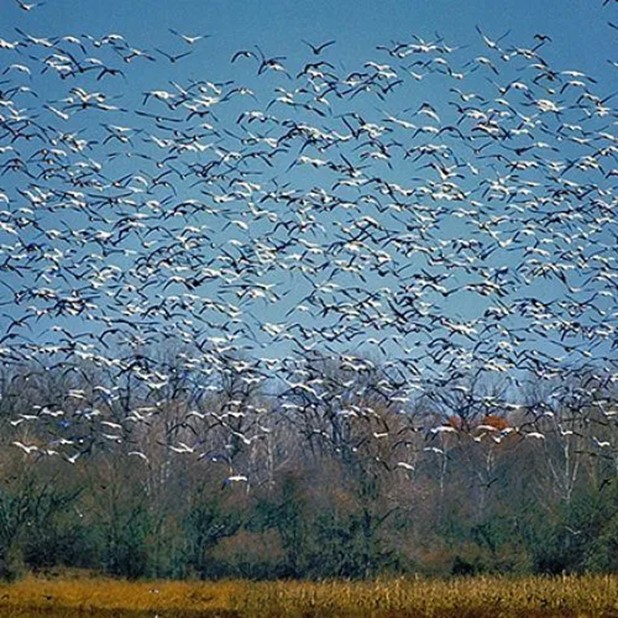
When I looked online, I found Holla Bend National Wildlife Refuge is a 7,055-acre (28.6 km2) site located 5 miles (8 km) south-east of Dardanelle, Arkansas.  The refuge is bounded on one side by the Arkansas River and on its others by an oxbow lake that was formed in 1954 by the Army Corps of Engineers during efforts to straighten the river navigation channel.  The resulting island was transferred to the US Department of the Interior in 1957 for a wildlife refuge.  The refuge provides habitat for migratory waterfowl, indigenous endangered species, other resident wildlife, and offers interpretation and recreation to the public.  The area is a year-round sanctuary for the 236 species of birds, tree frogs, and the American alligator.  Migratory fowl following the Central and Mississippi flyways stay in the refuge during the winter months, including 14 species of ducks and 4 kinds of geese, with as many as 100,000 there at once.  Winter migratory neotropical songbirds use the refuge as a rest stop during their long journey to and from Central and South America and during the spring and summer migratory birds use the refuge for breeding and nesting.  I anticipated birds.

Last year I purchased an Interagency Lifetime Pass from the US National Park Service so we cruised past the Holla Bend information center without stopping.  We turned around realizing we did not know where we were going without a flyer.  As we got into the refuge, we saw large flocks of American Robin (Turdus migratorius) on the road between the trees and European starling (Sturnus vulgaris) passing among the harvested grain fields.  Along the oxbow we found a flock of mallards (Anas platyrhynchos) and a flock of ring-billed gull (Larus delawarensis) along the river.  The best find however, was totally unexpected.  We stopped to admire a herd of 20 does and fawns racing across the far end of a harvested field.  Then I noticed what I thought was a group of black vultures (Coragyps atratus) about 300 yards (274 m) out.  When I focused my camera, I realized this was a flock of wild turkey (Meleagris gallopavo) feeding in the field.  It turned out to be a great day.  And we topped it with a great burger.

Thoughts: When we stopped at the Holla Bend information office a sign listed the daily hours along with the caveat of “Closed when we are not here”.  They were not there.  The Wildlife Refuge System is the US’s largest network of lands and waters dedicated to wildlife conservation, but it is facing a staffing crisis.  The Refuge System has lost over 800 permanent positions since fiscal year 2011, resulting in a 27% loss in capacity.  No national wildlife refuge is fully staffed, and more than half have zero staff on-site.  Much of the system is unprotected due to the lack of law enforcement officers.  This shortage impacts critical volunteers by a lack of staff supervision or infrastructure.  We need to invest in this system and prioritize staffing to ensure the future of this network and the wildlife it protects.  Act for all.  Change is coming and it starts with you.
Birds 2024

January 04, 2025

I am a little later than usual, but it is again time to recap my annual birder list. Once more I saw a number of red-tailed hawks (Buteo jamaicensis) on the power lines going to and from town but this year I was unable to actually get a picture, so they were not added to my count. I was unable to take my usual trip to the wildlife area this year and so missed out on any of the birds I might have seen there. The end of year presence on my feeders was good as the cold weather brought the small Passerines (sparrows and finches), although the larger birds (cardinals and jays) were mostly absent. I cleaned out the bluebird (Sialia sialis) house last week. One of the squirrels who frequent the feeders has taken to gnawing on the entrance, so I opened it to check if everything was ok. It was fine but I cleaned the nest and debris in preparation for the next nesting season. BTW: for those who read last week’s blog (Gaggle) a group of squirrels is called a “dray” or a “scurry”.

All that said leads up to the “great reveal” concerning my birder totals for 2024. You may recall I recorded 26 species in my first year (2020). I got off to a great start in 2021 with 29 species by the end of January and a total of 52 species for the year. During 2022 the sightings were slower, with 44 different species, not counting the six European sightings (50 total?). During 2023 I recorded my lowest number of sightings since my first year, with only 30 species. During 2024 the numbers rose slightly to 39 documented species. Building a fence in the side yard helped as the kids no longer play near the feeders and the birds feel free to come and go more frequently. Still, early morning and early evening are the best times to watch. We also added three new feeders that attach to the glass on the bay window next to where Melissa works. This allows her to watch as the American gold finch (Spinus tristis) and Dark-eyed junco (Junco hyemalis) as they battle for feeding rights.

As I pulled onto the entrance road to the lake to take the kids for a walk yesterday, I caught sight of a large bird perched in the trees. I drove by as the bird turned and flashed the unmistakable white head of a bald eagle (Haliaeetus leucocephalus). I slowed and then pulled over as soon as I (no shoulders). I walked back the 1/4 mile (400m) scanning the trees and hoping to be able to get a photo for my birding list. Unfortunately, the eagle had moved on and was now out of sight. When we began our walk out onto the first spit of land, I heard the call of a red-bellied woodpecker (Melanerpes carolinus). I scanned the trees along the road and caught sight of the bird high among the branches. I pulled out my phone to take a photo but again, by that time the bird was gone. That made two birds I usually only see a couple of times a year and I had missed documenting them both. These were part of the many birds I have seen but not photographed over my last five years of birding. The official Cornell Lab of Ornithology bird list guide does not require documentation with a photo to count as a sighting, although that has been my criteria. Perhaps I should rethink.

THOUGHTS: I acquired several new feeders (now 13, plus 9 hummingbird feeders) during 2024. Melissa asked about the cost as she watched me buying seeds and filling the feeders on a daily basis. I tend to buy seeds in bulk, and I only have to restock two or three times a year. Watching the birds (and squirrels) gives us both pleasure. Like my garden and Melissa’s succulents, the expense to feed the birds is well spent. Be sure to mark your calendars for the Great Backyard Bird Count 2025 (February 14 to February 17, 2025). As I mentioned last year, birds are the (literal) canary in the mine shaft (earth) when it comes to gauging the health of our ecosystems. Act for all. Change is coming and it starts with you.

Gaggle

December 30, 2024

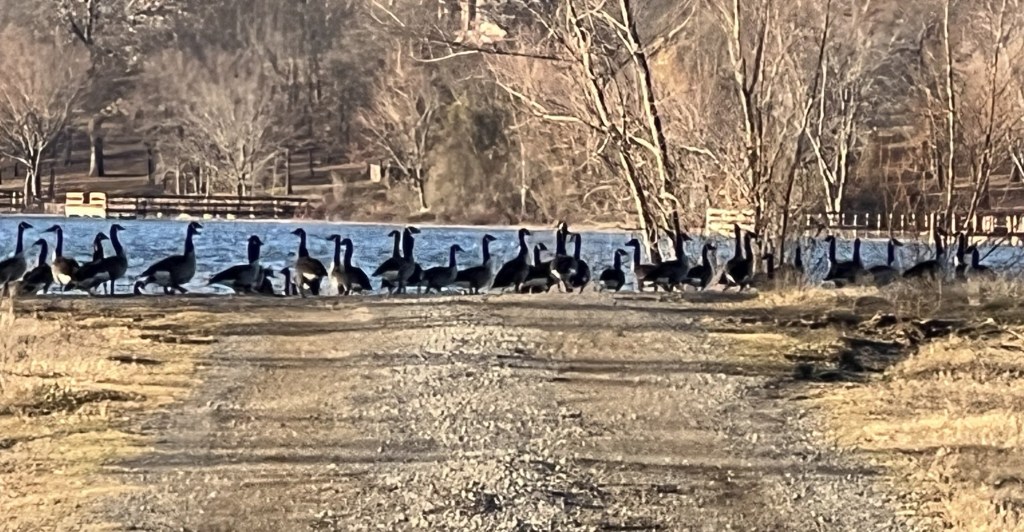
The kids were overwhelmed as we took our walk at the lake last week. They had been intrigued in the past by the occasional greater egret (Ardea alba) or great blue heron (Ardea herodias) that spend time in the shallows at the end of the two spits we walk. The kids will stop and even strain on their leash trying to get a better look at these large solitary birds. They were not prepared for the mass of birds we encountered on this occasion. The herons had flown away as the kids approached, but the Canada geese (Branta canadensis) stood their ground. Both Zena and Loki hesitated in the face of this loud and raucous group of birds. It was not until the kids composed themselves and began to move forward that the group decided they wanted no part of these two large dogs (Canis familiaris). This gaggle of geese took flight and moved to the safety of the water.

When I looked online, I found a gaggle of geese occurred in English print in Julia Berners book, “The Book of Hawking, Hunting and Blasing of Arms” in 1486. Geese are called a “gaggle” because together they are noisy and rowdy. Little is known of Berners, and much of what is known cannot be verified with certainty, but she is thought to be the earliest female author writing in the English language. Based on her last name, scholars suggest that she was either the daughter of the courtier Sir James Berners or wife to the lord of the manor of Julians Barnes, and she was high-born and well-educated. Since she was most likely brought up at court, she would have hunted and fished with the other fashionable court ladies. It is generally believed that she entered the monastic life and became the prioress of Sopwell Nunnery near St Albans. Berners seemed to retain her love of hawking, hunting and fishing, and her passion for field sports, leading her to write her treatise on hunting and others. These treatises are some of the earliest extant writings of their kind and include remarks on the virtues of environmental conservation and on etiquette for field sports. These concepts would not become commonly accepted for hundreds of years after the publication of these treatises. She is also remembered as one of the first authors (of either sex) to write on angling.

A gaggle is just one of the 165 collective nouns (a “naming word for groups of things) for groups Berners defines in her publication. A group of owls (Order: Strigiformes) is called a parliament, possibly attributed to the idea that owls are considered intelligent and wise. A group of wildebeests (Genus: Connochaetes) is called a confusion. This could be due to the huge numbers of animals that in the annual Great Migration and the resulting confusion and noise that happens when the animals migrate. A group of lemurs (Superfamily: Lemuroidea) is called a conspiracy. Lemurs are social animals and live in communities of around 10 to 25 members who often work together (conspire) to outwit predators using a technique called “mobbing”. A group of hippopotamuses is called a bloat. Hippos live in groups of 10 to 20 females and one male, and bloat may refer to their large, bloated bellies. Finally, a group of wild cats is called a destruction. Feral cats can be territorial and fight to protect their territory, and when a group of feral cats get together, they can become destructive.

THOUGHTS: Canada geese thrived around the golf courses I played in Salt Lake City and would form into a large gaggle around the water hazards. The geese were generally docile as they sat on the lawn or swam in the ponds. The problem came when you hit your ball in their midst, when they cackled and blustered a warning. One even decided my ball was her egg and made an aggressive defense. Animals form groups for protection and defend their territory against predators. Humans use the same tactic and form resistance movements against tyrants or marauders. Like a gaggle of geese, we are stronger together. Act for all. Change is coming and it starts with you.
Mud Tracks

November 06, 2024

We have received heavy rain over the last two days, and I tried to keep the kids out of the side yard. I monitor them when I do let them out to make sure they are not mischievous (Loki is a digger and Zena is a roller) and end up covered in mud. Today the rain stopped, and I decided to brave our walk site at the lake. A portion of the walk is on a paved parking lot, but the majority covers packed dirt tracks that lead out to the end of two spits. We were the only ones there when we arrived to begin our walk. We walked to the end of the first spit and while it was wet, we were able to pick our way through the puddles without getting our paws muddy. As we were coming off the spit two 4-wheel drive pickups pulled out onto the other spit and began to cut mud tracks through the vegetation. As we walked around the paved lot on the trail the trucks moved to the area we had just left. This had a wider area that had been torn up by previous off-road activity. It did not take long for one of the trucks to get stuck axel deep in the mud. This was obviously why they had come in the first place. After extricating the truck, they drove to the boat ramp and took selfies of the mud covered truck to share with their friends. Teenagers in pickups are not the only ones that leave mud tracks.

When I looked online, I found one of the more famous mud tracks is located at Racetrack Playa in Death Valley. Racetrack playa is approximately 3 miles (4.8 km) long and 1.2 miles (1.9 km) wide and is located at a height of 3708 feet in a north-south valley east of the Panamint Range within Death Valley National Park. The playa receives only 3 inches of annual precipitation and is bounded on all sides by north-south ranges rising 1500 to 2000 feet (457 to 610 m). The surface of the playa is mainly dried clay and provides a hard, smooth, and level pavement. The sailing stones, also called sliding or walking rocks, move and inscribe long tracks along a smooth valley floor without animal intervention. The movement of the rocks occurs when large, thin sheets of ice floating on a brief winter pond break up in the sun. Rocks weighing up to 705.5 pounds (320 kg) travel across the playa and leave mud tracks. Stones with rough bottoms leave straight striated tracks, while those with smooth bottoms tend to wander. The mud trails differ in both direction and length. Rocks that start next to each other may travel parallel for a time and then one abruptly changes direction to the left, right, or even back to the direction from which it came. This phenomenon has been documented since 1948 and is not unique to Racetrack Playa. Tracks in the mud have been observed around the world.

Traditionally, these rocks were considered to be pushed by wind over a wet and slippery playa surface but observations from 2014 called this assumption into question and several aspects of the mud tracks remain a mystery. A thorough system was put up to investigate the rock movement that included a weather station near the playa, time-lapse cameras centered on the southeast corner, and 15 GPS-equipped boulders on the surface. The researchers went to the location for maintenance and data retrieval 5-8 times per year and from November to March of each year the time-lapse camera recorded hourly conditions. Interwoof GPS loggers were also installed in limestone blocks northeast of natural stones and captured GPS and temperature data every 60 minutes. The GPS trackers began recording constantly at one-second intervals after being triggered. The shape of the shallow lake named Ontario Lacus on Saturn’s moon Titan has been compared to that of Racetrack Playa.

THOUGHTS: Despite the signs and barriers forbidding driving on the surface and making mud tracks posted along parts of the playa, park rangers still find new tire tracks on it every couple of years. The walking rocks will not slide if the surface is defaced. Destruction of such natural wonders takes decades to repair. Act for all. Change is coming and it starts with you.

House Finch

November 05, 2024

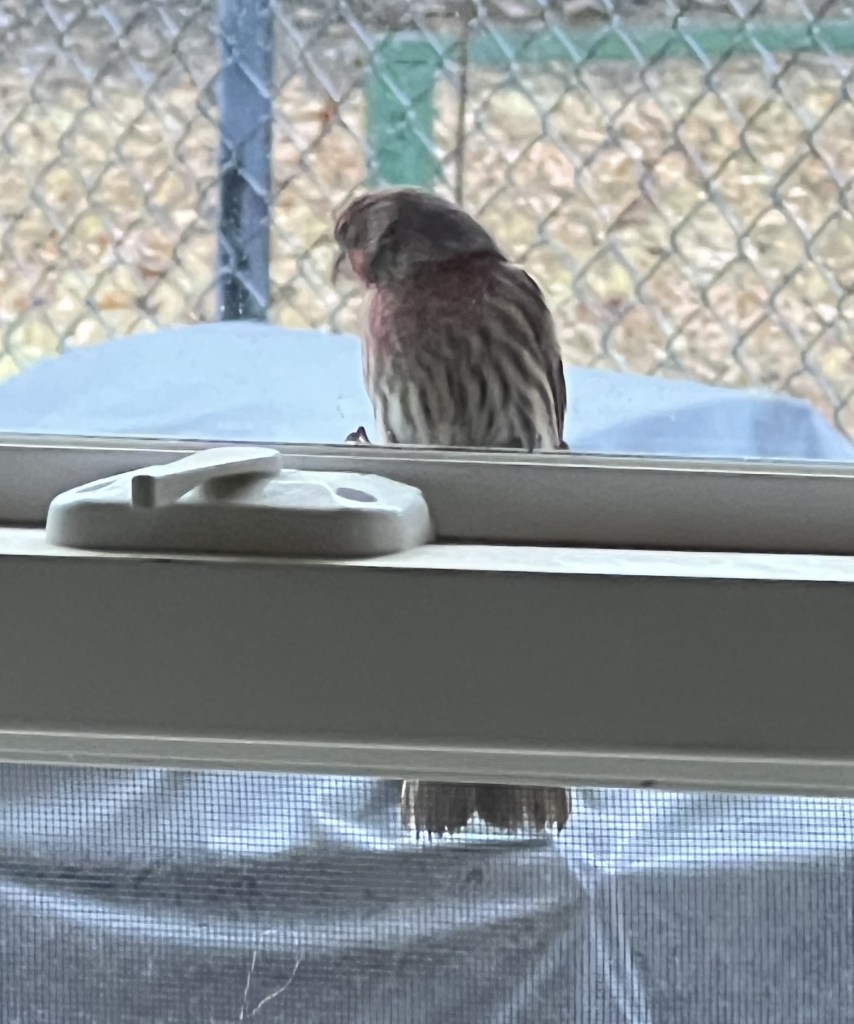
Melissa received a window box bird feeder as a gift from our son and family earlier this year. The feeder has suction cups on the back that allow it to attach directly to the glass. I placed the feeder in the bay window in the breakfast nook that serves as her home office so she can enjoy the bird activity while working. I fill the two sections of the feeder with different seeds to make it more attractive to the small birds willing to approach the window. One side has always had black sunflower seed (Helianthus annuus). I have varied the seed on the other side, but it currently has cracked safflower seed (Carthamus tinctorius). This feeder has become a preference for the eastern bluebirds (Sialia sialis), the sparrows (Genus, Zonotrichia), and purple finches (Haemorhous purpureus) that frequent our back yard. On Sunday I noticed what seemed to be a new species at the feeder. This was similar to the finches I have been watching but somehow seemed different. When I checked my bird ID this turned out to be a house finch.

When I looked online, I found the house finch (Haemorhous mexicanus) is a North American bird in the finch family. The species is native to Mexico and southwestern US but has been introduced to the eastern part of North America and Hawaii and is now found year-round throughout the US and most of Mexico. The house finch is a moderate-sized bird at 5 to 6 inches (12.5 to 15 cm) long, with a wingspan of 8 to 10 inches (20 to 25 cm). Body mass can vary from 9⁄16 to 15⁄16 ounces (16 to 27 g) with an average weight of 3⁄4 ounces (21 g). Adults have a long, square-tipped brown tail and are a brown or dull-brown color across the back with some shading into deep gray on the wing feathers. Breast and belly feathers may be streaked, and the flanks usually are. Most adult males have reddish heads, necks, and shoulders, and the color can extend to the belly and down the back as well. Male coloration varies in intensity with the seasons as it is derived from a diet of berries and fruits. Adult females have brown upperparts and streaked underparts. There are around 40 million house finches across North America, making it the second-most populous finch behind the American goldfinch.

The house finch and purple finch are closely related species and can be hard to identify. The main difference between the two species is the amount of red on the bird and the pattern on the face. They have similar body shapes, but the bill of the purple finch is a bit bigger, more conical, and deeper, while that of the House Finch has a more rounded shape. Both species get along with other small birds except during breeding season when they become protective of their territory. The other big difference comes with habitat. The house finch prefers a wide range of arid, open, and semi-open habitats, and will live in oak-juniper woodlands, open coniferous forests, and shrubby, and desert habitats from sea level to more than 11,000 feet, the house finch avoids dense forest of the purple finch. A small flock of house finch in Long Island, NY, escaped captivity in 1939 and has become the common bird of the eastern US and southern Canada. Their population has grown and expanded to millions of birds that thrive in urban and suburban places, preferring parks and urban settings with conifers and ornamental trees. Their songs are similar, but the purple finch sings a more melodious and “warbling” song, while the house finch incorporates chattering and trilled sounds.

THOUGHTS: Another similarity between the house finch and purple finch is they are both attracted to bird feeders. This explains why I have seen both species (and probably not realized it until now) in our backyard. Neither species is rare, but the house seems more urban and the purple more forest. Nature tells us that when the same species spend enough time separated and/or refusing to interact they grow apart and eventually become distinct. While humans have not yet reached that point as a species, it is a good lesson to be learned. Act for all. Change is coming and it starts with you.