
June 18
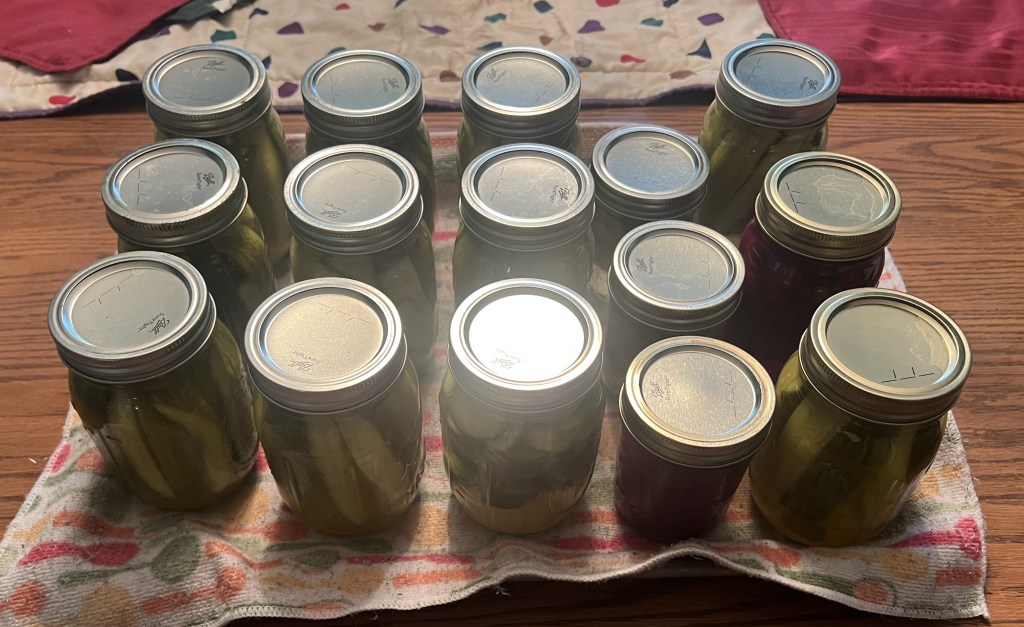
I got excited last year when my cucumbers started coming up. We like to make cucumbers (Cucumis sativus) as an appetizer. I peel and slice the cucumbers and arraign them on a plate. Then I drizzle olive oil over them and sprinkle them with either Italian seasoning or a spice mixture called Slap Your Mama. I also like eating cucumbers on my salad. We often make a side salad for whatever happens to be the entrée. This is what I call a “full-blown salad” of lettuce (Lactuca sativa), carrots (Daucus carota), and bell pepper (Capsicum annuum). Melissa will add tomatoes (Solanum lycopersicum) to hers as well. My “easy salad” is just romaine lettuce with slicked cucumber. When the cucumbers began producing, I bought canning jars, vinegar, pickling salt, and a bag of dill pickle seasoning so I would be ready. Then I checked to see how to begin pickling my cucumbers. I found I had grown slicing cucumbers, not the pickling variety.
When I went online, I found pickling is a way to preserving or extending the shelf life of food by either anaerobic fermentation in brine or immersion in vinegar. The procedure typically affects the food’s texture and flavor. The resulting foods are called pickles. If the food is named, the name is prefaced with the word “pickled”. Foods that are pickled include vegetables, fruits, mushrooms, meats, fish, dairy, and eggs. Pickling solutions are typically highly acidic, with a pH of 4.6 or lower, and high in salt, preventing enzymes from working and micro-organisms from multiplying. Pickling can preserve perishable foods for months or even years. Antimicrobial herbs and spices, such as mustard seed, garlic, cinnamon, or cloves are often added. If the food contains sufficient moisture, a pickling brine may be produced by simply adding salt. Sauerkraut and kimchi are produced by salting the vegetables to draw out excess water. Natural fermentation at room temperature, by lactic acid bacteria, produces the required acidity. Other pickles are made by placing vegetables in vinegar. Unlike the canning process, pickling does not require that the food be completely sterile. The acidity or salinity of the solution, the temperature of fermentation, and the exclusion of oxygen determine which microorganisms dominate, and determine the flavor of the pickled product.
This year I grew pickling cucumbers. As usual I did not know how many cucumbers a single plant would produce. I bought a small six pack of plants and looked forward to completing the job I tried to do last year. Neither did I know when I should pick my pickling cucumbers. I knew for slicing cucumbers they were often 8 to 10 inches (20 to 25 cm) long. If I picked them too soon, they would not be ripe, but if I waited too long, they could be tough. I ended up picking fruits that were getting too large as well as what I thought were the ripe ones. When I prepared them for pickling, I realized the “right size” was determined by what would fit in the pint jars I was using. I cut the ends off the cucumbers. The blossom end has enzymes that soften the pickles, and I do not like it when the stems are left on my pickles. I was making spears, but since some were too long to fit in the jar I also ended up with pickle slices. I found that 6 cumber plants produce way more fruit than I wanted to can. I ended up pickling 8 jars today and will have more by the time I am ready to pickle my beets. Now I just need to figure out what to do with all my pickling.
THOUGHTS: It is often claimed that pickling cucumbers was developed for workers building the Great Wall of China, although another hypothesis is that they were first made as early as 2030 BC in the Tigris Valley of Mesopotamia. Ancient sources documented awareness around the nutritional benefits of pickling and the perceived beauty benefits of pickles. Cleopatra credited pickles with contributing to her health and legendary beauty. Perhaps it is a good thing to have 15 jars of pickles. The best part is sharing produce with others. Act for all. Change is coming and it starts with you.
 A travelers odyssey