Cigarette Snail

June 10, 2026

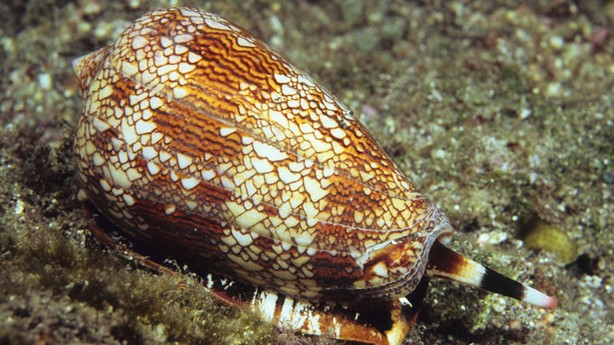
While perusing my MSN browser I came across a post from the journal Sciencing addressing one of the worst ways to die.  During the summer people are drawn to the beach for the nice sea breeze and warm sand.  Rather than relaxing and trying to get a suntan (harder now with my SPF 50 sunscreen) I like to spend time walking along the shore looking for shells.  Melissa and her family did the same and we have several snail-shaped glass vases filled with some of the shells rescued and brought home as souvenirs.  The best time of day to collect is after high tide as the water recedes and the shells are deposited on the beach.  An even better time is after a storm has passed and more shells and creatures have been deposited along the shore.  The article cautioned to avoid picking up one particularly pretty, cone shaped shell.  The occupant resting inside this beautiful relic is equipped with enough venom to kill 700 people.  It is said that if you were stung by this snail, you would perish before you had time to smoke one last cigarette.

When I went online, I found the geography cone (Conus geographus), also called the cigarette snail, is a species of predatory cone snail that lives in reefs of the tropical Indo-Pacific and hunts small fish.  While all cone snails hunt and kill prey using venom, the venom of this species is potent enough to kill humans.  Individuals grow to about 4 to 6 inches (10 to 15 cm) in length, with the size of an adult shell between 1.7 to 6.5 inches (43 and 166 mm).  The color of the shell is pink or violaceous white, but occasionally reddish and has a mottled appearance with two irregular chestnut or chocolate bands.  This intricate brown-and-white pattern is highly prized by shell collectors.  Geography cones are common and occur in the Red Sea, off the coast in the Indian Ocean, and are indigenous to the reefs of the Indo-Pacific (except Hawaii), and off northern Australia.  The snail’s distribution is largely explained by the temperature of its habitat and alterations due to climate change are predicted to impact its distribution in the following decades.

There are over 600 species of cone snails that are not equally dangerous to humans.  Only two species, the geographic cone and the textile cone (Conus textile), have reportedly resulted in human death.  There is also rich diversity in the venom that these snails produce.  Their venom is generally characterized by peptides known as conotoxins. Each snail produces over 100 of these conotoxins, and only 5% of them are estimated to overlap among species.  Only a few of these toxins have been characterized fully, which makes development of an antidote a challenge. The complexity of the conotoxins makes it difficult to understand exactly how death occurs in humans.  While scary, there have not been a lot of human fatalities recorded.  A review from 2016 showed that there have been a total of 36 recorded cone snail deaths and researchers are unsure whether these deaths have been a result of cardiovascular damage or damage to the respiratory system.  Humans are fortunate not to be a target species for the cigarette snail, leading to relatively rare toxic encounters.

THOUGHTS: While a sting by a cigarette snail may be one of the worst ways to die, their toxins may lead to medical innovation that could save lives.  Researchers have identified a drug based on cone snail venom that was approved in 2004 to treat chronic pain.  Another potential benefit might be derived from the cone snail insulin, which takes effect more quickly than human insulin.  There are currently about 11 to 12 FDA-approved medications derived directly from animal toxins, with 100’s more in clinical trials and research, adapted to treat everything from high blood pressure to chronic pain and diabetes.  If you do not provoke (pick up) the pretty shell, the snail cannot kill you.  Act for all.  Change will come and it starts with you.
Waves

February 05, 2025

Last night’s sleep was hard as our ship headed into the Aegean Sea.  Melissa had worried about being on open water and prepared with a motion sickness remedy.  The problem was, she did not take it in advance.  I reserved an elegant Italian dinner in the ship-board restaurant, and we were seated next to a window to allow us to overlook the water.  The meal started as we watched the rolling waves along with our first three courses.  By the time we reached the main course melissa’s stomach was rolling along with the ocean.  She excused herself and went back to our stateroom for the medicine.  I finished the meal (it was amazing) and watched as the waves continued to roll.  I thought nothing of the waves as I crawled into bed and lay down for what I thought was going to be a good night’s sleep.  I was wrong.  When I lay down all I could feel was the rolling of the ocean.  Neither of us had been on a ship in the open ocean and we figured we were just being susceptible to the rolling waves.

When I looked online, I found most ocean waves are wind generated.  Wind blowing across the water’s surface creates little disturbances or ripples (capillary waves) that start from gentle breezes.  Capillary waves have a rounded crest with a V-shaped trough, and wavelengths around 1 inch (less than 1.7 cm).  These small ripples give the wind something to “grip” to create larger waves as the wind increases.  Once the wavelength exceeds 1 inch (1.7 cm) the wave transitions from a capillary wave to a wind wave.  All waves are opposed by a restoring force that attempts to return the water to calm.  The restoring force of capillary waves is the surface tension of the water, but for wind-generated waves the restoring force is gravity.  As the energy of the wind increases, so does the size, length, and speed of the waves.  There are three important factors determining how much energy is transferred from wind to waves, and how large the waves get.  These are wind speed, wind duration, and distance the wind blows across the water in the same direction (fetch).  Increasing any of these factors increases the energy of wind waves along with their size and speed.  There is an upper limit to how large wind waves can get.  As wind increases, the waves get larger, but when the wave height exceeds 1/7 of the wavelength, the wave becomes unstable and collapses, forming whitecaps.

The waves kept Melissa and I up for much of the night and we were tired the new day.  While Melissa chose to stay on the ship, I set out on the day’s excursion to Dion, an archaeological site from the Classical Greek and Roman eras.  Melissa asked several of the crew about the waves and none of them had noticed anything unusual (i.e., it was us).  I traveled with other “landlubbers” who had experienced excessive waves.  Over lunch, it was mentioned the rough seas had been created by the hundreds of earthquakes that rattled the Greek islands on the Aegean Sea.  This “seismic swarm” could continue for weeks before diminishing.  Santorini’s Mayor Nikos Zorzos told The AP Tuesday, “This phenomenon may play out with small quakes or a single, slightly stronger one, followed by gradual subsidence.”  The quakes are credited with the rough sea and waves we experienced.  There are thousands of residents and seasonal workers who have left the Cycladic Islands as quakes up to magnitude 5 have been recorded in the volcanic region since Friday.

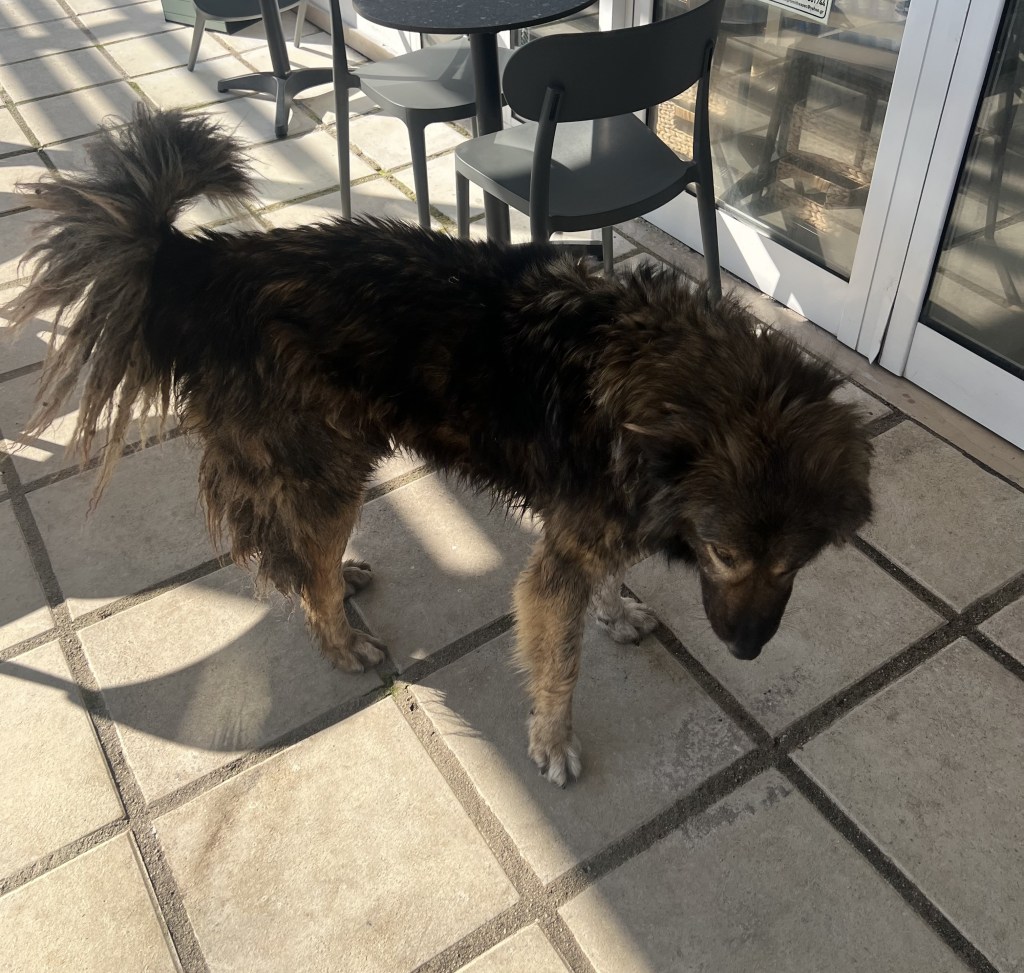
Thoughts: The waves we encountered the night before left melissa and I both seeking solace.  Melissa found it lying on a beach chair on the ship overlooking the city of Volos.  As I struggled to walk the site of Dion, I found it with a large dog.  I stopped listening to the lecture and felt something on my hand.  Looking down I saw a scraggly dog nudging me for attention.  I stopped to pet him, and I did feel better.  Animals have an uncanny ability to sense unease and try to make us feel better.  I would be nice if humans could find the same compassion.  Act for all.  Change is coming and it starts with you.