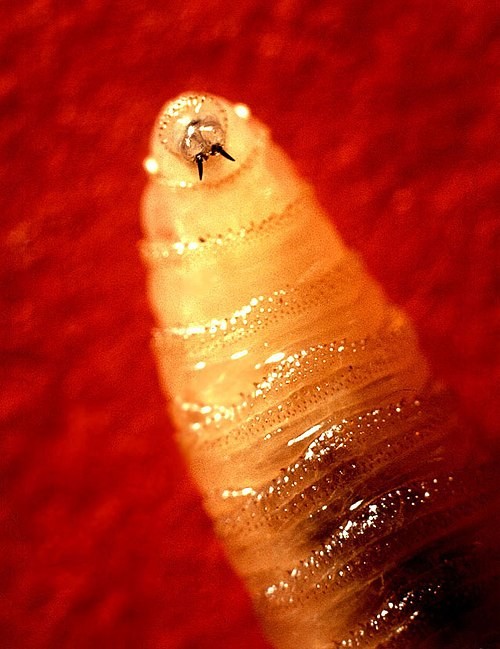
Screwworm

November 10, 2025

The Sunday before Halloween, the Homes section of my local newspaper ran a Reutters article detailing a new sterile fly plant added in Mexico.  In Metapa, Mexico, engineers, veterinarians, and entomologists are racing to repurpose a plant that will play a pivotal role in trying to eradicate the flesh-eating fly threatening the country’s cattle industry and raising tensions with the US.  The facility used to help control Mediterranean fruit flies, but workers are dismantling old infrastructure and rebuilding specialized laboratories designed to mimic the conditions of an animal wound.  The plant aims to be ready by July 2026 and would double the number of sterile flies Mexico can release into the wild.  The US has kept its border mostly closed to Mexican cattle imports since May 2025 and has invested US$21 million towards the US$51 million facility in Chiapas state in an effort to keep the screwworm fly out of America.

When I went online, I found the New World screwworm fly (Cochliomyia hominivorax), or simply screwworm, is a species of parasitic blowfly which is present in the New-World tropics.  The screwworm larvae (maggots) eat the living tissue of warm-blooded animals.  Of the four species of Cochliomyia, only the species hominivorax is parasitic, but a single parasitic species of Old-World screwworm fly is placed in a different genus (Chrysomya bezziana).  The maggots of many fly species eat dead flesh and may occasionally infest an old and putrid wound.  Infestation of a live vertebrate animal by the screwworm maggot (myiasis) is unusual because they attack healthy tissue, increasing the chances of infection, which then attracts more flies.  Screwworm females lay 250 to 500 eggs in the exposed flesh which hatch and burrow into the surrounding tissue as they feed.  If the wound is disturbed during this time, the larvae burrow or “screw” deeper into the flesh, giving the larva its common name.  The maggots can cause severe tissue damage or even death to the host.  About three to seven days after hatching, the larvae fall to the ground to pupate, reaching the adult stage about seven days later.  The female will mate four to five days after hatching and can lay up to 3,000 eggs and fly up to 120 miles (200 km) during her life.  Males mate up to ten times, but females mate only once and retain the male’s sperm for life, leading to the sterile eradication technique.

The screwworm was the first species to be tested with the sterile insect technique and resulted in control and systematic eradication of the species from the US, Central America, and parts of the Caribbean beginning in the 1950’s.  The US and Mexico bred and released more than 94 billion sterile flies from 1962 to 1975.  By the early 2000’s, it was considered eradicated from North America, but was detected in Mexico in 2024 and 2025, prompting renewed efforts to prevent its re-emergence.  The fly is still widespread in tropical and subtropical parts of the Caribbean and South America and animals imported from these areas must be inspected or treated to prevent the pest’s reintroduction.  Eradication efforts continued and in 1998 the first sterile flies were released in Panama with the goal of creating a barrier zone at the Darién Gap against a screwworm invasion.  This is achieved through weekly sterile screwworm releases of up to 50 million insects bred in factories and sterilized by ionizing radiation.  The bred insects must not suffer any impairment to compete with wild, fertile insects.  In September 2025, a case of New World screwworm was found in Sabinas Hidalgo, Mexico, less than 70 miles (110 km) from the US-Mexico border.

THOUGHTS: When sterile screwworm males’ mate with wild females no offspring are produced, and the population collapses over time.  Coordinator Jose Luis Quintero said, “The screwworm was eradicated once before in Mexico — it took 19 years.  We hope to do it in far less time.”  Let’s hope that is the case.  Act for all.  Change is coming and it starts with you.

Wavy-lined

October 14, 20254

Melissa tends to keep the back door to the porch open to help provide a breeze and keep down the humidity for the succulents.  If the air conditioner is not running, she will often keep the house door open as well.  This provides a breeze for us and allows the kids to roam freely in and out of the house without having to get up every time they hear a noise or want to go outside.  While this is convenient, it allows house flies (Musca domestica), moths (order, Lepidoptera), and other flying insects (and occasional birds) to fly enter both the porch and the main house.  I have tried to combat this by placing a bug-zapper next to the doorway.  The blue light is not visible during the day but does attract moths at night.  When it is time for a final constitutional, Loki will wait at the door for Melissa or I to go first to “protect” him from the sounds of the moths hitting the zapper.  When I got up yesterday, I noticed one of the moths had avoided the zapper and was attached to the wall above the kitchen sink.  When I looked closer the moth’s coloration was “wavy-lined”.

When I went online, I found the wavy-lined emerald moth (Synchlora aerate), or camouflaged looper, is a species of moth of the family Geometridae.  The species is found in the US and Canada and was described by Johan Christian Fabricius in 1798.  There are dozens of species in the subfamily of emeralds in North America.  Most look incredibly similar, being green (sometimes tan) and typically resting with their wide wings spread out to the sides.  The key identifying features for the species are the mildly wavy white lines that run across the wings, a pale green fringe on the wings, and a long, thin white stripe running the whole length of the abdomen.  The adult wingspan is about 0.67 inches (17 mm).  The caterpillar of this species is an inchworm (looper) that camouflages itself from predators with small clippings from flower petals they are feeding on.  The wavy-lined is a common moth that has two or three broods a year and overwinters as a partially grown larva. 

The wavy-lined emerald moth is an important food for birds and other predators.  While some insects use camouflage or mimicry to outwit predators, the wavy-lined caterpillar blends these two defenses.  Insect camouflage often refers to creatures like stick bugs (order, Phasmatodea) that have evolved to look like their surroundings.  Mimicry means looking like a completely different creature, like the less toxic Viceroy Butterfly (Limenitis archippus) which looks like the toxic Monarch (Danaus plexippus).  The wavy-lined larva will attach bits of the plant material on which it is feeding to its back with bits of silk to blend into its host plant and avoid detection.  When it feeds on a different plant it will “wear” the appropriate foliage.  These fragments start off colorful (to blend in with the flower) and then dry out to look like a chunk of debris.  It also seems to detach and replace the parts as they wilt, keeping the larvae covered in fresh adornments that match its meal.  While it is essentially using camouflage, the insect is an active participant in the process, mimicking whatever flower it feeds on. 

THOUGHTS: While I have no problem swatting the flies and mosquitoes (family, Culicidae) that invade my house, I did not feel threatened or bothered by the wavy-lined emerald moth.  It spent the entire day resting on the wall as Melissa and I came and went around the sink, allowing me to admire its delicate lines many times.  When I got up this morning the moth was gone.  Hopefully it made it past the bug zapper on its way outside.  Most insects tend to go about their business and do not seek out humans.  Flies and mosquitoes are an exception and use humans as a source of food (dead skin, blood), water (sweat), and salt.  The fact that the moths are aesthetically pleasing is another plus.  Sometimes I need to remind myself that every creature has a role to play in the larger biome.  Act for all.  Change is coming and it starts with you.
Wildflower Bed

July 07, 2025

Five years ago, I blogged about my stint as director of a conference center in Kansas.  The camp was located on 63 acres (25.5 ha) of mixed trees and (originally) prairie grass that was now mostly seeded with Bermuda grass (Cynodon dactylon) for lawns.  During the summer we spent 5 to 6 days a week on the mower cutting grass.  Part of our mission was to provide opportunities for education, so I decided to let the prairie grass return.  The first year we let most of the camp return to natural grass to evaluate where the prairie grass was still abundant.  The second year we selected about 12 acres (4.5 ha) to return to native prairie.  We also reseeded those acres with the Big Five grasses prominent in the Tall Grass Prairie that used to dominate Kansas.  This provided lawn for camp activities and nature trails with identification signage for eco-visitors.  To complete the prairie’s restoration, we seeded a variety of prairie wildflowers in prominent locations along the roads.  Being on the flyway of the Monarch butterfly, I transplanted 20 milkweeds (Asclepias syriacaplants) from the lawns into a wildflower bed near the entrance of the camp.

When I went online, I found a wildflower is a flower that grows in the wild, rather than being intentionally seeded or planted.  The term implies that the plant is neither a hybrid nor a selected cultivar that is any different from the native plant, even if it is growing where it would not naturally be found.  This can refer to the whole plant, even when not in bloom, and not just the flower.  The term “Wildflower” is imprecise, and more exact terms refer to specific types of flowers including native species naturally occurring in the area, exotic or introduced species not native to the area, invasive species that outcompete other plants (introduced deliberately or accidentally), and plants that have become naturalized (imported but considered native by the public).  Wildflowers can be annual (germinates from seed, live one year), perennial (live multiple years, return each growing season), or biennial (two-year life cycle, blooming in the second year).  In recent years, wildflower gardening has gained popularity.  A planted wildflower bed not only looks attractive but has the advantage of supporting pollinators, reducing maintenance, and conserving water. 

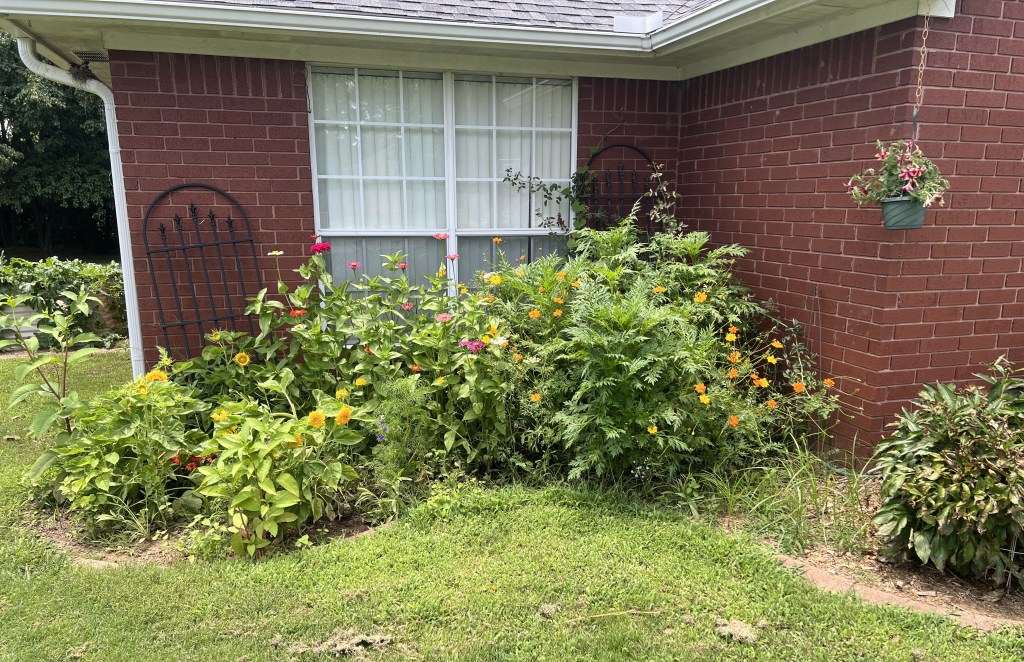
I wanted to duplicate my conference center experience when we moved to Arkansas, but I could never decide where to plant the wildflowers.  Melissa’s mom established several flower beds that I thought Melissa wanted me to maintain.  Melissa likes the look of a green lawn and symmetrical flower beds more than the asymmetrical look of a wildflower bed.  I was also interested in expanding my garden into the front beds to replace the roses neither of us liked.  Indecision meant we did nothing for five years.  Last year we did decide to place wildflowers in one of the beds in front of the house but never got around to doing so.  When Melissa retired this year, she decided she would plant a wildflower bed.  We sprayed to kill all the grass that had taken over the beds, spaded the soil and weeded the bed to prepare it, Melissa sowed the seed, and then we waited.  The first thing that grew was more grass and weeds, so I weeded the bed again.  The wildflowers finally began to grow.  Now we have a wildflower bed in the front of the house.

THOUGHTS: One of the problems with weeding the wildflower bed was knowing what to pull and what to leave.  Removing the grass was obvious, but how do you tell the difference between the wildflowers Melissa planted and the weeds that grew naturally?  In essence, all wildflowers are weeds if they are intruding in the vegetables or “planted” flowers.  I decided to leave any plants I could not identify.  If it grew a flower it was supposed to be there, whether Melissa sowed the seed or not.  The same could be said for people.  If they flourish in a new location they are meant to be there, no matter how they arrive.  Act for all.  Change is coming and it starts with you.
Leafcutter

June 29, 2025

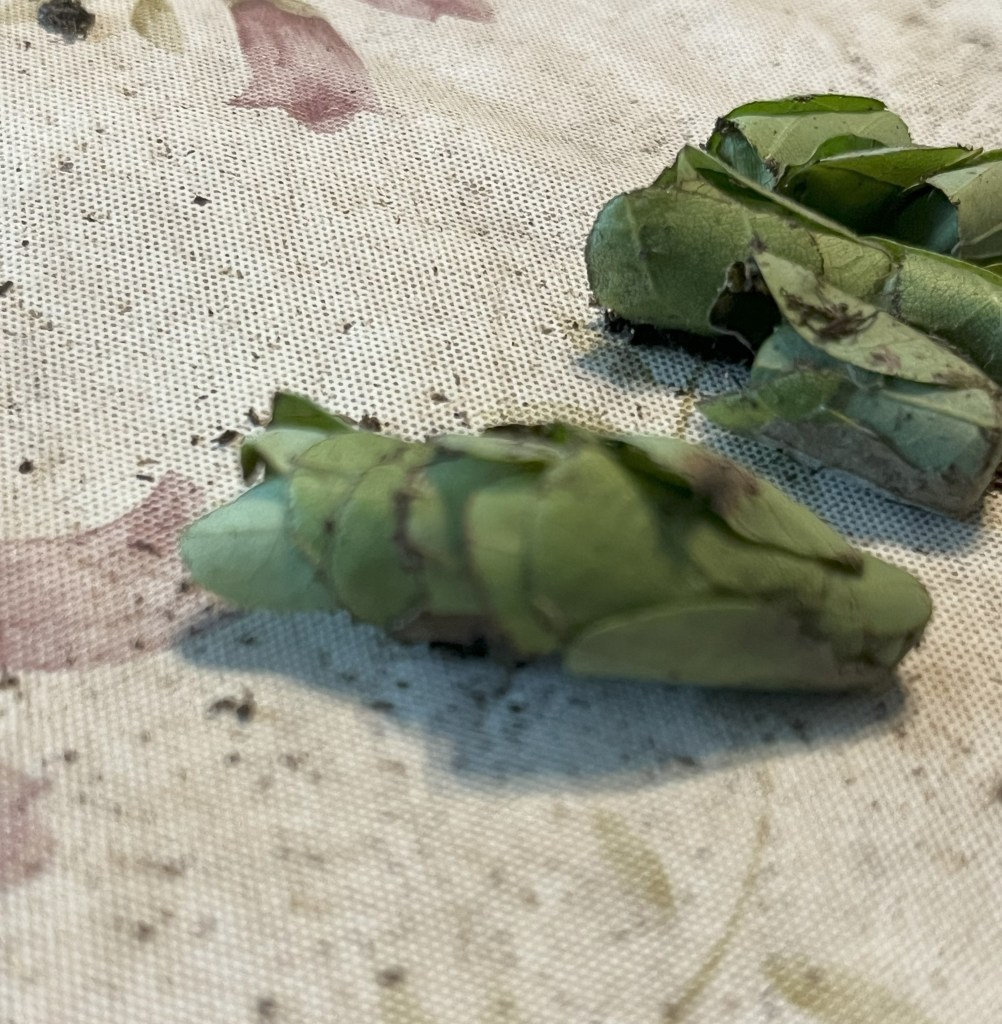
Melissa went shopping with me yesterday to get out of the house.  I needed to get some roasted peanut chips for the birds and Melissa wanted to look at the succulents.  She was surprised by the large number of inexpensive arraignments, and by their state of disrepair.  They were all soaked in water (causes root rot) and the leaves were starting to fall off.  Melissa bought a large arraignment to divide into separate plants and try and save them.  As we were checking out, I mentioned to the attendant that the plants were getting too much water.  She agreed and said she had also bought several to save them from dying.  When we got home Melissa began dividing the arraignment and repotting them into a cactus medium.  The plants were in potting soil (retains water) rather than cactus medium and the bright containers were made of plastic (retains heat).  Each of the plants were root-bound from their previous pots and the soil had not been broken up.  As Melissa dug through the potting soil she came across what looked like a leaf tube buried deep in the soil.  When she googled the odd structure, she found it was the egg nest of a leafcutter.

When I went online, I found leafcutter bees (Megachilidae), are part of a widespread (cosmopolitan) family of mostly solitary bees.  Characteristic traits of this family are the restriction of their pollen-carrying structure (scopa) to the ventral surface of the abdomen, rather than on the hind legs as in other bee families, and their typically elongated flap-like structure immediately in front of the mouth (labrum).  The scientific name Megachilidae refers to the genus Megachile, translating roughly as large lipped (Ancient Greek mégas – “big” and kheîlos – “lip”).  Their “large lips” and strong jaws are well-suited for collection of building materials for the nest.  These bees get their names from the materials they use to build their nest cells.  Leafcutter bees use leaves while mason bees use soil.  A few species collect plant or animal hairs and fibers (carder bees) while others use plant resins in nest construction (resin bees).  All species feed on nectar and pollen, but a few are kleptoparasites, which feed on the pollen collected by other megachilid bees.  The parasitic species do not possess scopae.  North America has an estimated 630 different megachilid species.  Most are native but a few are introduced, accidentally and intentionally.  Globally the number of species identified exceeds 4,000 and represents 15% to 20% of named species of bees.

The Nonparasitic Megachilidae divide their nests into cells with each cell receiving a supply of food and an egg.  The larva hatches from the egg and consumes the food supply.  After molting a few times, it spins a cocoon and pupates, then emerges from the nest as an adult.  Males die shortly after mating, but females survive for another few weeks, during which they build new nests.  Nest cavities are often linear, like the one found by Melissa, but not always.  Above ground megachilid bees are more commonly cultivated than ground nesting bees.  They accept nesting materials made from hollow stems, tubes, and blocks with preformed holes (“nest blocks”), and several megachilids have become important species for agricultural or horticultural pollination.  In North America these cultivated bees include the introduced alfalfa leafcutter bees (Megachile rotundata), used extensively in alfalfa pollination, and the orchard mason bee or blue orchard bee (Osmia lignaria), used in orchard pollination.  Other species are also in commercial use in North America, Europe and Asia.

THOUGHTS: Arkansas is home to at least 40 species of bees and the genus Megachile, has an estimated 15 to 20 species, including many leafcutter species.  Finding the nest tube of a leafcutter bee shows how easy it is to transport a species to another area.  While the leafcutter is beneficial, not all invaders are.  People criticize states like California which have tight controls on agricultural products.  Perhaps we should all be vigilant.  Act for all.  Change is coming and it starts with you.