Conjunction

September 18, 2025

Image credit: Matt Champlin via Getty Images

A USA Today article toward the back of the front section of my local newspaper reported on the celestial event taking place on September 19th (tomorrow).  Three celestial bodies are preparing to meet for one night that should be widely visible in the sky.  The Earth’s moon and the planet Venus of Sol’s solar system will be briefly joined by the star Regulus.  This event follows the close appearance of Venus and Jupiter during much of August.  This moon-planet-star combination involves three of the brightest objects in our solar system and should make it easy for amateur astronomers to spot.  This coming together, or conjunction, presents a special opportunity for even casual stargazers to see multiple celestial bodies at the same time.

When I went online, I found an astronomical conjunction occurs when two objects or spacecraft appear to be close to each other in the sky.  This means they have either the same angular distance of a particular point measured eastward along the celestial equator (right ascension) or the same apparent positions, orbits, and pole orientations (ecliptic longitude).  This closeness phenomenon is caused by the observer’s perspective, and the objects are not actually close to one another in space.  Conjunctions between two bright objects close to the ecliptic, such as two bright planets, can be seen with the naked eye.  More generally, it means they have the same right ascension.  A conjunction seen by an observer on Earth involves two (or more) astronomical bodies and the times and details depend only slightly on the observer’s location on the Earth’s surface.  The differences are greatest for conjunctions involving the Moon because of its relative closeness, but even for the Moon the time of the observed conjunction never differs by more than a few hours.

Conjunctions occur as the various paths of celestial objects traveling at varying speeds are brought together on the same side of the sun (from Earth’s perspective).  The moon orbits around the Earth as our only satellite.  Venus orbits as the sun’s second planet and is often referred to as “the Earth’s twin” as both are rocky (rather than gaseous) and have a similar orbit.  Regulus is the brightest star in the constellation Leo.  This trio should be visible in the sky tomorrow night.  Those who are in the Northern Hemisphere (North America, Europe, Asia) should be able to spot the conjunction easily by looking for the moon.  Chelsea Gohd, science communicator at NASA’s Jet Propulsion Laboratory in California, explained attention should be directed east in the early pre-dawn toward the waning crescent moon as it sets in the sky.  Pre-dawn may be a stretch for me as I generally do not stay up that late or rise that early.  We will see.

THOUGHTS: Conjunction is one of the words that stuck in my mind in high school as I was a cartoon connoisseur and often did stay up late enough to catch the pre-dawn shows that aired.  This was the 70’s and evils of television were being countered by short educational promos offered by educational media like “Schoolhouse Rock!”.  One segment in the series was titled “Conjunction Junction” and addressed the grammatical use of a conjunction.   It was presented as a catchy song that is running through my head as I blog.  The phrase “conjunction junction what’s your function” draws its meaning as a “junction” that connects things, and its “function” is to join words, phrases, and clauses together to form more complex sentences.  The song uses the analogy of railroad “boxcars” hooked up by the conjunctions (i.e., “and,” “but,” “or”) to help viewers understand their grammatical role (analogical reasoning).  This cognitive process uses prior knowledge of a known situation (“base domain”) to understand or solve a new, similar problem (“target domain”) by identifying shared structures and relationships between them.  In human relationships, such analogies may create positive or negative responses.  Act for all.  Change is coming and it starts with you.

Marrow

July 08, 2025

My MSN browser scroll reported on a new study that shows evidence of Neanderthal “fat factories” dating back as far as 125,000 years ago.  The inhabitants of the settlement strategically selected the lakeside location for the factory and harvested bone marrow by breaking open the bones as well as through a process of crushing and heating.  The fat factory suggests Neanderthals were able to understand their environment and plan for hunting and resource-gathering.  The recent research from Leiden University and published in the journal Science Advances adds to decades of previous research at the Neumark-Nord archaeological site near Leipzig, Germany.  According to a press release from Leiden University, there is also evidence of plant use in the area, though it’s rarely preserved.  Additionally, previous studies found proof that inhabitants used fire to manage vegetation.  Needless to say, Neanderthals have long been underestimated, and the new study does nothing to dissuade that notion.  This fat factory was created to extract marrow from bones.

When I went online, I found bone marrow is a semi-solid tissue found within the spongy (cancellous) portions of bones.  In birds and mammals, bone marrow is the primary site of new blood cell production (haematopoiesis).  Marrow is composed of hematopoietic cells, marrow adipose tissue, and supportive stromal cells.  In adult humans, bone marrow is primarily located in the ribs, vertebrae, sternum, and bones of the pelvis.  Bone marrow comprises approximately 5% of total body mass in healthy adult humans.  A person weighing 161 pounds (73 kg) will have around 8 pounds (3.7 kg) of bone marrow.  Human marrow produces approximately 500 billion blood cells per day, which join the systemic circulation via permeable vasculature sinusoids within the medullary cavity.  All types of hematopoietic cells, including both myeloid and lymphoid lineages, are created in bone marrow.  However, lymphoid cells must migrate to other lymphoid organs (like the thymus) to complete maturation.

Archeologists found the Neanderthals intentionally selected the lakeside location to process the bones of at least 172 mammals including deer (genus, Cervus), horses (Equus ferus caballus), and aurochs (Bos primigenius), an extinct species of bovine.  Inhabitants at the site broke open large mammal bones to extract the marrow and ground the bones into fragments and heated them in water to extract calorie-rich bone grease.  This indicates estimates of advanced resource collection began thousands of years earlier than previously thought.  Lutz Kindler, the study’s first author, said, “Neanderthals were clearly managing resources with precision.  They understood both the nutritional value of fat and how to access it efficiently.”  Experts believe Neanderthals understood there was a “fat quota” they had to meet to make the process worthwhile.  The authors emphasized the number of herbivores that Neanderthals at Neumark-Nord must have been hunting and were likely able to plan and use their environment effectively.  Research into marrow extraction at the Neumark-Nord site complex was possible because this was not a single site but an entire landscape and provided the opportunity to investigate how Neanderthals influenced their environment. 

THOUGHTS: The Neanderthals who created the marrow extraction factory at Neumark-Nord present a far different picture than the often-depicted primitive, club-wielding, nonsocial individual driven solely by animal instinct.  Modern humans tend to seek ways to differentiate ourselves from our homo sapiens ancestors as well as extant animals.  The more research done indicates we are often more alike than different.  All creation should be respected for both its similarity and difference.  Act for all.  Change is coming and it starts with you.

Atolls

March 31, 2025

© Laurent Ballesta

Today’s MSN browser carried an article about the mysterious circles found on the floor of the Mediterranean.  The circles were discovered in 2011 by a team of scientists led by marine biologist Christine Pergent-Martini.  More than 1,300 rings, about 65.5 feet (20 m) in diameter with a dark spot at their center, were detected through satellite images and confirmed through underwater explorations.  Theories on the circle’s origin ranged from unusual geological formations to extraterrestrial intervention (when in doubt it must be UFO’s).  A decade of research has found the key to their origin.  When biologist Laurent Ballesta submerged himself to reach one of the rings he realized “it was alive”.  The formations are composed of calcareous algae and various marine organisms which create rigid structures on the seafloor that, over time, form a circular arrangement.  The study of these circles revealed that they are biological structures known as coral atolls.

When I looked online, I found atolls are ring-shaped islands with a coral rim that encircles a lagoon.  Atolls occur in warm tropical or subtropical parts of the oceans and seas.  Most of the approximately 440 atolls are in the Pacific Ocean.  There are two models which explain how atolls form.  Charles Darwin described the subsidence model, where the atoll is formed by the sinking of a volcanic island that had a coral fringe reef.  The extinct volcanic island erodes and sinks under the surface of the ocean until the reef and small coral islets on top of it are all that is left, leaving a lagoon in place of the former volcano.  The antecedent karst model has formation as the development of a flat top, mound-like coral reef during the sinking of an island (volcanic or nonvolcanic) below sea level.  When the sea level drops, the coral reef is exposed to the atmosphere and is dissolved by rainfall to form limestone karst.  The rate the exposed coral is dissolved is lowest along its rim and increases inward to its maximum at the center of the island resulting in a saucer shaped island with a raised rim.  When the sea level rises the island is submerged and the rim provides a core where the coral grows to form the atolls, and the flooded bottom of the saucer forms the lagoon.

While the Mediterranean coral atolls do not breach the surface, they form in a similar fashion.  The perfect symmetry of the rings is due to the radial growth of the algae and corals that make up the ecosystem.  The interaction between the ocean currents and the development of the living organisms generates this unusual arrangement on the ocean floor.  The discovery of coral atolls has important implications for the study and conservation of marine ecosystems as these formations play a crucial role in the biodiversity of the Mediterranean, providing shelter for numerous species and acting as indicators of the health of the oceans.  Experts warn these structures are extremely fragile and climate change, pollution, and human activity could affect their development.  Ocean acidification and rising temperatures may alter the growth of the organisms that form these atolls, threatening their existence.

THOUGHTS: We still know very little about the submerged coral atolls found in the Mediterranean.  Pergent-Martini said, “What is clear is that their preservation is key to maintaining the balance of marine ecosystems in the region.”  The ocean covers approximately 70% of Earth’s surface and represents the largest livable space on our planet.  Its surface area is about 139 million miles2 (360 million k2) and an average depth of 12,080 feet (3,682 m).  Life exists throughout these depths, but much of the ocean is unexplored.  As of June 2024, 26.1% of the global seafloor had been mapped with modern high-resolution technology (multibeam sonar systems).  While 54% of the seafloor beneath US waters had been mapped to these modern standards, the US seafloor is larger than the land area of all 50 states, the District of Columbia, and the five territories combined.  The future of exploration is both out there and under here.  Act for all.  Change is coming and it starts with you.

Blue Ghost

March 07, 2025

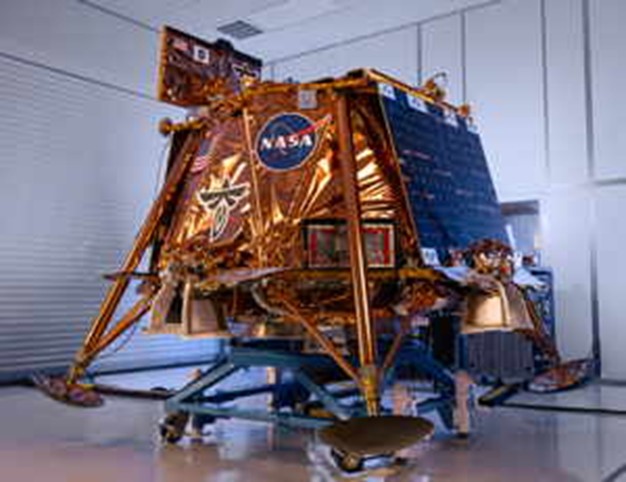
Inside the back section of Thursday’s newspaper was a USA Today article on the lunar lander that touched down early Sunday morning, March 2nd.  NASA’s Janet Petro said, “This incredible achievement demonstrates how NASA and American companies are leading the way in space exploration for the benefit of all.”  The Texas based Firefly Aerospace was hired by NASA to carry scientific instruments to the moon’s Earth-facing side to study its environment ahead of a manned return.  The 10 instruments will be used for lunar subsurface drilling, sample collection, X-ray imaging, and dust mitigation.  The craft has already sent striking images of the moon since it arrived in Lunar Orbit on February 10th.  Firefly has named this class of lunar lander the Blue Ghost.

When I looked online, I found the Firefly Aerospace Blue Ghost, or simply Blue Ghost, is a class of lunar landers designed and manufactured by the private American company Firefly Aerospace designed to deliver small payloads to the surface of the Moon.  The first Blue Ghost mission was launched January 15, 2025, at 1:11 a.m. EST and successfully landed on the Moon on March 2, 2025.  The landers are named after the firefly (Phausis reticulata) known as the Blue Ghost.  Firefly is the prime contractor for lunar delivery services using Blue Ghost landers which provide payload integration, launch from Earth, landing on the Moon, and mission operations.  Blue Ghost has four landing legs and is designed and built to be easily adapted to each customer’s needs between the earth and moon or in the moon’s orbit (cislunar).  Blue Ghost can be customized to support larger, more complex missions and is compatible with multiple launch providers. NASA awarded Firefly the first Blue Ghost lunar delivery task order in February 2021 as part of the Commercial Lunar Payload Services (CLPS) initiative.

The lander’s blue ghost namesake is a species of firefly found in the eastern and central US and is common in the southern Appalachians.  Adults are found in a variety of habitats, including dry and moist woods, near water, and along high, dry ridges.  The male of the beetle species is all-brown and about 0.2 to 0.4 inches (6 to 9 mm) long with large eyes.  The female is smaller, measuring 0.2 to 0.4 (4 to 9 mm) long.  Female blue ghosts are wingless, are yellow. and remain in larval form through adulthood (paedomorphic).  The females glow continuously from 4 to 9 spots on her body so they can be spotted by the males.  Once a female lays her clutch of 20 to 30 eggs, she guards them until she dies in one to two weeks.  The eggs hatch approximately 4 to 5 weeks after the mother dies. The larvae are extremely tiny, approximately 0.05 in (1 – 2 mm) and are bioluminescent.  Unlike many firefly species in the US, the blue ghost displays a steady glow rather than the typical flashing pattern.  The light emitted appears (to humans) as blueish-white when seen from a distance, but bright green when examined at close range.

THOUGHTS: The discrepancy in the observed color of the blue ghost is likely due to the Purkinje effect.  While the effect is often described from the perspective of the human eye, it occurs in other animals under the same name.  This effect describes the general shifting of spectral sensitivity due to pooling of rod and cone output signals as a part of dark/light adaptation.  The colors seen by different animals vary greatly depending on the makeup of those rod and cone features.  Humans seem to be in the middle of both color detection and acuity.  This is also true about our ability to make observations and gain understanding.  “Not like us” means different, not better or worse.  That is true for other animals and other humans.  Act for all.  Change is coming and it starts with you.
Aurora

October 11, 2024

Both the national and local news were abuzz yesterday with predictions of the amazing light displays that were going to appear in the northern sky last night.  This dazzling display of color was the result of a powerful solar storm that slammed into Earth.  This celestial phenomenon is more often a tourist attraction for people traveling to Alaska, Iceland, and regions within the Arctic Circle, but last night’s storm triggered lights in the night sky much further south.  This is the second time a severe solar storm hit the Earth this year, with the first being in May.  My sister lives in Maine and she started the buzz for our family, posting photos on our family feed of the crimson display seen from her back yard.  It was also suggested by the National Oceanic and Atmospheric Administration that the lights were going to be visible as far south as Alabama and northern California.  Reports came in from as far south as Texas and Arizona, while the southern lights were seen in parts of Australia.  As we watched the 10 pm news, there were postings of the aurora from areas of northwest Arkansas.

When I looked online, I found an aurora, commonly known as the northern lights (aurora borealis) or southern lights (aurora australis), is a natural light display in Earth’s sky that is predominantly seen in high-latitude regions around the Arctic and Antarctic.  Auroras display dynamic patterns of brilliant lights that appear as curtains, rays, spirals, or dynamic flickers covering the entire sky.  An aurora is the result of disturbances in the Earth’s magnetosphere caused by the solar wind.  Major disturbances result from enhancements in the speed of the solar wind from coronal holes and from coronal mass ejections that alter the trajectories of charged particles in the magnetospheric plasma.  The particles, mainly electrons and protons, then precipitate into the Earth’s upper atmosphere (thermosphere or exosphere) and the ionization and excitation of atmospheric components emit light of varying colors and complexity.  The form of the aurora is dependent on the amount of acceleration the solar winds impart to the precipitating particles.  Most of the planets in Sol’s Solar System, some moons, brown dwarfs, and even comets can display an aurora.

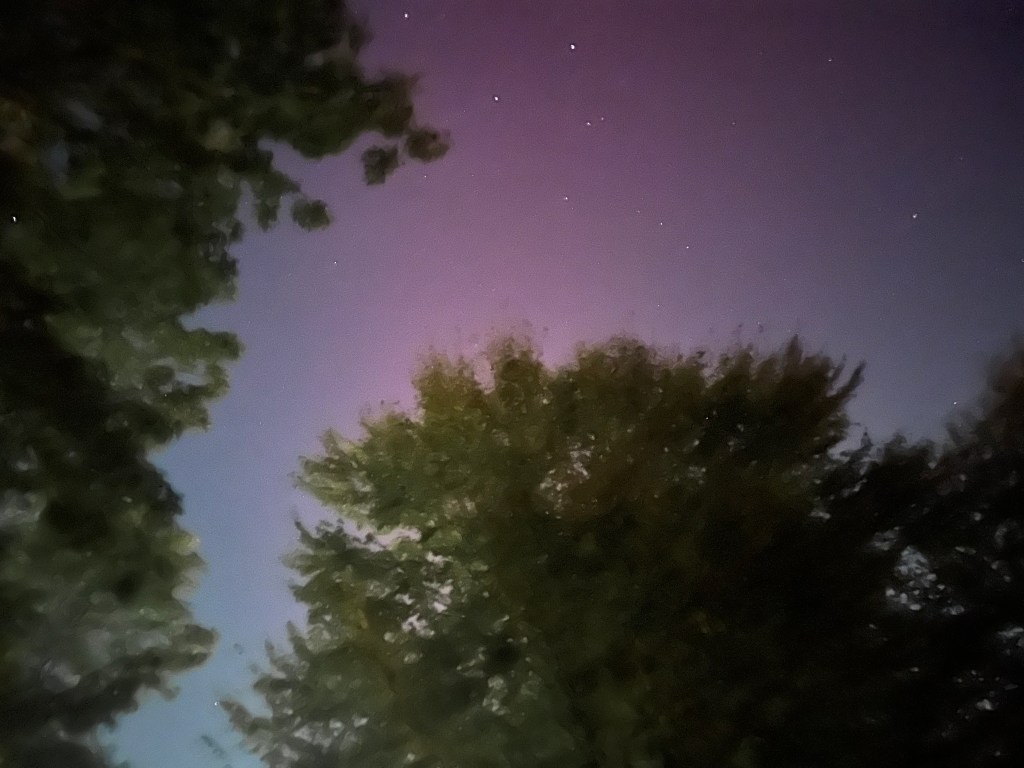
Melissa and I had taken the bait in May and gone outside to look for the aurora on our back deck.  The TV news had been posting photos taken throughout our state and we wondered if we could see anything.  Our deck is mostly surrounded by trees, but there is a patch of northern sky that is visible.  At the time we had not seen anything.  This time Melissa’s friends began sending photos and we were again lured into the dark.  Melissa used her flashlight rather than the porch lights to keep the area as dark as possible.  When situated she turned off the flashlight and we scanned the horizon.  Nothing.  The night was pitch black with only the faint lights of the city to the north visible.  Then I remembered the lights could often be seen through filters such as a phone camera.  Again, I scanned and horizon.  Nothing.  However, as I looked higher in the sky, I began to see the pink glow above the blue caused by the lights of the city to the north.  We saw the aurora. 

THOUGHTS: Witnessing the aurora goes along with the total Eclipse of the sun as memorable celestial events for Melissa and me during 2024.  The contrast between the blackness seen by the naked eye and the colors seen by the camera were amazing.  While ancients watched the skies and considered such events as omens or predictors of the future, but this aurora would have gone unseen in the past.  The problem with celestial predictions, is they portend “something”, more so than “a thing”.  History predicts the coming elections in the US will bring some sort of change.  While that may be an easy prediction for modern pollsters, the last two elections have proven the “what” is far less known.  Change happens, but humans can play an active role in what that change is going to be.  Work for positive change.  Act for all.  Change is coming and it starts with you.
SMBH

September 26, 2024

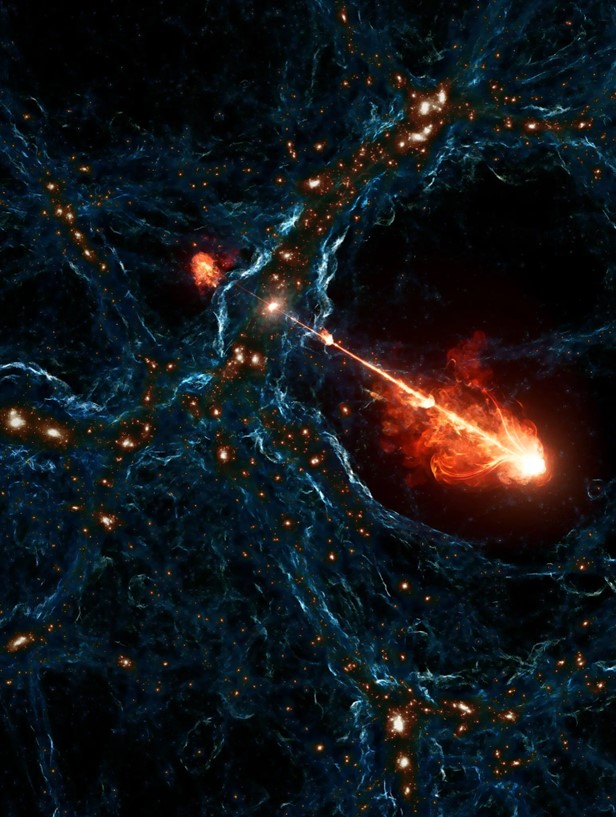
Today’s NY Times feed reported on the massive pair of jets releasing from a supermassive black hole (SMBH) 7.5 billion light-years from Earth.  The megastructure spans 23 million light-years in length, making these black hole jets the largest ever seen, according to new research.  While Black holes gobble up nearly everything that comes close to them, a fraction of material is ejected before an object falls in, forming a jet on either side of the black hole, said Martijn Oei, a postdoctoral scholar at the California Institute of Technology and the lead author of a new study describing the discovery published September 18 in the journal Nature.  The jets have a power output equivalent to trillions of suns and are so massive that researchers have nicknamed the megastructure Porphyrion after a giant from Greek mythology.  The discovery is causing astronomers to rethink their understanding of how massive black hole jets can be as well as how these giant features can affect their surroundings and the structure of the universe.  

When I looked online, I found a supermassive black hole (SMBH or SBH) is a black hole more than one hundred thousand times the mass of the Sun.  Solar mass (M☉) is a standard unit of mass used in astronomy equal to approximately 2×1030 kg, or the approximate mass of the Earth’s Sun.  It is often used to indicate the masses of other stars, as well as stellar clusters, nebulae, galaxies and black holes.  Black holes are a class of astronomical objects that have undergone gravitational collapse, leaving behind spheroidal regions of space from which nothing can escape, including light.  The discovery of SMBH was a consequence of the investigation of quasars in the mid-20th century.  Nearly every large galaxy has a SMBH at its center.  Active galactic nuclei, such as Seyfert galaxies and quasars, are powered by supermassive black holes.  The largest SMBH is in the galaxy cluster Abell 1201 and has a mass thirty billion times that of the Sun.  The SMBH at the center of the Milky Way Galaxy (Sagittarius A*) has a mass four million times that of the Sun.  Two supermassive black holes have been directly imaged by the Event Horizon Telescope: the black hole in the giant elliptical galaxy Messier 87 and Sagittarius A* at the Milky Way’s center.

When sustained for mega years, high-power jets from SMBH become the largest galaxy-made structures in the Universe.  “This pair is not just the size of a solar system, or a Milky Way; we are talking about 140 Milky Way diameters in total.  The Milky Way would be a little dot in these two giant eruptions” Oei said.  The structure consists of a northern lobe, a northern jet, a core, a southern jet with an inner hotspot, and a southern outer hotspot with a backflow.  This system demonstrates that jets can avoid destruction by magnetohydrodynamical instabilities over cosmological distances.  How jets can retain such long-lived coherence is unknown at present.  The haunting question is what Porphyrion is doing to the rest of the universe.  Cosmologists have found that the visible features of the universe are structured in a weblike manner, with galaxies clumped in giant clusters and connected by thin filaments that span dark voids of tens to hundreds of millions of light-years.  In Porphyrion’s day, this cosmic web was half the size it is now, and these jets would have been big enough to affect the overall web. 

THOUGHTS:  In total, the team spotted 10,000 new black hole jet pairs.  Like many discoveries, the researchers were not looking for jets from the SMBH but were trying to observe the cosmic web.  Research (and exploration) often mistakenly makes discoveries that expand our understanding of the universe, the Earth, and even humanity.  The quest for understanding is one aspect that (we think) sets humans apart from other animals.  Act for all.  Change is coming and it starts with you.