Conjunction

September 18, 2025

Image credit: Matt Champlin via Getty Images

A USA Today article toward the back of the front section of my local newspaper reported on the celestial event taking place on September 19th (tomorrow).  Three celestial bodies are preparing to meet for one night that should be widely visible in the sky.  The Earth’s moon and the planet Venus of Sol’s solar system will be briefly joined by the star Regulus.  This event follows the close appearance of Venus and Jupiter during much of August.  This moon-planet-star combination involves three of the brightest objects in our solar system and should make it easy for amateur astronomers to spot.  This coming together, or conjunction, presents a special opportunity for even casual stargazers to see multiple celestial bodies at the same time.

When I went online, I found an astronomical conjunction occurs when two objects or spacecraft appear to be close to each other in the sky.  This means they have either the same angular distance of a particular point measured eastward along the celestial equator (right ascension) or the same apparent positions, orbits, and pole orientations (ecliptic longitude).  This closeness phenomenon is caused by the observer’s perspective, and the objects are not actually close to one another in space.  Conjunctions between two bright objects close to the ecliptic, such as two bright planets, can be seen with the naked eye.  More generally, it means they have the same right ascension.  A conjunction seen by an observer on Earth involves two (or more) astronomical bodies and the times and details depend only slightly on the observer’s location on the Earth’s surface.  The differences are greatest for conjunctions involving the Moon because of its relative closeness, but even for the Moon the time of the observed conjunction never differs by more than a few hours.

Conjunctions occur as the various paths of celestial objects traveling at varying speeds are brought together on the same side of the sun (from Earth’s perspective).  The moon orbits around the Earth as our only satellite.  Venus orbits as the sun’s second planet and is often referred to as “the Earth’s twin” as both are rocky (rather than gaseous) and have a similar orbit.  Regulus is the brightest star in the constellation Leo.  This trio should be visible in the sky tomorrow night.  Those who are in the Northern Hemisphere (North America, Europe, Asia) should be able to spot the conjunction easily by looking for the moon.  Chelsea Gohd, science communicator at NASA’s Jet Propulsion Laboratory in California, explained attention should be directed east in the early pre-dawn toward the waning crescent moon as it sets in the sky.  Pre-dawn may be a stretch for me as I generally do not stay up that late or rise that early.  We will see.

THOUGHTS: Conjunction is one of the words that stuck in my mind in high school as I was a cartoon connoisseur and often did stay up late enough to catch the pre-dawn shows that aired.  This was the 70’s and evils of television were being countered by short educational promos offered by educational media like “Schoolhouse Rock!”.  One segment in the series was titled “Conjunction Junction” and addressed the grammatical use of a conjunction.   It was presented as a catchy song that is running through my head as I blog.  The phrase “conjunction junction what’s your function” draws its meaning as a “junction” that connects things, and its “function” is to join words, phrases, and clauses together to form more complex sentences.  The song uses the analogy of railroad “boxcars” hooked up by the conjunctions (i.e., “and,” “but,” “or”) to help viewers understand their grammatical role (analogical reasoning).  This cognitive process uses prior knowledge of a known situation (“base domain”) to understand or solve a new, similar problem (“target domain”) by identifying shared structures and relationships between them.  In human relationships, such analogies may create positive or negative responses.  Act for all.  Change is coming and it starts with you.

Blue Ghost

March 07, 2025

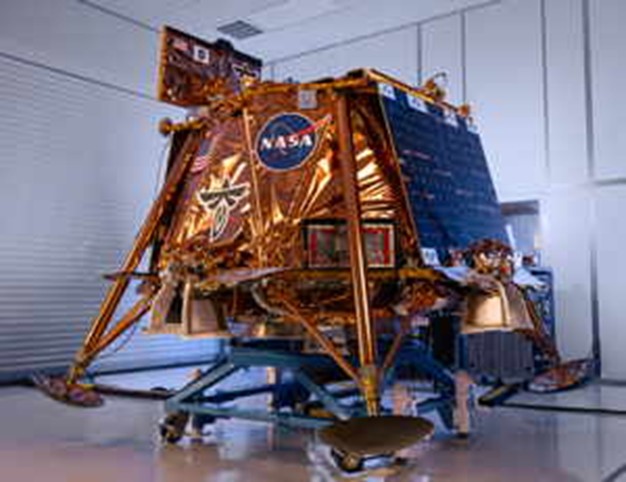
Inside the back section of Thursday’s newspaper was a USA Today article on the lunar lander that touched down early Sunday morning, March 2nd.  NASA’s Janet Petro said, “This incredible achievement demonstrates how NASA and American companies are leading the way in space exploration for the benefit of all.”  The Texas based Firefly Aerospace was hired by NASA to carry scientific instruments to the moon’s Earth-facing side to study its environment ahead of a manned return.  The 10 instruments will be used for lunar subsurface drilling, sample collection, X-ray imaging, and dust mitigation.  The craft has already sent striking images of the moon since it arrived in Lunar Orbit on February 10th.  Firefly has named this class of lunar lander the Blue Ghost.

When I looked online, I found the Firefly Aerospace Blue Ghost, or simply Blue Ghost, is a class of lunar landers designed and manufactured by the private American company Firefly Aerospace designed to deliver small payloads to the surface of the Moon.  The first Blue Ghost mission was launched January 15, 2025, at 1:11 a.m. EST and successfully landed on the Moon on March 2, 2025.  The landers are named after the firefly (Phausis reticulata) known as the Blue Ghost.  Firefly is the prime contractor for lunar delivery services using Blue Ghost landers which provide payload integration, launch from Earth, landing on the Moon, and mission operations.  Blue Ghost has four landing legs and is designed and built to be easily adapted to each customer’s needs between the earth and moon or in the moon’s orbit (cislunar).  Blue Ghost can be customized to support larger, more complex missions and is compatible with multiple launch providers. NASA awarded Firefly the first Blue Ghost lunar delivery task order in February 2021 as part of the Commercial Lunar Payload Services (CLPS) initiative.

The lander’s blue ghost namesake is a species of firefly found in the eastern and central US and is common in the southern Appalachians.  Adults are found in a variety of habitats, including dry and moist woods, near water, and along high, dry ridges.  The male of the beetle species is all-brown and about 0.2 to 0.4 inches (6 to 9 mm) long with large eyes.  The female is smaller, measuring 0.2 to 0.4 (4 to 9 mm) long.  Female blue ghosts are wingless, are yellow. and remain in larval form through adulthood (paedomorphic).  The females glow continuously from 4 to 9 spots on her body so they can be spotted by the males.  Once a female lays her clutch of 20 to 30 eggs, she guards them until she dies in one to two weeks.  The eggs hatch approximately 4 to 5 weeks after the mother dies. The larvae are extremely tiny, approximately 0.05 in (1 – 2 mm) and are bioluminescent.  Unlike many firefly species in the US, the blue ghost displays a steady glow rather than the typical flashing pattern.  The light emitted appears (to humans) as blueish-white when seen from a distance, but bright green when examined at close range.

THOUGHTS: The discrepancy in the observed color of the blue ghost is likely due to the Purkinje effect.  While the effect is often described from the perspective of the human eye, it occurs in other animals under the same name.  This effect describes the general shifting of spectral sensitivity due to pooling of rod and cone output signals as a part of dark/light adaptation.  The colors seen by different animals vary greatly depending on the makeup of those rod and cone features.  Humans seem to be in the middle of both color detection and acuity.  This is also true about our ability to make observations and gain understanding.  “Not like us” means different, not better or worse.  That is true for other animals and other humans.  Act for all.  Change is coming and it starts with you.