Garbage Patch

December 17, 2025

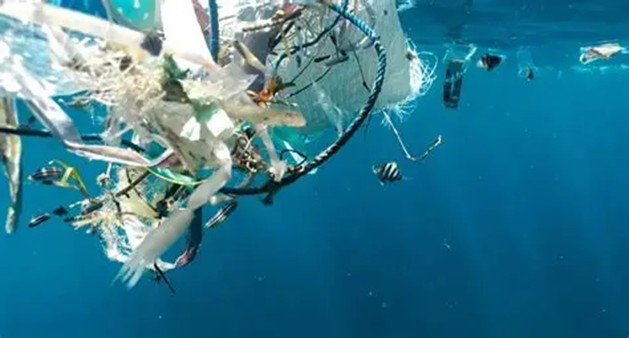
When I opened my MSN browser this morning I found an article on life flourishing in the open ocean.  This is a mix of natural, surface-dwelling ocean creatures and resilient coastal species that use floating plastic as rafts to colonize the open sea, forming new (artificial) ecosystems even as they face dangers from entanglement, plastic ingestion, and toxic contamination.  This biological hotspot is also an ecological nightmare as the plastics disrupt feeding, growth, and development of other marine animals.  Life on the plastics includes coastal species like barnacles (subphylum Crustacea), bryozoans (Phylum Bryozoa), anemones (class Anthozoa), and crustaceans (Subphylum Crustacea) that were carried from home by currents from the 2011 Japan tsunami.  Open-Ocean species like violet snails (Janthina exigua) and blue button jellies (Phylum Ctenophora) also thrive using floating plastic for shelter and feeding.  The non-biodegradable plastics allow these diverse communities to form and even reproduce, bringing life to the Great Pacific Garbage Patch

When I went online, I found the Great Pacific Garbage Patch, or Pacific trash vortex, is a spiral (gyre) of marine debris particles in the central North Pacific Ocean.  The patch is located roughly from 135°W to 155°W and 35°N to 42°N and originates from the Pacific Rim, including countries in Asia, North America, and South America.  Despite the common perception of the patch as giant islands of floating garbage, it is of low density (4 particles per 3.1 yd2 or 1 m2) which prevents its detection by satellite imagery or boaters or divers in the area.  The patch is a widely dispersed area consisting primarily of suspended “fingernail-sized or smaller” (often microscopic) particles (microplastics) in the upper water column.  Researchers from The Ocean Cleanup project claimed the patch covers 620,000 square miles (1.6 million km2) and consists of 50,000 to 142,000 tons (45,000 to129,000 metric tons) of plastic as of 2018 and has grown to twice the size of Texas.  By 2024, the group had removed more than 1 million pounds (453592 kg) of trash from the Patch.

Rehabilitating the Garbage Patch poses a significant challenge due to its immense size and location far from any country’s coastline, making it difficult for any nation to bear the financial responsibility for cleanup.  Various international organizations have pledged to stop the growth of the Garbage Patch.  Charles Moore (who initially uncovered the patch in 1997) is actively involved in raising awareness through the Algalita Marine Research Foundation.  The Ocean Cleanup, led by Boyan Slat, aims to eliminate 90% of ocean plastic pollution by 2040.  The organization is developing technology to extract plastic from the oceans and intercept it in rivers before it reaches the sea.  Their approach is to concentrate the plastic in “artificial coastlines” before collecting and removing it with a long U-shaped barrier that directs the plastic towards a retention zone.  The group’s collection exceeds hundreds of tons (90+ metric tons) and continues to grow.  While microplastics dominate the patch, 92% of the mass consists of larger objects like plastic lighters, toothbrushes, water bottles, pens, baby bottles, cell phones, and plastic bags.  The patch contains around 6 pounds (2.7 kg) of plastic for every pound (0.45 kg) of plankton.  A similar patch of floating plastic is found in the Atlantic called the North Atlantic garbage patch.

THOUGHTS: As plastics are being removed from the Garbage Patch the question remains about the life that exists there.  A team of scientists found almost every piece of plastic removed was carrying (mostly invertebrate) life.  On average, each plastic item carried about 4 to 5 different species and nets and ropes tended to have especially dense communities.  Nature seems to adapt to humans’ worst levels of pollution.  Act for all.  Change is coming and it starts with you.

Erosion

November 07, 2025

I have been going to a coffee shop to visit a friend every month or so.  I always enter from the rear of the building into the semi-outdoor seating area.  This is enclosed with glass doors that can be raised when the weather is appropriate, although I have never seen them raised.  Several years ago, they did some remodeling on the exterior to replace the concrete that backed up to the mini-mall parking lot where it was located.  The shop has an AC unit on top of the building and a downspout that channels the water off the roof and out to the street.  Over the years this has resulted in the water cutting a path from the spout to the parking lot.  When I arrived this last week, it impressed me with the power of water to cause erosion.  

When I went online, I found water erosion is the process of soil and rock being moved by water.  This erosion can be categorized into types.  Splash erosion comes from the impact of raindrops detaching soil particles.  Sheet erosion is the removal of a thin, uniform layer of soil across a slope.  Rill erosion is the small, channel-like cuts formed by runoff water.  Gully erosion is the larger, more-defined channels that develop from rills.  Stream-bank erosion is the wearing away of the banks of a stream or river.  Coastal erosion is the wearing away of land along the coastline, often caused by wave action.  This natural process shapes landscapes by carving out valleys and canyons, but human activities like deforestation and farming can accelerate it, impacting soil quality and water resources.  Techniques to control water erosion include keeping soil covered with vegetation, practicing conservation tillage, and building structures like terraces and grassed waterways.  The erosion at the coffee shop appears to be rill erosion.  I suppose if left long enough it would become gully erosion.

While erosion is a natural process, human activities have increased by 10 to 40 times the rate at which soil erosion is occurring globally.  At agriculture sites in the Appalachian Mountains, intensive farming practices have caused erosion up to 100 times the natural rate of erosion in the region.  Excessive (or accelerated) erosion causes both “onsite” and “offsite” problems.  Onsite impacts include decreases in agricultural productivity and even ecological collapse from the loss of the nutrient-rich upper soil layers and in extreme cases this can lead to desertification.  Offsite effects include sedimentation of waterways and an accumulation of nutrients (eutrophication) in a body of water.  Both can result in an increased growth of organisms that may deplete the oxygen in the water.  Intensive agriculture, deforestation, roads, anthropogenic climate change (global warming), and urban sprawl are among the most significant human activities regarding their effect on stimulating erosion.  There are also prevention and remediation practices that can curtail or limit erosion of vulnerable soils.

THOUGHTS: I recall being amazed when they had to shut down the 20-year-old spillway outlet at the reservoir where I fished in high school.  The outlet Shannel had two massive rows of 20-foot-high (6 m) concrete blocks that had suffered erosion from the water being released and were needing to be replaced.  Famous examples of water erosion include the Grand Canyon, formed by the Colorado River; the Mississippi River Delta, a large fan-shaped deposit of sediment; and Niagara Falls, which is slowly receding upstream due to erosion.  Water and wind erosion are the two primary causes of land degradation and are responsible for about 84% of degraded land globally, making excessive erosion one of the most significant environmental problems worldwide.  While erosion is a natural process, humans can choose to lessen (or increase) the effect by our actions.  It takes eons for the landscape to recover, if it does at all.  Act for all.  Change is coming and it starts with you.
Prevention

October 17, 2025

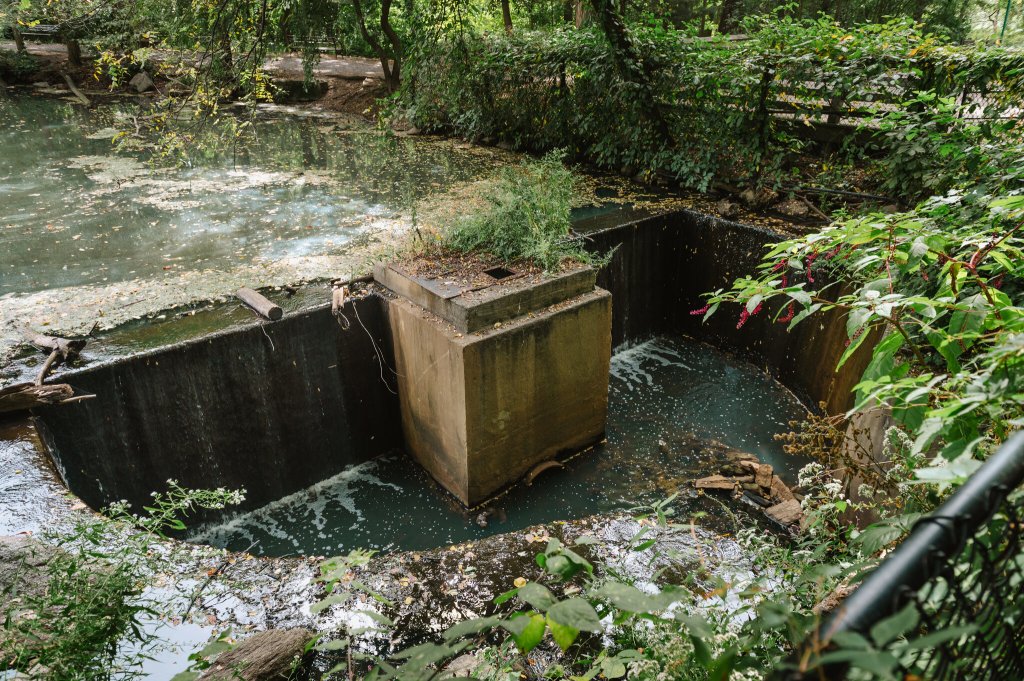
Browsing my NY Times app, I came across an illustrated article that explained what New York City will need to do to survive the predicted flooding over the next 50 years.  New York’s coastal location allowed it to thrive but has now become a threat.  Future models predict tidal flooding will mainly hit Southern Brooklyn, Queens, and Lower Manhattan.  By 2080, many areas will face an increased risk of tidal flooding because of rising sea levels.  At the same time, more neighborhoods will become vulnerable to extreme rainfall and wide swaths of the city face increasing risk from storm surge from a hurricane.  Nearly 30 % of the city’s land mass could be at risk of significant flooding by 2080, and 17% of the city’s population (1.4 million) currently live in these areas.  Climate experts recommend three strategies for the city to adapt.  The city could increase its ability to absorb water by converting 5areas of asphalt and concrete to green space.  It could be fortified by building barriers along its shores, and possibly a gate around the harbor.  Or it could retreat, relocating people out of the most hazardous regions.  Flood prevention will likely have to embrace all three approaches.

When I went online, I found New York’s flood prevention strategies include large-scale infrastructure projects along the East and Hudson Rivers to protect against storm surges and rising sea levels.  New York is installing continuous flood protection systems along its coastlines, including flood walls, elevated landscapes, and discreet barriers like flip-up gates and stop logs.  The Big U is a series of interconnected flood resilience projects to create a 5.5-mile (8.9 km) protective system around lower Manhattan to shield against sea level rise and storm surges.  Projects like Battery Park have improved drainage infrastructure with systems of tide gate chambers to manage water during coastal surge events.  Other initiatives include creating “cloudburst” sunken public spaces to temporarily hold water and providing residents with flood protection resources like sandbags, dams, and flood-resistant materials to help protect individual properties.  FloodHelpNY provides information and connects eligible homeowners with engineers to help reduce flood risk.  Finally, residents are encouraged to install features like sump pumps and drain plugs to protect their homes.

A 2024 study in Nature emphasizes how New York needs prevention measures to combat extreme rainfall events.  Since 1970, the city’s stormwater system has been built to handle up to 1.75 inches (4.5 cm) of rain per hour.  Hourly precipitation recorded in Central Park did not exceed this limit until 1995, but it has been eclipsed in three of the last five years.  Little of that rainfall is absorbed or stored before reaching the stormwater system.  Today, only about 30% of the city’s surface area is composed of absorbent surfaces.  The remaining 70% is covered by impervious surfaces that replaced the original porous landscapes.  The contemporary city was built atop wetlands and ponds that absorbed and stored water and the original shoreline was artificially expanded with landfill over the course of centuries.  The areas at risk of flooding in the modern city overlap to a striking degree with the city’s historical wetlands.  Understanding New York’s historical environment is crucial to imagining a more resilient urban future based on the city’s past topography. 

THOUGHTS: In “Mannahatta: A Natural History of New York City,” author Eric Sanderson, a landscape ecologist at the New York Botanical Garden, addressed the prevention measures needed.  “I was trying to imagine a configuration of the landscape . . . restoring streams, wetlands and agricultural lands, connecting the urbanized parts of the city, and depaving a lot of what we have.”  Islands and coastal cities around the globe are struggling to keep up with the rising oceans caused by climate change.  Sounds like sink or swim is more than an adage.  We can no longer wait.  Act for all.  Change is coming and it starts with you.
Pestalotiopsis

June 20

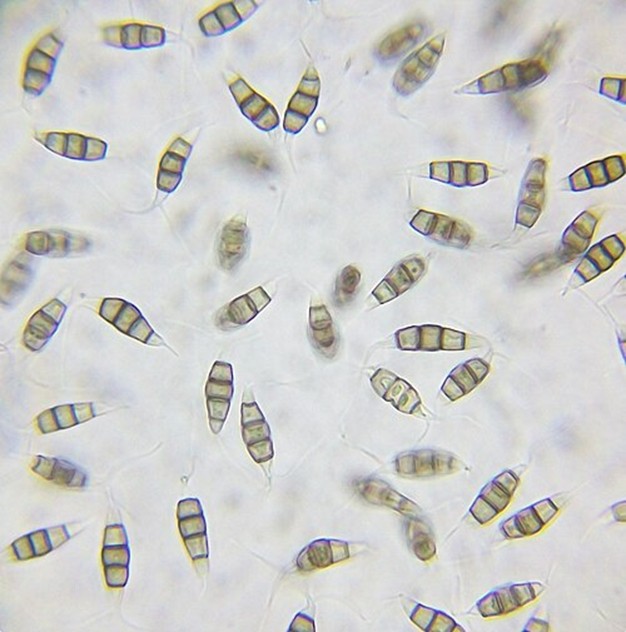
In the middle of the back section of my local newspaper was a Reuters article on the discovery of a fungi that can break down the plastic found in landfills.  The discovery has launched a startup in Austin, Texas, which will sell disposable diapers paired with the fungi intended to break down the plastic.   Tero Isokauppila co-founded Hiro Technologies which now sells online “diaper bundles”.  Three sealed jars at the company’s lab show the stages of decomposition of the treated diaper overtime.  By 9 months the product appears as black soil.  The diapers the fungus attacks contribute significantly to landfill waste.  The Environmental Protection Agency says an estimated 4 million tons (907,000 metric tonnes) of diapers were disposed of in the US in 2018 with no significant recycling or composting.  It takes 100’s of years for the diapers to break down naturally.  Each of the Myco-Digestible Diapers comes with a packet of Pestalotiopsis microspore fungi which is added to the dirty diaper before it is thrown into the trash.

When I went online, I found Pestalotiopsis microspora is a species that lives within a plant for at least part of its life cycle without causing apparent disease (endophytic).  The fungus can break down and digest polyurethane (plastics).  Pestalotiopsis was originally described from Buenos Aires, Argentina in 1880 in the fallen foliage of common ivy (Hedera helix) by mycologist Carlo Luigi Spegazzini, who named it.  Pestalotiopsis also causes leaf spot in Hypericum ‘Hidcote’ (Hypericum patulum) shrubs in Japan.  The species polyurethane degradation activity was only discovered in the 2010’s in two distinct strains isolated from plant stems in the Yasuni National Forest within the Ecuadorian Amazon rainforest.  This was a discovery by a group of student researchers led by molecular biochemistry professor Scott Strobel as part of Yale’s annual Rainforest Expedition and Laboratory.  It is the first fungus species found to be able to subsist on polyurethane in low oxygen (anaerobic) conditions making the fungus a potential candidate for bioremediation projects involving large quantities of plastic.

The Pestalotiopsis fungi evolved to break down the lignin compound found in trees.  Isokauppila said the carbon backbone of the compound is very similar to the backbone of plastics.  Lignin is a class of complex organic polymers that form key structural materials in the support tissues of most plants.  Lignin is particularly important in the formation of cell walls, especially in wood and bark, because it lends rigidity and does not rot easily.  Most fungal lignin degradation involves secreted peroxidases.  Fungal laccases are also secreted, which aid degradation of phenolic lignin-derived compounds.  An important aspect of fungal lignin degradation is the activity of accessory enzymes to produce the hydrogen peroxide (H2O2) required for the function of lignin peroxidase.  More research is required to see how Pestalotiopsis will decompose in real world conditions.  That data should enable the company to make a “consumer-facing claim” by next year.  Hiro Technologies plans to experiment with the plastic eating fungi on adult diapers, feminine care products, and other items.

THOUGHTS: When my son was born the reaction of Pestalotiopsis on plastics was unknown.  I decided to avoid the waste of disposables by using cloth diapers.  While his mom agreed, it was my job to take care of the mess and cleaning required by the diaper pail.   There has been a resurgence of interest in cloth diapers recently among environmentally and financially conscious new parents.  While disposable diapers remain popular, a growing number of families are choosing to use cloth diapers.  This shift is driven by environmental concerns, cost savings, and improved cloth diaper designs.  The cost of the fungi diaper packs is not cheap (neither are the disposables), but it could make a significant difference environmentally.  Act for all.  Change is coming and it starts with you.

Recapture

December 23, 2024

Ariana Gomez for The New York Times

Back in 2022 I blogged on growing battle surrounding carbon recapture in the US’s Mississippi River Chemical Corridor, commonly known as Cancer Alley. While critics acknowledged the process worked, they objected to the pollution caused by the facility itself, and the energy required to power the equipment. Today, my NY Times feed reported that more than 2 years later over 1,000 big companies have pledged to eliminate their carbon emissions over the next few decades, and part of those efforts came from paying for carbon dioxide removal. During 2024, Microsoft, Google, and British Airways were among the companies that committed a total of US$1.6 billion to purchase carbon removal credits. This is up from less than US$1 million in 2019, and it is believed this will grow to US$10 billion during 2025, and reach US$1.2 trillion by 2050. While huge sums of money are being dedicated to the emerging field, these projects will not have a meaningful effect on global temperatures anytime soon. There are only a few dozen operational facilities today that capture only a trace of carbon emissions. It is estimated that if 100’s of more such plants were built it would only recapture about 1% of the worlds annual carbon dioxide emissions.

When I looked online, I found that while there are several ideas for geoengineering plans and technologies designed to cool the planet, carbon dioxide recapture is attracting the big money. Investors believe while this will have a negligible short term impact on temperatures, it will begin to make a difference as emissions fall and the technology becomes more powerful. While some carbon polluters have committed to reducing carbon emissions, more are opting to continue to pollute and instead paying for carbon recapture credits. The US government is supporting the recapture movement through the Inflation Reduction Act that has tripled tax credits for capture and storage of carbon directly from the atmosphere. This 2021 bipartisan bill included US$3.5 billion to build four demonstration projects.

Pulling greenhouse gases out of the air is expensive and currently costs as much as US$1,000 per ton to capture and sequester carbon dioxide. Analysts say the price would need to drop to US$100 a ton for the industry to be viable. Damien Steel, chief executive of the carbon recapture firm Deep Sky, says, “This isn’t a market. A market means liquidity, repeatability, standards. We have none of that here.” As the NY Times reported, the industry is still creating a form of gold rush as investors readily fund new companies hoping that some of their bets will pay off. Many scientists and activists say the most effective way to combat global warming is to rapidly phase out oil, gas, and coal, as it is the burning of these fossil fuels which heat the planet. Former Vice President Al Gore, co-founder of Climate Trace, said, “We need to obey the first law of holes. When you’re in one, stop digging.”

THOUGHTS: Carbon recapture is only the latest technological innovation humans employed to try and resolve a problem of our own making. As an archaeologist the irony was not lost on me that I was digging through the trash dumps that the next culture had buried as they created a new living space on the remains of the past. When the pollution became too great, people would move to the next pristine site and begin again. The problem now is the pristine places are diminishing, and the polluted locations are broadening. This is particularly evident as our land, water, sea, and air are polluted on a globalized scale. If we do not “stop digging” our holes, the earth will be left for the next interplanetary archaeologists to dig. Act for all. Change is coming and it starts with you.

TREES

December 02, 2024

Last week my browser featured an effort sponsored by the UN that received designation as a Flagship project. The Flagship award is part of an effort by the UN Decade on Ecosystem Restoration to ensure that measurable progress is made on the UN’s environmental goals by 2030. When Africa’s fertile terrains become drylands, farmers are thrown into poverty and biodiversity shrinks. Trees for the Future (TREES) is successfully reversing this trend by assisting hundreds of thousands of smallholder farmers in several African countries to fight soil degradation, biodiversity loss, and climate change. TREES has restored 102,165.72 acres (41,345 ha) since 2014. The restoration supports over 50,000 households and captures 382.5 tons (347 metric tons) of CO2 per hectare through its model, the equivalent of emissions from over 26,420 gallons (100,000 liters) of diesel fuel. Restoration of the drylands helps increase the income and improve the health of farmers and their families. TREES is expecting to create 230,000 jobs by 2030 in Kenya, Mali, Senegal, Tanzania, and Uganda, and is recognized as one of the best large-scale ecosystem restoration efforts on the planet. Central to the TREES model is the creation of a series of structures known as a bund.

When I looked online, I found a bund, also known as a demi-lune or half-moon, is a rainwater harvesting technique consisting in digging semi-lunar holes in the ground with the opening perpendicular to the flow of water. The holes are oriented against the slope of the ground which generates a small dike in the curved area with the soil from the hole itself. The dikes capture the rainwater as it runs downhill, allows the water to seep into the subsoil, and prevents the loss of fertile soil by erosion. Semi-circular bunds are used to reforest arid zones with irregular rain patterns and allow the growth of plants and trees. The TREES initiative works closely with tens of thousands of farmers living in poverty on degraded lands following decades of unsustainable agriculture practices, deforestation, pollution, and climate change by providing training in a regenerative agroforestry technique called the Forest Garden Approach. In this four-year program, farmers receive training, seeds, and other resources, while planting thousands of trees and dozens of food and resource crops on their property. The small farmers typically own less than 2.5 acres (1 ha) of land.

TREES projects in Senegal and Mali are a part of the African Union’s initiative as part of the Great Green Wall. Elvis Tangem, Great Green Wall Initiative Coordinator, says, “Once it’s completed, the Great Green Wall will be the largest natural structure on the planet. It’s a massive undertaking, but the dedication and teamwork of organizations like TREES will ultimately make it a reality.” The Great Green Wall project was adopted by the African Union in 2007 to combat desertification in the Sahel region and hold back expansion of the Sahara Desert. The original dimensions of the “wall” were to be 9 miles (15 km) wide and 4,831 miles (7,775 km) long. The program has evolved to encompass nations in both northern and western Africa and promotes water harvesting techniques, greenery protection, and improving indigenous land use techniques, aimed at creating a mosaic of green and productive landscapes across North Africa.

THOUGHTS: TREES is recognized as one of the best examples of large-scale and long-term ecosystem restoration in any country or region, embodying the 10 Restoration Principles of the UN Decade on Ecosystem Restoration. The announcement was made ahead of the 6th UN Environment Assembly, held from February 26 to March 1, 2024. The Assembly convenes to address the triple planetary crisis of climate change, nature and biodiversity loss, and pollution and waste. This should represent an ongoing emphasis not just for the developing countries of Africa, but for the world. Act for all. Change is coming and it starts with you.
Landfill

November 12, 2024

I mentioned in October how Melissa and I had bitten the bullet and purchased new furniture for our living room. We repurposed the old furniture by donating it to the Habitat ReStore. They had been willing to pick up the two couches, a love seat, and a recliner, but refused my old chair because it was too worn. That meant the large recliner has been sitting in the middle of our garage for the last month. I have been cleaning (disposing of) and rearraigning the garage for several weeks to finally address the boxes we brought from Kansas and those we had temporarily stored from her parents’ collection when we moved in five years ago. A cleaner garage also meant it was time to move the recliner. I hesitated when we bought the Jeep six years ago because I have longed for a pickup, and more importantly the bed to haul things in. A local supply store has been advertising a small 5 by 8 foot (1.5 by 2.4 m) trailer and this could be the answer to move my old recliner to the landfill.

When I looked online, I found a landfill is a site for the disposal of waste materials. It is the oldest and most common form of waste disposal, although the systematic burial of waste with daily, intermediate, and final covers only began in the 1940’s. In the past, waste was simply left in piles or thrown into pits (called middens in archeology). Landfills take up a lot of land and depending on what materials are disposed of can pose an environmental risk. Some landfill sites are used for waste management purposes, such as temporary storage, consolidation, and transfer (transfer stations). A landfill can also be used for various stages of processing of waste material, such as sorting, treatment, or recycling. The compacted waste is typically covered with soil or alternative materials (chipped wood or other “green waste”) daily. Compaction of waste is critical to extending the life of the landfill, and unless stabilized the materials may undergo severe shaking or soil liquefaction during an earthquake. Once full, the area over a landfill is covered and site may be reclaimed for other uses.

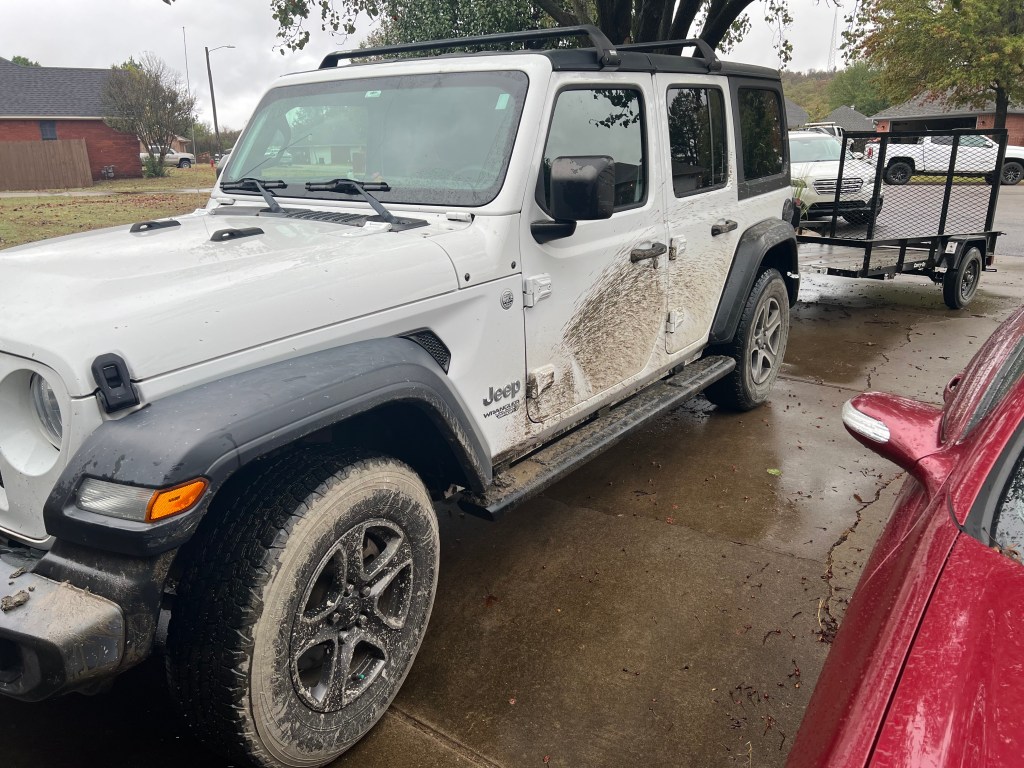
As I pulled my new trailer and the recliner into the landfill the attendant asked if my Jeep had a 4- wheel drive. I thought it was an odd question, but they went on to suggest (twice) that I drop into 4-wheel before entering the site. Still skeptical, I put the vehicle into 4-high and proceeded along the winding road leading to the current disposal area. On arrival I realized why the attendant had asked. We had several days of rain and the area in front of the waste pile had been churched to a morass. I pulled forward into the quagmire as directed by another attendant, but was stopped and told I needed to back in. As I started to back the trailer out to turn around, he asked if all I had was the one chair. He then told me to just pull forward and he tossed the chair onto the ground. I then plowed back through the mud to turn around and continued to the checkout station. Between the trailer and fees, it cost me US$1100 to take my worn recliner to the landfill. It was still better than allowing the chair to sit in the middle of my garage, and now I can think up new projects to use the trailer.

THOUGHTS: While one of the badges of honor with a 4-wheel drive is showing off the mud caked sides of your vehicle (ala the teenage boys), I did not think my visit to a muddy landfill qualified for this honor. I took the Jeep and trailer home and promptly washed them down. Landfills have the potential to cause a number of issues. The heavy vehicles cause damage to access roads. Pollution of local roads and watercourses from wheels as vehicles leave the landfill can be significant, as can contamination of groundwater, aquifers, or soil by the waste materials. Landfills in the US are regulated by each state’s environmental agency. However, none of these standards may fall below those set by the United States Environmental Protection Agency (EPA). Three hundred years from now an archeologist will be combing through our local midden, and worder how the mechanism for my recliner worked. Think of it as job security. Act for all. Change is coming and it starts with you.
Mini Split

October 29, 2024

I have been hinting around about getting a new HVAC system for our porch in my blog for the last week.  The idea began when Melissa and I took a Maine vacation at my sister’s house in July.  They had installed a compact system in their house and had plans for the shop and the “barn” (more like guest dining hall with a two bedroom apartment upstairs).  When I was director of a conference center in Kansas, we used heat pumps for the 30 hotel rooms and found them very efficient.  These were self-contained window units.  We also had a window mounted heat pump in our shop (it was “taken”) that had worked well, and I plan to put another in “sometime”.  My sister had instead put in an outdoor compressor with a wall mounted blower unit.  The glass we installed on the porch works during the winter keeping temps above 32F (0C), but as it continues to drop it dropped to around 25F (-4C).  Many of Melissa’s succulents were not happy.  We decided it was time to get a mini split.

When I looked online, I found Mini split systems are compact heating and cooling systems with indoor and outdoor components that can be installed in the wall to control the temperature of an individual room.  They are often referred to as ductless mini splits since they do not require ductwork to disperse air throughout a home.  A mini split consists of an outdoor compressor unit and one (or more) indoor unit (air handlers) that delivers the air.  The mini split transfers heat between the indoor and outdoor units through refrigerant lines (via heat pump) to either extract or release heat and allows both heating and cooling capabilities in one system.  Ductless mini split systems are increasingly popular due to their efficiency and versatility.  Not only do they eliminate ductwork, but they also provide more efficient heating and cooling by targeting rooms where heating and cooling is needed.  A targeted system provides significant energy savings and lower utility bills verses a conventional central HVAC system.  Benefits of mini split systems are flexible placement, easy and affordable installation, energy-efficiency, and compact design.  This seemed like the way to go on our porch.

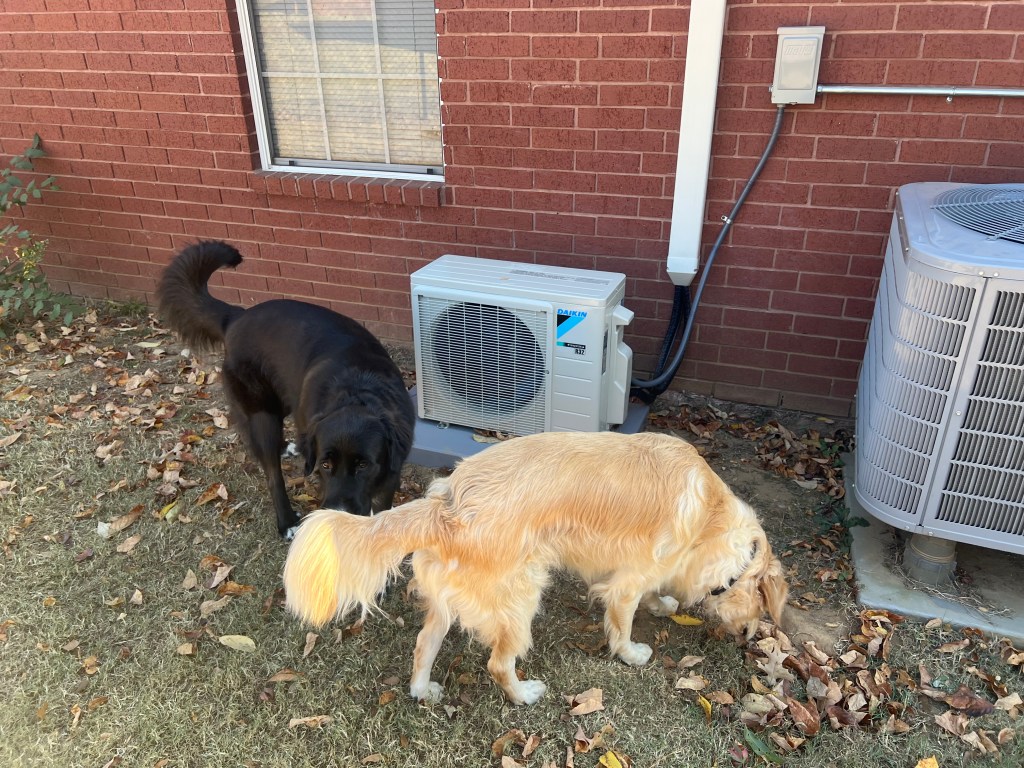
On Friday the electrician arrived and installed the connection box from our electrical panel to the outside of the house.  The HVAC person came by at the same time to get final measurements and drill holes from the garage to the porch in preparation for the mini split arrival on Monday.  We arranged to take the kids to the kennel for foot grooming rather than cooping them up franticly in the back bedroom.  The installation went smoothly, and the system was in place by 1 pm.  I picked up the kids and took them for a walk at the lake (always a treat).  When we got home, they ran outside to survey the unit placed on the ground next to the A/C.  After a good amount of sniffing and inspection, they were happy with this new feature in their yard.  When the temps drop below freezing (32F/0C) this winter the succulents will be happy as well.

THOUGHTS: Another outcome of installing the mini split was finding local HVAC and electrical techs.  We even got the two ceiling fans installed that have been sitting on our floor since January.  Both were surprised to learn we were not looking to cool the porch, but to heat it during the coldest parts of winter.  The porch windows are open most of the year to provide circulation.  The new fan and mini split make Melissa happy.  Happy succulents, happy dogs, happy wife, all makes a happy life!  Ok, it takes a little more than that, but comfortable surroundings are a good start.  A recent Pew Research Center survey found 69% of Americans were “very concerned” about the cost of housing, up from 61% in April 2023.  “Affordable” is defined as 30% of household income and 31.3% of US households were cost burdened in 2023, including 27.1% of households with a mortgage and 49.7% of households that rent.  Affordable, comfortable housing should be a right, not a luxury.  Act for all.  Change is coming and it starts with you.