
TREES

December 02, 2024

Last week my browser featured an effort sponsored by the UN that received designation as a Flagship project. The Flagship award is part of an effort by the UN Decade on Ecosystem Restoration to ensure that measurable progress is made on the UN’s environmental goals by 2030. When Africa’s fertile terrains become drylands, farmers are thrown into poverty and biodiversity shrinks. Trees for the Future (TREES) is successfully reversing this trend by assisting hundreds of thousands of smallholder farmers in several African countries to fight soil degradation, biodiversity loss, and climate change. TREES has restored 102,165.72 acres (41,345 ha) since 2014. The restoration supports over 50,000 households and captures 382.5 tons (347 metric tons) of CO2 per hectare through its model, the equivalent of emissions from over 26,420 gallons (100,000 liters) of diesel fuel. Restoration of the drylands helps increase the income and improve the health of farmers and their families. TREES is expecting to create 230,000 jobs by 2030 in Kenya, Mali, Senegal, Tanzania, and Uganda, and is recognized as one of the best large-scale ecosystem restoration efforts on the planet. Central to the TREES model is the creation of a series of structures known as a bund.

When I looked online, I found a bund, also known as a demi-lune or half-moon, is a rainwater harvesting technique consisting in digging semi-lunar holes in the ground with the opening perpendicular to the flow of water. The holes are oriented against the slope of the ground which generates a small dike in the curved area with the soil from the hole itself. The dikes capture the rainwater as it runs downhill, allows the water to seep into the subsoil, and prevents the loss of fertile soil by erosion. Semi-circular bunds are used to reforest arid zones with irregular rain patterns and allow the growth of plants and trees. The TREES initiative works closely with tens of thousands of farmers living in poverty on degraded lands following decades of unsustainable agriculture practices, deforestation, pollution, and climate change by providing training in a regenerative agroforestry technique called the Forest Garden Approach. In this four-year program, farmers receive training, seeds, and other resources, while planting thousands of trees and dozens of food and resource crops on their property. The small farmers typically own less than 2.5 acres (1 ha) of land.

TREES projects in Senegal and Mali are a part of the African Union’s initiative as part of the Great Green Wall. Elvis Tangem, Great Green Wall Initiative Coordinator, says, “Once it’s completed, the Great Green Wall will be the largest natural structure on the planet. It’s a massive undertaking, but the dedication and teamwork of organizations like TREES will ultimately make it a reality.” The Great Green Wall project was adopted by the African Union in 2007 to combat desertification in the Sahel region and hold back expansion of the Sahara Desert. The original dimensions of the “wall” were to be 9 miles (15 km) wide and 4,831 miles (7,775 km) long. The program has evolved to encompass nations in both northern and western Africa and promotes water harvesting techniques, greenery protection, and improving indigenous land use techniques, aimed at creating a mosaic of green and productive landscapes across North Africa.

THOUGHTS: TREES is recognized as one of the best examples of large-scale and long-term ecosystem restoration in any country or region, embodying the 10 Restoration Principles of the UN Decade on Ecosystem Restoration. The announcement was made ahead of the 6th UN Environment Assembly, held from February 26 to March 1, 2024. The Assembly convenes to address the triple planetary crisis of climate change, nature and biodiversity loss, and pollution and waste. This should represent an ongoing emphasis not just for the developing countries of Africa, but for the world. Act for all. Change is coming and it starts with you.
Landfill

November 12, 2024

I mentioned in October how Melissa and I had bitten the bullet and purchased new furniture for our living room. We repurposed the old furniture by donating it to the Habitat ReStore. They had been willing to pick up the two couches, a love seat, and a recliner, but refused my old chair because it was too worn. That meant the large recliner has been sitting in the middle of our garage for the last month. I have been cleaning (disposing of) and rearraigning the garage for several weeks to finally address the boxes we brought from Kansas and those we had temporarily stored from her parents’ collection when we moved in five years ago. A cleaner garage also meant it was time to move the recliner. I hesitated when we bought the Jeep six years ago because I have longed for a pickup, and more importantly the bed to haul things in. A local supply store has been advertising a small 5 by 8 foot (1.5 by 2.4 m) trailer and this could be the answer to move my old recliner to the landfill.

When I looked online, I found a landfill is a site for the disposal of waste materials. It is the oldest and most common form of waste disposal, although the systematic burial of waste with daily, intermediate, and final covers only began in the 1940’s. In the past, waste was simply left in piles or thrown into pits (called middens in archeology). Landfills take up a lot of land and depending on what materials are disposed of can pose an environmental risk. Some landfill sites are used for waste management purposes, such as temporary storage, consolidation, and transfer (transfer stations). A landfill can also be used for various stages of processing of waste material, such as sorting, treatment, or recycling. The compacted waste is typically covered with soil or alternative materials (chipped wood or other “green waste”) daily. Compaction of waste is critical to extending the life of the landfill, and unless stabilized the materials may undergo severe shaking or soil liquefaction during an earthquake. Once full, the area over a landfill is covered and site may be reclaimed for other uses.

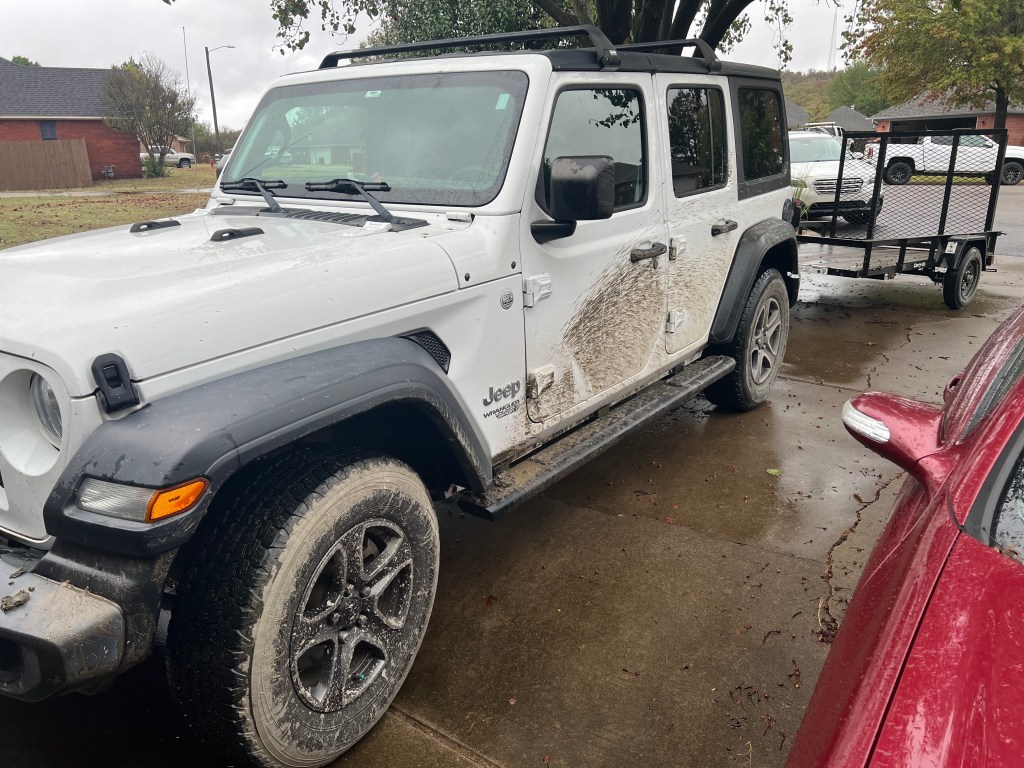
As I pulled my new trailer and the recliner into the landfill the attendant asked if my Jeep had a 4- wheel drive. I thought it was an odd question, but they went on to suggest (twice) that I drop into 4-wheel before entering the site. Still skeptical, I put the vehicle into 4-high and proceeded along the winding road leading to the current disposal area. On arrival I realized why the attendant had asked. We had several days of rain and the area in front of the waste pile had been churched to a morass. I pulled forward into the quagmire as directed by another attendant, but was stopped and told I needed to back in. As I started to back the trailer out to turn around, he asked if all I had was the one chair. He then told me to just pull forward and he tossed the chair onto the ground. I then plowed back through the mud to turn around and continued to the checkout station. Between the trailer and fees, it cost me US$1100 to take my worn recliner to the landfill. It was still better than allowing the chair to sit in the middle of my garage, and now I can think up new projects to use the trailer.

THOUGHTS: While one of the badges of honor with a 4-wheel drive is showing off the mud caked sides of your vehicle (ala the teenage boys), I did not think my visit to a muddy landfill qualified for this honor. I took the Jeep and trailer home and promptly washed them down. Landfills have the potential to cause a number of issues. The heavy vehicles cause damage to access roads. Pollution of local roads and watercourses from wheels as vehicles leave the landfill can be significant, as can contamination of groundwater, aquifers, or soil by the waste materials. Landfills in the US are regulated by each state’s environmental agency. However, none of these standards may fall below those set by the United States Environmental Protection Agency (EPA). Three hundred years from now an archeologist will be combing through our local midden, and worder how the mechanism for my recliner worked. Think of it as job security. Act for all. Change is coming and it starts with you.

Mini Split

October 29, 2024

I have been hinting around about getting a new HVAC system for our porch in my blog for the last week.  The idea began when Melissa and I took a Maine vacation at my sister’s house in July.  They had installed a compact system in their house and had plans for the shop and the “barn” (more like guest dining hall with a two bedroom apartment upstairs).  When I was director of a conference center in Kansas, we used heat pumps for the 30 hotel rooms and found them very efficient.  These were self-contained window units.  We also had a window mounted heat pump in our shop (it was “taken”) that had worked well, and I plan to put another in “sometime”.  My sister had instead put in an outdoor compressor with a wall mounted blower unit.  The glass we installed on the porch works during the winter keeping temps above 32F (0C), but as it continues to drop it dropped to around 25F (-4C).  Many of Melissa’s succulents were not happy.  We decided it was time to get a mini split.

When I looked online, I found Mini split systems are compact heating and cooling systems with indoor and outdoor components that can be installed in the wall to control the temperature of an individual room.  They are often referred to as ductless mini splits since they do not require ductwork to disperse air throughout a home.  A mini split consists of an outdoor compressor unit and one (or more) indoor unit (air handlers) that delivers the air.  The mini split transfers heat between the indoor and outdoor units through refrigerant lines (via heat pump) to either extract or release heat and allows both heating and cooling capabilities in one system.  Ductless mini split systems are increasingly popular due to their efficiency and versatility.  Not only do they eliminate ductwork, but they also provide more efficient heating and cooling by targeting rooms where heating and cooling is needed.  A targeted system provides significant energy savings and lower utility bills verses a conventional central HVAC system.  Benefits of mini split systems are flexible placement, easy and affordable installation, energy-efficiency, and compact design.  This seemed like the way to go on our porch.

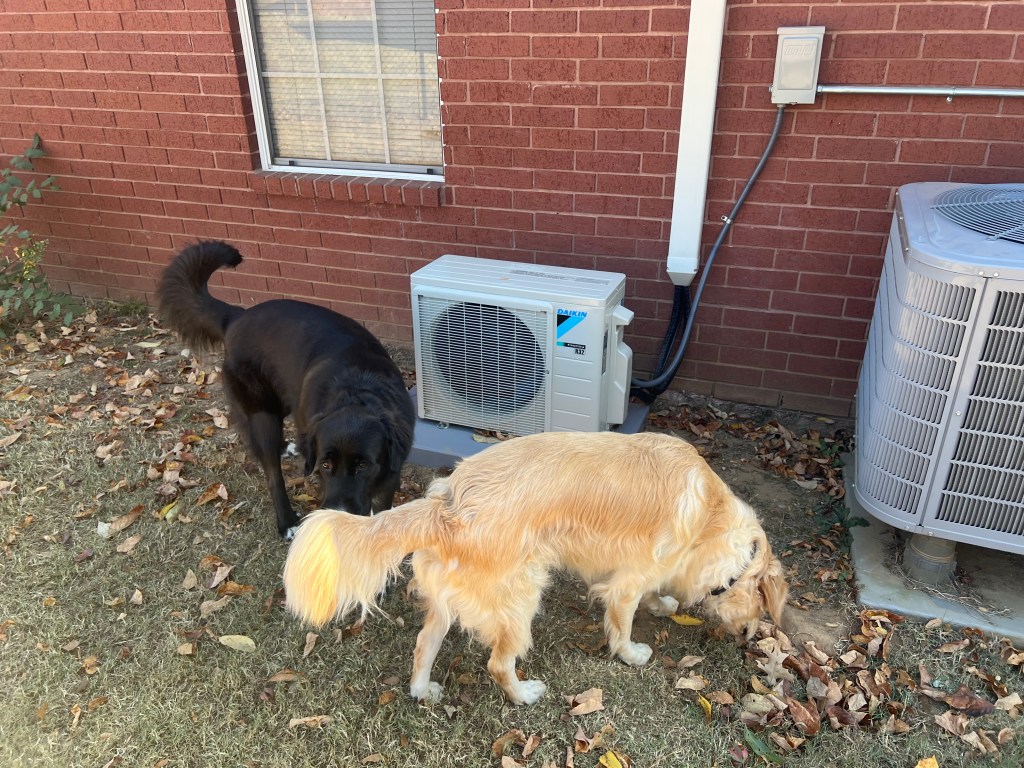
On Friday the electrician arrived and installed the connection box from our electrical panel to the outside of the house.  The HVAC person came by at the same time to get final measurements and drill holes from the garage to the porch in preparation for the mini split arrival on Monday.  We arranged to take the kids to the kennel for foot grooming rather than cooping them up franticly in the back bedroom.  The installation went smoothly, and the system was in place by 1 pm.  I picked up the kids and took them for a walk at the lake (always a treat).  When we got home, they ran outside to survey the unit placed on the ground next to the A/C.  After a good amount of sniffing and inspection, they were happy with this new feature in their yard.  When the temps drop below freezing (32F/0C) this winter the succulents will be happy as well.

THOUGHTS: Another outcome of installing the mini split was finding local HVAC and electrical techs.  We even got the two ceiling fans installed that have been sitting on our floor since January.  Both were surprised to learn we were not looking to cool the porch, but to heat it during the coldest parts of winter.  The porch windows are open most of the year to provide circulation.  The new fan and mini split make Melissa happy.  Happy succulents, happy dogs, happy wife, all makes a happy life!  Ok, it takes a little more than that, but comfortable surroundings are a good start.  A recent Pew Research Center survey found 69% of Americans were “very concerned” about the cost of housing, up from 61% in April 2023.  “Affordable” is defined as 30% of household income and 31.3% of US households were cost burdened in 2023, including 27.1% of households with a mortgage and 49.7% of households that rent.  Affordable, comfortable housing should be a right, not a luxury.  Act for all.  Change is coming and it starts with you.