
February 26, 2026
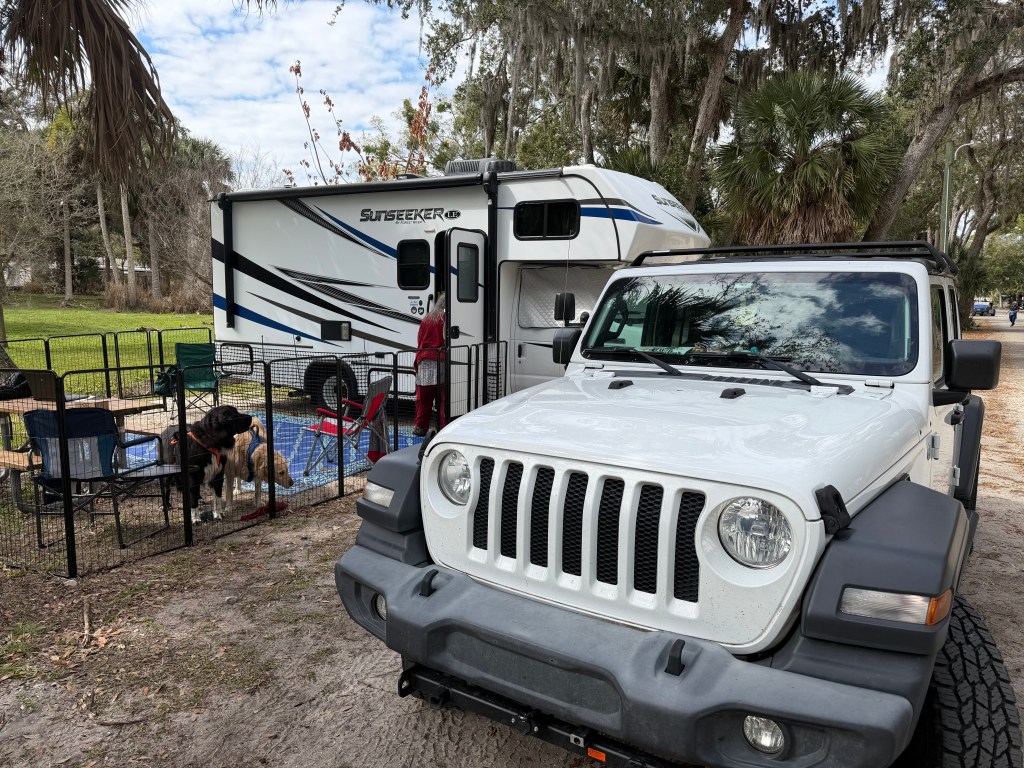
A lot has happened since we set out on our first long distance RV trip last week. We spent the first night in a Love’s gas station parking lot, which was like camping in a parking lot (because it was). The next two nights we spent in a state park and private RV campground. Both were nice but closer quarters than we were used to (with our vast experience, haha). The drama started immediately. I set up the jeep as a toad (pulled) vehicle and installed the Blue Rhino barking system. For some reason I could not get the brake to secure. Since the dealer was on our way out of town, we decided to stop and ask what we were doing wrong. It turned out the “problem” was I had set the seat too close to the auto brake. The tech moved the seat back 1/4 inch (0.3 cm) and it worked fine. The next difficulty came as I tried to back the toad (jeep) and found when the transmission is disengaged the wheels lock in reverse. The final drama came on the third day of driving as the brake system kept turning off. I reset the jeep to ACC twice before giving up. When we arrived at our campsite, I found the battery on our jeep JL was completely dead.
When I went online, I found a Jeep JL battery dies in toad mode because the vehicle’s computer systems, especially the LED taillight system, remain active and wake up periodically. This causes a significant parasitic draw. The battery drawdown is compounded as the ignition needs to be left in accessory mode to power the supplemental braking systems. There are four systems that contribute to the drawdown. First is communication with the LED Taillights as the computer constantly checks for connected lights. LED lights have a low resistance which keeps the computer awake and drains the battery. Leaving the ignition in Accessory (ACC) or Run mode keeps electronic components powered by using the battery. Supplemental braking systems (like ours) can draw power from the Jeep battery if not properly set up or if they lack a dedicated charging line (ours does not). Finally, JL’s auxiliary battery system can also cause issues. These drained our battery.
When we disconnected the dead toad at the camp site Melissa and I were both trying to figure out how to get our Jeep JL started the following morning. We had AAA road assistance, so we thought of calling for a jump. We also have Good Sam assistance so we could call them as well. The problem would be waiting for the drivers to arrive to jump the vehicle. Then we thought we could ask the campground hosts for a jump. I always carry cables for situations just like this (from experience). We went to bed dreading the hassle that awaited us in the morning. During the night, I had an epiphany. While the toad may have been drained, the RV was not. I unhooked the toad, turned the RV around, and applied the jump. The jeep fired up and we were ready to go. However, we were still 200 miles (322 km) from our destination. Melissa decided to drive the Jeep to our next destination to maintain the charge and avoid the drawdown.
THOUGHTS: Now that we knew what was causing the problem with our JL, we needed to figure out how to fix it. We could install a 12-volt charge line from the RV to keep the battery charged, install a wiring harness that disconnects the Jeep’s lights from the computer, or install a battery disconnect switch. I asked our RV mechanic if I could do any of these and he said, “probably not” (he knows me too well). You could also just make sure the ignition is off (not in ACC) after setting the transfer case to neutral, but this will not allow the brake system to operate. We decided to Jerry-rig the system by running the engine every time we stopped. “Jerry-rigging” refers to a makeshift, temporary repair, and originates from 18th-century nautical terminology where a “jury mast” was a temporary mast. Bailing wire and duct tape do wonders, but you ultimately need to get things fixed right. That is also true for relationships. Act for all. Change is coming and it starts with you.


 A travelers odyssey