Citrus

November 19, 2025

I have been winterizing my garden for the last several weeks.  That means taking down the trellises for storage and removing what is left of the plants.  I mentioned how I tore out the tomato (Solanum lycopersicum) vines in mid-October, resulting in 14 jars of salsa verde.   I did keep three vines on the off chance the fruit would ripen but gave up on them last week.  While I did have several fruits that had begun to ripen, most were solid green.  I was surprised as several more of the green tomatoes have ripened on the counter.  I harvested one head lettuce (Lactuca sativa) that grew, and we ate it as a salad last night.  The one spinach (Spinacia oleracea) that grew will become a wilted spinach salad for tonight along with fried green tomatoes.  I blanched the ripe/partially ripe tomatoes and froze them to make pasta sauce later.  I still have six cabbage (Brassica oleracea) I am holding out for sauerkraut.  They have yet to form a head so they will probably not make it before the frost.  Only about a third of the second crop peas (Pisum sativum) grew and are now producing pods.  We will finish them this week.  This year I am also trying another tact to preserve my citrus trees.

When I went online, I found Citrus is a genus of flowering trees and shrubs in the family Rutaceae that produce fruits.  Citrus is native to South Asia, East Asia, Southeast Asia, Melanesia, and Australia where indigenous people have used and domesticated various species since ancient times.  Citrus cultivation first spread into Micronesia and Polynesia through the Austronesian expansion (3000 to 1500 BCE), later spread to the Middle East and the Mediterranean (1200 BCE) via the incense trade route, and then from Europe to the Americas.  Citrus fruits are renowned for their fragrant aromas and complex flavor and are among the most popular fruits in cultivation.  The plants tend to hybridize between species making their taxonomy complicated.  The numerous varieties cover a wide range of appearance and fruit flavors.  Many important citrus crops have been developed through extensive hybridization, including oranges (Citrus macroptera), lemons (Citrus limon), grapefruits (Citrus paradisi), and limes (Citrus aurantiifolia) which all have many cultivars.

Two years ago, I purchased two citrus trees (limon and lime) hoping to grow my own fruit.  These were 4 feet (1.3 m) tall, and the seller suggested I might even get a few fruits that first year.  While the lime never fruited, the limon did have one fruit that I used for zest.  I had placed them in pots seated on rolling carriers to move them inside as I did not think they would survive the winter.  It proved impractical to move them indoors, so I bought protective covers to keep out the frost.  Citrus trees are evergreen and keep their foliage year-round, but stress from sudden temperature drops, low light (especially indoors), or lack of humidity can cause them to shed leaves.  When I removed the covers in late winter the leaves and most of the branches were dead.  I thought they had completely died, but they both began to sprout new stems by the spring.  This year I am putting them in the garage to protect them from the bitter cold.  Now to get them some light (grow lamps?).

THOUGHTS: It made more sense why my citrus trees died when I found out they were evergreen.  While some leaves may fall, they still need sunlight, water, and moderate temperatures.  Covering them deprived them of sunlight and never watering them dried them out.  Melissa told me when we return from our trip, she will make room on the sunporch so they can winter with the succulents.  I am hopeful they will continue to thrive under these conditions.  Much like my citrus trees, humans also need the right conditions to survive.  That includes adequate food, safe water, and protection from the elements (clothing and shelter).  A study focusing on low- and middle-income countries suggests 4.4 billion people lack safe drinking water and the WHO found 1 in 4 lack safe access to water.  We need to find another tact.  Act for all.  Change is coming and it starts with you.
Indeterminant

September 26, 2025

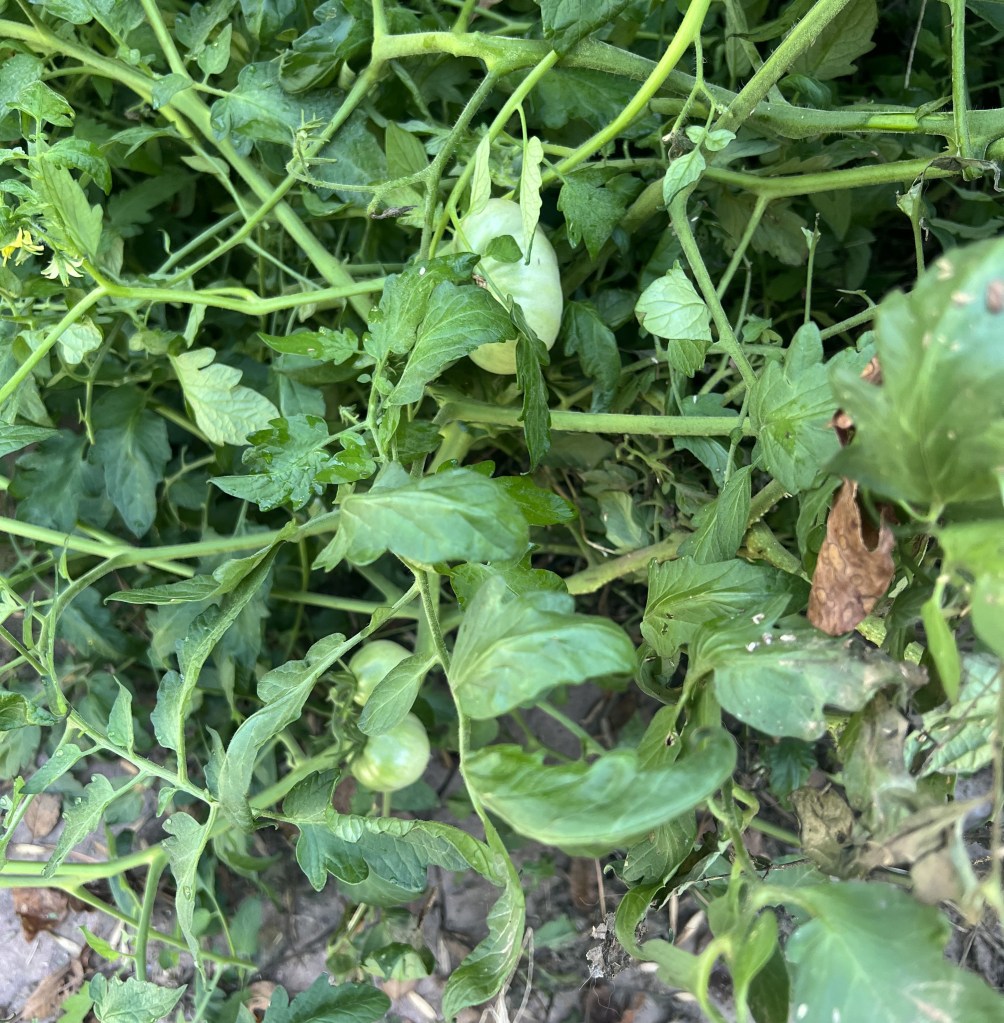
I toyed with the idea of tearing out my tomato (Solanum lycopersicum) plants since the beginning of August.  They quit producing and while I was getting scattered flowers, they did not result in fruit.  The exception was my super sweet 100’s which were doggedly producing, but the size of the cherry tomatoes had dropped from over a nickel (US) to less than a centavo (Mexico).  My gardener friend went on an extended trip during this time and when she returned many of the plants had died and she tore them out.  What stopped me was the weather began to cool, and we had a period of rain, so I did not feel the need to water.  Since all I was doing was monitoring the plants, I decided to leave them.  I still needed another gallon (3.8 liters) of tomatoes to augment the gallon I had frozen in June in hopes of more pasta sauce.  I had only given a quick scan to the plants along the back of the house for several days.  These Arkansas travelers are an indeterminant (keep growing) variety that had spent the summer producing vines without any fruit.  You can imagine my surprise when I gave them a more thorough inspection and found dozens of healthy green tomatoes up to a US half dollar size.

When I went online, I found in biology and botany, indeterminate growth refers to growth that is not limited (terminated) but continues to grow.  In contrast, determinate growth stops once a genetically predetermined structure has completely formed.  That means any plant that grows and produces flowers and fruit until killed by frost or some other external factor is called indeterminate.  Many tomato varieties (especially heirloom) tend to grow in a rangy fashion and produce fruit throughout the growing season.  A determinate tomato plant grows in more of a bushy shape and is most productive for a single, larger harvest.  It then either tapers off with minimal new growth or fruit or dies.  The Arkansas Traveler is an open-pollinated heirloom variety bred by the University of Arkansas in 1968.  The plant is indeterminate and produces round red fruits weighing approximately 6 ounces (170 grams).

When I told Melissa about the green tomatoes flourishing on these indeterminant plants she suggested if they did not ripen (for my pasta sauce or salsa), we could use them for green tomato relish.  Coming from the North I have never eaten this relish, although I have heard of it, but this is a popular and traditional staple in Southern cuisine.  This sweet and tangy relish is often referred to as “chow-chow” and is especially common towards the end of the summer harvest season to use up unripe tomatoes.  Green tomato relish is traditionally made when the season’s last tomatoes fail to ripen on the vine and as a way of preserving the harvest to enjoy throughout the winter.  The unripe tomatoes are mixed with peppers, onions, and pickling spices.  The relish can be preserved through water bath canning for long-term storage.  Another (Southern) use of green tomatoes is to cut them into 1/4-inch (0.6 cm) slices, season with salt and pepper, coated with plain, coarse cornmeal, and shallow-fry slices in bacon fat.  We had tried this (and green tomato pie) earlier in the year.

THOUGHTS: I am interested in trying the unripe fruit of my indeterminant tomatoes as both relish and again fried.  The relish is a traditional topper or side dish that provides a savory accent to meats, fish, or potatoes (Solanum tuberosum).  It is suggested to use bacon fat when frying, which is called “liquid gold” in traditional Southern cooking, as it adds a smokey, salty, and savory depth of flavor that is difficult to replicate with other fats.  While we did not fry tomatoes, my mom always had a can of bacon dripping beside the stove to supplement the can of lard in the cupboard and I still save bacon fat the same way today.  The practice is rooted in the practicality and “no waste” philosophy of southern cuisine as well as my rural Midwestern roots.  “You can take the boy out of . . .” Act for all.  Change is coming and it starts with you.

Cucumber

June 27, 2025

Earlier this month I commented on the pickling I was doing.  That post mentioned the sliced cucumbers I use in a variety of salads.  This year I decided to grow “pickling” cucumbers.  I enjoy dill pickles, so I ended up canning 11 jars of dill pickle spears and three jars of dill pickle slices.  The slices are the result of having to cut more off the ends of the spears to get them into the pint jars I used for canning.  The cucumbers have excellent taste, and I am looking forward to trying my first jar of dill pickles.  While some vegetables produce a single crop at around the same time, cucumbers do not.  I waited for the cucumber to grow and discovered when a pickling cucumber gets large (over about 8 in/20 cm) the seed becomes a prominent feature of the eating experience.  I now harvest daily to ensure the fruits do not grow too large.   I bring in a bag of cucumber every morning. 

When I went online, I found cucumber (Cucumis sativus) is a widely cultivated creeping vine plant in the family Cucurbitaceae that bears cylindrical to spherical fruits elongated with tapered ends.  The fruit may grow as large as 24 inches (62 cm) long and 4 inches (10 cm) in diameter.  Cucumber is considered an annual plant whose fruits consist of 95% water.  There are three main types of cucumber (slicing, pickling, and seedless) within which several cultivars have been created.  The cucumber originates in Asia, extending from India, Nepal, Bangladesh, China (Yunnan, Guizhou, Guangxi), and Northern Thailand.  The plants are now grown on most continents and many different types of cucumber are grown commercially and traded on the global market.  In botanical terms, the cucumber is classified as a type of botanical berry (pepo) with a hard outer rind and no internal divisions.  Much like tomatoes (Solanum lycopersicum) and squashes (genus Cucurbita), cucumber is often perceived, prepared, and eaten as a vegetable. 

After pickling my two batches of cucumber I decided that was enough.  Even there I gave a jar away to our gardening friend and to my sister-in-law.  They have also been the recipients of cucumber and squash bags, as has my next-door neighbor.  Melissa wants to use some of the fruit to make a sweet refrigerator pickle.  I took 20 pounds (9 kg) of cucumber and 10 pounds (4.5 kg) of squash to the local food bank (and will no doubt take more).  Still, the cucumber keeps coming which has gotten me to be more innovative with the cucumber.  Last night I made a cucumber salad which we enjoyed along with fresh corn (local farmer) and squash I roasted on the grill.  Melissa commented the salad did not look much different than the Greek salad we were served when we were there earlier this year.  I took some of the salad, added tomato, feta cheese, and Kalamata olives and turned it into a passable version of a Greek salad.  Since the larger cucumber gets seedy, I am going to remove the seeds and use the larger fruit to make one of our favorites, Tzatziki Sauce (it goes on everything!).  I am looking forward to a long and fruitful summer.

THOUGHTS: Harvesting and eating fresh vegetables, like cucumber and tomato, is one of the reasons we grow our garden.  I also like to share the harvest with others who do not have access or the ability to grow their own vegetables.  Picking fresh vegetables off the vine or out of the soil to make dinner is its own reward.  The produce is crisper, and you know exactly what went into the soil without the expensive “organic” label.  Growing your own vegetables can be inexpensive, but if you want to grow a larger crop it does take up an investment (annually).  Harvesting, processing, canning, and freezing the produce is another step toward reducing our carbon footprint.  Act for all.  Change is coming and it starts with you.
Long-term

October 23, 2024

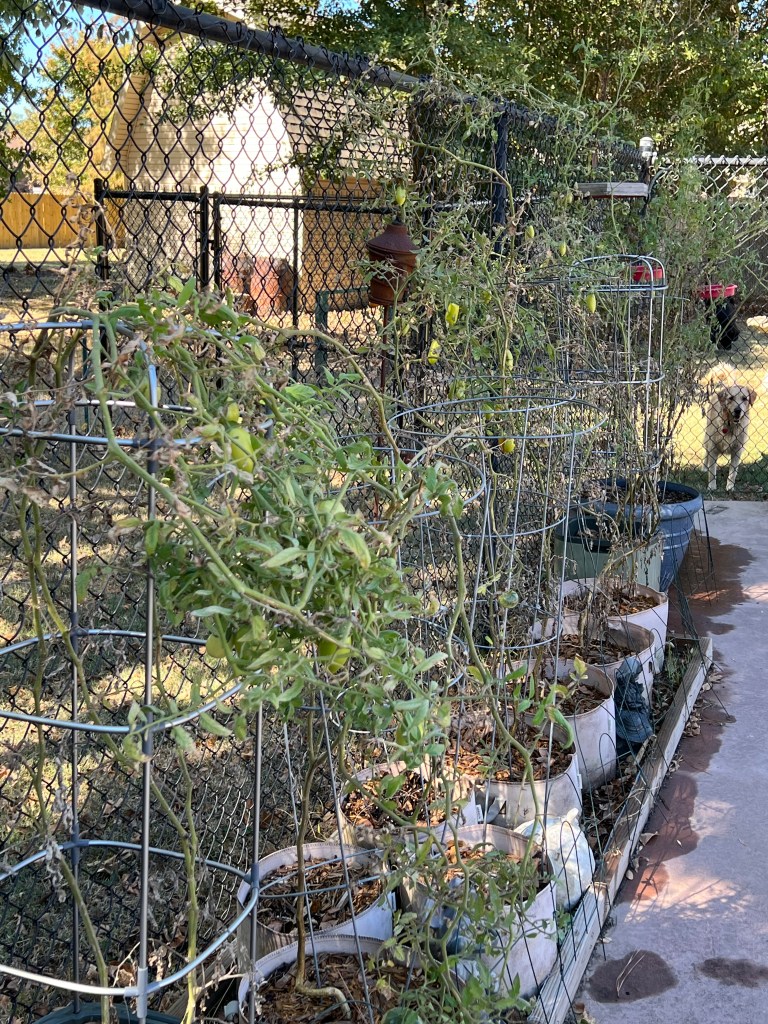
I have mentioned how most of my vegetables have matured and stopped producing.  The exceptions are the pole beans (Phaseolus vulgaris) representing the last of my three sisters’ harvest.  They started late but now still provide several cups of beans every few days.  The raised beds are empty except for the 5 rattlesnake watermelons (Citrullus lanatus) struggling to mature, the 2 late starting green bell peppers (Capsicum annuum), and the 2 red okra (Abelmoschus esculentus) that produce beyond their limit.  There are also 8 cabbages that are finally picking up as the temperatures cool.  I really did not expect much from my tomatoes as the heat kept them from much production during the summer (I did get 3 jars of pasta sauce).  The friend I swap gardening stories with said she tore her tomatoes and peppers out several months ago to avoid having to water them.  We are having temperature shifts as the nights get into the 40’s (4.5+C) and the days get to the high 80’s (27+C), causing a resurgence of my San Marzano and plum tomatoes, making me wonder what to expect in long-term production.

When I looked online, I found that depending on their maturation date, “indeterminate” tomato (Lycopersicon lycopersicum) cultivars are the best long-term producers and will yield tomatoes for two to three months.  “Determinate” tomatoes, including dwarf and bush cultivars, typically only yield tomatoes for around two weeks after they blossom.  Tomatoes are grown as perennials in tropical climates and as annuals in USDA plant hardiness zones 2 through 10.  Traditional and heirloom indeterminate tomato cultivars continue to grow taller throughout the growing season and will reach heights of 5 to 8 feet (1.5 to 2.5 m) and typically require support with a wire tomato cage or stakes.  They grow flowers and yield tomatoes from shoots or “suckers” that grow on the sides of their main stem from the time they mature and flower until the first autumn frost.  The best long-term producing cultivars are those that mature early and grow in an area with a long growing season.

Most cultivated tomatoes in my area (zone 7) are planted soon after the last spring frost (c. April 15) and the fruit is expected sometime between 57 to 100 days after the seedling is planted.  If you plant an indeterminate tomato cultivar, you are encouraged to prune the vines regularly to maintain a long harvest of large, quality tomatoes.  I have done this in the past, but I have only done this sporadically this year.  The University of Arizona horticulturalists recommend pruning all but three or four of the shoots that grow in a tangle inside the cage and allow the foliage to protect the fruit from the sun.  If you don’t prune the suckers, these stems consume a lot of a plant’s energy and may result in smaller yields and fewer tomatoes (like I saw).  I did use 4 foot (1.2 m) cages but as the season went on the plants far exceeded that height.  I found out the San Marzano I planted for pasta sauce are a larger variety of plum tomatoes (I planted both) and are some of the better plants in long-term production.

THOUGHTS: As the temperatures dropped, I quit the daily watering I maintained throughout the summer and removed the dying vegetable plants one by one as they ceased production.  A month ago, I was tempted to tear out all of my tomatoes as they had essentially stopped producing fruit but kept them to see what the long-term might bring.  Now they are again producing blossoms and fruit.  I had little to lose when I took a long-term approach in my vegetable garden.  If the plants failed to produce, I would not have been out much in terms of time and water.  Since they did produce, I will reap the benefit of fresh tomatoes into the fall.  Corporations seem less willing to take a long-term approach toward products or employees.  If the product does not make a quick profit, it is dropped.  If the employee does not prove productive, they are let go.  While moving from one product to the next might make economic sense, employees should not be used as expendable.  Act for all.  Change is coming and it starts with you.