Tortoise

December 24, 2025

Inside Monday’s newspaper was a USA Today article on a dog being trained to help with relocation of a threatened species in Florida.  Gerry-Anna Jones, a trainer at Goldstar Puppy Academy in Fort Pierce, is training Echo, a 3-year-old male husky-shepherd mix, to sniff out a small fake scented shell so the reptiles can be moved and protected before their habitat is developed.  Florida’s building boom is having a disastrous effect on the reptiles which are a 60-million-year-old keystone species whose burrow provides food and habitat for about 365 species of bugs, reptiles, rodents and other mammals.  Before 2007, developers could bury them alive, which suffocated or starved them.  Since being deemed a threatened species, they must be relocated.  Relocations have increased 358% on the Treasure Coast from 178 in 2014 to 816 in 2021, compared to 66% in Florida from 6,730 in 2014 to 11,171 in 2021, according to Neal Halstead, research director and lead instructor in the authorized gopher tortoise relocation agent training program at the nonprofit Wildlands Conservation.

When I went online, I found the gopher tortoise (Gopherus polyphemus) is a species of tortoise in the family Testudinidae native to the southeastern US.  The genus Gopherus contains only tortoise’s native to North America.  The species has forefeet well adapted for burrowing, and elephantine (stocky) hind feet, a feature common to most tortoises.  The front legs have scales to protect the tortoise while burrowing.  Individuals are dark brown to gray-black in color, with a yellow bottom shell (plastron).  A projection on the throat (gular) is evident on the front (anterior) plastron where the head projects from the shell.  The female has a flat plastron while the male has a concave plastron that is generally longer than the female.  The adult upper section of the shell (carapace) length ranges from 6 to 11 inches (15 to 28 cm), with a maximum of 16 inches (41 cm), and is at least twice as long as it is high.  Body mass averages 8.8 pounds (4 kg), with a range of 4.4 to 13.2 pounds (2–6 kg).  They are the only extant species of the genus Gopherus found east of the Mississippi River.  The IUCN Red List of Threatened Species lists the gopher tortoise as “vulnerable”, primarily because of habitat degradation.  The animals are considered threatened in some states while they are endangered in others.  The gopher tortoise is the state reptile of Georgia and the state tortoise of Florida.

Jones is working with Echo to switch from scent samples to live tortoises now that he knows his job, with a goal to have Echo ready for field work by spring 2026.  “He has been able to pick up the scent,” Jones said, “This morning (December 18), he hit on a burrow.”  She trains Echo to zigzag through the landscape until he smells a live tortoise.  After pinpointing a location, Echo will lie down next to a tortoise or its burrow.  Handlers will work with a registered gopher tortoise agent or researcher to collect data and move the animal to a permitted recipient site if needed.  At the recipient site, the tortoise ideally will become habituated to its new home range over several months to prevent the tortoises from homing back to their old burrow.  Jones believes the collaboration between the Goldstar Academy and Gopher Tortoise Alliance is a major step toward conservation.

THOUGHTS: While Echo is being trained to find the gopher tortoise, other dogs are being trained to locate other species.  Dogs are used in surveys with the Mojave Desert Tortoise (Gopherus agassizii) prior to construction to protect critical habitat.  Dogs find Eastern Box Turtles (Terrapene carolina carolina) to aid research on reptile diseases by the St. Louis Zoo.  Dogs located the

once-thought-extinct western pond turtle (Actinemys marmorata) in California’s Golden Gate National Recreation Area.  I was impressed that the kids were able to determine which hand their treat was in!  The association between wolves and hunter–gatherers began 17,500 years ago and they are the only domesticated large carnivore.  Act for all.  Change is coming and it starts with you.
Christmas Pickle

December 05, 2025

After a nearly two-hour bus ride our tour arrived at Neuschwanstein Castle today.  The castle is a 19th-century palace on a rugged hill of the foothills of the Alps in the south of Germany above the incorporated village of Hohenschwangau and the narrow gorge of the Pöllat stream.  Since 2025, the castle has been part of the UNESCO World Heritage Site, “The Palaces of King Ludwig II of Bavaria”.  According to Guinness World Records, it is the tallest castle in the world at 213 feet (65 meters).  Walt Disney used this castle as a model for Disneyland.  When we arrived on site there was snow on the ground and the castle was shrouded in fog.  The walk to the castle began with a 30-degree incline that took me 30 minutes to navigate.  After a brief rest we began the last 15 minutes of the walk that shifted to a 45-degree incline.  When our appointed 5-minute entry slot arrived we began a 25-minute tour that took us to the top (fourth) floor.  Although the trip was tiring, it was well worthwhile.  As our tour continued to Oberammergau our guide told us of one of the Christmas traditions celebrated by her family while growing up, the hiding of the Christmas Pickle.

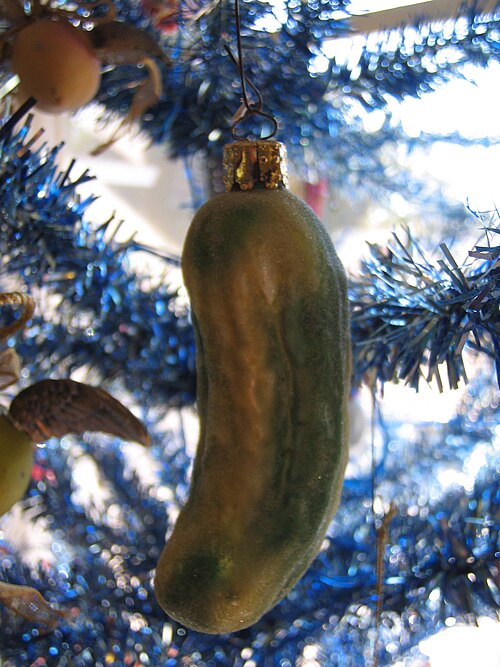
When I went online, I found Christmas pickle (Weihnachtsgurke) is a game of hiding a pickle shaped Christmas ornament among the branches of the tree.  While supposedly a centuries-old German Christmas tradition, most Germans have never heard of it, but it is beloved by many families in the US and UK.  After decorating their tree on Christmas Eve, the parents hide a pickle ornament among the branches.  The first child to find the pickle on Christmas Day receives an extra present or good fortune for the coming year.  In some stories, the pickle-hiding game is a centuries-old German tradition that has been passed down through generations.  In others, a captured German-American soldier was saved from starvation on Christmas Eve during the Civil War by eating a pickle.  Other people believe the tradition is related to St Nicholas resurrecting three boys who had been murdered and hidden in a barrel of pickles.  Anyone familiar with traditional German Christmas will see some flaws in the story.  Germany celebrates the arrival of St. Nicholas on December 6 rather than Christmas Eve and children open their presents on December 24, not Christmas Day.  The biggest problem is that few in Germany have ever heard of it.   A December 2016 survey by YouGov found only 7% of Germans had heard of Weihnachtsgurke, and only 6% of families practice the custom.

Our guide pointed out a souvenir store where we could buy a Christmas Pickle.  I toured the other shops before deciding to get a Christmas Pickle for my son and his family as a nice way of sharing a German tradition as we are of German descent.  When I asked the cashier where I could find a Christmas Pickle, her response was, “Was is pickle, I do not know this word.”  I broke out the translator on my phone and typed in my request, which was displayed on my screen in German.  “Ah, gerken!”  Then she showed me a wooden pickle for 24 Euro.  She saw the look on my face and told me to wait while she found a cheaper version upstairs.  While I waited, I Goggled “Christmas pickle” and found this was not a German tradition, but an American tradition that has only recently spread to Germany.  When I shared this information with the clerk, she told me she only keeps the Christmas pickle for tourists.  I did not buy a Christmas pickle for my son and his family.           

THOUGHTS: When my guide asked if I found a Christmas pickle I just laughed and said I had.  I knew nothing would be gained by telling her what I had learned.  I have found that traditions come from all sorts of origins, and the origin is not as important as the joint celebration it brings to a family or community.  Sometimes it is better to just keep your traditions alive (no matter where they come from) to bind us together in a shared belief.  Act for all.  Change is coming and it starts with you.
Glockenspiel

December 04, 2025

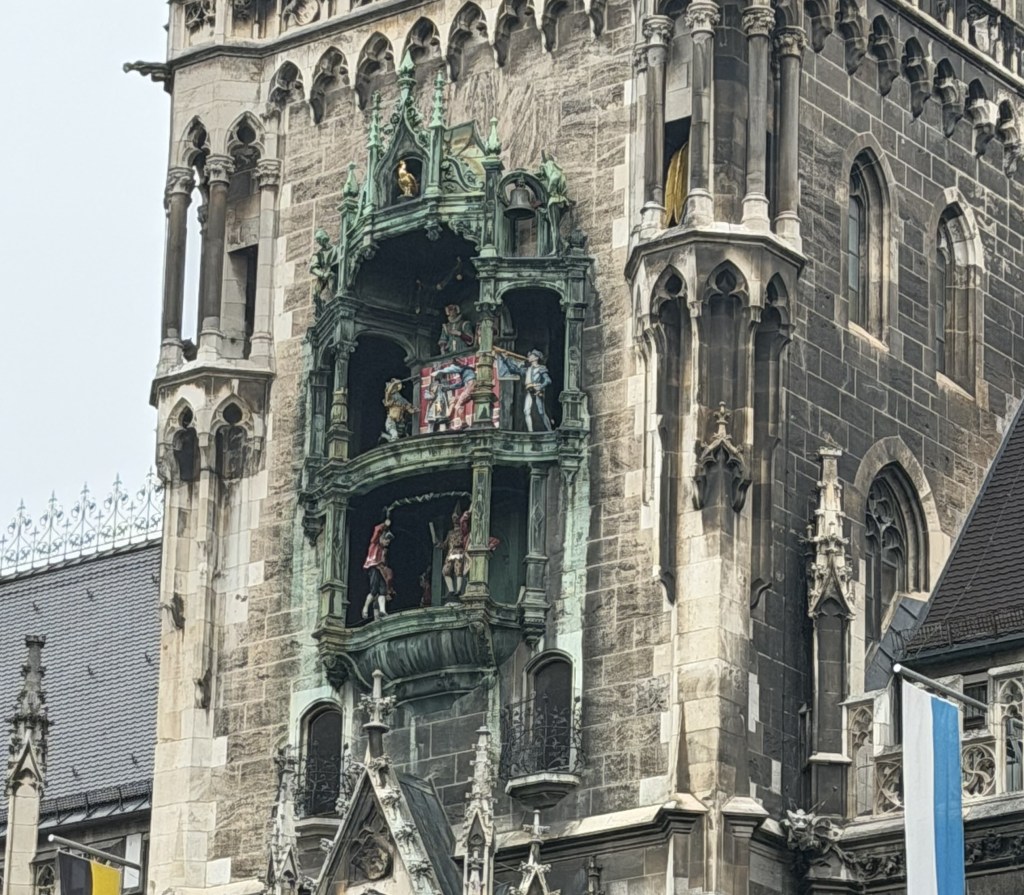
Our walking tour of Munich was timed so the first section of our walking tour would arrive in the city center in time for the sounding of the bells at noon.  On arrival our guide asked if we had seen the bells of the Ankeruhr clock in Vienna (what?? must have missed it).  This unusual Art Nouveau work was created by Franz von Matsch in the period between 1911 to 1914, and Franz Morawetz the court clockmaker had made the clockwork mechanism.  Although the city square was the site for the largest Christmas market in Munich, the bells had nothing to do with the markets.  The bells and figures were added to the town hall in 1908 and consist of 43 bells and 32 life-sized figures.  The mechanism is powered by solar power and is only semi-automatic, as it needs a player to turn the levers at the exact right times 364 days a year.  The glockenspiel at Munich is the largest in Germany and the fourth largest in Europe.

When I went online, I found glockenspiel is a percussion instrument that originally consisted of a set of graduated bells, and later a set of tuned steel bars (a metallophone).  These are struck with wood, ebonite, or even metal hammers.  The bars are arranged in two rows, the second corresponding to the black keys of the piano.  The name glockenspiel is German (“bell play”) and refers to the sound of small bells.  The very first instruments to carry this name did indeed consist of a set of small bells which were played either by a group of musicians or struck by means of a complex mechanism.  At the end of the 17th century steel bars began to replace the bells.  Initially they were only a substitute for real bells, but this arrangement of metal bars soon developed into a musical instrument of its own and retained the name “glockenspiel”.  Like the xylophone, the glockenspiel is a great favorite with children.  Carl Orff used it from the 1930’s for his Method.  The children’s instruments have a smaller range, are tuned diatonically, and have bars resting over a frame like a trough.  Lower-pitched glockenspiels have short resonators and are generally known as metallophones.

The glockenspiel of the Munich New Town Hall (Neues Rathaus) on the central square (Marienplatz) attract huge crowds every day for reenactments of two events from Munich’s city history.  The first is the wedding of Duke Wilhelm V and Renate of Lorraine, in February 1568 when a jousting match in honor of the bride and groom took place on the square.  The Bavarian knight (of course) triumphed over his opponent from Lorraine.  The lower floor shows the famous Coopers’ Dance (Schäfflertanz) is a guild dance of the coopers (Barrel makers) originally started in Munich.  Early documented cases of Schäfflertanz are dated by 1702 when the Münich magistrate approved the performance of the dance as a well-established tradition.  For a long time the date 1517 was prevalent in the literature originating the legend that the tradition started after the 1517 plague to revive the spirits of the people “to lure them out of their houses”.  There are no records of any plague in Münich at this period.  Still, the 500th anniversary was celebrated in 2017.  There is no clear indication of the origin of the seven-year cycle, but since the early 1800’s the custom has spread, and it is now a common tradition over the region of Old Bavaria.

THOUGHTS: We waited in the city square to see the glockenspiel along with a select group of 3000 of our closest friends.  We had been told the figures did not move until the third song.  First came the church bells (always the priority) followed by a introductory number.  The third number set the first group of jousters in motion and the fourth featured the dancing coopers.  The finally was the cock crowing three times.  Our guide had warned us that time had not been good on the crow mechanism and he was right.  It sounded more like the honking of a goose.  It felt good to join others in a century-old tradition.  Act for all.  Change is coming and it starts with you.
Sound of Music

December 03, 2025

We decided to go on the Danube tour because Melissa wanted to see the Christmas markets.  My sister and her husband had gone on the Danube tour several years ago in late November and told us when they took the extension the Christmas markets were already in full swing.  We booked a tour that left on the 25th of November (two days before Thanksgiving) and ended on the 1st of December.  We arrived two days early to overcome the jet lag that can accompany overseas travel (and did for us!).  That also meant we did not have to plan anything for Thanksgiving, a meal that is always difficult for two.  A (somewhat) traditional meal was served on the ship with turkey (sliced white and dark meat), mashed potatoes and stuffing (sort of), and cranberry sauce with pumpkin pie for dessert.  I have had potatoes and stuffing at other meals on board and while ok, the consistency is much different than I am used to in the US.  The extension included four days before we fly home on December 6th.  I noticed the extension was called the Sound of Music Tour, but I was not ready for what that entailed. 

When I went online, I found the Sound of Music is a 1965 musical film (Rodgers and Hammerstein) based on the 1949 book by Maria von Trapp.  The story is set in Austria on the eve of the German annexation (Anschluss) and tells the story of Maria who takes on the job as governess of the large family while she decides whether to become a nun.  She falls in love with the seven children and eventually with the widowed father, Captain von Trapp.  A former submarine captain, he is ordered to accept a commission with the German navy but opposes the Nazis.  The captain and Maria decide on a plan to flee Austria with the children.  The family left by train to Italy, then traveling to London and the US.  The film version made the escape more dramatic by having the family hide in the cemetery before escaping over the mountains to Switzerland on foot.  Many of the songs have become standards, including the title song, “The Sound of Music”. 

Our Sound of Music tour started with a panoramic coach drive through the mountains.  At every stop and turn we were told about how the movie had used such and such location for filming, even though it had nothing to do with the von Trapp experience.  The scenery was amazing and at one stop I saw several dozen lake trout, all about 18 inches (45 cm) long, swimming along the shore (that was not included in the musical).  As we passed several locations the guide played appropriate songs from the movie over our bus sound system.  Many of the guests sang along, some becoming very animated.  On arrival in Salzberg we saw the façade of the villa used in the film (not the von Trapp villa) and the gazebo used in the film (“I am 17”).  The gazebo was from the film but not the von Trapp villa and had been moved several times because tourists were harassing the owners.  The tour continued the following day as we passed four or five Salzberg sites used in the film but were far removed from the family.  The church where the couple were married is still an active convent.

THOUGHTS: While the tours were focused on the Sound of Music, we also passed the birthplace and several residences of Wolfgang Motzart.  These were of keen focus in Vienna but seemed of only passing interest (to our guide) in Salzburg.  We did get to the cathedral of St. Peter and its large Christmas market.  They had amazing pretzels.   It was interesting to see many Chinese tourists poising and dancing and singing the screenplay of the movie as they passed through the film locations.  Like so many things, we give the customer what they want (or we think they want).  When telling the difference between reality and what we would like to be, the facts seem to be harder to discern.  Act for all.  Change is coming and it starts with you.
Concentration

December 01, 2025

We began yesterday with a panoramic tour of Linz, Austria.  While the city was nice, a “panoramic” tour meant we rode a tram to see important buildings.  Even bundled up it was cold (30F/-1C) and the fog made it difficult to see anything more than a few hundred feet (60 m) away.  The river port was a 20-minute walk from the main city and the Christmas market (our reason for the tour) did not open until it was time to return to the ship.  While several stayed, we had scheduled a bus trip that afternoon that left us just enough time to eat a fast lunch.  We piled into the bus, and our guide took us for a tour of Mauthausen, Hungary.  Mauthausen is a small market town in the Austrian state of Upper Austria located about 12 miles (20 km) east of Linz.  I had not paid much attention when we had signed up for the tour but was aware this was the site of one of the many German work camps established from 1933 to 1945.   Our guide informed us the difference between a prison and a concentration camp was there was never a trial for the people detained there.

When I went online, I found the Nazis had no plan for concentration camps prior to their seizure of power in the German government on January 30, 1933.  The concentration camp system arose in the following months due to the desire to suppress tens of thousands of Nazi opponents in Germany.  The Nazis used the arson attack on the German parliament building on February 27, 1933 (Reichstag fire) to consolidate power and as the pretext for mass arrests.  The Reichstag Fire Decree eliminated the right to personal freedom enshrined in the Weimar Constitution and provided a legal basis for detention without trial.  Historian Jane Caplan estimated the number of prisoners in 1933 to1934 at 50,000, with arrests perhaps exceeding 100,000.  Eighty per cent of prisoners were members of the Communist Party of Germany and ten per cent members of the Social Democratic Party of Germany.  About 70 camps were established in 1933, in any convenient structure that could hold prisoners, including vacant factories, prisons, country estates, schools, workhouses, and castles.  The early camps were heterogeneous and fundamentally differed from the post-1935 concentration camps in organization, conditions, and the groups imprisoned.

From 1938 to 1945, the Mauthausen concentration camp was at the center of a system of over 40 subcamps and was the main site of political, social, and racist persecution by the National Socialist regime on Austrian territory.  Mauthausen was originally intended as a work camp to extract the granite blocks from the associated quarry.  These blocks were used to build camp buildings as well as building material for the surrounding towns.  The outbreak of the war shifted the workers’ emphasis to forced labor in the surrounding industries.  The tone of the group was hushed as we toured the site.  The dense fog was thicker as we rose above the city and many of the locations were pointed out with, “if you could see, down there was . . .”   The fog seemed appropriate as much of the site’s history had been shrouded in secret.  Like many of the camps, as the allies got closer the emphasis shifted toward cleaning up the evidence of atrocities.  Of a total of around 190,000 people imprisoned here, at least 90,000 were murdered.

THOUGHTS: Rather than denying the concentration camps past or trying to make it more palatable, the Mauthausen Memorial is maintained as a site of political and historical education.  Its task is to ensure public awareness of the history of the Mauthausen concentration camp and its subcamps, the memory of its victims, and the responsibility borne by the perpetrators and onlookers.  At the same time, it seeks to promote critical public engagement with this history in the context of its significance for the present and future.  George Santayana wrote, “Those who cannot remember the past are condemned to repeat it”.  The same still holds.  Act for all.  Change is coming and it starts with you.

Vienna

November 28, 2025

Yesterday we continued our trip along the Danube River to Bratislava, Slovakia.  Bratislava is the capital and largest city of Slovakia.  The city has deep historical ties to Hungary and served as its capital and coronation city for centuries and is now the capital seat of Slovakia.  Bratislava borders both Austria and Hungary, making it the only national capital in the world to have land borders with two other sovereign states.  After the Ottoman conquest in 1526, Bratislava (then Pozsony) became the capital of the Kingdom of Hungary from 1536 until 1783.  Eleven Hungarian kings and eight royal consorts were crowned in the city’s St. Martin’s Cathedral.  “Bratislava” was adopted as its name following World War I (1919) after it became part of Czechoslovakia.  After an afternoon walking tour of the city and a lively evening of entertainment (dancers and operetta), we departed Bratislava late last night and continued our way up the Danube River toward Vienna.   

When I went online, I found Vienna is the capital and largest city (2 million inhabitants) of Austria.  Its larger metropolitan area has a population of nearly 2.9 million, representing nearly one-third of the country’s population. Vienna is the cultural, economic, and political center of the country, the fifth-largest city by population in the European Union, and the most populous of the cities on the Danube River.  The city lies on the eastern edge of the Vienna Woods (Wienerwald), the foothills of the Alps that separate Vienna from the more western parts of Austria.  The city sits on the Danube and is traversed by the Vienna River (Wienfluss).  Although surrounded by Lower Austria, the city lies 31 miles (50 km) west of Bratislava, Slovakia, 31 miles (50 km) northwest of Hungary, and 37 miles (60 km) south of Moravia (Czech Republic).  The Romans founded a fortress (castrum) at the site in the 1st century CE called Vindobona, which was elevated to a town (municipium) with Roman city rights in 212.  In 1155, Vienna became the seat of the Babenbergs (976 to 1246) and was granted city rights in 1221.  The Habsburgs succeeded the Babenbergs during the 16th century and Vienna became the seat of the emperors of the Holy Roman Empire, a position it held until the empire’s dissolution in 1806.  With the formation of the Austrian Empire in 1804, Vienna became the capital of the Austrian and all its successor states.

Our morning in Vienna began with a panoramic (bus) tour of the major sites of the city followed by a walking tour of the interior.  This tour took us from the old city gates (no longer in existence) toward St. Stephen’s Cathedral.  We had toured St. Stephen’s Cathedral in Bratislava, but this was named for Stephen I, the first king of Hungary reigning from approximately 1000/1001 until his death in 1038 CE.  Although his parents were baptized, he was the first of his family to be a devout Christian.  Stephen led the Church in Hungary to develop independently from the archbishops of the Holy Roman Empire and encouraged the spread of Christianity by meting out severe punishments for those ignoring Christian customs.  He became the principal patron saint of Hungary.  St. Stephen’s Cathedral in Vienna is named for the first martyr of Christianity according to the Acts of the Apostles (Chapter 6).  During the modern era, Vienna has been among the largest German-speaking cities in the world and host to major international organizations.  In 2001, the city center was designated a UNESCO World Heritage Site.

THOUGHTS: One excursion in Vienna is a concert by the Vienna Residence Orchestra that features some of Vienna’s most beloved music, including Strauss waltzes and Mozart’s The Magic Flute.  This is a bucket list for Melissa I am grateful to share.  Sharing each other’s expectations and hopes bonds relationships.  The more the better.  Act for all.  Change is coming and it starts with you.
Locks

November 27, 2025

One of the smarter things Melissa and I did on our Danube River trip was to fly into Budapest several days prior to our embarkation date.  Still, we were not prepared for the toll the trip would have.  We were both so exhausted that we struggled to make it through our first dinner and suffered cramps the first two nights from being on the plane (not moving enough).  Our embarkation point was close to our hotel but did not relish the thought of dragging our luggage along the banks of the river.  We were able to secure the hotel car (for a small fee) to drop us in front of the ship on Tuesday.  The next two days were spent exploring the sights of Buda, the hilly south side, and Pest, the flat north side of the river.  I had exchanged 50 Euros into 17,450 Forint thinking there would be shops who would not take foreign currency but everywhere took both Euro and credit cards.  Since Forint is not excepted anywhere but Hungary, the maid and guides were tipped with Forint.  On the last day in town, I took a final walk to the Christmas market to spend my last 2000 Forint (5.26 Euro).  I watched from the sundeck as we pulled out marveling at the breadth and power of the Daube.  It was hard to fathom that tomorrow we would pass through several locks that would raise the ship 60 feet (18.3 m).

When I went online, I found the Danube has a series of locks to allow river passage associated with the 18 river power plants (from Kelheim to Sulina) that generate energy from the dams.  These locks are of either one (4) or two (14) chambers that can allow simultaneous locking of vessels travelling upstream and downstream.  The steep gradient of the Upper Danube (Kelheim and Gönyu) has 16 power plants with locks, while the Middle and Lower Danube has only 2 locks situated at the Iron Gates, a gorge forged by the Danube through the Carpathians, which forms the border between Romania and Serbia.  The Iron Gate locks are also the largest on the Danube.  Iron Gate I (river km 942.90) and Iron Gate II (river km 863.70/ 862.85) each have two lock chambers which are 1017 feet (310 m) long and 111.5 feet (34 m) wide, located on the right bank and the left bank.  The lock chambers on the right bank (Djerdap I and II) are maintained and run by Serbia, while those on the left bank (Portile de Fier I and II) are maintained and run by Romania.

When I woke up this morning, I opened the curtains of our stateroom and was surprised to see the banks of the Danube only 20 yards (18 m) away as this was such a contrast to the massive river channel we had left in Buda pest.  While the banks did widen some as we continued upstream, they never reached the distance of the previous night.  When we arrived at the first lock (Gabclkovo) we squeezed into an area 111.5 feet (34 m) wide and 902 feet (275 m) long.  We were nearly pressed against the side of the lock, with a wide berth on the right hand (starboard).  Once we began to rise, a new friend and I went to the observation deck to watch the process.  That was when I saw another small cruise ship situated beside and slightly behind our larger craft.  At least now our proximity to the side of the lock made sense.  As the lock opened, we sailed into the Dunajsky canal that connected us back to the river.  We were on our way to our second destination city of Bratislava.

THOUGHTS: Locks are designed for boats and not for migratory fish and can act as a barrier to migratory fish.  The lock can also be modified by adapting operation protocols to guide fish through a lock with a series of controlled water-level changes that mimic a fish lift.  The effectiveness of an adapted lock depends on sufficient attraction flow and careful timing to ensure fish enter and move upstream successfully.  Under standard operation, the area near the lock is calm, making it difficult for fish to find the entrance, and less than 1.5% of fish may use the lock.  The impact on ecosystems along the Danube has been partially mitigated through various national and international agreements and national parks.  It takes planning.  Act for all.  Change is coming and it starts with you.

PS: For my American followers, Happy Thanksgiving!

Forint

November 24, 2025

Melissa and I both finally got to sleep last night and woke ready to see some sights of Budapest.  We checked with the concierge at the front desk about what to see and were given a map which he marked with possible locations.  The first thing I wanted to do was check the location of our tour line’s port.  We have heard at times there may be more than one point of embarkation.  We set out using my phone map app knowing it was only 650 feet (198 m) to our location.  We got closer and then the distance began to increase as I had made a wrong turn.  It turned out it will be an easy trip tomorrow, but I am glad I checked before dragging our luggage around Budapest.  I made several purchases last night using Euros and received sighs, and calculators, so I decided I should convert some of my US$ to Forint, the official currency of Hungry. 

When I went online, I found the forint’s name comes from the city of Florence, where gold coins called fiorino d’oro were minted from 1252.  In Hungary, the florentinus (later Forint), also a gold-based currency, was used from 1325 under Charles Robert, with several other countries following Hungary’s example.  Between 1868 and 1892, the Forint was the name used in Hungarian for the currency of the Austro-Hungarian Empire, known in German as the Gulden.  It was subdivided into 100 krajczár.  The introduction of the forint on 1 August 1946 was a crucial step in the post-World War II stabilization of the Hungarian economy and remained relatively stable until the 1980’s.  Transition to a market economy in the early 1990’s resulted in inflation, which peaked at 35% in 1991.  Between 2001 and 2022, inflation was in single digits, and the Forint has been declared fully convertible.  In May 2022, inflation reached 10.7% amid the Russian invasion of Ukraine and economic uncertainty.  As a member of the European Union, the long-term aim of the Hungarian government may be to replace the forint with the euro, although under the current government there is no target date for adopting the euro.  Currently 1 Euro equals 382.45 Hungarian Forint.

When I checked with the concierge desk I was told to go to a bank or exchange station to convert my currency to forint.  We had decided to go to St. Stephen’s Basilica which was only a few blocks farther and (sort of) in the direction of the cruise dock.  As we approached, we saw a Christmas market in full swing on the streets surrounding the church.  We knew there would be shops, and after last night’s experience I wanted at least some forint for a purchase.  We found an exchange shop not far from the market.  It turned out they did not know how to convert US$ into Forint (?) but it was easy to convert with Euros.  We had prepared our credit card with our trip as they accepted foreign exchanges (no fee).  Armed with nearly 17,000 Forint (50 Euro) we were ready to face the markets.  We browsed the shop and food venders on our way to the basilica, deciding what to eat on our return.  When we arrived at St. Stephens, we were both cold and decided to see the exterior rather than the tour.  We then stopped for a large Hungarian sausage, potato cake, and stuffed cabbage.  None of the shops took cash, so we used our credit card.  Now what to do with 17,000 Forint.       

THOUGHTS: After we got back to the hotel with my Forint in hand (and tons of food) we laid down for a rest before taking off again.  This time it was my foot that woke me up in pain.  I decided to go back to the shop I visited last night and buy some Gatorade (or facsimile) with my forint.  I bought 3 Gatorades, orange juice, and a bag of chips for 4500 Forint.  When we went to Greece we came home with 450 Euros.  We did not mind as we knew the Danube trip ended in Germany so it would be spent.  We still have another day and a half to spend our Hungarian forint.  Many charities, airports, and airlines collect leftover currency for donations.  I saw a donation bin in Munich but did not understand what it was for, until now.  Act for all.  Change is coming and it starts with you.
Holiday Travel

November 23, 2025

Melissa and I decided to go two days early for our trip up the Danube River and set our flights to arrive on Sunday prior to embarking Tuesday afternoon.  Our 11:30 am flight meant we began our trip taking the kids for boarding on Friday evening.  Loki has recently become frantic with visits to the Vet and again became frantic as we dropped him off at the kennel.  I watched as he got past the first door and by the second he was straining to get inside.  That made me feel better about leaving the kids for an extended visit.  Saturday began with a 1-1/2-hour drive to our connecting airport, a two hour wait for the plane to depart (customs was a breeze), and another 1-1/2 hours to arrive in O’Hare.  Since we had a 4-hour layover, we proceeded to the airlines lounge.  This was a first for us and I was pleased with the comfort, food, and drink offered for free (for members).  We sat as a steady stream of people came in and out, while another steady stream was turned away without the proper credentials.  We had planned on early travel as flights in the US have been disrupted by the government shutdown, but our greater concern was the potential crush of holiday travel. 

When I went online, I found US airlines are predicting another record Thanksgiving holiday travel season.  Airlines for America, a lobbying group representing the largest US carriers, predicted Thursday that airlines will carry more than 31 million people between Friday, November 21, and Monday, December 1.  The busiest days are expected to be the Sunday after Thanksgiving (30th), with about 3.4 million people flying, and the Monday after Thanksgiving (31st), with around 3.1 million passengers.  The airlines have expressed relief after the longest-ever government shutdown ended November 12th.  Shortages of air traffic controllers delayed and canceled flights, disrupting travel plans for some 6 million people.  The industry is pushing lawmakers to pass legislation to ensure that air traffic controllers are paid in the event of another shutdown.  The latest bill only funds the government through January, so industry members are hoping to avoid a repeat of the closure just before winter break and spring break seasons begin.

We arrived at our hotel in Budapest after 20 hours of holiday travel.  This included two drives (car 1-1/2 hours and taxi-1 hour), two layovers (6 hours), two short hops (O’Hare – 1-1/2 hours and Budapest – 1 hour), and an overseas flight to Munich (9 hours).  We were tired but thankful the trip had been relatively easy.  We had purchased economy plus (for legroom) on the overseas flight.  I got up several times to go to the restroom (actually to stretch my legs) but it was still uncomfortable.  We were both exhausted when we reached the hotel and after check-in decided to eat in the hotel bar.  We ordered a cheese and meat plate along with a variety of humus dips.  I was so tired during the meal I almost fell asleep.  By the time we went to our room it was 5:00 pm local time, but we decided it was late enough to go to bed. 

THOUGHTS: You have got to love holiday travel.  I went right to sleep but woke with horrific cramps in my left calf.  Apparently, I had not moved enough on the flight.  I looked at my watch, and it said 8:20.   Even though the blackout curtains were pulled it seemed like there should be morning light coming through from outside.  That was when Melissa told me I had only been asleep for an hour.  Since I was wide awake, I wondered how I was ever going to get through the night.  Then I realized in my new time zone it was still early.  I putzed around for a couple of hours and then went back to bed.  Even as I bemoaned the difficulty faced arriving at my trip destination, I realized how easy it was compared to earlier travelers.  It took four to six months to cover the 2,170-mile (3,490 km) to traverse the Oregon trail by wagon and 20,000 to 30,000 people died (1 in 10).  I guess cramps are not all that bad.  Act for all.  Change is coming and it starts with you.
Seed Bank

November 21, 2025

Today’s NYT The Morning scroll included a link to photos and an article from Times photographer Ruth Fremson about an island used to gather seeds to replace parts of the deforested Amazon forest.  The Brazilian government built a hydroelectric dam fifty years ago and flooded 100s of 1,000s of acres of rainforest along the Tocantins River and transforming a mountainous peak into an island.  That island now supplies seeds to replenish deforested areas and preserve native species throughout the Amazon.  Workers arrive by boat and scale towering trees to reach the fruit that contains the seeds which are then donated to schools, government agencies, and farmers.  The owner of the dam, AXIA Energia, said it compensated the 32,000 people displaced by the project and uses the seed bank to replenish areas throughout the Amazon.  Workers gathered almost nine million seeds last year and are on pace to far exceed that amount this year.  Their seed bank stores about 30 million seeds in one of three chambers (cold, humid, and dry).

When I went online, I found the worlds’ largest seed bank is the Svalbard Global Seed Vault, a secure backup facility for the world’s crop diversity on the Norwegian island of Spitsbergen in the remote Arctic Svalbard archipelago.  The vault provides long-term storage for duplicates of seeds from around the world, conserved in gene banks.  This provides security of the world’s food supply against the loss of seeds in gene banks due to mismanagement, accident, equipment failures, funding cuts, war, sabotage, disease, and natural disasters.  The vault is managed under terms spelled out in a tripartite agreement among the Norwegian government, the Crop Trust, and the Nordic Genetic Resource Center (NordGen).  The Norwegian government entirely funded the Seed Vault’s KR$45 million (US$8.8 million in 2008) construction cost.  Norway and the Crop Trust pay for operational costs and storing seeds in the vault is free to depositors.  As of June 2025, the seed bank conserves 1,355,591 accessions, representing more than 13,000 years of agricultural history.

Another Amazon Basin living seed bank is located at Camino Verde in the richly biodiverse region of Madre de Dios in Peru.  This resource grows over 400 species of native trees and plants, and some with often incredible properties little-known to science.  Camino Verde sits alongside the Tambopata River, whose basin is one of the richest ecological areas on the planet.  It is home to native (endemic) species of birds, reptiles, and mammals, along with at least 1,255 plant species.  However, the unique biodiversity of this region has been disappearing over the past decades.  In 2020, Peru recorded its highest levels of deforestation in history, with a total of 502,296 acres (203,272 ha) of Amazonian forest lost due largely to logging and mining.  Since 2001, almost 741,3161 acres (3 million ha) have been deforested.  Similar deforestation is taking place across the tropics both legally and illegally.

THOUGHTS: I do not have a seed bank, but Melissa did buy me several 100 packets of seed two Christmases ago.  I used several varieties that first year and then replanted some of the leftover seeds again this year.  Most seed packets state the year of intended use and many also list minimum germination standards and usual seed life.  Seeds that have been stored in a cool, dry place are generally viable for at least a year past the season for which they were packaged and may be good for up to five years.  I realize I do not have the perfect conditions required for a seed bank, but I was surprised by how many of the seeds were not viable.  My “survival seed packets” are still sealed in airtight packaging intended to keep them viable for longer periods.  The oldest viable seed ever planted and successfully grown is a 32,000-year-old narrow-leafed campion (Silene stenophylla) found in the Siberian permafrost. Preserving seeds for the next year is another step toward being sustainable.  Act for all.  Change is coming and it starts with you.