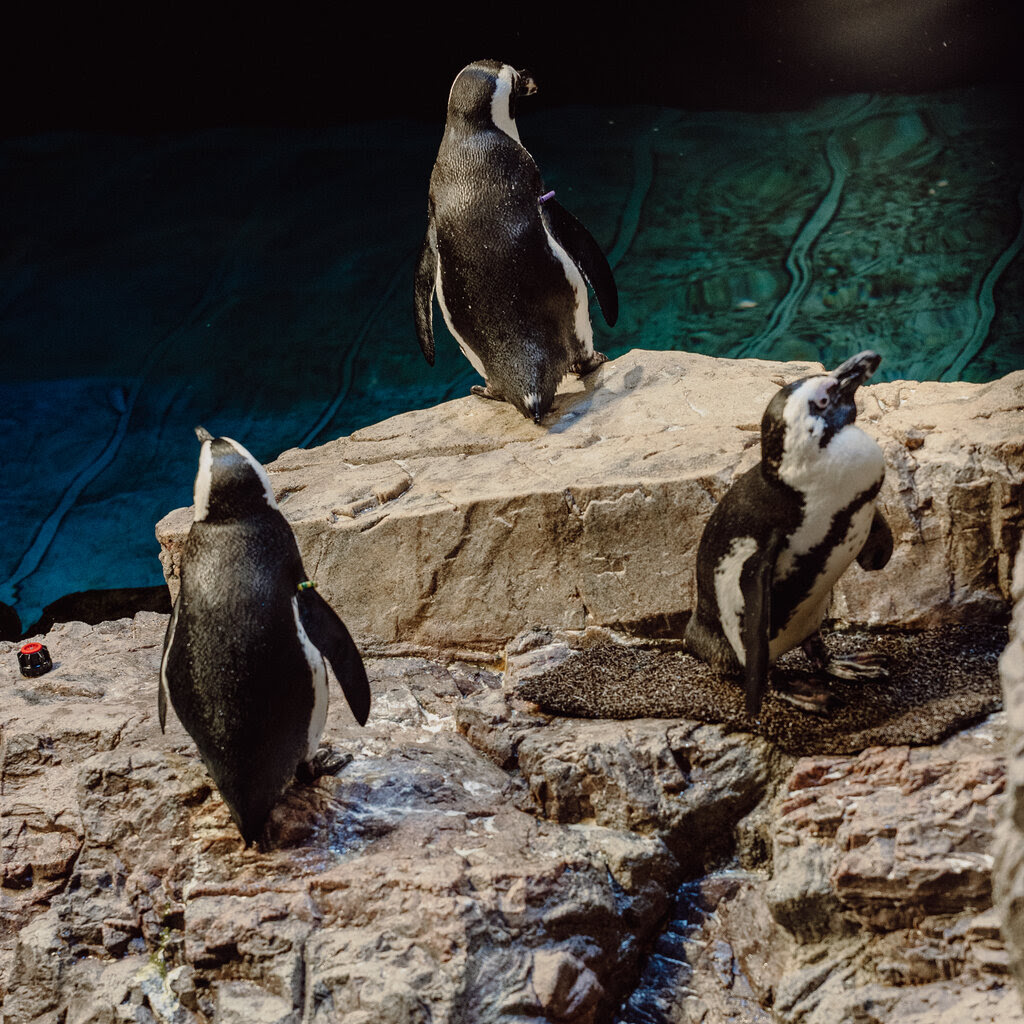
African Penguin

March 17, 2025

Photograph by Cody O’Loughlin

This morning’s NY Times Morning feed carried an article about a group of penguins who are receiving special treatment at the New England Aquarium in Boston.  Six seabirds were moved to the island for “retired” penguins that opened in February.  The birds were relocated to address the large number of penguins at the aquarium who are living well beyond the age they would be expected to reach in the wild.  The residents of this “country club for older animals” are sectioned off from three other islands inhabited by penguins via a mesh gate in the water.  “They all get a good opportunity to eat and take their time and not feel rushed, not get pushed off the island by another animal that’s anxious to eat,” said Kristen McMahon, the aquarium’s curator of pinnipeds and penguins.  About half of the aquarium’s 40 African penguins are older than the bird’s life expectancy of 10 to 15 years, and some have doubled it.

When I looked online, I found the African penguin (Spheniscus demersus), also known as the Cape penguin or South African penguin, is a species of penguin confined to southern African waters and is the only penguin found in the Old World.  All penguins are flightless and have a streamlined body and wings stiffened and flattened into flippers for a marine habitat.  Adults weigh an average of 4.9 to 7.7 pounds (2.2 to 3.5 kg) and are 24 to 28 inches (60 to 70 cm) tall.  The upper parts of the body are black and are sharply delineated from the white underparts (counter shading), which are spotted and marked with a black band.  The African has distinctive pink patches of skin above the eyes and a black facial mask.  The birds are pursuit divers that feed primarily on fish and squid.  Wild penguins are found in the coastal waters of South Africa and Namibia, where they face threats that include the depletion of food from overfishing, climate change, and pollution.  Once extremely numerous, they are now the rarest species of penguin. 

The geriatric penguins at the aquarium are mostly in their 30’s and receive close monitoring for ailments like cataracts and arthritis.  They are fed fish injected with extra water to promote kidney health, and they get treatments such as eye drops and physical therapy.  Some even get acupuncture.  McMahan said, “We wanted a space that was a little bit lower paced and more easily observed by the veterinarian team and our training team on a daily basis.”  The life expectancy for a wild African penguin likely does not reflect the reality for the species today, said Christina Hagen, the Pamela Isdell Fellow of Penguin Conservation at the organization BirdLife South Africa, a group who are attempting to establish an African penguin colony in the wild.  The aquarium’s penguins can live longer because they do not face the same threats as wild birds and receive specialized care.  The African penguin is classified as a critically endangered species, and conservationists say that they could become extinct in the wild by 2035. 

THOUGHTS: The aquarium’s oldest African penguin, Good Hope (35), and his mate St. Croix (23), are set to move to the retirement island soon.  McMahan said the aquarium does not have plans to move in other birds and will instead let this group “live in harmony”.  Human retirement homes in the US range from independent living to assisted living to skilled nursing care, and the costs vary greatly depending on location and level of care needed.  While independent living costs vary widely based on location and specific community, the national median monthly cost for assisted living is around $5,676, a semi-private room in a skilled nursing facility is around $8,669, and a private room is $9,733.  As of Mar 7, 2025, the average annual pay for a Retirement Community in the United States is $62,680 a year.  Being able to live in harmony is not cheap.  As our population ages new innovations are needed to provide housing.  Act for all.  Change is coming and it starts with you.

Parthenogenesis

February 21, 2025

undefined

Inside the front section of Monday’s newspaper was a USA Today article on the birth of a baby swell shark (Cephaloscyllium ventriosum).  The swell shark pup hatched on January 3rd after an egg was spotted by the Shreveport aquarium’s animal husbandry team eight months ago.  The birth could be from rare form of asexual reproduction (parthenogenesis), or from delayed fertilization.  The two female sharks present in the tank had not been in contact with a male for more than three years.  A DNA analysis once the pup is big enough for a blood sample to be taken will determine how the birth occurred, but it will take months before the test can be performed.  “This situation is incredible and shows the resilience of this species,” said Greg Barrick, the curator of live animals at Shreveport aquarium. “We are very excited in the coming months to confirm whether this was indeed a case of parthenogenesis or if it was delayed fertilization.”

When I looked online, I found parthenogenesis (Greek parthénos, “virgin” and “génesis, “creation”) is a natural form of asexual reproduction in which the embryo develops directly from an egg without need for fertilization.  In animals, parthenogenesis means the development of an embryo from an unfertilized egg cell.  Parthenogenesis occurs naturally in some plants, algae, invertebrate animal species, and a few vertebrates (some fish, amphibians, and reptiles) and has been induced artificially in animal species that naturally reproduce through sex (fish, amphibians, and mice).  Normal egg cells form in the process of meiosis (division) and have half as many chromosomes as their mother’s body cells (haploid).  Such individuals are usually non-viable, and parthenogenetic offspring usually have a complete number of chromosomes (diploid).  In parthenogenesis, the offspring having all of the mother’s genetic material are called full clones and those having only half are called half clones.

The baby shark has been named Yoko, after the Native American Chumash people’s word for shark (onyoko) and is said to be thriving, although sharks born by such reproduction face significant challenges.  The aquarium staff said she will leave an “unforgettable legacy” to the study of shark reproduction and conservation.  If Yoko was born via parthenogenesis, she would join a small number of invertebrate animals capable of “virgin births”.  Laying eggs without mating is much rarer in vertebrates, but it has been seen in zebra sharks (Stegostoma tigrinum), sawfish (Pristis zijsron) and a handful of reptiles.  This type of birth was first documented in Komodo dragons (Varanus komodoensis) in 2006 in two separate British zoos.  Charlotte, a stingray (Hypanus americanus) in an aquarium in North Carolina, was found to be pregnant in 2024 despite not having been in contact with a male for eight years.  While scientists assume vertebrates turn to parthenogenesis when no mates are present, it is unknown why they occur and what triggers birth. 

THOUGHTS: Whether Yoko was born from delayed reproduction or parthenogenesis, she is an extraordinary birth. The aquarium staff said she will leave an “unforgettable legacy” to the study of shark reproduction and conservation.   While the behavior of domesticated animals has long been studied (ethology) attention has only focused on animals in the wild during the last century.  What we have found is they are far more complex and diversified than we previously believed.  The study has even forced us to reconsider what “makes us human”.  It seems we are not so different after all.  Act for all.  Change is coming and it starts with you.
Acropolis

February 13, 2025

One of the reasons we decided to take our Greek Cruise was because it marked off so many of my bucket list items.  That included the Mycenean Palace of Knossos and the isle of Santorini.  Regrettably we were not able to see the island because of the current earthquakes.  Our follow up tour includes two more of my bucket lists, the Oracle of Delphi (tomorrow) and the Acropolis of Athens (today).  Melissa knew that our visit to the Acropolis meant a good hike uphill, and she was tentative at the least.  On arrival by bus, we began the slow assent that wound from the parking lot to the entrance gate.  By the time we reached the entrance we could see the Parthenon towering 490 feet (150 m) above us.  Melissa looked at the steps up to the Acropolis and then looked at me and said, “Well that ain’t going to happen is it”.

When I looked online, I found the Acropolis of Athens is an ancient citadel located on a rocky outcrop above the city of Athens, Greece.  During ancient times this acropolis was more properly known as Cecropia, after the legendary serpent-man Cecrops, the supposed first Athenian king.  The word Acropolis is from Greek ἄκρον (akron – “highest point” and πόλις (polis – “city”).  The term is generic and there are many other acropolises in Greece.  The site contains the remains of several ancient buildings of great architectural and historical significance, including the Parthenon.  The entrance to the Acropolis was a monumental gateway (the Propylaea) and to the south of the entrance is the tiny Temple of Athena Nike.  The Parthenon or Temple of Athena Parthenos (Athena the Virgin) stands at the center of the Acropolis.  East of the entrance and north of the Parthenon is the temple known as the Erechtheum.  South of the platform that forms the top of the Acropolis there are the remains of the ancient (remodeled) Theatre of Dionysus.  A few hundred meters (320+ yards) away, there is the partially reconstructed Odeon of Herodes Atticus.  All the valuable ancient artifacts are situated in the Acropolis Museum, which resides on the southern slope of the same rock.

Despite her trepidation, Melissa decided to attempt the climb up the steps to the Acropolis.  Our tour guide took off for the top, dragging the climbers along with her.  The program guide stayed behind with the rest of us stragglers.  She told us not to worry, the others would have to wait for us because she was the one who had all the tickets.  We were able to wind our way up to the top, past the huge gateway (Propylaea), and then up the final steps to the top of the Acropolis.  The Acropolis towered over the city of Athens down below and the Parthenon stood dwarfing everything else on the site.  As we marveled at both the size and magnificence of the building, Melissa told me the effort to reach the top had been worth it.

THOUGHTS: The trip to the Acropolis of Athens checked off another of my bucket list items and became an instant favorite for Melissa.  I know when looking back on this day, the struggle will become an integral part of the story for why the trip was worthwhile.  Like most worthwhile things, it required determination and effort to achieve the goal.  Our world faces a monumental struggle to overcome the effects of both climate change and indifference.  The result of our (continued) indifference results in the wild swings in weather patterns (wildfires and record snowstorms, hurricanes and floods along with draughts).  Hopefully we will be able to look back and say the struggle was worth it.  Act for all.  Change is coming and it starts with you.

Buffet

February 11, 2025

When I booked our Greek cruise, I did not figure in that we would be at sea during the Super Bowl.  That would have been bad enough but being one-third of the way around the world there was an 8-hour time difference.  That meant the game was scheduled for 1:30 am Monday (our time), and the predicted length of the game was over 4 hours.  The game was being broadcast live on a special on-board sports channel and would be over in time for an 8:00 am departure for our shore excursion.  We weighed our options.  We could stay up and be too exhausted to make the excursion, but this was a trip to the Palace of Knossos, a bucket list tour.  We could miss the game, but that would mean I was a fair-weather fan, and I had already packed my Chiefs shirt to wear the night before the game.  The bigger disappointment was I always put out a spread for 8 to 10 people as part of the game (even if it was just Melissa and me).  How was I going to watch the game without my buffet?

When I looked online, I found the Super Bowl buffet was not just my obsession.  In fact, football is merely the main course on a menu designed to bring fans together.  There are commercials with their own buildup, the halftime show, parties held in houses and bars, and the rare sense most of the country is watching the same thing together.  More than anything, the event is built around food for everyone (but the players in the game).  Everyone else watches football for more than three hours and will eventually get hungry.  USA Today decided to rank the 10 best super Bowl snacks, and mentioned the “closest thing to a vegetable on this list is a jalapeno”.  This begins with soft pretzels and sliders, a tray with a variety of meats and cheeses (charcutier board), nachos, chili, potato skins, pigs in a blanket (or hot dogs) chips and dip, pizza, and wings.  Many of these favorites have been on my buffet over the years.

Our only choice was to go to bed early and wake up in time for the start of the game at 1:30 am.  This worked, and we woke up in time to see the coin toss.  I made it through the first half (24-0) but refused to watch 45 minutes of half-time extravaganza and went to sleep.  The score was exasperated by the fact we were not getting any of the commercials (soccer and MMA previews only) on the special sports channel.  Melissa lasted through the third quarter then also gave up.  Her sister did inform her of the outcome at the end of the game.  The ship planned their own Super Bowl party for later that evening.  The game was broadcast in the theater on the movie screen.  Most had not stayed up late and were not aware of the score.  For them it was great, for me knowing the score was another form of torture.  There was a bright spot.  The cruise made hundreds of bags of popcorn and there were two lines of tables placed in the hall.  One was held basic football food (nachos, wings, chips and dip) while the other was filled with a wide assortment of finger desserts.  I did not partake of the food and only lasted a quarter rewatching the game, but I complemented them on their buffet.

THOUGHTS: The all-you-can-eat buffet has become an integral part of dining culture worldwide, offering a lot of different foods at a fixed price.  This dining experience dates to ancient times and has evolved through different cultures until it is now a staple across the world.  That said, it stands in opposition to the 733 million people and women and children who are the most vulnerable around the world.  Clean air, water, and sufficient nutrition should be a right, not a privilege.  Act for all.  Change is coming and it starts with you.
Medieval

February 09, 2025

When we arrived in Rhodes I was not prepared for the abrupt shift in focus (time and culture).  The Greek sites we had been touring dated from the Classical – Hellenistic – Roman eras, or the 1000-year period from 600 BCE to 400 CE.  Rhodes seemed to jump forward another 1000 years to concentrate on the later times of the Crusaders (14th and 16th centuries CE) and the Ottomans who controlled the island and city until the early 20th century.  Our tour of Rhodes featured this Medieval history. 

When I looked online, I found the history of Europe known as the medieval period, or Middle Ages, lasted from the 5th to the late 15th centuries, and was similar to the post-classical period for global history.  The medieval period began with the fall of the Western Roman Empire and transitioned into the Renaissance (Age of European Discovery).  The period is marked by population decline, counter-urbanization, the collapse of centralized authority, invasions, and mass migrations of tribes, which began in late antiquity and continued into the Early Middle Ages.  The large-scale movements of the Migration Period, including various Germanic peoples, formed new kingdoms in what remained of the Western Roman Empire.  Although there were substantial changes in society and political structures, the break with classical antiquity was incomplete. The Byzantine Empire (Eastern Roman) survived in the Eastern Mediterranean and remained a major power.  The Roman Empire’s law code (Corpus Juris Civilis) was rediscovered in Northern Italy in the 11th century and most western kingdoms incorporated the few extant Roman institutions.  Monasteries were founded as campaigns to Christianize the remaining pagans across Europe continued.  The Franks, under the Carolingian dynasty, briefly established the Carolingian Empire during the latter 8th and early 9th centuries. I The medieval period covered much of Western Europe but later succumbed to the pressures of internal civil wars combined with external invasions from the Vikings (north), Magyars (east), and Saracens (south).

The island of Rhodes stands at a crossroads between Europe, the Middle East, and Africa, which has given the city and the island many different identities and cultures.  The island itself has been inhabited since the Neolithic (stone) Period (4000 BCE), but Rhodes became an important trading post for shipping between Constantinople and Alexandria during the Byzantine Period and the European Crusades to the Holy Land.  The Knights Hospitallers captured and established their headquarters on Rhodes when they left Cyprus in 1307 and remained on the island for the next two centuries.  The Ottoman Empire expanded rapidly after the fall of Constantinople in 1453, and the Knights defense of the island in 1480 halted Sultan Mehmed the Conqueror from the invasion of the Italian peninsula by Ottoman forces.  Sultan Suleiman the Magnificent led a second Ottoman Siege of Rhodes in 1522 but after a spirited defense the Knights were allowed to depart on January 1, 1523.  New buildings were constructed during the Ottoman era, including mosques, public baths, and mansions, while the Greeks were forced to abandon the fortified city and move to new suburbs outside its walls.  The tours of Rhodes were not like the ruins we had visited, but of intact buildings for continuous occupation for the last 1000 years.  A different tour, but very interesting.

Thoughts: Disembarking our ship, we approached the Medieval city through one of the smaller side gates.  We then wound our way up hill from the harbor to the Palace of the Grand Masters(fortress) at the top of the citadel.  The stone-lined streets were the same as the crusaders and Ottomans trod for the last 1000 years as they wound toward the top.  You find a sense of longevity and continuity in Europe that does not exist in the US.  This also illustrates the transitory nature of human rulers and kingdoms.  Both are good reminders.  Act for all.  Change is coming and it starts with you.
Ephesus

February 08, 2025

Today I was able to visit Ephesus, one of my bucket list sites.  I studied Old World Archaeology and New Testament Church History, so it is natural to be drawn to this site.  Ephesus was founded as an Attic-Ionian colony in the 10th century BCE on a hill 1.9 miles (3 km) from the current center of ancient Ephesus.  The Greek goddess Artemis and the Anatolian goddess Kybele were identified together as Artemis of Ephesus and venerated in the Temple of Artemis (550 BCE), one of the Seven Wonders of the Ancient World and largest building of its time.  Ephesus has intrigued archaeologists because there is no definite location during the Archaic Period.  The silting up of the natural harbor along with the movement of the Kayster River meant the location never remained the same.  During the Hellenistic period the city was again forced to move to its present site, as the silted in marshes caused malaria and death.  During the Classical Roman period (129 BCE to 395 CE) Ephesus became part of the kingdom of Pergamon.  Deforestation, overgrazing (goats), erosion, and soil degradation, means the coast is now 2 miles (3 to 4 km) away from this once port city.

When I looked online, I found Ephesus was a city in Ancient Greece on the coast of Ionia, 1.9 miles (3 km) southwest of present-day Selçuk, Turkey.  During the Classical Greek era (5th and 4th centuries BCE), it was one of twelve cities that were members of the Ionian League.  The city later came under the control of the Roman Republic in 129 BCE.  The city was famous in its day for the nearby Temple of Artemis and the many monumental buildings, including the Library of Celsus (12,000 reported volumes) and a theatre capable of holding 24,000 spectators.  Ephesus was a recipient of a Pauline epistle, and one of the seven churches of Asia addressed in the Christian Bible in the Book of Revelation.  The Gospel of John may have been written there, and it was the site of several 5th-century Christian Councils (Council of Ephesus).  The city was destroyed by the Goths in 263CE, and although later rebuilt, its importance as a port and commercial center declined as the river continued to slowly silt up the harbor.  The present-day ruins of Ephesus are a favorite local and international tourist attraction accessible from the resort town Kuşadası, Turkey.  The city ruins were designated a UNESCO World Heritage Site in 2015.

Our Ephesus tour guide led us through the gates and past the upper theater along the stone paved road.  While most of the groups continued to follow this road, our guide took us off to the left to see some of the servant houses.  Even this area had sewers, water pipes, and a fountain used to cool the air and stone blocks during the heat of the summer.  The stone side street we found led back to the main street leading down through the city toward the Celsus library.  Another tour could have taken me through the excavated houses of the rich with their mosaic tile floors and muraled walls.  Half-way down the street was the (small) temple of Hadrian, dedicated by the emperor to his companion whom he had killed for infidelity (remorse?).  Then it was down to the library, a truly impressive building whose style I recognized from Petra and other ancient sites.  We passed the Plaka (market) and proceeded out of the city, pausing to look back at the larger theater.  This area is currently under excavation using a lift crane and dump trucks to remove the dirt to be sifted for artifacts (not the trowel and hand baskets I was used to).  Ephesus stood at the eastern end of the silk road to Persia.

Thoughts: Arriving at Ephesus we went through the metal checks and turnstiles and gathered around our tour guide.  Seeing the well-fed stray dog upside down and spread eagle in the middle of the path I noticed she had a clip tag in her ear.  The tags mean they’ve been neutered/spayed and vaccinated. Like the strays of Greece, these dogs (and cats) are fed by the community, but life outside is still hard.  The same is true for unhoused people.  Act for all.  Change is coming and it starts with you.

Aigai

February 07, 2025

Yesterday we docked early in the port of Thessaloniki (Greek: Θεσσαλονίκη), also known as Thessalonica, Saloniki, Salonika, or Salonica.  Thessaloniki is the second-largest city in Greece (just over one million inhabitants) and the capital of the geographic region of Macedonia.  In Greek, the city is also known as Symprotévousa (literally “the co-capital”), a reference to its historical status as the “co-reigning” city (Symvasilévousa) of the Byzantine Empire alongside Constantinople.  From there we caught an early bus for a 1-1/2-hour ride to visit the royal tombs in Vergina.  The small town of Vergina (Greek: Βεργίνα) is in Northern Greece, part of the Veria municipality in Imathia, Central Macedonia.  Vergina was established in 1922 in the aftermath of the population exchanges after the Treaty of Lausanne which officially resolved the conflict that had arisen between the Ottoman Empire and the Allied nations after World War I.  Vergina is best known as the site of ancient Aigai (Ancient Greek: Αἰγαί,), the first capital of Macedon.

When I looked online, I found the capital of Macedonia was moved from Aigia (Vergina) to Pella in the 5th Century BCE, and Pella was the birthplace of Alexander the Great, but Vergina (Aigia) still served as the royal burial grounds.  The town became internationally famous in 1977 when the Greek archaeologist Manolis Andronikos unearthed what he claimed was the burial site of the kings of Macedonia, including the tomb of Philip II.  In 336 BCE Philip II was assassinated in Aigai’s theatre and his son, Alexander the Great, was proclaimed king.  Researchers uncovered three tombs at Vergina in 1977.  Tomb I contained Philip II, Alexander’s father, tomb II belonged to Philip III of Macedon, Alexander’s half-brother, while tomb III contained Alexander IV, Alexander’s son.  While Tomb I had been looted, Tombs II and III were intact and contained an array of burial goods.  Aigai was also the site of an extensive royal palace and the current town of Vergina sits atop a vast burial acropolis which has only been partially excavated.  The new archaeological museum of Vergina was built to house the artifacts found at Aigai (completed in 2022) and is one of the most important museums in Greece.  The first museum at the site of the tombs contains artifacts excavated there.  Aigai has been awarded UNESCO World Heritage Site status as “a significant development in European civilization, at the transition from classical city-state to the imperial structure of the Hellenistic and Roman periods”. 

Our tour of Aigia was designed to take us to the new museum located 10 minutes outside of Vergina, and then to the tombs located within the village.  I struggled with this placement as I had no context for the artifacts on display.  The new museum began with an overview of Alexander and his conquest of the known world and a replica of the second floor of the royal palace (in grand detail).  This led to the funerary stones and monuments, some of the pottery and goods from the burials, and closed with the decorative adornments from the cluster of the “queen’s burials”.  Little made sense to me until we visited the village where the excavations took place.  The tombs were the most impressive excavation and had their own museum, but I would have liked to have taken less time at the new museum and more time exploring the other excavations.  Maybe it is just me.

Thoughts: As we traveled to Aigai, our tour guide was from Thessaloniki and her pride was obvious concerning the role of this second capital of Greece and the importance of the region of Macedonia in the development of the “entire world” (read, Western World).  I cannot say much, as I made sure to bring my Chiefs shirt to wear this Sunday during the Super Bowl to claim my own association.  We take pride in who we are and where we are from.  This is true around the world.  The trick is to take pride in one without disparaging others.  Act for all.  Change is coming and it starts with you.
Waves

February 05, 2025

Last night’s sleep was hard as our ship headed into the Aegean Sea.  Melissa had worried about being on open water and prepared with a motion sickness remedy.  The problem was, she did not take it in advance.  I reserved an elegant Italian dinner in the ship-board restaurant, and we were seated next to a window to allow us to overlook the water.  The meal started as we watched the rolling waves along with our first three courses.  By the time we reached the main course melissa’s stomach was rolling along with the ocean.  She excused herself and went back to our stateroom for the medicine.  I finished the meal (it was amazing) and watched as the waves continued to roll.  I thought nothing of the waves as I crawled into bed and lay down for what I thought was going to be a good night’s sleep.  I was wrong.  When I lay down all I could feel was the rolling of the ocean.  Neither of us had been on a ship in the open ocean and we figured we were just being susceptible to the rolling waves.

When I looked online, I found most ocean waves are wind generated.  Wind blowing across the water’s surface creates little disturbances or ripples (capillary waves) that start from gentle breezes.  Capillary waves have a rounded crest with a V-shaped trough, and wavelengths around 1 inch (less than 1.7 cm).  These small ripples give the wind something to “grip” to create larger waves as the wind increases.  Once the wavelength exceeds 1 inch (1.7 cm) the wave transitions from a capillary wave to a wind wave.  All waves are opposed by a restoring force that attempts to return the water to calm.  The restoring force of capillary waves is the surface tension of the water, but for wind-generated waves the restoring force is gravity.  As the energy of the wind increases, so does the size, length, and speed of the waves.  There are three important factors determining how much energy is transferred from wind to waves, and how large the waves get.  These are wind speed, wind duration, and distance the wind blows across the water in the same direction (fetch).  Increasing any of these factors increases the energy of wind waves along with their size and speed.  There is an upper limit to how large wind waves can get.  As wind increases, the waves get larger, but when the wave height exceeds 1/7 of the wavelength, the wave becomes unstable and collapses, forming whitecaps.

The waves kept Melissa and I up for much of the night and we were tired the new day.  While Melissa chose to stay on the ship, I set out on the day’s excursion to Dion, an archaeological site from the Classical Greek and Roman eras.  Melissa asked several of the crew about the waves and none of them had noticed anything unusual (i.e., it was us).  I traveled with other “landlubbers” who had experienced excessive waves.  Over lunch, it was mentioned the rough seas had been created by the hundreds of earthquakes that rattled the Greek islands on the Aegean Sea.  This “seismic swarm” could continue for weeks before diminishing.  Santorini’s Mayor Nikos Zorzos told The AP Tuesday, “This phenomenon may play out with small quakes or a single, slightly stronger one, followed by gradual subsidence.”  The quakes are credited with the rough sea and waves we experienced.  There are thousands of residents and seasonal workers who have left the Cycladic Islands as quakes up to magnitude 5 have been recorded in the volcanic region since Friday.

Thoughts: The waves we encountered the night before left melissa and I both seeking solace.  Melissa found it lying on a beach chair on the ship overlooking the city of Volos.  As I struggled to walk the site of Dion, I found it with a large dog.  I stopped listening to the lecture and felt something on my hand.  Looking down I saw a scraggly dog nudging me for attention.  I stopped to pet him, and I did feel better.  Animals have an uncanny ability to sense unease and try to make us feel better.  I would be nice if humans could find the same compassion.  Act for all.  Change is coming and it starts with you.

Barriers

February 04, 2025

After a quick 20-hour travel flight (yesterday) we arrived in Athens, Greece.  A tour of Greece and the Greek Isles had been on my bucket list for the last 40 years, so I was excited.  After arriving in Athens, we boarded a bus which would take us to the waiting ship where we would spend the next week.  The bus chaperone pointed out several points of interest as we ‘whizzed by’ amid rush hour traffic, but the drive was mainly accomplished in silence.  As we moved along, I noticed the retainer walls that flanked both sides of the motorway.  The noise barriers were made of metal posts that had clear 10-foot (3 m) inserts, not the concrete sound walls I am used to seeing in the US.  The other aspect that interested me were the bird silhouettes placed on each panel of the noise barrier.

When I looked online, I found noise barriers (also called a soundwall, noise wall, sound berm, sound barrier, or acoustical barrier) are exterior structures designed to protect inhabitants of sensitive land use areas from noise pollution. Noise barriers are the most effective method of mitigating roadway, railway, and industrial noise sources, other than cessation of the source activity itself.  Extensive use of noise barriers began in the US after noise regulations were introduced in the early 1970’s.  Several different materials are used for noise barriers, including masonry, earthwork or berms, steel, wood, concrete, plastics, insulating wool, or composites.  Walls made of absorptive material mitigate sound differently than hard surfaces.  It is also possible to make noise barriers with active materials such as solar photovoltaic panels to generate electricity while reducing traffic noise.  Noise barriers can be effective tools for noise pollution abatement, but certain locations and topographies are not suitable for their use.  Cost and looks also play a role in the choice of noise barriers.  Potential disadvantages of noise barriers can be blocked vision for motorists and rail passengers.  While glass elements in the barriers can reduce visual obstruction, they require regular cleaning, provide an expanded target for graffiti, and create a possibility of bird strikes in the clear barriers

These disadvantages were evident in the barriers along the motorway in Athens.  Environmental noise barriers are common in Greece to reduce noise being emitted from outdoor installations or sources of traffic/railway noise.  Most such projects involve the construction of opaque or transparent noise barriers or even entire enclosures in cases of small/medium-size installations.  Each of the clear glass panels along the motorway had a bird silhouette emblazoned on it.  It took me a while to figure out why these silhouettes were on the panels.  Then I remembered several past blogs where I discussed the problem of bird strikes.  The bird figures warned any birds there was a solid surface, or at least another bird they needed to avoid.  There were a few sections of barriers that did not contain bird silhouettes.  Interestingly, these sections were heavily tagged with graffiti.  While such tags are considered an act of vandalism by some, many display an elaborate style and can often be identified through their uniqueness and methods.

Thoughts: The bird silhouettes and graffiti tags on the noise barriers were both a way of making a presence known.  The creators of the barriers wanted to make their presence known to keep birds from flying into the walls.  The graffiti was an effort by the taggers to let others in the city know they existed, and their presence mattered.  The desire to be recognized seems innate to humans.  It is even more so as we seek to create respect and unity among us all.  Act for all.  Change is coming and it starts with you.

Crab

January 31, 2025

One of my NY Times feeds suggested a unique approach to stemming the advance of an invasive species which has taken over New England.  The invasion is aided by the species being omnivores, scavengers, and cannibals, meaning they sustain themselves on almost any organic food.  They have a high fecundity, with females releasing as many as 185,000 eggs a year.  They survive in water temperatures from freezing (32F/0C) to 86F (30C) and tolerate sweet water zones where salt meets fresh.  An adult can live more than 10 days out of water.  Taken together, these characteristics explain why they were first documented along the United States coast in 1817 and continue their tour of the temperate world.  The suggested remedy to control the European green crab was to eat them.

When I looked online, I found the European green crab (Carcinus maenas) is a common near shore (littoral) crab known by different names around the world.  In North America and South Africa, it is called the European green crab, while in the British Isles it is referred to as the shore crab, or green shore crab.  The crab is a widespread invasive species and is listed among the 100 of the World’s Worst Invasive Alien Species.  The green crab is native to the north-east Atlantic Ocean and Baltic Sea, but has colonized similar habitats in Australia, South Africa, South America, and both Atlantic and Pacific coasts of North America.  The adult crab grows to a carapace (back shell) up to 2.4 inches (60 mm) long and 3.5 inches (90 mm) wide.  It can grow larger outside its native range, reaching 3.9 inches (100 mm) wide in British Columbia.  The color of the green crab varies greatly, from green to brown, grey, or red.  While this variation has a genetic component, it is largely due to local environmental factors.  The crab feeds on a variety of mollusks, worms, and small crustaceans, and has affected the fisheries where it spread.  The crab has been dispersed in a variety of ways, including on ships’ hulls, sea planes, packing materials, and bivalves moved for aquaculture.

In its native range, European green crab is mostly used as an ingredient in soups and sauces.  Italian fisher people cultivate soft-shell green crabs (moeche in Venetian, moleche in Italian) and sell hard-shell crabs for their roe (masinette).  Several groups in New England have successfully adapted these methods to produce soft-shell green crabs from the invasive species.  Various groups have looked at using green crabs in cuisine.  The Green Crab Cookbook (2019) was released and included recipes for soft-shell green crab, green crab roe, green crab stock, and green crab meat.  Researchers at the University of Maine have actively been developing green crab products with the goals of driving business interest, stimulating a commercial green crab fishery, and alleviating predation effects.  The same researchers developed a patty product made from minced green crab meat using restructuring additives (transglutaminase, dried egg white, isolated soy protein).  Americans consume enormous amounts of seafood, and several favorites (like scallops, lobster, and salmon) can be too expensive for many households.  The low-cost crabs are abundant, easy to catch, and are delicious, especially as a full-bodied stock that becomes the basis for ramen.

Thoughts: Some invasive species do not lend themselves to eating, but the European green crab is an exception.  The one obstacle comes with the small size of the carapace. The tiny claws, legs and segmented body chambers people typically eat are difficult to pick.  The small size is the one that has protected this crab from human consumption.  The smaller make an excellent stock and seasoned and dried can be a crunchy hand food eaten whole, much like a potato chip.  In the US, invasive species like the Asian carp (Family, Cyprinidae) and green crab are often seen as fertilizer, while they are eaten as a delicacy elsewhere.  Climate change and invasive species might force a reassessment.  The trick calling them something else and learning how to fix them.  Act for all.  Change is coming and it starts with you.