
February 09, 2025
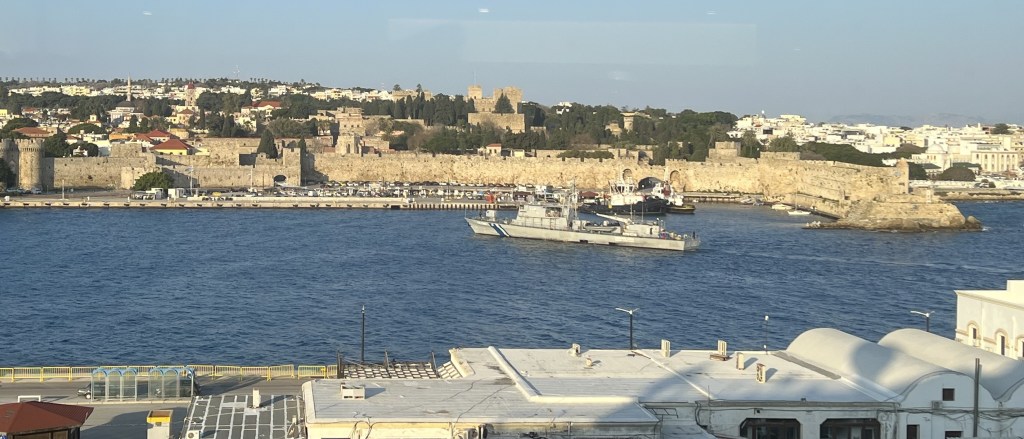
When we arrived in Rhodes I was not prepared for the abrupt shift in focus (time and culture). The Greek sites we had been touring dated from the Classical – Hellenistic – Roman eras, or the 1000-year period from 600 BCE to 400 CE. Rhodes seemed to jump forward another 1000 years to concentrate on the later times of the Crusaders (14th and 16th centuries CE) and the Ottomans who controlled the island and city until the early 20th century. Our tour of Rhodes featured this Medieval history.
When I looked online, I found the history of Europe known as the medieval period, or Middle Ages, lasted from the 5th to the late 15th centuries, and was similar to the post-classical period for global history. The medieval period began with the fall of the Western Roman Empire and transitioned into the Renaissance (Age of European Discovery). The period is marked by population decline, counter-urbanization, the collapse of centralized authority, invasions, and mass migrations of tribes, which began in late antiquity and continued into the Early Middle Ages. The large-scale movements of the Migration Period, including various Germanic peoples, formed new kingdoms in what remained of the Western Roman Empire. Although there were substantial changes in society and political structures, the break with classical antiquity was incomplete. The Byzantine Empire (Eastern Roman) survived in the Eastern Mediterranean and remained a major power. The Roman Empire’s law code (Corpus Juris Civilis) was rediscovered in Northern Italy in the 11th century and most western kingdoms incorporated the few extant Roman institutions. Monasteries were founded as campaigns to Christianize the remaining pagans across Europe continued. The Franks, under the Carolingian dynasty, briefly established the Carolingian Empire during the latter 8th and early 9th centuries. I The medieval period covered much of Western Europe but later succumbed to the pressures of internal civil wars combined with external invasions from the Vikings (north), Magyars (east), and Saracens (south).
The island of Rhodes stands at a crossroads between Europe, the Middle East, and Africa, which has given the city and the island many different identities and cultures. The island itself has been inhabited since the Neolithic (stone) Period (4000 BCE), but Rhodes became an important trading post for shipping between Constantinople and Alexandria during the Byzantine Period and the European Crusades to the Holy Land. The Knights Hospitallers captured and established their headquarters on Rhodes when they left Cyprus in 1307 and remained on the island for the next two centuries. The Ottoman Empire expanded rapidly after the fall of Constantinople in 1453, and the Knights defense of the island in 1480 halted Sultan Mehmed the Conqueror from the invasion of the Italian peninsula by Ottoman forces. Sultan Suleiman the Magnificent led a second Ottoman Siege of Rhodes in 1522 but after a spirited defense the Knights were allowed to depart on January 1, 1523. New buildings were constructed during the Ottoman era, including mosques, public baths, and mansions, while the Greeks were forced to abandon the fortified city and move to new suburbs outside its walls. The tours of Rhodes were not like the ruins we had visited, but of intact buildings for continuous occupation for the last 1000 years. A different tour, but very interesting.
Thoughts: Disembarking our ship, we approached the Medieval city through one of the smaller side gates. We then wound our way up hill from the harbor to the Palace of the Grand Masters(fortress) at the top of the citadel. The stone-lined streets were the same as the crusaders and Ottomans trod for the last 1000 years as they wound toward the top. You find a sense of longevity and continuity in Europe that does not exist in the US. This also illustrates the transitory nature of human rulers and kingdoms. Both are good reminders. Act for all. Change is coming and it starts with you.

 A travelers odyssey