
April 18, 2025
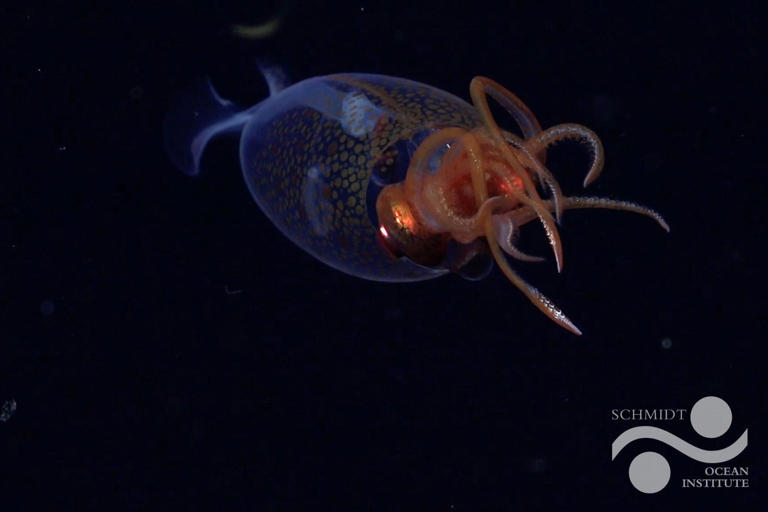
My MSN browser reported that the world’s largest squid species was filmed and photographed in its natural habitat for the first time since scientists discovered it about a century ago. The video was recorded in the South Atlantic on March 9th by the crew of a vessel owned by the Schmidt Ocean Institute. The crew’s remotely operated vehicle sighted the animal 2,000 feet (609.6 m) below the surface around the South Sandwich Islands, a volcanic archipelago located between the tip of South America and Antarctica. The squid caught on video was a juvenile and much smaller than a full-grown adult. The research team estimated its size at around 11 inches (28 cm) long. According to the Schmidt Ocean Institute, the expedition occurred during a 35-day voyage where researchers sought to find new marine life. Although this was a juvenile, the squid can become enormous and have been named colossal squid.
When I looked online, I found the colossal squid (Mesonychoteuthis hamiltoni) is a species of large squid belonging to the family Cranchiidae, known as cockatoo squids or glass squids. Glass squid are a group of about 60 squid species that have transparent bodies. As the squid grow their bodies become opaque over time. The colossal is sometimes called the Antarctic cranch squid or giant squid (not to be confused with the genus Architeuthis) and is believed to be the largest squid species in terms of mass. Individuals have been confirmed to reach at least 1,091 pounds (495 kg). Beaks found in sperm whale stomachs suggest some may weigh as much as 1,300 to 1,500 pounds (600 to 700 kilograms). That would make it the largest extant invertebrate. The maximum total length has been estimated between 33 to 46 feet (10 to 14 m). The colossal squid has the largest eyes of any known creature to ever exist, with an estimated diameter of 11 to 12 inches (27 to 30 cm), with a whopping 15 inches (40 cm) for the largest collected specimen. The colossal is presumed to be an ambush predator, with a diet including various fish, and is likely a key prey item of the sperm whale.
Chief scientist Dr. Michelle Taylor said the team was initially unsure what the squid was but filmed the animal because it was “beautiful and unusual”. The footage was later verified by Dr. Kat Bolstad, who said previous squid encounters had mostly been as remains in whale and seabird stomachs. A distinguishing feature of the species is the presence of hooks on the middle of their eight arms. Dying adults have previously been filmed by people fishing but they have never been seen alive at depth. The Natural History Museum has suggested it is hard to estimate the global population of colossal squids. In 2022, the institution said the lack of observations meant that, “even to this day, the enormous invertebrates still straddle the line between legend and reality”. The Schmidt Ocean Institute’s research trips have led to the first sightings of four species of squid, including the colossal squid sighting. The institute’s executive director Jyotika Virmani described the encounters moments which “continue to remind us that the Ocean is brimming with mysteries yet to be solved.”
THOUGHTS: The recording of the colossal and other three species of squid is another reminder of the amazing diversity yet to be discovered in the oceans of the earth. Yet even as we seek and find new life, the actions of humans are threatening to destroy the species and ecosystems that are known. It is unclear whether the Ocean depths are so far immune from human intervention, or just so far out of our radar that we do not see the changes we are making. It is known that microplastics have been found in the bodies of deep-water fish. We need to take steps to preserve these fragile ecosystems while there is still time. Act for all. Change is coming and it starts with you.
 A travelers odyssey