House Finch

November 05, 2024

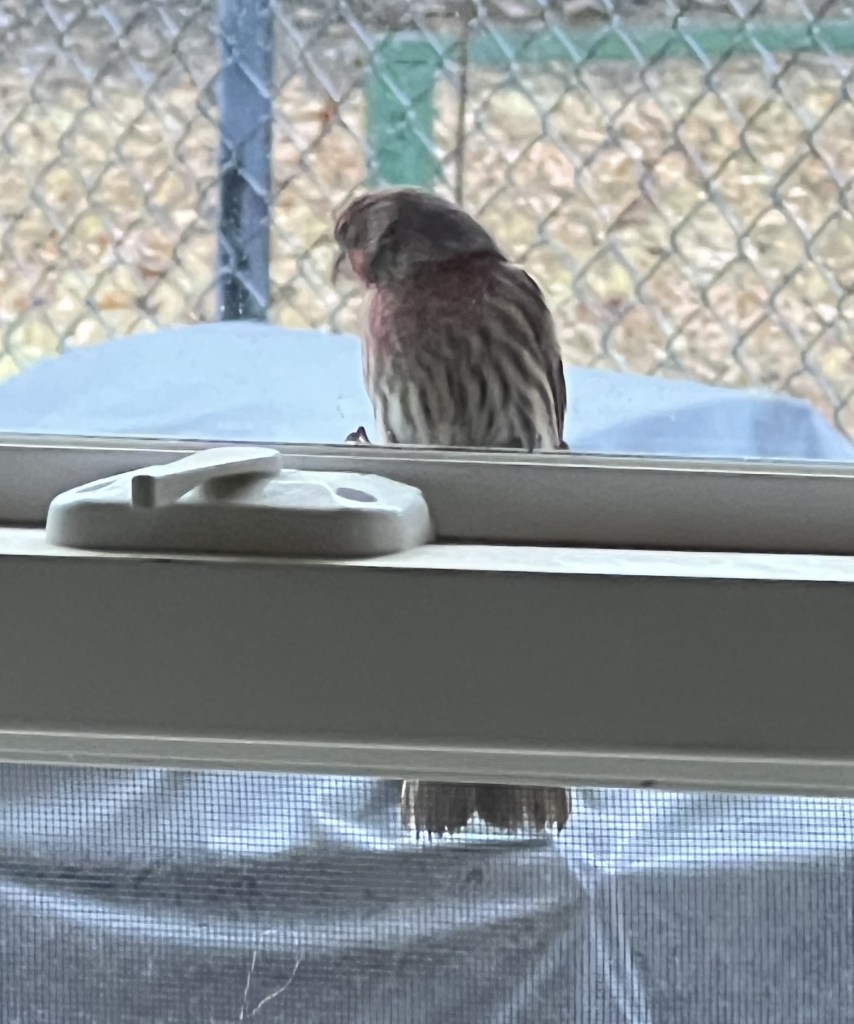
Melissa received a window box bird feeder as a gift from our son and family earlier this year. The feeder has suction cups on the back that allow it to attach directly to the glass. I placed the feeder in the bay window in the breakfast nook that serves as her home office so she can enjoy the bird activity while working. I fill the two sections of the feeder with different seeds to make it more attractive to the small birds willing to approach the window. One side has always had black sunflower seed (Helianthus annuus). I have varied the seed on the other side, but it currently has cracked safflower seed (Carthamus tinctorius). This feeder has become a preference for the eastern bluebirds (Sialia sialis), the sparrows (Genus, Zonotrichia), and purple finches (Haemorhous purpureus) that frequent our back yard. On Sunday I noticed what seemed to be a new species at the feeder. This was similar to the finches I have been watching but somehow seemed different. When I checked my bird ID this turned out to be a house finch.

When I looked online, I found the house finch (Haemorhous mexicanus) is a North American bird in the finch family. The species is native to Mexico and southwestern US but has been introduced to the eastern part of North America and Hawaii and is now found year-round throughout the US and most of Mexico. The house finch is a moderate-sized bird at 5 to 6 inches (12.5 to 15 cm) long, with a wingspan of 8 to 10 inches (20 to 25 cm). Body mass can vary from 9⁄16 to 15⁄16 ounces (16 to 27 g) with an average weight of 3⁄4 ounces (21 g). Adults have a long, square-tipped brown tail and are a brown or dull-brown color across the back with some shading into deep gray on the wing feathers. Breast and belly feathers may be streaked, and the flanks usually are. Most adult males have reddish heads, necks, and shoulders, and the color can extend to the belly and down the back as well. Male coloration varies in intensity with the seasons as it is derived from a diet of berries and fruits. Adult females have brown upperparts and streaked underparts. There are around 40 million house finches across North America, making it the second-most populous finch behind the American goldfinch.

The house finch and purple finch are closely related species and can be hard to identify. The main difference between the two species is the amount of red on the bird and the pattern on the face. They have similar body shapes, but the bill of the purple finch is a bit bigger, more conical, and deeper, while that of the House Finch has a more rounded shape. Both species get along with other small birds except during breeding season when they become protective of their territory. The other big difference comes with habitat. The house finch prefers a wide range of arid, open, and semi-open habitats, and will live in oak-juniper woodlands, open coniferous forests, and shrubby, and desert habitats from sea level to more than 11,000 feet, the house finch avoids dense forest of the purple finch. A small flock of house finch in Long Island, NY, escaped captivity in 1939 and has become the common bird of the eastern US and southern Canada. Their population has grown and expanded to millions of birds that thrive in urban and suburban places, preferring parks and urban settings with conifers and ornamental trees. Their songs are similar, but the purple finch sings a more melodious and “warbling” song, while the house finch incorporates chattering and trilled sounds.

THOUGHTS: Another similarity between the house finch and purple finch is they are both attracted to bird feeders. This explains why I have seen both species (and probably not realized it until now) in our backyard. Neither species is rare, but the house seems more urban and the purple more forest. Nature tells us that when the same species spend enough time separated and/or refusing to interact they grow apart and eventually become distinct. While humans have not yet reached that point as a species, it is a good lesson to be learned. Act for all. Change is coming and it starts with you.
Moo Deng

September 28, 2024

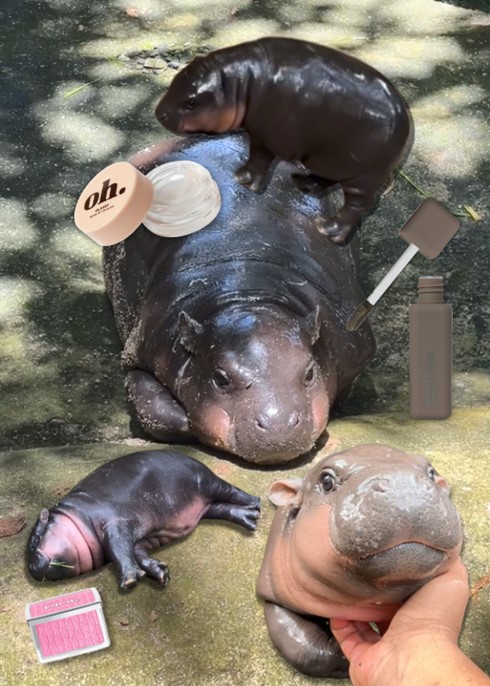
Moo Deng is a pygmy hippopotamus living in Khao Kheow Open Zoo in Si Racha, Chonburi province, Thailand, born on 10 July 2024.  Her name was chosen through a public poll with over 20,000 people voting for “Moo Deng”, translating to “bouncy pig”.  The zoo posted images of her on its Facebook page and Moo Deng quickly became a fan favorite for her playful and energetic romps.  Her popularity led the zoo to sell clothing and other merchandise featuring designs based on her likeness.  Other companies produced merchandise, including a cake shop (Vetmon Café) which created a realistic cake shaped like her.  Moo Deng’s viral popularity resulted in a doubling of daily visitors in early September.  The zoo is in the process of copyrighting and trademarking “Moo Deng the hippo” to raise funds for the zoo and plans to launch a livestream to allow fans to watch Moo Deng over the Internet.

When I looked online, I found Moo Deng is a pygmy hippopotamus (Choeropsis liberiensis) or pygmy hippo, a small hippopotamid native to the forests and swamps of West Africa.  The pygmy is one of only two extant species in the family Hippopotamidae, the other being the larger common or Nile hippopotamus (Hippopotamus amphibius).  The pygmy hippo was unknown outside West Africa until the 19th century and is a reclusive and nocturnal forest creature difficult to study in the wild.  Like the common hippo, the pygmy hippo displays terrestrial adaptations but is semiaquatic and relies on water to keep its skin moist and its body temperature cool.  Mating and birth may occur in water or on land.  The pygmy is herbivorous and feeds on ferns, broad-leaved plants, grasses, and fruits it finds in the forests.  Current pygmy populations are primarily in Liberia, with small groups in Sierra Leone, Guinea, and Ivory Coast.  It has been extirpated (eradicated) from Nigeria.  Pygmy hippos are primarily threatened by loss of habitat, as forests are logged and converted to farmland.  The Pygmy are also vulnerable to poaching, hunting for bushmeat, natural predators, war, and are illegally hunted for food in Liberia.  The species breed well in captivity and the vast majority of research is derived from zoo specimens.  A 2015 assessment by the International Union for Conservation of Nature estimated that fewer than 2,500 pygmy hippos remain in the wild.

As a viral sensation Moo Deng has prompted a makeup trend popular with beauty influencers.  Moo Deng makeup is in line with what beauty enthusiasts look for, super dewy skin and lots of blush.  The trend is perfect for fall as the skin will be hydrated and glass-like as the drier months approach.  The trend started with influencers trying to recreate her iconic look by achieving the baby pygmy’s glass-like skin with the prettiest shade of blush.  Before applying makeup, you need to ensure the base is nice and dewy to capture the baby hippo’s glistening skin.  The trend incorporates lots of grey hues to represent Moo Deng’s skin color.  An element common among influencers’ is the heavily flushed cheeks.  Any blush shade will do, as long as it has a great color payoff.  Grey eyeshadow or lip gloss, followed by a particular shade of blush create the final makeup look.

THOUGHTS:  While Moo Deng may create viral views, sales, and makeup, she is at risk.  Some visitors harassed Moo Deng by splashing her with water and throwing objects to wake her up, forcing the zoo to install security cameras around her enclosure.  The zoo also implemented a 5-minute time limit for visitors to accommodate the high volume of visitors.  While most marvel at the wonder of nature, there are others who find pleasure in destruction.  Whether it is throwing objects at Moo Deng or toppling 100,000 year old rock formations the seconds of fame being sought are not worth the cost.  “Influence” comes with responsibility.  Act for all.  Change is coming and it starts with you.

Leopard Darters

September 25, 2024

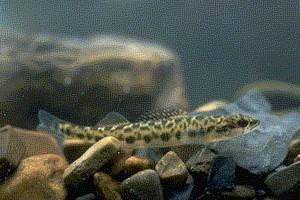
Last week the Arkansas Game and Fish Commission (AFGC) released 80 leopard darters into the wild with the help of state and federal partners along with Conservation Fisheries LLC, a private hatchery specializing in propagating rare and threatened species.  According to Chance Garrett, fish ecologist for the AGFC, this release is the first of two scheduled for the Cossatot River in western Arkansas this year and is the first historical reintroduction effort of leopard darters anywhere.  The fish were grown from broodstock taken from the Mountain Fork River which flows from Arkansas into Oklahoma.  Another 250 fish are planned for release in early October.  Garrett said, “They originally thought it was only found in Oklahoma, but some populations were found in the Rolling Fork and Cossatot after its listing.  Those two populations are thought to no longer exist, so this effort to re-establish them is extremely important.”  This is the second year of the project, but the first year saw a low survival rate as the hatchery and were added to the broodstock rather than being released.  The leopard darters measured and an inch or two (2.5 to 5 cm) at stocking size and were transported from the hatchery to their destination in one day.

When I looked online, I found leopard darters (Percina pantherina) are a species of freshwater ray-finned fish, from the subfamily Etheostomatinae.  The family (Percidae) also contains the perches (Genus, Perca), ruffes (Gymnocephalus cernua), and pikeperches (Genus, Sander).  The species is native to the US and is only be found in the Little River drainage in Oklahoma and Arkansas.  A typical habitat is medium to large streams with rubble and boulder substrate.  The leopard darter feeds on small invertebrates on the riverbed and spawns in March and April.  Adults rarely exceed 3 inches (8 cm) in length and have 11 to 14 large, dark spots on their sides, which contrast against a light background that ranges from pale olive on the back to yellowish olive on the underside.  The back of the fish has numerous saddles and bars.  The leopard darter is threatened by impoundment, habitat loss, and runoff from agricultural activity.  It has never been a common species and has been listed as a threatened species in the US since 1978.

Transporting and releasing the leopard darter was a full day affair.  They left the Conservation Fisheries hatchery in Knoxville, Tennessee in the morning, were met by AGFC personnel in Memphis, and driven to the other side of other side of Arkansas by 6:30 p.m. that evening.  Once at the river, the fish had to be tempered to adjust to the river water.  They arrived in bags which were floated to slowly acclimate to the temperature of the river water.  Then some river water was let into the bags to help them adjust slowly to the chemistry of that location.  Finally, they are ready for release.  The staff scanned the release pool the next day and found many of the fish had dispersed.  Garrett said. “Hopefully we’ll see them in future survey efforts . . . Ultimately our goal is to see some spawning activity in spring.”  The leopard darters represent one of the longest-standing members of the Endangered Species Act.

THOUGHTS:  Leopard darters typically live less than two years, but individuals older than three years have been found.  Introduction of these 320 fish (total) could reintroduce a viable population into the Cossatot River, but the fragile species still faces the loss of habitat due to construction of reservoirs and population isolation, along with agricultural and industrial activity, that drove them to decline in the first place.  Species reintroduction and preservation takes the combined efforts of government agencies, business, and individual landowners to be effective.  While it may take a village to raise a child, it takes concerned communities to preserve endangered species.  Act for all.  Change is coming and it starts with you.