
March 21, 2026
I knew the Lake Pleasant campground where we chose to stay was several miles north of the Surprise baseball stadium. When we approached the campground, we saw signs saying the road was closed ahead. Since we did not know another route to the site, we kept driving and hoped for the best. It turned out we got within a mile (1.6 km) of the entrance when we were routed to the south. I asked one of the construction workers as we slowly passed how to get there and was told to take the road to 303 West, then Grand North to 74 East and come back in from the other side. While this sounded simple enough, I did not realize this meant taking an 80-mile (128.7 km) detour. By the time we arrived I was more than a little upset that the camp had failed to mention this small detail. I also wondered what this would mean for driving to Surprise for the three games we had purchased. When I googled the location of the stadium from our campsite, I found that while it was farther than I expected, it was only about 5 miles (8 km) more than without the detour (down to Surprise then up to the campground). The next day we made allowances for the distance and arrived in time to be seated along the first base line before the start of the game. After the traditional “first pitch” by some unknown local celebrity we heard the umpire cry, “Play Ball”.
When I went online, I found in the US, “play ball” generally means “play baseball,” though the usage is often heard in connection with football, basketball, and other sports. The phrase, or various versions, were in use hundreds of years before baseball was invented. According to the Oxford Dictionary, the expression simply referred to a game played with a ball. Concerning baseball, the Dickson Baseball Dictionary (3rd ed.) defines “play ball!” as “the command issued by the plate umpire to start a game or to resume action but it is sometimes abbreviated to a simple order of ‘play!’” Dickson quotes from the Boston Globe (May 13, 1886) the first use in newsprint: “McKeever held a long discussion with Pitcher Harmon about signs. The crowd got impatient; one man yelled ‘Get a telephone!’ while the umpire ordered them to ‘play ball.’” The phrase caught on and showed up a few years later in in James Maitland’s, The American Slang Dictionary (1891): “Play ball (Am.), go on with what you are about.” Dickson says, “play ball” has a special meaning to baseball fans and is the “emblematic phrase for the start of any baseball game.”
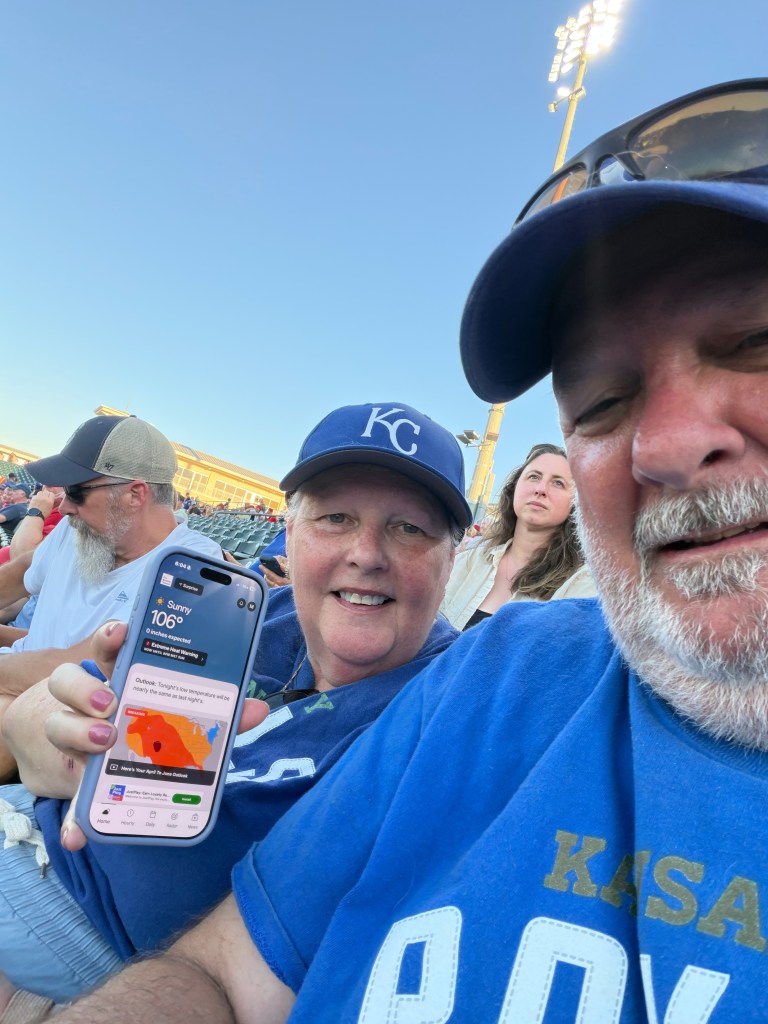
We were able to see the Royals play three games in Surprise. Tuesday night they played the Dodgers in a packed house. The temperature at “Play Ball” was 99F (37C). We left with a 4-4 tie in the eighth inning and heard they ended up losing 12-4. The next night it was 102F (39C) at the start. The Royals share the field with the Texas Rangers and were considered the away team on that night. They lost 10-2. On Thursday they played the Angels and the temperature at the start was 106F (41C). While the desert has a “dry heat”, it was still hot every night. The worst part was the World Baseball Classic wrapped up last weekend and most of the players we came to see were not suited up. The Royals had 14 players in the 2026 World Baseball Classic, with 10 of them on the 40-man US roster, causing some to name this the “Royal Baseball Classic”. The final saw Venezuela beat the US 3-2 with a 9th inning double. I guess that made us 0-4 for the weekend. Check my bucket list.
THOUGHTS: While the emblematic phrase may be “play ball”, the official umpires rule book states the game is to be started when the umpire points to the pitcher and says, “play”. Despite this rule, most fans (like me) still hold out for and can even hear the traditional shout. I have found in most things our traditions tend to overrule our rules, at least in our minds. What one believes can be more important than the facts. However, there are times when we should try and go with the facts. Act for all. Change is coming and it starts with you.

 A travelers odyssey