
June 08, 2023
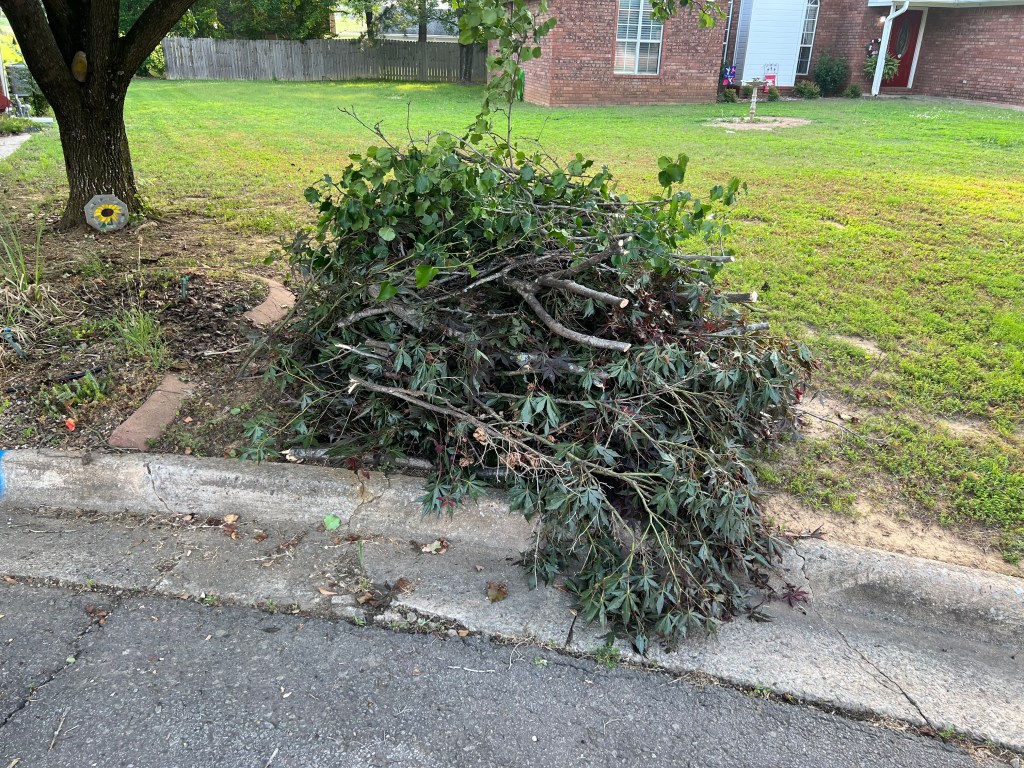
I have been trying to get my mower repair person on the phone for the last two weeks. The mower would start and work well until it got into any high grass, where it would sputter and die. Since I have not been able to mow, the grass is now all in the “high” state. I prefer this repair service as he is local (always my preference), but also “mobile”, meaning I do not have to worry about getting the mower to his shop. I was able to contact him on Tuesday and he agreed to drop by yesterday afternoon. I putzed around inside the house during the morning but decided I might as well work on the outside during the afternoon while I waited for him to arrive. One task Melissa had asked me to complete was to trim the Japanese Maple (Acer palmatum) that dominates the bed in the front of the house. Since I do not own a chainsaw, I took loppers and a camp saw (backpacking) and began to cut away the limbs and branches overhanging the roof and draping the sidewalk and entryway. As I cut off the limbs, I neatly stacked them in a pile along the front curb as yard waste.
When I checked online, I found that yard waste materials are comprised of grass clippings, leaves, and yard trimmings, and make up approximately 10% (by volume) of the municipal waste stream. Yard waste can account for 50% or more of residential solid waste during the active growing season. While yard waste is biodegradable, landfills do not get the oxygen and water needed for breakdown, as they are built to prevent the movement of air and moisture to protect the surrounding environment. These materials can be better used to enhance gardens and landscapes through composting. There are some communities with established municipal composting facilities to efficiently manage large quantities of yard waste, but gardeners can reduce the amount of yard waste generated (mulching and composting) and recycle the rest. Composting on site can have a great impact, both economically and ecologically.
When we moved back to Arkansas, I did a lot of work trimming the trees and along the back hedgerow. I knew yard waste was not permissible in the regular garbage pickup. Melissa told me that rather than burning the debris (which is allowable), and since we do not own a trailer or pickup to haul the yard waste to the tree dump, she and her dad had always thrown the limbs into the hedgerow. That meant every time I trimmed the trees, I had to drag the debris from the front yard to the back of the house. Last year I noticed our neighbor across the street cut down one of his trees, and rather than hauling it off he cut it into smaller pieces and stacked it in a pile in front of his house. When I asked, he told me if the trees were not trimmed or cut by a commercial company, the city will come on the first week of every month and remove the yard waste. However, there are criteria for this to happen. The brush needed to be cut in lengths no longer than 4 feet (1.2 m), stacked no more than 2 feet (0.6 m) from the curb, and the pile could not be in the gutter. I tried this earlier this spring and was pleased to see the pile was picked up. This time I created a larger pile of yard waste, and I hope it will happen again.
Thoughts: I have tried composting in the past but never thought of putting the limbs and branches into a pile as yard waste. For leaves and grass clippings I use a mulching blade on my mower to recycle the yard waste back into the lawn. In the past I bought a composting barrel and used it in several yards where we lived but never had much luck creating any compostable material. Whether it is composting yard waste or recycling plastic or cans, there is always thought, planning, and at times added expense that need to occur. This is worth the time and expense if we can make an impact economically and ecologically. Maybe it is time to rethink how to compost my yard waste. Act for all. Change is coming and it starts with you.
 A travelers odyssey