
October 09, 2023
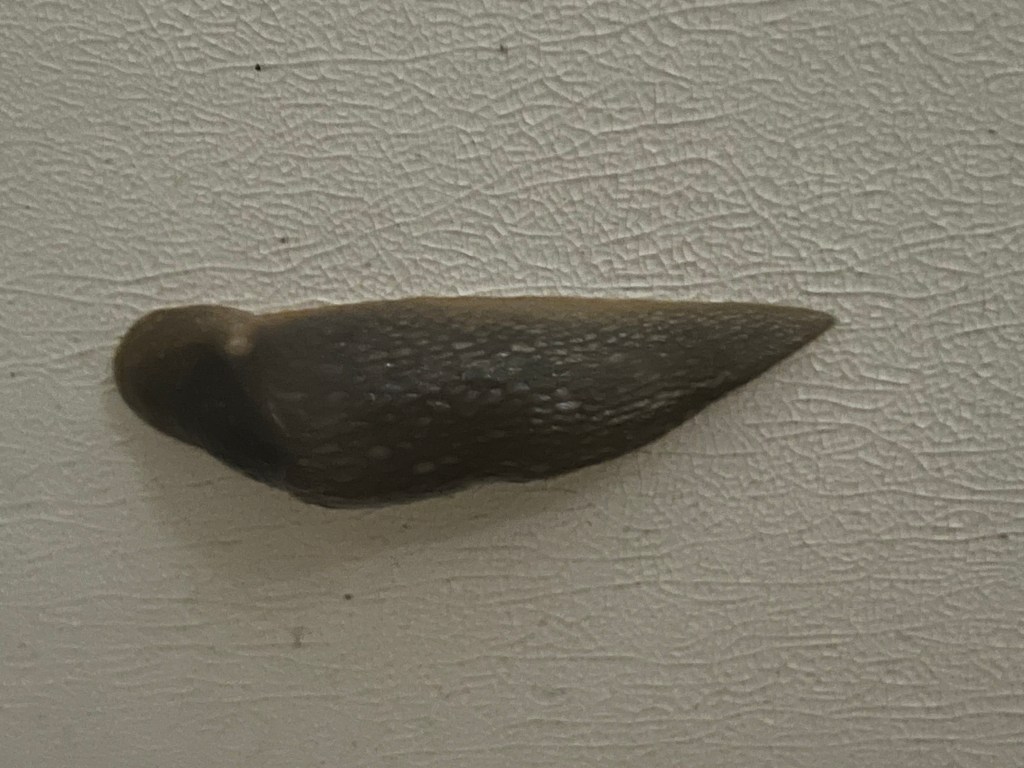
Our trash service happens early on Monday mornings and that means I need to get the trash before I go to bed on Sunday night. I usually make a run through the house to collect all the trash and then take it to the waste bin we keep in the garage. That means I need to open the garage door, guide the bin between the cars parked in the driveway, and then maneuver it out to the street for pickup. After coming back inside I pushed the controller to bring the door down when I noticed something clinging to the bottom of the door. I brought the door back up and saw whatever was still attached to the door. When I went to see what was on my door, I saw a long black stationary object. I touched it to see if I could discern what it was. Even though the antennae were not extended, it was clear I had a large garden slug on my garage door.
When I looked online, I found the black slug (Arion ater), also known as black arion, European black slug, or large black slug, is a large terrestrial gastropod mollusk in the family Arionidae, the round back slugs. The size of the black slug varies from 3.9 to 5.9 inches (10 to 15 cm), reaching maturity at about 1 inch (2.5 cm). It moves at the blistering speed of 1.8 inches (4.5 cm) per minute. The black slug is generally deep black, but some adults are brown or even white. Their pigmentation is known to darken directly with increasing latitude. Young specimens tend to be brown or ivory whitish, turning to grey before becoming characteristically black at maturity. Rust-brown individuals are arguably classified as a separate species called the red slug (Arion rufus). The two species of slug can only be distinguished by dissecting the reproductive anatomy.
Most slugs retain a vestigial remnant of their shell (underdeveloped) which is usually internalized, unlike other terrestrial mollusks (like snails) which have external shells. Without external shells, terrestrial slugs produce two other forms of mucus that facilitate locomotion and prevent death from drying. Slugs possess both male and female reproductive organs, structures, or tissue (hermaphroditic). Slugs are often decomposers but are also omnivores. The black slug is this type, decomposing organic matter, preying on other organisms, and consuming vegetative matter including agricultural crops. The black slug is native to Europe and is an invasive species in Australia, Canada (British Columbia, Newfoundland, Quebec), and the US (Pacific Northwest). The black slug often appears chunkier and slightly less elongated. These are not a full-proof distinction and dissection is often the only way to isolate the species. I did not perform a dissection but threw it in the trash which was picked up this morning.
Thoughts: Usually when I encounter a slug it is while I am digging in my garden, not hanging on my garage door. The black slug is and invasive species that has been introduced to southeastern Australia and North America. The black slug is a voracious seedling predator and endangers sensitive ecosystems, but it is not yet clear what affects the slug may have on plant community composition. The slugs are of special concern in fragmented ecosystems and areas with high shrub and tree cover. I am hesitant to destroy even a slug and was glad I sent it to the landfill where it will be happy decomposing local trash. This environment will protect my garden and help rid the city of debris. This slug is yet another example of human activity introducing invasive species into areas without historic predators or controls. This is a lesson that needs to be learned and heeded as we prepare to move into space. Act for all. Change is coming and it starts with you.
 A travelers odyssey