
October 10, 2023
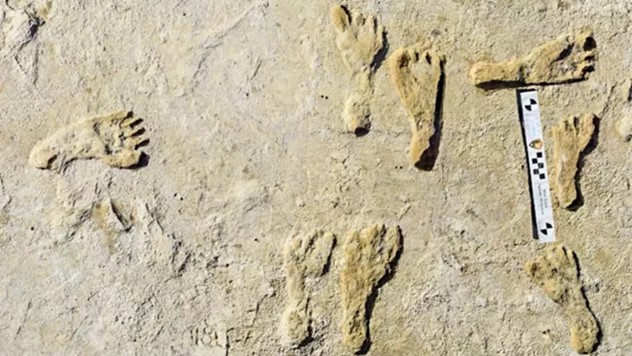
Photo: National Park Service
Buried inside of today’s front section of the local newspaper was a USA Today reprint on a new study on the footprints found in September 2021 in White Sands National Park, New Mexico. Researchers from the US Geological Survey and an international team of scientists had announced the ancient human footprints were dated between 21,000 and 23,000 BP. This discovery pushed the known date of human presence in North America back several thousand years (from 15,000 BP) and implied that early humans and megafauna co-existed for several millennia before the terminal Pleistocene extinction event (around 12,000 BP). In a follow-up study, published October 5, 2023, in Science, researchers used two new independent approaches to date the footprints, both of which resulted in the same age range as the original estimate. The 2021 results began a global conversation (and controversy) that sparked public imagination and commentary throughout the scientific community as to the accuracy of the ages. The original ages were obtained by radiocarbon dating based on seeds of the common aquatic spiral ditchgrass (Ruppia cirrhosa) found in the fossilized impressions. Aquatic plants can acquire carbon from dissolved carbon atoms in the water rather than ambient air, which can potentially cause the measured ages to be too old.
When I looked online, I found seed and pollen dating is often used to establish relative chronologies when the material is stratified (layered) and can be securely dated. All three pollen samples used for radiocarbon dating were found fossilized in the sedimentary rock that contained the human footprints. Pollen dating can also complement other dating techniques, and pollen grains are “highly suitable” for radiocarbon dating. Pollen grains have morphological characteristics that allow them to be identified into different taxonomic groups providing contextual information for dating the sample. Combined with radiocarbon dates, pollen analysis can provide a more comprehensive understanding of the context of an archaeological site and help archaeologists construct a more accurate timeline of human activity. In addition, pollen dating can provide “relative dates beyond the limits of radiocarbon (40,000 years)”.
The follow-up study focused on radiocarbon dating of conifer pollen which avoids potential issues when dating aquatic plants. With three separate lines of evidence pointing to the same approximate age, it is highly unlikely that they are all incorrect or biased and together provide strong support for the 21,000 to 23,000-year age range for the footprints. The researchers used painstaking procedures to isolate approximately 75,000 pollen grains for each sample they dated. The pollen samples were collected from the exact same layers as the original seeds, so a direct comparison could be made. In each case, the pollen age was statistically identical to the corresponding seed age. In addition to the pollen samples, the team used a different type of dating called optically stimulated luminescence, which dates the last time quartz grains were exposed to sunlight. This method found that quartz samples collected within the footprint-bearing layers had a minimum age of 21,500 years, providing further support to the radiocarbon results.
Thoughts: Various theories have attributed the wave of megafauna (animals weighing over 100 lbs./46 kg) extinctions to human hunting, climate change, disease, or other causes. The first humans in North America were thought to have arrived around 15,000 to 12,000 BP and coincided with extinction. The footprints in New Mexico (23,000 BP) also supports the wide presence of humans across the Americas by 12,000 BP. While human hunting alone may not have caused extinction, global extinctions are known to occur not long after the spread of humans into new areas. This is a legacy we have the ability (if not the willingness) to change. Act for all. Change is coming and it starts with you.

