
April 01, 2024
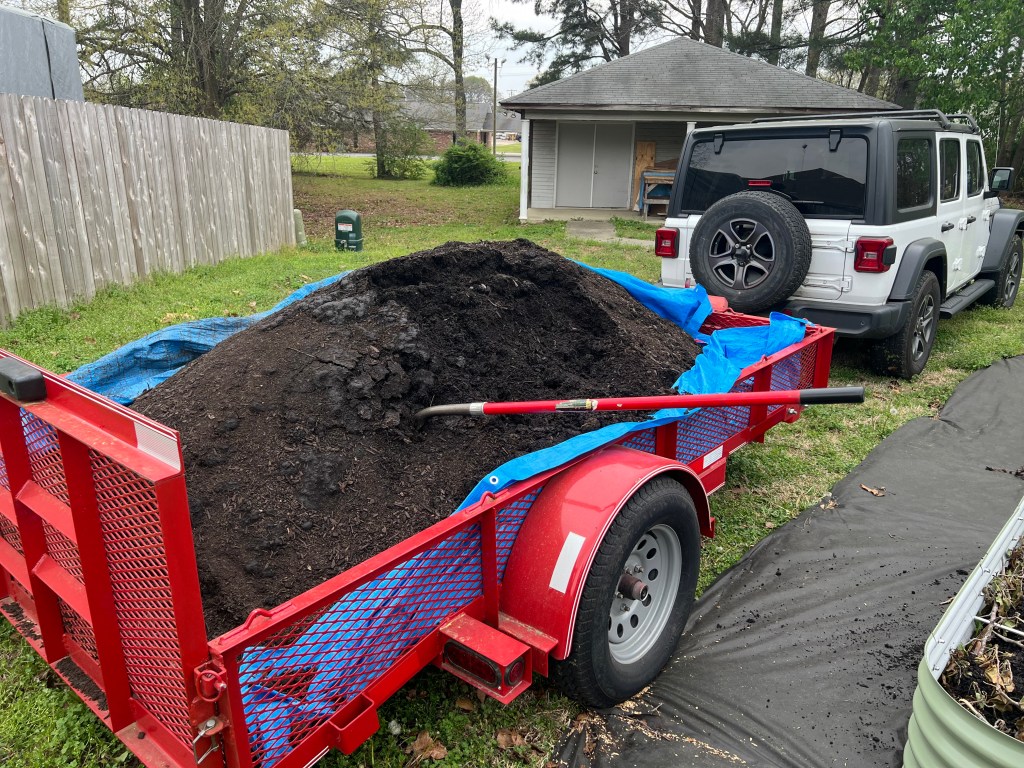
I finished getting the bottom layers into my raised Hügelkultur beds on Saturday. This took a lot more wood and limbs than I expected, but part of my madness came from knowing I needed to prune the two trees in my front yard regardless. When I checked pruning techniques for the large Bradford pear (Pyrus calleryana) and Japanese Maple (Acer palmatum), it was advised not to top the trees (as most do in my neighborhood) and instead to shape them and cut away the dead branches. After pruning on the limbs and branches for two weeks I was able to fill the beds about half full, along with a large pile of smaller branches laid on the curb for city pickup. I got compliments for how I shaped my trees so I must have done it right. After the long days spent pruning and breaking the limbs and branches down to size I decided to take Easter Sunday as a day of rest. That meant I got up early today and set about the task of getting the compost which fills the next layer of the four beds.
When I looked online, I found compost is a mixture of ingredients used to improve the physical, chemical, and biological properties of soil. This is often prepared by mixing plant and food waste, recycling organic materials, and manure. The result is rich in plant nutrients and organisms that are beneficial, like bacteria, protozoa, nematodes, and fungi. Compost improves soil fertility and reduces dependency on commercial chemical fertilizers. The benefits of compost include providing nutrients to crops as fertilizer, acting as a soil conditioner, increasing the humus or humic acid contents of the soil, and introducing beneficial microbes that help to suppress pathogens in the soil and reduce soil-borne diseases. At the simplest level, compost requires a mix of “greens” (green waste) and “browns” (brown waste). Greens are rich in nitrogen (leaves, grass, and food scraps) and browns are rich in carbon (stalks, paper, and wood chips) which break down over a period of months. Earthworms and other detritivores further help with decomposition. Aerobic bacteria and fungi help the chemical process by converting the materials into heat, carbon dioxide, and ammonium ions.
Since I have four large, raised beds, I required a lot of compost. The hardware store sold compost in 2 cubic foot bags (40 pounds/18 kg), but I opted for bulk compost from a local lumber yard by the “scoop” (1/2 yard3/.38 m3). A friend lent me his trailer and I bought a large tarp to cover the bottom and sides. I was careful as I pulled out of his yard since I was not used to towing a trailer. I had not gone more than a 1/2 mile (800 m) when a student pulled out of the college at a red light and nearly rammed the front of my Jeep. I slammed on the horn and brakes simultaneously and came to a stop. They backed up and I was on my way to the lumberyard. I bought 6 scoops of compost but could only get four safely on the trailer. I got a raincheck on the other two, covered the load to keep it from blowing away on the highway, and then headed for home. Now if I can get the compost down before the rain tonight it will settle and let me know how much more I need.
THOUGHTS: I have tried making compost several times with past gardens and have once again purchased a bin for compost that will go into my large, raised bed this year. I have never had much luck and could not seem to generate enough green waste. This year Melissa and I are both conscious about what goes into the trash, what goes down the disposal, and what goes into the compost bin, and I have been surprised at how much green waste we generate. I obviously was not paying attention in my previous attempts. Managing waste and determining its disposal is critical to conserving our planet. Trash, recycle, or reuse is a decision that needs to guide the disposition of everything we no longer want or need. Act for all. Change is coming and it starts with you.
 A travelers odyssey