
April 03, 2024

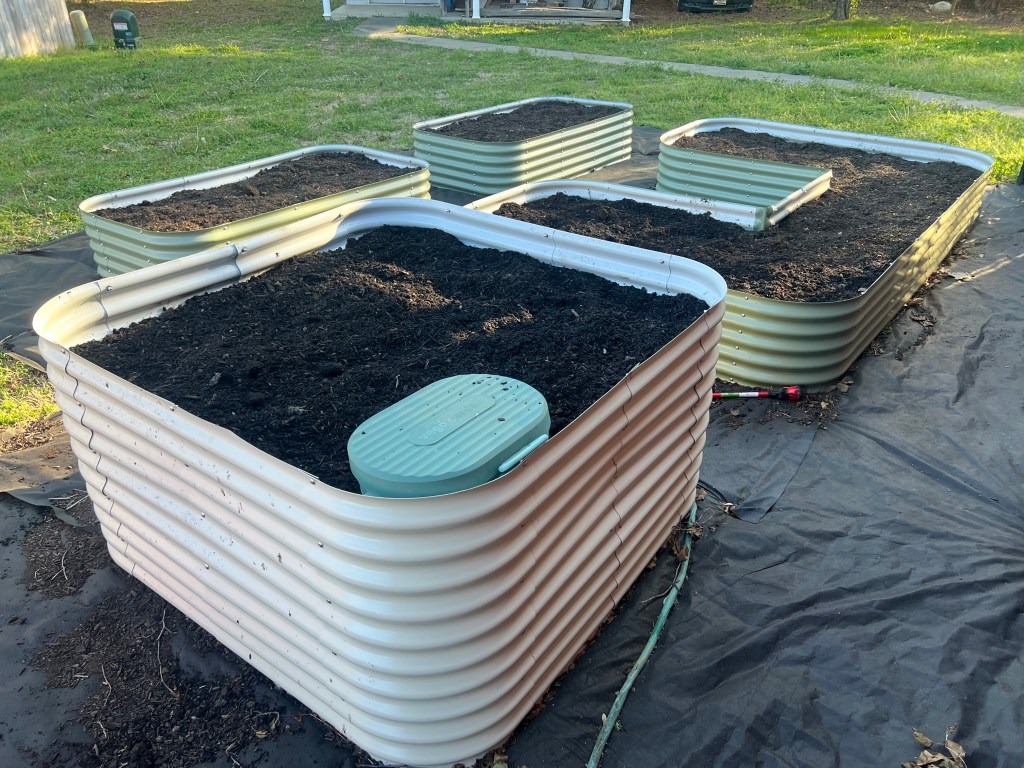
I mentioned how I had purchased 6 scoops of compost on Monday. I loaded four scoops (2 yards3 or 1.5 m3) on the trailer and a mere 5 hours later had three of the four raised beds filled to about 7 inches (17-3/4 cm) and the fourth to about 1 foot (30.5 cm) from the top. The big storm we were promised (threatened) never arrived but I had watered the compost down to try and help it settle. I picked up the last two scoops (1 yard3 or .75 m3) on Tuesday and was able to finish most of the fourth bed. By that time, I was exhausted and decided to call it a day. I was revived today and determined to get the base for my three sisters (corn, beans, squash) beds on the ground. That meant I had to clear the weeds out of the long patio bed and fill it with about 5 inches (12.7 cm) of compost. The kids had a great time while I was weeding. I was down on my knees and both dogs decided they needed to sniff my face to see what I was up to. Loki was also interested in the weeds and roots I was removing and started a pile of the “best pieces” off to the side. I put fencing around the bed to deter Loki from digging, but Loki was not deterred. Instead decided to lick the wet compost. All I could think of was the odor of the mixture.
When I looked online, I found an odor (American English) or odour (Commonwealth English) is caused by one or more volatilized chemical compounds that are found in low concentrations that humans and many animals can perceive via their sense of smell. An odor is also called a “smell” or a “scent” and can refer to both a pleasant and unpleasant odor. The compost odor was unpleasant, which makes sense as it is composed of plant and food waste, recycling organic materials, and manure. The perception of an odor, or sense of smell, is mediated by the olfactory nerve. The olfactory receptor cells are neurons present in the olfactory epithelium, which is a small patch of tissue at the back of the nasal cavity. There are millions of olfactory receptor neurons that act as sensory signaling cells and each neuron has cilia in direct contact with the air. The odor is sensed by odorous molecules which bind to receptor proteins extending from cilia and act as a chemical stimulus, initiating electric signals that travel along the olfactory nerve’s axons to the brain.
After I finished building the base for the sister beds, I had enough compost to complete the last tall, raised bed. After I finished, I fed the dogs and decided they could use some play time. While I was petting Zena, Loki pushed in to get attention. He jumped up on my chair (as usual) and tried to lick my face. That was when I noticed the horrendous odor coming from his mouth. Loki had been busy licking the compost and now his breath had the same smell. I mentioned this to Melissa, and she let my know that while I may not have gotten sweaty working with the compost today, I had gotten remnants of the mixture all over my clothes and face. That was a polite way of saying I also retained the manure smell of the compost. I took a shower and changed clothes and when I came out, I mentioned that I now had a different odor, one of soap and deodorant. Melissa preferred the new odor over the last one. I need to get the container soil down to keep Loki from licking the compost.
THOUGHTS: Humans are good at detecting odor considering they only have 350 olfactory receptor genes compared to 1,300 in mice. The human sense of smell can distinguish around one trillion unique aromas. Acceptable body odor is often dictated by cultural norms and can refer to personal hygiene or maintaining the body’s cleanliness. Levels of acceptable odor can also vary given available cleansing resources and participation in active activities. The World Health Organization recommends washing hands for 20 seconds (ABC’s x 2?) before or after using the toilet, changing diapers, feeding a child, eating, and or preparing food. Act for all. Change is coming and it starts with you.

