
November 27, 2024
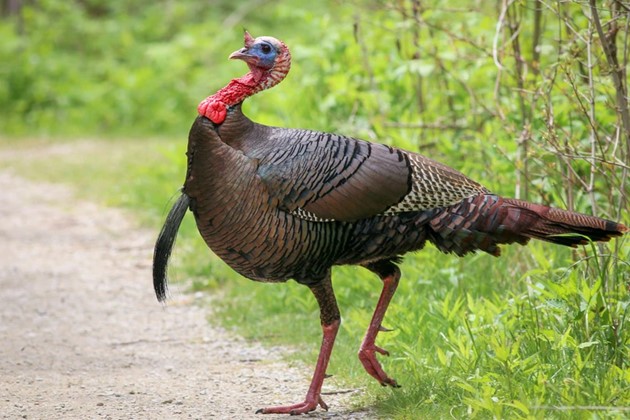
As we approach Turkey Day, also known as Thanksgiving in the US, there have been a rash of stories on my browser about these interesting birds. These include the recent tradition of the Presidential Pardon. The first official presidential turkey pardon was given by George H.W. Bush in 1989, but reports credit many presidents with the tradition. Abraham Lincoln’s son took a liking to the turkey destined for Christmas dinner and the bird was spared. Harry Truman liked his bird so much he had the first presidential photo op, but that bird was not so lucky and was later served as a meal. Two days ago, President Biden pardoned Peach and Blossom. These domesticated turkeys weighed an impressive 40 and 41 pounds (18.1 and 18.6 kg) respectively. Another story was offered by the National Audubon Society and provided 10 Fun Facts About the Wild Turkey. The most interesting of these facts concerned the bundle of feathers sprouting from their chest is known as turkey beards, and it gets longer as the bird ages.
When I looked online, Audubon also offered an in-depth discussion on turkey beards. Turkey beards are plumes of dark brown or black feathers, more hair-like than a typical feather, that protrude from the bird’s chest. “If you had it in your hand, it has the consistency of a miniature horsetail,” says Gary Norman, a retired gamebird biologist at Virginia Department of Game and Inland Fisheries. While all adult male turkeys (toms) have beards, nearly 10% of hens also have one, although it is a smaller and wispier version. Male turkey beards are thought to be used as another tool for mate selection, but it is unknown why some female birds have them. Kelsey Sullivan, a gamebird specialist with the Maine Department of Inland Fisheries and Wildlife, says the beards can “indicate dominance and health”. Turkey beards start sprouting when youngsters are around five months old and continue to grow at a rate of nearly 5 inches (12.7 cm) a year throughout a bird’s life allowing the biologists a rough estimation of the bird’s age. While a one-year-old beards may measure only a few inches older males can have beards over 10 inches (25 cm). The longest beard length recorded on the National Turkey Wildlife Federation website is 11.75 inches (29.2 cm). Some toms even grow 2 or 3 (and even up to 13) separate beards. In the rare occasion where multiple beards are grown most are just short, wispy feathers with a single dominant cluster.
Turkeys can lose their beards several ways. Turkey beard rot is caused by vitamin deficiency and may result in the beards shearing off. Longer beards can snap from the heavy weight of snow and ice that collects on them during winter. Fraying from being dragged on the ground is also an issue. Terrain is another factor that influences beard length, and turkeys inhabiting rocky terrain may have shorter beards than those foraging across flat, sandy ground. The abundance of bearded hens varies by region and is perhaps affected by previous conservation efforts to recover Wild Turkeys. In the mid-1900’s, wildlife biologists trapped turkeys and moved them across state boundaries to restore severely depleted turkey populations due to hunting and habitat loss. Wild Turkeys have sharply rebounded and now inhabit every US state except Alaska. Wild turkey populations peaked at 7 million birds by the early 2000’s.
THOUGHTS: There are only two species of Wild Turkey; the North American (Meleagris gallopavo) and the Ocellated Turkey (Meleagris ocellata) in Central America. The domestic turkey (Meleagris gallopavo domesticus) shares their cousin’s trait by having beards, neither sex of the ocellated turkey have beards. As for the two pardoned turkeys, they will live out the remainder of their life at Farmamerica, a 360-acre agricultural interpretive center in Waseca, Minnesota. Act for all. Change is coming and it starts with you.
 A travelers odyssey