Wildflower Bed 2026

April 18, 2026

Last July I mentioned Melissa and I had established a wildflower bed in one of the flower beds in the front of the house.  This had been a vision of mine since we moved to Arkansas 8 years ago.  I had planted native grasses and flowers on sections of the 60 acres (24 ha) I managed as director of a conference center in Kansas.  This was done to rebuild a small part of the rapidly disappearing tall grass prairie as well as to create an oasis for the pollinator’s dependent on this ecosystem.  While we do not have tall grass prairie in Arkansas, last year we planted an area appropriate mix of perennial wildflowers.  The bed had done well after I removed the Bermuda grass (Cynodon dactylon) that had taken over the bed (several times) and some initial hesitation.  The flowers filled the entire area (72 feet2/7 m2) and bloomed well into Fall, providing nectar for the butterflies (lepidopteran superfamily Papilionoidea) and bees (monophyletic clade Anthophila within the superfamily Apoidea) that flocked to the garden.  Late in the Fall I took care to brush out the seeds from the old blooms and scatter them back into the soil before I carefully removed the dead plants.  Although I did a quick weed (grass) and cleaned out the bed in early April, I did not plant more seeds as I wanted to see if the bed would continue to reproduce itself.  I have been anxious to see the wildflower bed in 2026.  

When I went online, I found US Fish and Wildlife Service encourages homeowners to plant wildflower beds as a way of supporting pollinators, reducing maintenance, and conserving water.  Helping pollinators like bees, butterflies, and birds involves creating safe habitats by planting native, nectar-rich flowers, eliminating pesticide use, providing water sources, and leaving “messy” areas for nesting.  This includes planting diverse, blooming species to provide continuous forage to support local ecosystems.  The key is to choose a variety of native plants that bloom at different times of the year and are already adapted to your local climate and provide the best nectar and pollen. Planting milkweed (genus, Asclepias) is another way to aid monarch butterfly caterpillars (Danaus plexippus).  You should also reduce or eliminate insecticides and herbicides which can kill or harm pollinators. Other ideas beyond your wildflower bed are to leave fallen leaves and dead wood for nesting sites and delay garden cleanup in the fall and spring to protect overwintering insects.  Finally, create a “pollinator bath” with a shallow dish of water and stones help landing for a drink without drowning.

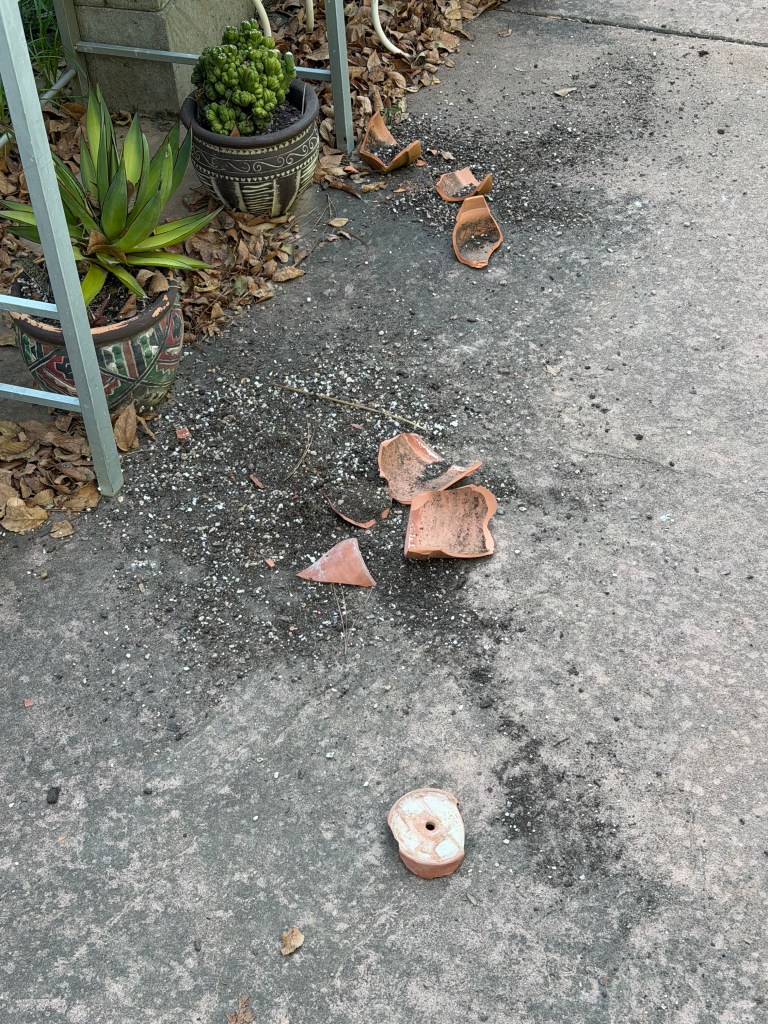
After clearing out the grass trying to reestablish itself, several plants began to emerge.  I did not have luck along the edge of the house last year (except for grass so I put a layer of mulch along the one foot (0.3 m) next to the house.  There were still quite a few bare spots, but these have begun to fill in this past week.  Most of the ground is now covered and several of the plants have begun to bloom and the pollinators are coming back.  I have also transformed our bird bath into a pollinator bath by keeping water in it along with a brick for the bees to cling to.  It appears my wildflower bed 2026 is well on its way.       

THOUGHTS: The insects that visit my wildflower bed in 2026 are fulfilling a critical ecological function.  Without pollinators, humans and all of Earth’s terrestrial ecosystems would not survive.  Over 80% of the world’s flowering plants require a pollinator to reproduce as they have separate male and female cones or flowers (monoecious).  While it is possible to hand pollinate between the male and female flowers in a small garden, this becomes untenantable for commercial growers.  Pollinator populations are declining rapidly, with over 20% of North American native species at elevated risk of extinction and US managed honeybee colonies experiencing average annual losses of 30% to 40%. Key drivers include habitat loss, pesticide use, and climate change.  Providing pollinator habits is everyone’s responsibility.  Act for all.  Change is coming and it starts with you.
Wash

April 15, 2026

I was surprised to see how much dirt and grime accumulated on the RV while we were on the road.  The vehicle had sat outside from December to February.  While I had winterized and cleaned the interior I did not do much to the exterior.  I had purchased a cover designed to go over the unit but had been reluctant to put it on due to the time and thought of trying to accomplish this on my own (yes, I could have asked Melissa).  I thought we might go on a short trip at some point, but this did not happen.  I had taken the RV to a truck wash prior to leaving and it cost US$56.  This did not seem outlandish as it cost around US$20 for my car but it was still a lot of money.  Now that we have returned, I knew I needed to get out and clean.  I did my research and ordered the necessary tools online (I could not find them locally).  Everything arrived Monday and I was ready to wash the RV.       

When I went online, I found it best to establish an RV maintenance schedule that includes an exterior wash every 4 to 6 weeks during travel season.  Regular washing prevents the buildup of road grime, bugs, and environmental contaminants (bird droppings or tree saps) that can damage paint and seals.  Several types of washes should occur along with the standard exterior wash.  This includes a post-trip rinse to remove fresh bugs and salt from the surface.  A full detail (wash and wax) should occur 2 to 3 times a year to protect the gel coat and finish from UV rays.  The roof should be cleaned 2 to 4 times a year to prevent black streaks and allow seal inspection.  The chassis and underside should have annual washing, and an immediate wash if the RV is exposed to road salt or beach camping.  If stored outdoors and uncovered you may need to wash it more frequently to prevent oxidation, while if in a climate-controlled garage an annual cleaning may be enough.  Many owners prefer using a large ladder for safety rather than standing on the roof itself.  The RV should be washed in the shade or on a cloudy day to prevent soap leaving water spots, while using a soft-bristled brush or micro-fiber mitt to avoid scratching the delicate exterior, along with an RV-specific soap as household detergents can strip protective wax and damage seals.  This seemed like a lot of rules.

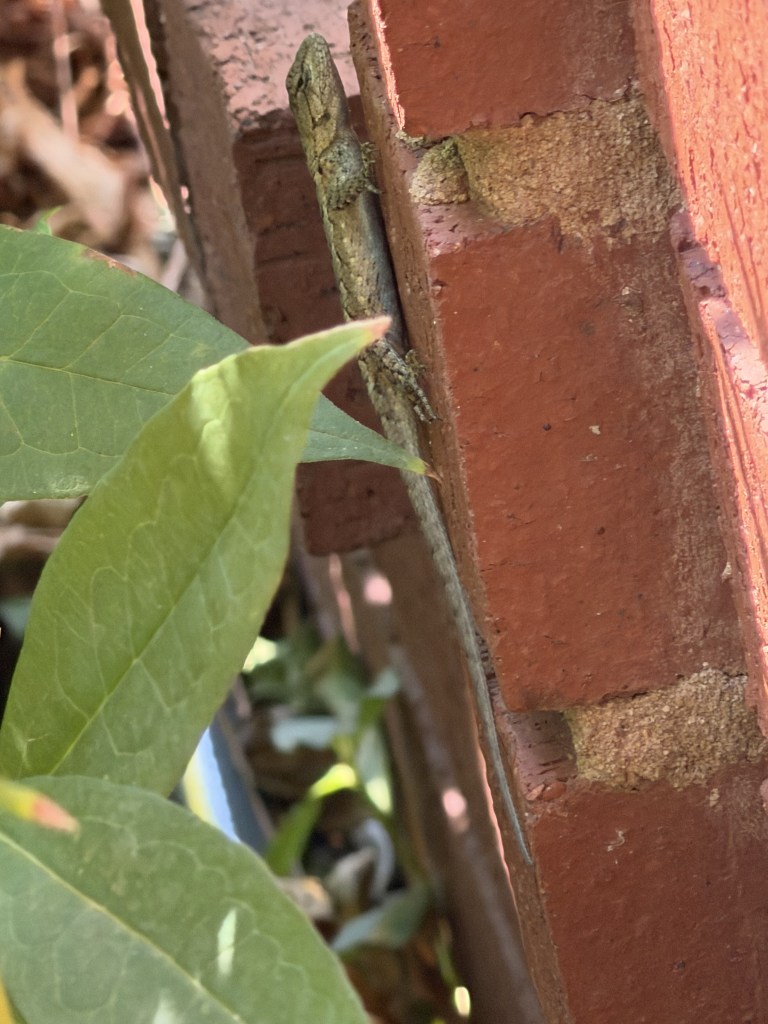
Monday turned out to be the perfect day to wash the RV as it was warm yet overcast.  I moved the vehicle onto the street to allow the gutter to whisk away the water rather than creating a mud puddle in my yard.  I had watched enough YouTube videos to know I needed to start with the roof and then work my way down to avoid streaks (one saying, “Wash your RV in minutes rather than hours”).  I have acquired several ladders and thought that might be the best way to clean.  Two were too short and the third was so unwieldy it made it hard to maneuver the brushes.  I had checked the capacity rating for our fiberglass roof and found it could easily hold me.  The problem was climbing the small ladder on the rear to get onto the roof and then figuring out how to wash the front.  I finally overcame my vertigo and climbed onto the back of the roof.  The brush setup had a 20-foot (6 m) extension and after much trial and error I was finally able to clean the roof.  Cleaning the sides and front were simpler as I was firmly on the ground.  None of this was hard, merely time-consuming.

THOUGHTS: It took me over four hours (lunch included) to wash the RV.  The quick video included a power washer which other postings warned about (strips the decals and paint).  I was amazed how much grime came off and Melissa commented on how clean the RV looked.  I think my established schedule will include trips to the truck wash along with my hand detailing.  While I do not look forward to these washes, it will keep our exterior looking fresh and new for more years.  My grandfather used to say you can tell how good a farmer is by how they keep their yard.  The same is probably true for an RVer.  Act for all.  Change is coming and it starts with you.
Slime Mold

April 14, 2026

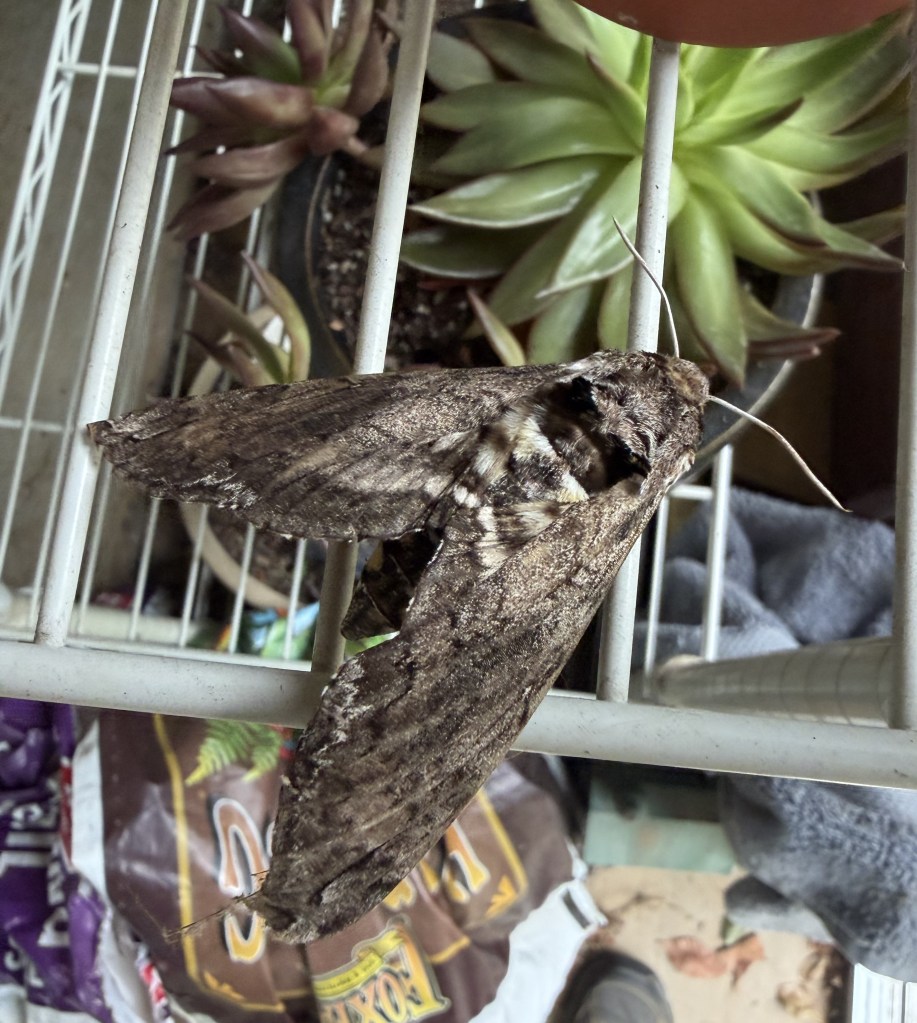
Today was time for a second planting of several vegetables in the raised beds.  The seed package suggested I plant my peas (Pisum sativum) with a second planting two weeks later to ensure I had a continued harvest later during the season.  I thought this was a good idea for my cabbage (Brassica oleracea) and cauliflower (Brassica oleracea var. botrytis) as well.  It was also time to plant the artichoke (Cynara cardunculus var. scolymus) seeds I had placed in the refrigerator (scored) two weeks ago to prepare them for planting.  Scoring is done to “trick” the seeds into thinking they are coming out of Winter and into Spring.  While I was placing the new seeds in the ground I found most of the seeds I had planted had yet to sprout, except for my radishes (Raphanus sativus).  Something should have sprouted in all these seeds.  After planting the new seeds, I watered the raised beds to keep all the unsprouted seed moist.  Then I noticed several spots of bright yellow blobs clinging to the watering hoses in one of the beds.  This appeared to be a form of slime mold.   

When I went online, I found the yellow slime mold (Fuligo septica) in my garden is in the class Myxomycetes.  It is commonly known as scrambled egg slime or flowers of tan because of its peculiar yellowish appearance, or even “dog vomit slime mold”.  This slime mold is relatively common with worldwide distribution and is often found on bark, mulch, lawns, as well as other rotting organic matter in urban areas after heavy rain or excessive watering.  The slime spores are produced on or in aerial spore cases (sporangia) and are spread by wind.  Slime mold is a harmless, amoeba-like organism that is not a fungus, but a type of organism (protist) that feeds on bacteria and decomposes organic matter.  Protists are a diverse group of (mostly) single-celled microorganisms that are not classified as plants, animals, or fungi, with a membrane-bound nucleus and thrive in moist environments.  It is a plasmodial slime mold, meaning it can move (up to several feet in a day) across surfaces.  Slime mold is not harmful to pets, humans, or plants.

I did not know what the slime mold was when I first saw it, although I knew it was not there when I checked the day before.  Being inquisitive, I reached out and touched it (yes, this is how the Blob attached itself to humans before engulfing them).  The blob disintegrated on my touch and left a slimy covering on my finger.  Northern European folk lore attributed slime mold to witches and demons.  In Scandinavia it is identified as the vomit of troll cats.  In Finland, the mold was believed to be used by witches to spoil their neighbors’ milk and is called “paranvoi” (butter of the familiar spirit).  Swedish folklore labels another slime (Tremella mesenterica) as the vomit of a witch’s “carrier” (familiar).  Both are referred to in Dutch as “heksenboter” (witches’ butter), and in Latvian as “ragansviests” (witches’ butter) or “raganu spļāviens” (witches’ spit).  At least “dog vomit” removes the slime from the realm of the supernatural.  Finding the slime safe, I left the other intact.

THOUGHTS: The overcast skies and mild temperatures (70’sF/20’sC) have combined with my watering to grow more than just slime mold.  The mulch in the paths around the raised beds are also growing mushrooms.  This term is applied to two divisions of subkingdom Dikarya (Basidiomycota, Agaricomycetes).  I remove the volunteer mushrooms that appear in my raised beds as they compete for the soil’s nutrients.  I decided to leave the mulch plants as they were not hurting anything.  When I went back outside to determine the species, the sun had come out and they had withered.  Fungi are paradoxically both fragile and incredibly resilient, depending on their visible fruits (mushrooms) or their underlying microscopic network (mycelium).  Humans often have a reverse characteristic, with a rough persona hiding a fragile psyche brought on by our exposure to stress, trauma, and emotional overload.  This should be noted in interactions.  Act for all.  Change is coming and it starts with you.
Rattail

April 12, 2026

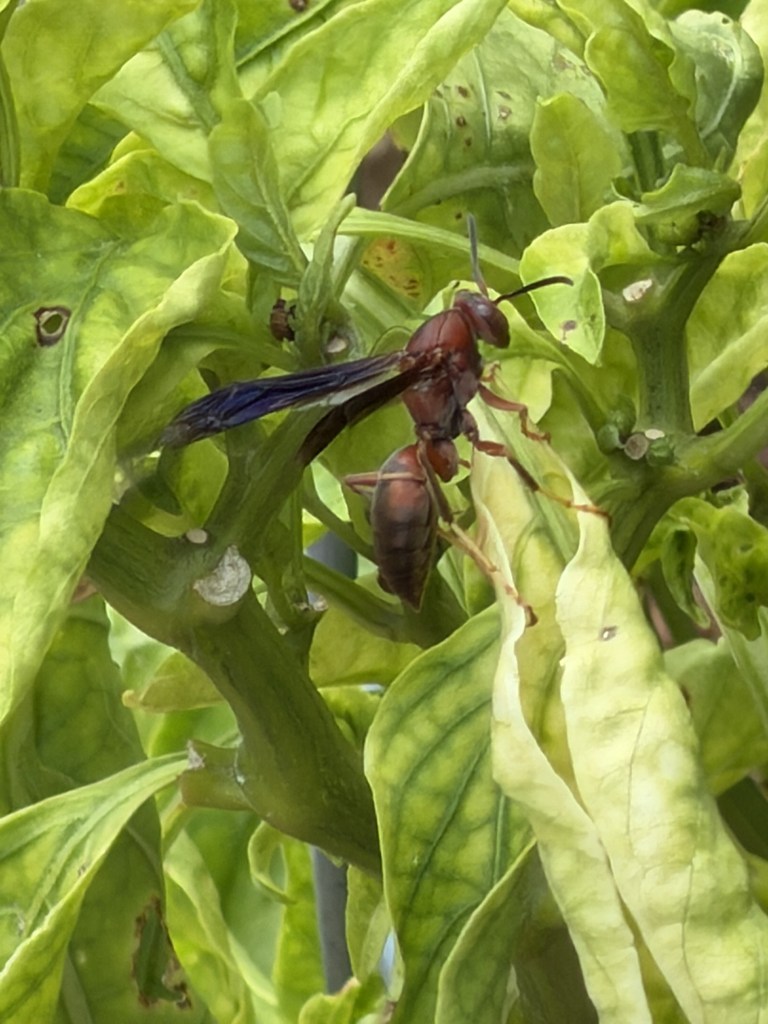
Traveling 5 of 6 weeks in February and March not only got me behind getting my garden in the ground but also in Melissa’s care for her succulents.  The good news is even with the 100’s of plants Melissa tends for she only needs to pay attention to about half of them at a time.  Different succulents grow at different rates within a year depending on the temperature, with some becoming dormant and growing slower when the weather is too hot or too cold and turn active again when the temperatures are ideal for their growth.  That is why succulents are known as “opportunistic growers”.  Succulents can be put into categories as either summer or winter growers.  Summer growers thrive in the hot months of summer (May to August) and are dormant in the winter, while winter growers thrive in the cold of winter (November to February) and are dormant in the summer.  The primary care given to all of Melissa’s succulents is an occasional misting during dormancy and scant watering and careful observation and maintenance during growing season.  When Melissa was able to get back at tending her succulents last week, she called me out to look at the blooms on her rattail cactus.

When I went online, I found the rattail cactus (Aporocactus flagelliformis) is a species of flowering plant in the cactus family Cactaceae.  With its ease of cultivation and attractive floral displays it is often grown as an ornamental potted plant.  The Latin specific epithet (flagelliformis) means “shaped like a whip”, in reference to the plant’s long stems.  The common name “rattail” refers to the same feature.  The species was one of the first cacti to be introduced into European culture.  Watson (1898) offers the year 1690 but it was probably earlier.  The species is native to the dry forests of the central Mexican state of Hidalgo north of Mexico City where it can grow naturally on rocks (lithophytic) or as rootless air plants (epiphytic) in the trees.  Specimens are rare in nature and are seldom collected in the field.  While rattail has always been one of the most popular cacti in cultivation, almost nothing is known about its natural habit.  The rattail cactus is a recipient of the Royal Horticultural Society’s Award of Garden Merit.

Rattail cacti are easy to grow and are suitable for either a greenhouse or container, indoors or out.  Plants need a minimum temperature of 43F (6C).  They should be grown in bright, indirect light, in a rich potting mix.  The best compost consists of 4 parts of sandy loam and 1 part of equal quantities of sand and crushed brick.  Rattail should be repotted every other year because their soil tends to sour.  However, that does not mean they will need a larger pot.  Once the plants are established, compost should be kept moist from April to October, with less water required from November until March, or just enough to keep stems from dying back.  In the winter, old or discolored stems may be cut out at the base to encourage new growth.  The rattail on our sunporch obviously made it through the dormancy of winter and greeted us with cascading blooms upon our return. 

THOUGHTS: Rattail cactus, like most cacti, are summer growers and settle into dormancy during the winter.  There are nine species of the Schlumbergera genus of cacti native to the coastal mountains of southeastern Brazil which reverse this rhythm.  These species are collectively called “Holliday” cactus, with annual blooms arriving between November and April (i.e., Thanksgiving cactus, Christmas cactus, or Easter cactus).  This illustrates the diversity that exists in nature as plants and animals adapt to the specific conditions of different regions.  Humans did the same, although less markedly so.  We are (at least now) all the same species, only differentiated by the tools, clothes, and culture we use to adapt to our region.   The main difference between all humanity is how we choose to differentiate ourselves from each other.  Act for all.  Change is coming and it starts with you.

Shellear

April 09, 2026

Inside the back section of my local newspaper was a Reuters article about 1000’s of small fish in Africa climbing up a 50-foot (15 m) waterfall.  A researcher from the Université de Lubumbashi in the Democratic Republic of Congo first discovered them 17 years ago at Luvilombo Falls, a waterfall in the south.  Pacifique Kiwele Mutambala, another researcher from the same institution, made the trek to the falls between 2018 and 2020 determined to document this African fish.  Mutambala witnessed the epic climb but lost all his evidence.  The fish had not been scientifically documented until a study was just published in Scientific Reports, with Mutambala as one of the lead authors.  Locals have known about this fish for at least 50 years.  In the local Sanga language, the shellear is called “kalumba,” which derives from a verb meaning “to stick.”

When I went online, I found the Parkouring shellear (Parakneria thysi) will spend hours crawling up a waterfall’s cliffside to reach better habitats.  These tiny fish are about 1.4 to 1.9 inches (3.5 cm to 4.8 cm) long.  The fish are remarkable for their endurance and adaptability, as they scale the cliff faces against strong water currents.  To move upward, the shellear use hook-like growths on the undersides of their pectoral and pelvic fins to grip the rock, then rock their tails side-to-side to generate extra momentum.  The climbing mostly happens between April and May (end of rainy season) when they move to better habitats.  Scaling the cliff takes about 9 hours 45 minutes on average to climb the 50-foot-high cliffside of Luvilombo Falls.  This is further broken down into about 15 minutes of active moment, 30 minutes of brief pauses, and nine one-hour respites.  The process is not always successful as a sudden jet of water can knock them off, forcing them to restart the climb.

Biologists have several theories why the Shellear may attempt these excursions after hard rains wash them downstream. This may be a way for the fish to reach locations with less food competition and fewer predators like the silver butter catfish (Schilbe intermedius).  Regardless of the reason, the climbing the waterfall makes the shellear susceptible to illegal fishing tactics.  The area is at even greater risk of biodiversity loss due to potential plans to divert the river upstream to irrigate crops during the dry season.  The shellear population could disappear entirely if conservation efforts in the Upemba National Park lose support.  The study’s authors hope a better understanding of the fish will highlight both the region’s incredible ecosystems, as well as the need to protect them.

THOUGHTS: While the Parkouring shellear is the first scientifically documented African species to climb waterfalls, other fish species around the world have evolved similar abilities to scale vertical rock faces.  In South America, several species in the order Characiformes (e.g., certain Corydoras catfish) and order Cichliformes (e.g., some cichlids) have been observed climbing waterfalls in the Amazon and Orinoco basins.  These fish use similar fin structures and body movements to grip and propel themselves upward.  In Southeast Asia, species such as the Asian climbing perch (Anabas testudineus) and certain mudskipper (Family, Oxudercidae) relatives can climb onto mudbanks or rocky substrates, though not always vertical waterfalls.  Finally, Australian lungfish (Neoceratodus forsteri), and mudskippers have been documented moving over rocky surfaces, though their climbing is more horizontal or bank based.  It seems the more humans research the more diverse our fellow Earth travelers are found to be.  Unless we protect and preserve the fragile ecosystems where they reside, knowledge of their diversity will be lost.  Act for all.  Change is coming and it starts with you.

Monarch Pass

April 04, 2026

Our return from Utah took Melissa and I along the southern route through Colorado to avoid having to drive the steep passes of the central Rocky Mountains.  Melissa drove the 13 miles (21 km) of 6% grade on I-17 that drops into the Verde Valley and neither of us were excited about a repeat.  Things began as we took US Highway 50 out of Grand Junction, encountering rolling hills but nothing we could not handle.  Then we saw a sign that said Blue Mesa Summit (elevation 8,704 feet or 2,653 m) was just ahead.  The pass divides the watersheds of Little Cimarron River to the west and Blue Creek to the east.  This stretch is approximately 12 to 15 miles (19 to 24 km) long and has sections with grades of 6 to 10%.  Having ridden Verde Valley the previous week I was prepared for Blue Mesa and drove through without much concern.  I assumed we had made it through the lower Rockies, and I breathed a sigh of relief.  Little did I know looming 50 miles (80 km) ahead was Monarch Pass. 

When I went online, I found Monarch Pass (elevation 11,312 feet / 3,448 m) is a high mountain pass in the Rocky Mountains of central Colorado, US.  The pass is located on the Continental Divide of the western US at the southern end of the Sawatch Range along the border between Gunnison and Chaffee counties, approximately 25 miles (40 km) west of the town of Salida.  The pass carries US Highway 50 over the Sawatch Range providing a route between Tomichi Creek in the upper basin of the Gunnison River on the west and the South Arkansas River on the east.  The pass can be traversed by all vehicles under most conditions and is generally open year-round.  However, 7% grades exist and the area is prone to heavy winter snowfall which often results in temporary closures during severe winter storms.  The highway does have some three-lane sections and runaway truck ramps are located about halfway down both the eastern and western sides of the pass.  Ten curves have a 35 mph (56 kph) advisory speed and one 30 mph (48 kph).  The West Descent has a 6% grade for 9 miles.  The East Descent has a 6% grade for 10 miles.

The climb up Monarch Pass begins at 8,184 feet (2494.5 m) and climbs over 3000 feet (914 m) to the summit with a steady 5-8% grade.  We were lucky enough to be traversing the eastern descent, so we got that extra mile (1.6 km) of steep grade.  Monarch Pass is rated as the #19 most feared road to drive in the US, especially during the winter due to heavy snowfall, strong winds, and several known avalanche areas.  The steep grades and sharp curves combine with a lack of shoulder or guard rails to make this route particularly hazardous.  As we neared the summit, we saw signs for “active snow removal” ahead.  The summit was covered in snow (thankfully not on the road) and a dense fog set in.  I did not know if that might be better as I could not see the drive awaiting us.  The fog lifted as we descended and Melissa looked out the side window into the 300 foot (91 m) drop to the trees below.  She kept her eyes directly ahead for the rest of the descent.  We crept down the mountain, only periodically applying the brakes.  A harrowing 25 minutes later we were down.

THOUGHTS: After Monarch Pass Melissa told me we are never going to take US Highway 50 again.  The problem is, unless you avoid Colorado entirely you will need to take some risk to cross the Continental Divide.  I had taken all these passes without incident when driving a car.  It was vastly different in a motor home towing our Jeep.  When we tried to find the number of annual fatalities on the road the site said, “it varied”, but they did occur “periodically”.  Spending six weeks driving 5000 miles (2495 km) across much of the southern US (Arizona to Florida) gave me a new perspective on the drivers that supply the US with 72% of domestic tonnage (11 to 13 billion tons/10 to 12 m tonnes) annually, valued at more than US$13 trillion.  These trucks do not stop on a dime, so give them a break.  Act for all.  Change is coming and it starts with you.
Moab

March 25, 2026

I moved to Salt Lake City in 1979 to attend graduate school.  I grew up in Kansas (various), and was used to living in towns surrounded by agricultural fields or the remnants of the big bluestem (Andropogon gerardi) that dominated the tall grass prairie.  What I found in Salt Lake was the Uinta Mountains on one side and a salt desert on the other.  While I quickly adapted to the mountains (skiing) I did not like the desert, finding it hot, salty, and barren.  After a few years I was drawn to the archeological sites of the four corners region and southeastern Utah (Anasazi cliff dwellings).  I later worked for the Division of State History mapping and encoding sites and participated in several archeological surveys in the area.  The more I worked in the area the more I was drawn to it.  By the time I left for California I found it was the desert I missed the most.  The largest city in the area at that time was the declining town of Moab with 4000 people.   

When I went online, I found Moab is the largest city and county seat of Grand County and is known for its dramatic scenery.  The population has risen from 4800 in 2010 to 5400 at the 2020 census.  Moab attracts lover 3 million tourist annually, mostly visitors to the nearby Arches (4 miles/6.5 km) and Canyonlands (22 miles/35.5 km) National Parks.  The town is also a popular base for mountain bikers who ride the extensive network of trails, including the Slickrock Trail.  Off roaders also come to for guided Jeep tours and the annual Moab Jeep Safari.  Moab has experienced a surge of second-home owners as the mild winters, and enjoyable summers attract people to the area.  This mirrors other resort towns in the American West and controversy has risen over the new residents and their houses, many of which are unoccupied most of the year.  Moab citizens are concerned the town is changing like the towns of Vail and Aspen in Colorado.  This means skyrocketing property values, a rising cost of living, and corresponding effects on local low- and middle-income workers.

I was anxious to revisit the quaint town of Moab and enjoy the solitude of the surrounding desert.  Melissa had been talking about visiting the area I loved ever since she heard stories of the many weekend trips taken by me and my son Alex.  Often, we would not see another human from the time we left the main road until we returned.  The desolation and isolation that had initially turned me off became the basis for my attraction.  What we found now was dramatically different.  Construction started several miles outside of town, with light industrial sites, gas stores, and fast-food chains.  These were interspersed with motels, residences, and RV parks.  The street was lined with businesses offering scenic tours by jeep and mountain bike.  If you did not want a tour, you could rent either to go on your own.  There were offers for ziplines along the canyon rim and plane rides.  What struck me most was the change from quiet isolation to the hundreds of people walking or biking along the main throughfare.  While the residents may be only 1500 more than I remembered, tourists overwhelmed the city.  Moab embraced the niche market of adventure tourism. 

THOUGHTS: Melissa and I camped our RV about 15 miles (24 km) north of Moab in the new (2021) Utahraptor (yes, found there) State Park.  This was centrally located to spend time at two sites I fondly remember, Dead Horse Overlook and Arches National Park.  We found Arches often has long wait lines to enter (exceeding 60 minutes from spring through fall) and the park temporarily restricts access if parking lots fill up.  We opted to go straight to Dead Horse.  Here again we found 100’s of people.  Most were hiking or mountain biking the roads and trails that wind through the park.  My recollection was seeing one or two other cars at the overlook.  While you can go home again, it may not be recognizable.  Still, the trip was worth it and the scenery spectacular!  It was worth the crowds.  Act for all.  Change is coming and it starts with you.
Burros

March 19, 2026

Several days ago, we camped in the Homolovi State Park in Winslow, Arizona.  I was excited to camp in the park as it contains the remains of two pueblos along with a petroglyph panel.  Homolovi now serves as a center of research for the late migration period of the Hopi from the 1200’s to the late 1300’s.  The park is over 4000 acres (1618.74 ha) and includes a visitor center and museum, various trails and the campground where we spent the night.  We arrived early as I wanted to explore the ruins and walk the trails.  As we entered the gated park, we saw a sign indicating it was an open range (animals roam free inside the fenced area).  We explored the partially excavated Homolovi II site and then took the kids for a walk around the parking lot.  The docent at the museum had shown me where the petroglyph (pecked rather than drawn) panel was located and that became our second stop.  On the way to the ruin, we noticed several animals grazing off in the brush.  On our return the animals had moved closer to the road, and we saw they were wild burros. 

When I went online, I found Wild burros (Equus asinus) in Arizona are primarily found in the western desert mountains, most famously in the historic mining town of Oatman, where they roam freely and interact with visitors.  The burros are descendants of 19th-century mining pack animals.  The protected animals can also be found near Lake Pleasant, near Peoria, Arizona.  While the burros are a popular attraction, they are wild.  They can bite or kick and feeding them is discouraged to protect their health and safety. The burros are often found in various Bureau of Land Management (BLM) areas in western Arizona and are particularly active during early morning and late afternoon.  There are over 10,000 estimated wild burros in Arizona, which is far above the sustainable level for the environment (less than 1,500), leading to BLM efforts to manage the population and reduce their impact on the desert.  The burros are protected under the federal Wild and Free-Roaming Horses and Burros Act (Public Law 92-195) of 1971, which means it is illegal to harass or harm them.  BLM suggests the best way to see the animals is from a distance, without pulling off the road.

While the burros we saw at Homolovi were from a distance, we found them close when we arrived at our Lake Pleasant campground.  There was a group of three who were feeding among the campers across from where we were assigned.  I had been wary of camping at several of the “Horse Motel” campgrounds set up to accommodate equestrian travelers along our route as I was unsure how the kids would react to the large animals.  Now I had no choice as we were invading their protected land.  We kept the kids inside while we set up camp and placed the night shade over the front windshield of the RV.  I checked outside before taking the kids for a walk to burn off energy before feeding them.  We all settled in together inside the RV as it was too hot to be outside.  Later that evening I put on their lease to take them out for a final trip.  I always go out before them to make sure I have control of the lease.  When I opened the door, Zena nearly knocked me down as she tore through the opening with her VERY loud protective bark.  One of the burros was standing about 15 feet (3 m) from our front door.  I do not know who was more surprised, the burro, the dogs, or me.   

THOUGHTS: While wild burros are predated by mountain lions, this is not enough to keep their population in check.  The Wild and Free-Roaming Horse and Burro Act charged BLM with managing wild burros in a thriving natural ecological balance with other plants and animals to maintain healthy ecosystems.  Wild burros removed from management areas due to overpopulation, emergency situations, or through nuisance are available for adoption through the BLM’s Wild Horse and Burro Adoption Program.  Protecting an invasive species is always a fine line.  Act for all.  Change is coming and it starts with you.

Verde Valley

March 18, 2026

After battling the winds across the Panhandle region, we were home free as we climbed into the Ponderosa pine (Pinus ponderosa) forest that surrounds Flagstaff, Arizona.   The Coconino National Forest is located within the world’s largest contiguous Ponderosa pine forest (yes, where the name Ponderosa Ranch comes from on the long-running TV series Bonanza).  These dominant, tall trees are famous for their orange-brown, puzzle-like bark that smells like butterscotch or vanilla.  We also passed three National Monuments along the route that were extant cliff dwellings of the prehistoric Ancestral Puebloans (Anasazi).  Like so many other first-time travelers to Arizona, we were surprised to find the dense forest of the Kaibab Plateau rather than the stark desert we associated with the state.  As we traveled south out of Flagstaff the forests diminished and the saguaro cactus (Carnegiea gigantea) took over as we began to drop in elevation.  The saguaro is the largest cactus in the US and acts as a vital, long-lived (up to 200 years) keystone species in the Sonoran Desert.  While I had anticipated the saguaro, I was not prepared for the Verde Valley descent.    

When I went online, I found the steep grade on Interstate 17 descending from Flagstaff toward Phoenix is often referred to as the Verde Valley grade or simply the I-17 mountain corridor.  This stretch includes a sustained 6% grade for roughly 13 miles (21 km) between Flagstaff and Camp Verde, Arizona that requires runaway truck ramps.  The stretch also includes another steep section for southbound traffic near Black Canyon City.  The route is known for high speeds, steep inclines, and sharp curves and is often cited as one of the most treacherous connections in Arizona.  While Flagstaff sits at 7000 feet (2133 m), Phoenix rests in the Verde Valley at an elevation of 1,086 feet (2133,6 m).  Although only 145 miles (233 km) apart, the great difference in elevation result in drastic climate changes.  Flagstaff is typically 20F to 25F degrees (36 C to 45C) cooler than Phoenix on any given day all year round.  This was a descent we were unprepared for.

Our first indication of the Verde Valley downgrade was a sign saying, “6% grade ahead.  Trucks and vehicles towing trailers use lower gears.”  We were driving the RV and pulling our Jeep behind.  We qualified for the warning.  My first thought was I was glad I was not driving.  Then, I wondered if I should offer to drive.  Neither of us had driven anything close to these conditions, so I was not sure I could do anything better than Melissa.  Instead of pulling over, Melissa asked for suggestions on how to drive.  She slowed down and I clicked on the emergency flashers as we began our descent.  The first thing we tried was shifting into 2nd gear.  That did not last long as the engine RPM climbed close to the red line.  I had just read an article online about the best way to slow your RV when on a steep grade and it suggested to make hard brakes followed by taking your foot off the brake.  Melissa shifted into Drive and periodically punched the brake to slow down.  There were also reprieves on the descent where it would level off or even ascend for short distances.  Melissa did a great job, and we got down without incident.

THOUGHTS: Toward the end of the Verde Valley descent, we passed a truck parked along the side of the road with its brakes smoking.  I was glad the driver was able to stop (and that we had avoided a similar situation).  I was also proud of the way Melissa had handled driving.  It was tense for me, and no doubt more so for Melissa.  I knew we had to retrace this route on our way to Utah, but this time we will be going up, a whole new set of problems.  This last month has been an amazing immersion into the diversity of the US.  We traveled from the Ozarks to the Florida Atlantic coast, then to the high plateau and desert of Arizona.  The people have been just as diverse.  Rather than a detriment, diversity is what defines our nation.  Act for all.  Change is coming and it starts with you.
Astoria

February 16, 2026

Scrolling the NY Times Headlines feed, I came across a bird who has captured the attention of New Yorkers.  The bird arrived in Manhattan’s Battery Park and eventually settled in the area near the Sea Glass Carousel, just north of the Staten Island Ferry terminal. Three human women have become her self-appointed caretakers and visit her daily.  New Yorker’s regularly fall in love with celebrity wildlife, including unusual ducks, a pair of coyotes, and Flaco the escaped owl in Central Park.  Sunny Corrao, the deputy director of the city parks department’s wildlife unit, said, “She’s the only known turkey in Manhattan, “but this is not unusual.”  A turkey was known to hang out in Inwood Hill Park in Upper Manhattan in the past and there are large flocks in the Bronx and on Staten Island.  Smaller groups come and go to Queens and Brooklyn.  Astoria got her name because she was first spotted in Astoria, Queens, before making her way to Roosevelt Island and, finally, Manhattan.

When I went online, I found Astoria is a descendant of the wild turkey (Meleagris gallopavo) first domesticated in Pre-Columbian Mexico.  The Classical Nahuatl word for the turkey (huehxōlō-tl) and the Spanish guajolote are still used in modern Mexico.  Mayan aristocrats and priests had a special connection to turkeys, with ideograms of the birds appearing in Mayan manuscripts.  Spanish chroniclers Bernal Díaz del Castillo and Father Bernardino de Sahagún describe the multitude of food (both raw fruits and vegetables and prepared dishes) offered in the vast markets (tianguis) of Tenochtitlán, noting there were tamales made of turkeys, iguanas, chocolate, vegetables, and fruits.  Turkeys were first exported to Europe via Spain around 1519 and gained immediate popularity among the aristocratic classes.  English settlers brought turkeys to North America during the 17th century.  There were an estimated 10 million turkeys in the US during the 17th century, but by the 1930’s only 30,000 remained.  In the 1960’s and 1970’s, biologists started trapping wild turkeys and re-introducing them into other states. 

The three self-appointed caretakers of Astoria coordinate their schedules in group chats and text messages, sharing photos and updates on Astoria’s location and condition.  Keiko Komiya visits the turkey in the morning, and Stella Hamilton and Anke Frohlich are generally there in the afternoon, and for bedtime.  Astoria spends her days strutting around on the ground, then every evening (at 20 minutes after sunset) she flies up into a tree to spend the night.   Hamilton is a retired nurse and birder who was previously a big fan of Flaco, the Eurasian eagle owl set free from Central Park Zoo.  Komiya is an English student and avid birder whose first New York City celebrity bird was the mandarin duck she photographed daily in 2018.  Frohlich started photographing birds during the covid-19 pandemic and runs an alternative healing practice in Greenwich Village which allows her to give the birds priority.  The women do not worry about Astoria, but everything and everyone else.  Young kids chase her, dogs scare her, and people press on her for selfies.  Astoria also crosses State Street to bask in the warmth emanating from the Starbucks on the corner and the friends fear she will be hit by a vehicle.  Their fears are not unfounded.

THOUGHTS: While Astoria has grown a devoted fan club, she is not the only wild Turkey residing in New York.  “New York City is actually great habitat for a wild turkey,” Jessica Wilson, the executive director of NYC Bird Alliance, said. She noted that the birds are native to the area, have plenty to eat here and do not necessarily need turkey friends.  “They often join flocks, but they also are fine on their own — and in general, we try not to interfere with their social life.”  Perhaps we should treat people with the same respect.  Act for all.  Change is coming and it starts with you.