
February 19, 2025
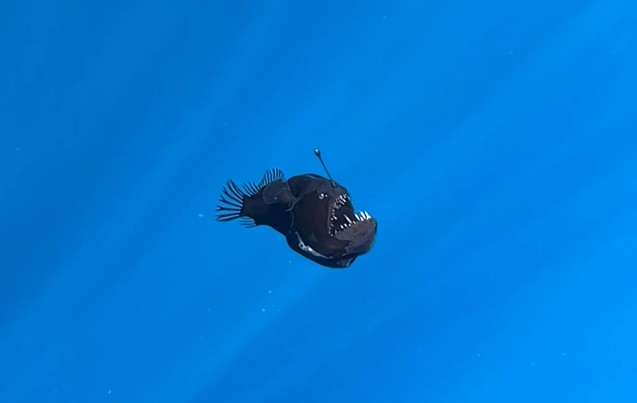
My NY Times feed carried a story about an eerie looking creature from the ocean’s depths that has become an inspiration for intense emotions on social media. It is easy to believe a fish with a gaping mouth of razor-sharp teeth, a bioluminescent rod sticking out of its head, and lidless eyes to scan the darkest depths of the ocean, might elicit fear. The freakish looking creature is also moving people to tears of emotion. Social media has turned the fish into a folk hero after it swam great lengths from its usual home 650 to 6,500 feet (200 to 2,000 m) deep in the ocean to the surface. Fans of the fish have turned this odyssey (which ended in death) into a version of the hero’s journey, a quest to reach the light. Hannah Backman, of Minneapolis, who posted about the fish on TikTok, said she succumbed to the poetry of a lone fish approaching the light, “spending her literal last seconds trying to do something beautiful.” The fish made headlines in late January when it was spotted by a group of researchers off the coast of Tenerife in the Spanish Canary Islands. The team observed the fish, which was already injured, for several hours and it ultimately died. Fans of the Black seadevil anglerfish have posted tributes set to ballads, written poems, created fan art, and even gotten tattoos.
When I looked online, I found a Black seadevil (Melanocetus johnsonii) is small, deep-sea fish of the order lophiiform and family Melanocetidae. There are five known species (only two are given common names) within the genus Melanocetus. They are found in tropical to temperate waters of the Atlantic, Indian, and Pacific Oceans, with one species known only from the Ross Sea. The Black seadevils are named for their intimidating appearance and typically pitch-black skin and are characterized by a gelatinous, mostly scaleless, globose body, a large head, and their large, sharp, glassy, fang-like teeth lining the jaws of a cavernous mouth. These teeth are depressible and present only in females. Like other anglerfishes, the black seadevil possess a modified dorsal spine “fishing rod” (illicium) and a bulbous, bioluminescent “fishing lure” (esca). The bioluminescence is produced by symbiotic bacteria thought to enter the esca via an external duct suggesting they originate from the surrounding seawater. The bacteria are apparently different in each anglerfish species. There is a strong sexual dimorphism, with females reaching a length of 7 inches (18 cm) or more, and males under 1 inch (3 cm). Males also lack lures.
It is unclear why the seadevil came to the surface, although scientists speculate it might have been from an illness or an unusual current. The fans on TikTok have woven a beautiful, albeit fanciful, narrative for the fish. This is a story of a creature in its final days, desperate to experience a source of light not generated by its own body. Madison Sharp, a behavioral therapist in Dallas, noticed an outpouring of emotion for the fish in her social media feeds. “Instead of just seeing a fish reach the surface, they see hope, and meaning, and symbolism,” she said. She was inspired to draw a picture of the seadevil approaching the surface, adding tears to its eyes, and the word “finally” floating above the waterline. “I think the most important part was the expression of the fish,” she said. “I added the little eyebrow on top to show the longing of it.” Well, there you go.
THOUGHTS: Humans often turn charismatic animals into anthropomorphized heroes. Consider Flaco, the Eurasian eagle-owl that escaped from the Central Park Zoo. Sadly, neither Flaco nor the seadevil survived. It seems their death is taken as indicative about our own struggle with life. Or as sci-fi writer David Gerrold is quoted, “Life is hard. Then you die. Then they throw dirt in your face. Then the worms eat you. Be grateful it happens in that order.” Being anthropomorphic about a seadevil does not seems so bad after all. Act for all. Change is coming and it starts with you.
 A travelers odyssey