Pyrenees

May 18, 2026

We are planning a cruise to Alaska and the inner passage this summer and I decided to do some clothes shopping before we left.  July is the warmest month of the year in Alaska, but temperatures vary drastically by region.  The Coastal and Southeast areas (Juneau) where we will travel typically range from 55F to 65F (13C to 18C).  That meant I needed to find additional transitional wear that I could layer.  I tend to follow my father’s rule-of-thumb when it comes to clothes and closets.  I keep three pairs of each type of outer wear, along with 10 shirts and 10 tee shirts.  I do have a variety of pants for different occasions (dress, daily, work).  This can drive Melissa crazy because every time she buys me a shirt, I donate one of my older shirts to charity.  In contrast, the other three closets are dedicated to her clothes, which she alternates between winter and summer outfits.  We went to the new big box sports store, and I got and nice short sleeved collared shirt to wear for dinners and a lightweight hoodie I could layer for sight-seeing.  I tried the hoodie on today and walked into the living room to show Melissa how it looked.  Our Pyrenees (Zena) was asleep on my spot on the couch (her favorite) when I walked in with the hood up.  She saw me and went nuts.

When I went online, I found the Pyrenean Mountain Dog or Chien de Montagne des Pyrénées, is a French breed of livestock guardian dog.  The Pyrenees breed originates from the eastern or French side of the Pyrenees Mountains that separate France and Spain and is recognized as a separate breed from the Mastín del Pirineo or Pyrenean Mastiff from the Spanish side of the mountains, although they are closely related.  It is sometimes claimed that the forebears of both breeds were white livestock guardian dogs brought to the area from Asia in Roman times.  The Pyrenean is large and heavily built, with males standing from 28 to 31 inches (70 to 80 cm) and bitches from 26 to 30 inches (65 to 75 cm).  Healthy adults typically weigh between 120 and 165 pounds (55 and 75 kg).  The neck is short and strong, the chest broad and moderately deep, and the tail long, hanging low when the dog is at rest but curling over the back when the dog is roused.  The dogs are widely used throughout France as a livestock guardian, particularly in the French Alps and the Pyrenees, protecting flocks from predation by wolves and bears.  It is known as the Great Pyrenees in the US.

Beginning in the late 1970’s, sheep farmers in the US began employing livestock guardian dogs to protect their flocks from predators, particularly coyotes (Canis latrans) and black bears (Ursus americanus), but also cougars (Puma concolor) and grizzly bears (Ursus arctos horribilis).  A 1986 survey of over 400 farmers employing 763 livestock guardian dogs in the US found 57% of them used Great Pyrenees.  While we do not own sheep, we have toyed with the idea of living off grid.  Our black Pyrenees (common but not AKC worthy) was the runt of the litter and now considered small at 90 pounds (41 kg), but she is still a very good protector, always patrolling our fence.  She did not recognize me in my hoodie and shot off the couch ready to protect Melissa, sounding her warning bark and her tail was tightly curled over her back.  She stopped being aggressive when she realized it was me, but it took a good five minutes of consoling to settle her and down.

THOUGHTS: We did not have a Great Pyrenees when I was growing up, but we did have a large Boxer named Lucky.  My sister never cared much for the dog until one day when she was alone at the house.  People knew our home as a place to get help with food or even money.  One day a man came onto the porch and tried to open the locked front door.  Lucky saw the threat and immediately slammed into the door barking, startling the man who quickly ran away.  Dogs give protection and keep alert to threats.  That is why many people on the streets keep dogs, and why we support a local feeding program by providing dog food.  Act for all.  Change is coming and it starts with you.
Velella

May 12, 2026

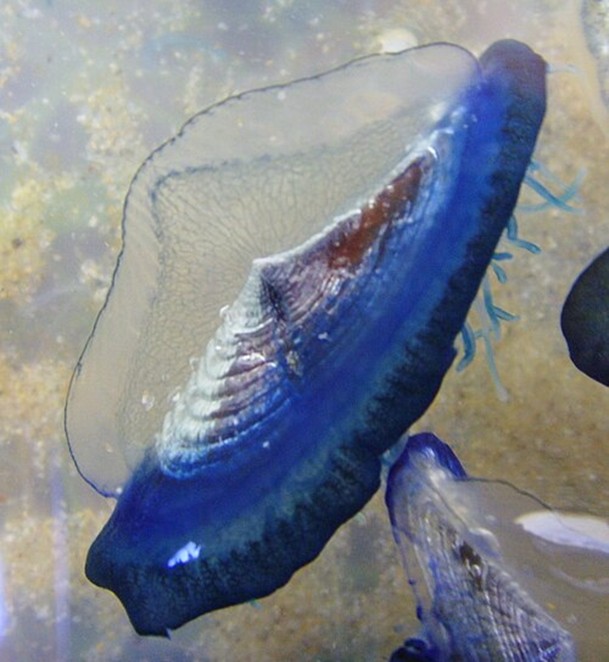
Monday’s local newspaper carried a USA Today article on hundreds of thousands of small sea creatures were washing up along the Pacific coast in the US.  These jelly-like creatures can be found around the globe but are most often in large accumulations off the US Pacific coast and in the Mediterranean.  According to Steven Haddock, a senior scientist at the Monterey Bay Aquarium Research Institute, while several miles-long stretches may float in the open ocean, it is when the winds pile them up along the shore that people really notice.  Rebecca Helm, Georgetown University Earth Commons Institute has been studying the creatures and says that although velella have been documented for decades, scientists do not yet fully understand them.

When I went online, I found Velella velella is the only known species in the genus of hydrozoa in the family Porpitidae.  Other common names are sea raft, by-the-wind sailors, purple sail, little sail, or simply Velella.  By-the-wind sailors are a widely distributed free-floating colonial animal that lives on the surface of the open ocean in a specialized ocean surface community collectively called Cnidarians.  Specialized predatory mollusks such as sea slugs (nudibranchs) in the genus Glaucus and purple snails (genus Janthina) prey on these cnidarians.  Each apparent individual is a hydroid colony, and most are less than about 2.8 inches (7 cm) long.  Like other cnidarians, velella are carnivorous and catch their prey (mostly plankton) by tentacles that hang down in the water and bear stinging nematocysts (or cnidocysts).  The toxins in their nematocysts are effective against their prey but are relatively benign to humans, although irritation may occur to skin. Some scientists describe velella as floating colonies, but Haddock said it is easier to understand each raft as a single individual with a central mouth that looks like a volcano surrounded by a field of 100’s of squirming noodles, which are also a mouth.  Each velella can produce 1000’s of free-swimming, sesame-seed sized offspring that drop off and sink to the seafloor where they produce another single cell that eventually returns to the surface as a new floating colony.  They are usually indigo blue in color and have a small stiff sail that catches the wind and propels them over the surface of the sea. 

Helm has been looking at how the velella survive in the wind and waves without getting turned around as they pop up right every time as well as their adaptation to use the wind for propulsion.  Scientists would also like to be able to predict when the velella armadas are going to appear.  One study suggests large concentrations may be found after particularly warm winters, but more research is needed.  The winter of 2025-2026 was a record breaker in California with intense marine heat waves observed in the ocean.  Scientists are encouraging people to report velella sightings and to take photos with GPS activated readings so they can track their exact locations.  Sightings can be reported through the iNaturalist app.

THOUGHTS: Like many unique creatures, the velella are being examined for military reasons.  A group of scientists in China have studied mimicking the velella as a prototype for unmanned surface vehicles, while a group at John Hopkins are working with the military on modeling them to create low-cost ocean sensors.  Heaven forbid, we take the time to study the uniqueness of nature without trying to adapt it for a military advantage.  Act for all.  Change is coming and it starts with you.
Play Ball

March 21, 2026

I knew the Lake Pleasant campground where we chose to stay was several miles north of the Surprise baseball stadium.  When we approached the campground, we saw signs saying the road was closed ahead.  Since we did not know another route to the site, we kept driving and hoped for the best.  It turned out we got within a mile (1.6 km) of the entrance when we were routed to the south.  I asked one of the construction workers as we slowly passed how to get there and was told to take the road to 303 West, then Grand North to 74 East and come back in from the other side.  While this sounded simple enough, I did not realize this meant taking an 80-mile (128.7 km) detour.  By the time we arrived I was more than a little upset that the camp had failed to mention this small detail.  I also wondered what this would mean for driving to Surprise for the three games we had purchased.  When I googled the location of the stadium from our campsite, I found that while it was farther than I expected, it was only about 5 miles (8 km) more than without the detour (down to Surprise then up to the campground).  The next day we made allowances for the distance and arrived in time to be seated along the first base line before the start of the game.  After the traditional “first pitch” by some unknown local celebrity we heard the umpire cry, “Play Ball”. 

When I went online, I found in the US, “play ball” generally means “play baseball,” though the usage is often heard in connection with football, basketball, and other sports.  The phrase, or various versions, were in use hundreds of years before baseball was invented.  According to the Oxford Dictionary, the expression simply referred to a game played with a ball.  Concerning baseball, the Dickson Baseball Dictionary (3rd ed.) defines “play ball!” as “the command issued by the plate umpire to start a game or to resume action but it is sometimes abbreviated to a simple order of ‘play!’”  Dickson quotes from the Boston Globe (May 13, 1886) the first use in newsprint: “McKeever held a long discussion with Pitcher Harmon about signs.  The crowd got impatient; one man yelled ‘Get a telephone!’ while the umpire ordered them to ‘play ball.’”  The phrase caught on and showed up a few years later in in James Maitland’s, The American Slang Dictionary (1891): “Play ball (Am.), go on with what you are about.”   Dickson says, “play ball” has a special meaning to baseball fans and is the “emblematic phrase for the start of any baseball game.”

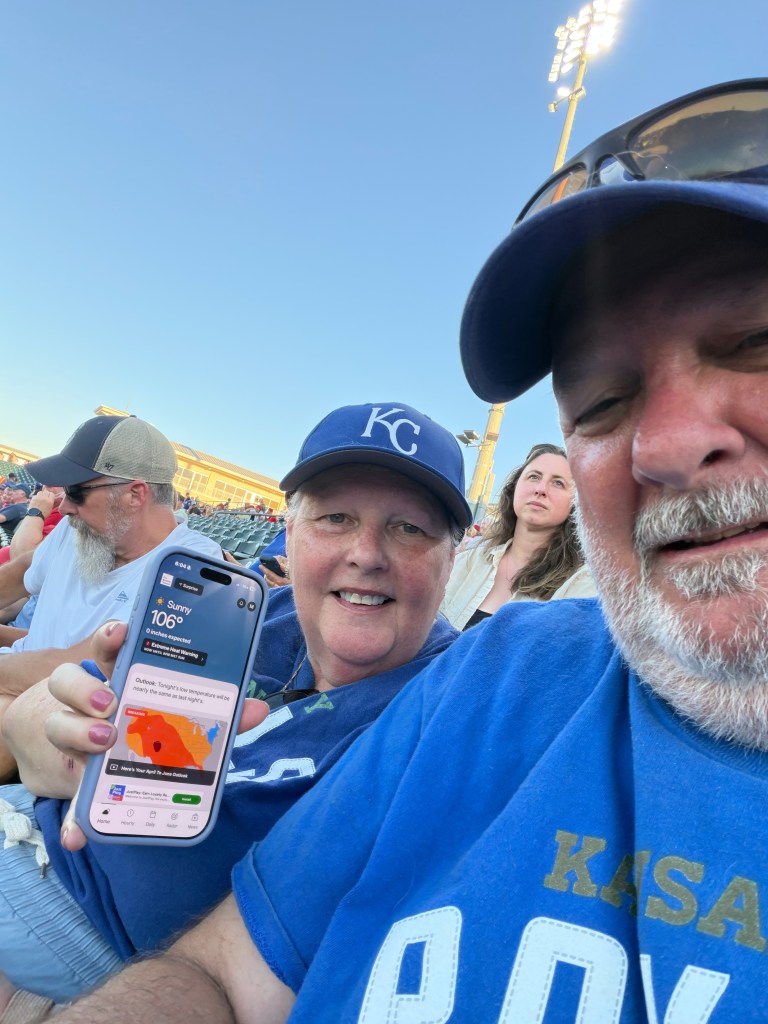
We were able to see the Royals play three games in Surprise.  Tuesday night they played the Dodgers in a packed house.  The temperature at “Play Ball” was 99F (37C).  We left with a 4-4 tie in the eighth inning and heard they ended up losing 12-4.  The next night it was 102F (39C) at the start.  The Royals share the field with the Texas Rangers and were considered the away team on that night.  They lost 10-2.  On Thursday they played the Angels and the temperature at the start was 106F (41C).  While the desert has a “dry heat”, it was still hot every night.  The worst part was the World Baseball Classic wrapped up last weekend and most of the players we came to see were not suited up.  The Royals had 14 players in the 2026 World Baseball Classic, with 10 of them on the 40-man US roster, causing some to name this the “Royal Baseball Classic”.  The final saw Venezuela beat the US 3-2 with a 9th inning double.  I guess that made us 0-4 for the weekend.  Check my bucket list.

THOUGHTS: While the emblematic phrase may be “play ball”, the official umpires rule book states the game is to be started when the umpire points to the pitcher and says, “play”.  Despite this rule, most fans (like me) still hold out for and can even hear the traditional shout.  I have found in most things our traditions tend to overrule our rules, at least in our minds.  What one believes can be more important than the facts.  However, there are times when we should try and go with the facts.  Act for all.  Change is coming and it starts with you.
Locator

February 11, 2026

Yesterday began as a normal day.  I drove into town to visit some friends and then decided to do some shopping.  We are preparing for a trip in our RV and I needed dog food.  While the little man will eat anything you put in front of him (he loves the crunch of carrots), our big girl is sort of picky about what she eats (no carrots!).  The store has a quality brand that is much cheaper than either the pet store we used to shop at or even online.  I have also started using their phone app that allows me to scan my purchases and skip the register   Since I was picking up several items (the alure of the box store) I placed my phone in the baskets to easily scan my items.  When I was done, I swiped the payment, put my phone back in the cart, and proceeded to the exit gate.  The woman at the door waved me through and I walked out to the parking lot.  That was where the trouble began.  I had forgotten where I had parked in the large lot.  I walked up and down several rows of cars and did not see my Jeep anywhere (come on, I know you have done this).  The vehicle does have a locator attachment geared to my phone, but it was not specific enough to pinpoint other than the right lot.

When I went online, I found Locator tags (or Bluetooth trackers) are small battery-powered devices that attach to personal items (keys, wallets, luggage, pets) to track their location.  Tracking can be done using smartphone apps via Bluetooth or from wider crowdsourced networks (e.g., Apple Find My, Android’s Find My Device).  Leading options are equipped with features like sound alerts, last-known location mapping, and, in some cases, precision finding.  AirTags use the extensive Apple network, while Tile relies on the Life360 network, and Samsung trackers use the SmartThings Find network.  Certain models (AirTag and SmartTag2) use Ultra-Wideband (UWB) technology to guide you directly to the item with on-screen arrows.  Many locator tags can play a loud sound to help locate items and will send alerts if the item is left behind.

Since the locator tag for my app was not specific, I started clicking the “open” button on my car keys to see if the taillights appeared anywhere close.  They were not.  In desperation, I finally hit the panic button.  The alarm went off and indicated the car was in the opposite direction to where I had been searching.  I moved toward this section of the lot and hit the alarm again.  There was my vehicle, right where I had left it.  I stowed on items in the Jeep, put up my cart, and proceeded to my next shopping destination.  As I exited that store, I happened to check my pants for my phone.  It was not there.  I franticly search the car.  It was not there.  I realized I had left my phone in the basket at the box store.  I hurried back and saw the carts had been taken back inside the store.  I asked the two young men standing outside if they had seen my phone.  They had not but suggested I check at the customer service inside.  I approached the service desk and asked if anyone had turned in a phone.  The woman asked me what color it was and after handing me the phone asked me to open it (to make sure it was mine).  The phone opened and she told me to “have a nice day”.  I finally could.    

THOUGHTS: After my two mishaps yesterday, I was grateful for having locator apps on my belongings.  I use them on my car keys, my luggage, my phone, and my vehicles (sort of), as well as several personal items.  I admit I got tags after losing my key fob at the lake while walking the kids.  One US$350 mistake more than makes up for the price (4 for US$20) of the locators.  While I have yet to again lose anything, my peace of mind is worth the cost.  I have even shared the locators with melissa so she can help find things.  The irony of losing my phone was I needed a phone to call to track the locator tags.  Lucky for me the one who found my phone was a good Samaritan and turned it in.  It reminded me to also do the same and gave me hope for humanity.  Act for all.  Change is coming and it starts with you.
Fools

April 04, 2025

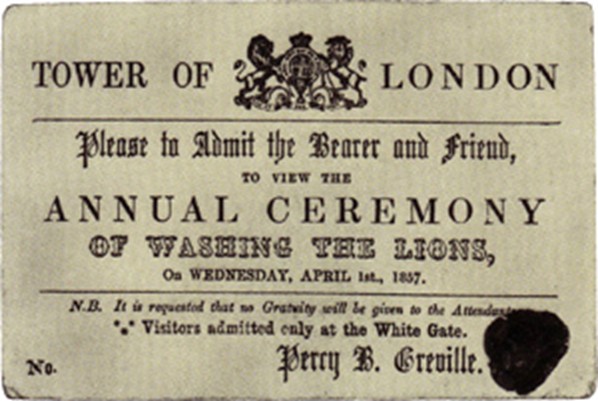
When I was growing up my dad had a running joke that occurred every April 1st.  As the boys would come sleepily downstairs and sit around the breakfast table, dad would rush in and exclaim, “There is a big brown dog outside!”  This would cause the three of us to jump up and run to the window hoping to get a glimpse of this large dog.  Later, dad was forced to change the joke as we owned a large brown boxer dog (Canis lupus familiaris) named Lucky.  Instead, dad would exclaim there was a large black dog outside.  The joke still worked and went on for years.  After we had looked expectantly out of the window for several seconds the punch line was delivered.  April Fools!  

When I looked online, I found April Fools’ Day, or April Fool’s Day, is an annual custom on April 1st consisting of practical jokes and hoaxes.  Participants often complete their prank by shouting “April Fools!” at the recipient.  Mass media can be involved with these pranks, which are often revealed the following day.  The custom of setting aside a day for playing harmless pranks on one’s neighbor has been relatively common historically throughout the world.  While many theories have been proposed for the origin of April Fools’ Day, it is not exactly known.  A disputed association between April 1st and foolishness is found in Geoffrey Chaucer’s The Canterbury Tales (1392) when in the “Nun’s Priest’s Tale”, a vain cock (Chauntecleer) is tricked by a fox on the first of April.  In 1508, French poet Eloy d’Amerval referred to a poisson d’avril (April fool, literally “April’s fish”), possibly the first reference to the celebration in France.  Some historians suggest April Fools originated because during the Middle Ages New Year’s Day was celebrated on March 25th in most European towns, and the festivities continued until April 1st.  Those who celebrated New Year’s Day on January 1st made fun of those who celebrated on other dates by the invention of April Fools’ Day.  The first British reference came from John Aubrey in 1686 who referred to the celebration as “Fooles holy day”.  

My best April Fool’s joke happened when I was working for the Division of State History in Utah.  I was monitoring a particular thorny case where a pipeline installation was running roughshod over the archeological resources that stood in the way.  I sent a scathing memo to my boss on April 1st that detailed a new set of offenses and demanding he do something about this clear breach of contract.  When he received the memo, he immediately took it to his boss and demanded something be done.  His boss calmly read the memo and began to laugh.  My boss had failed to read the complete memo, as the last line said, April Fool’s!”  Both his boss and I thought the joke was extremely funny.  My boss did not think it was funny.

THOUGHTS: Most can attest to the fact that if you are around someone long enough, they will repeat the same joke time and again.  My dad’s April Fool’s joke was done purposefully (and as it always worked).  Dad also had the reputation for telling a joke and either forgetting or screwing up the punchline.  The black dog did not have that issue.  Repetitive storytelling is such a widespread phenomenon across age groups that a group of researchers at the University of Waterloo in Ontario studied both short-term and long-term memory and discovered there is a particular kind of memory (destination memory) where humans do not excel.  Destination memory is the inability to remember to whom we have told our stories.  Another reason for repetition is when you hear (or live) a good story you want to share it with others, even if it is again and again.  Laughter is used to ease tension, to amuse, or to introduce yourself.  Knowing what another finds funny can tell a lot about their thoughts and values, but only if you listen.  Act for all.  Change is coming and it starts with you.
Seadevil

February 19, 2025

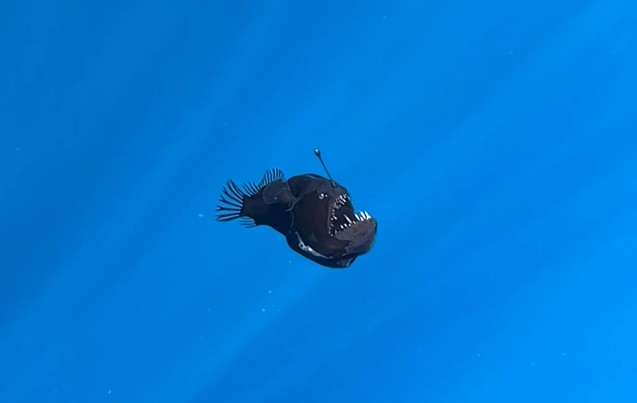
My NY Times feed carried a story about an eerie looking creature from the ocean’s depths that has become an inspiration for intense emotions on social media.  It is easy to believe a fish with a gaping mouth of razor-sharp teeth, a bioluminescent rod sticking out of its head, and lidless eyes to scan the darkest depths of the ocean, might elicit fear.  The freakish looking creature is also moving people to tears of emotion.  Social media has turned the fish into a folk hero after it swam great lengths from its usual home 650 to 6,500 feet (200 to 2,000 m) deep in the ocean to the surface.  Fans of the fish have turned this odyssey (which ended in death) into a version of the hero’s journey, a quest to reach the light.  Hannah Backman, of Minneapolis, who posted about the fish on TikTok, said she succumbed to the poetry of a lone fish approaching the light, “spending her literal last seconds trying to do something beautiful.”  The fish made headlines in late January when it was spotted by a group of researchers off the coast of Tenerife in the Spanish Canary Islands.  The team observed the fish, which was already injured, for several hours and it ultimately died.  Fans of the Black seadevil anglerfish have posted tributes set to ballads, written poems, created fan art, and even gotten tattoos.

When I looked online, I found a Black seadevil (Melanocetus johnsonii) is small, deep-sea fish of the order lophiiform and family Melanocetidae.  There are five known species (only two are given common names) within the genus Melanocetus.  They are found in tropical to temperate waters of the Atlantic, Indian, and Pacific Oceans, with one species known only from the Ross Sea.  The Black seadevils are named for their intimidating appearance and typically pitch-black skin and are characterized by a gelatinous, mostly scaleless, globose body, a large head, and their large, sharp, glassy, fang-like teeth lining the jaws of a cavernous mouth.  These teeth are depressible and present only in females.  Like other anglerfishes, the black seadevil possess a modified dorsal spine “fishing rod” (illicium) and a bulbous, bioluminescent “fishing lure” (esca).  The bioluminescence is produced by symbiotic bacteria thought to enter the esca via an external duct suggesting they originate from the surrounding seawater.  The bacteria are apparently different in each anglerfish species.  There is a strong sexual dimorphism, with females reaching a length of 7 inches (18 cm) or more, and males under 1 inch (3 cm).  Males also lack lures.

It is unclear why the seadevil came to the surface, although scientists speculate it might have been from an illness or an unusual current.  The fans on TikTok have woven a beautiful, albeit fanciful, narrative for the fish.  This is a story of a creature in its final days, desperate to experience a source of light not generated by its own body.  Madison Sharp, a behavioral therapist in Dallas, noticed an outpouring of emotion for the fish in her social media feeds.  “Instead of just seeing a fish reach the surface, they see hope, and meaning, and symbolism,” she said.  She was inspired to draw a picture of the seadevil approaching the surface, adding tears to its eyes, and the word “finally” floating above the waterline.  “I think the most important part was the expression of the fish,” she said. “I added the little eyebrow on top to show the longing of it.”  Well, there you go.

THOUGHTS: Humans often turn charismatic animals into anthropomorphized heroes.  Consider Flaco, the Eurasian eagle-owl that escaped from the Central Park Zoo.  Sadly, neither Flaco nor the seadevil survived.  It seems their death is taken as indicative about our own struggle with life.    Or as sci-fi writer David Gerrold is quoted, “Life is hard.  Then you die.  Then they throw dirt in your face.  Then the worms eat you.  Be grateful it happens in that order.”  Being anthropomorphic about a seadevil does not seems so bad after all.  Act for all.  Change is coming and it starts with you.

Flat Stanley

October 31, 2024

Last week we received a text from my son saying we would receive a package from our grandson.  His second grade teacher in Washington state started a project for the students to connect with their relatives living in different parts of the country.  The idea was to get responses over the next month and a half by sending a journal to track the progress of his avatar, a two dimensional representation of himself.  When the package arrived, I took pictures of the avatar participating in activities around our house.  He joined the fall pumpkin display, hung out with the succulents on the porch, and spent time in the garden among the tomatoes.  I e-mailed these back to his teacher to share and sent a letter to describe the fun he was having in Arkansas.  As requested, I sent the package along to my sister in Maine for her to do the same.  The project was based on the children’s book character, Flat Stanley.         

When I looked online, I found Flat Stanley is an American children’s book series written by author Jeff Brown.  The idea began as a bedtime story for Brown’s sons, which Brown turned into the first Flat Stanley book published in 1964 featuring illustrations by Tomi Ungerer.  Brown did not continue the series until two decades later, when he published five more books: Stanley and the Magic Lamp, Stanley in Space, Stanley’s Christmas Adventure, Invisible Stanley, and Stanley, Flat Again!  By 2003, the Flat Stanley series had sold almost one million copies in the US and had been translated into French, German, Spanish, Italian, Japanese, and Hebrew.  Brown died in December 2003, but other children’s book authors have continued the series under a new name, Flat Stanley’s Worldwide Adventures.  The Flat Stanley Project began in 1995 under the direction of Dale Hubert, a third grade teacher in London, Ontario, Canada.  The project is meant to facilitate letter-writing between schoolchildren as they document Flat Stanley accompanying them around the world.  The goal of the project is to increase reading and writing skills, as well as teaching children about people and cultures from different places.  In 2008, more than 6,000 classes from 47 countries took part in the Flat Stanley Project.

My grandson’s teacher gave the Flat Stanley project a different twist.  Rather than having Stanley travel around the states, it was a (flat) picture of himself who was to participate in the adventures.  The students begin by reading the book to become familiar with Flat Stanley’s story.  Stanley is flat because a bulletin board had fallen on him, but he was able to overcome this drawback to excel and travel.  The journal will document the places and activities along the avatars’ journeys.  Each student’s journal is to be mailed back to the school with entries from family and friends.  Postcards or letters returned to the class during the project help track the various places their avatars travel.  The project is similar to the traveling gnome prank, except that the Flat Stanley Project has a focus on childhood literacy.  While the project is focused on writing letters, my grandson’s teacher also suggested using email (as well) to assist with quicker travel time.  I wrote in the journal, sent three pictures via email, and wrote a “flat” letter to the class about the wonders of Arkansas. 

THOUGHTS: When I asked my sister if she would participate, she mentioned she had met the Flat Stanley author.  She was with her daughter and entered a café in Maine that had cutouts of Stanley on the tables.  They had read the book, recognized the character, and exclaimed, “Flat Stanley!”  A man behind them answered “Yes?” and identified himself as the author.  Education can be innovative and fun when teachers take time to present learning as more than “just the 3 R’s”.  More critical is for the parents and larger family to participate.  It is one thing to force a child to do math at the kitchen table, it is quite another way to sit with them as they read or do their math tables.  It may not always take a village, but village support certainly helps.  Act for all.  Change is coming and it starts with you.