
May 12, 2026
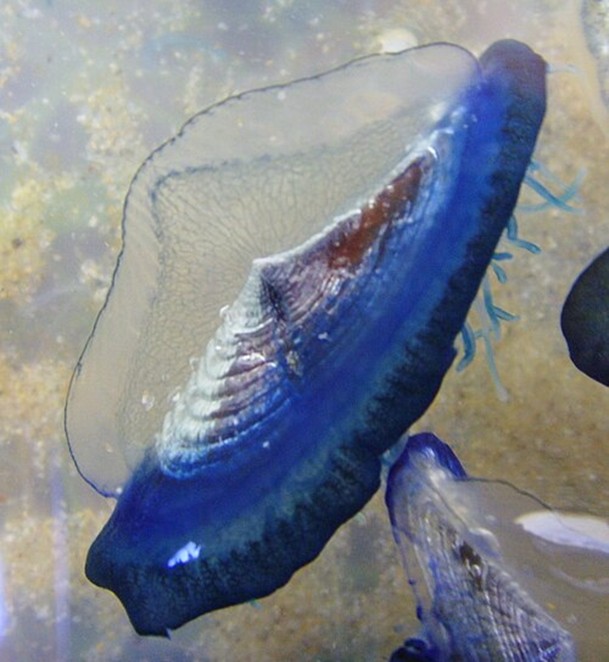
Monday’s local newspaper carried a USA Today article on hundreds of thousands of small sea creatures were washing up along the Pacific coast in the US. These jelly-like creatures can be found around the globe but are most often in large accumulations off the US Pacific coast and in the Mediterranean. According to Steven Haddock, a senior scientist at the Monterey Bay Aquarium Research Institute, while several miles-long stretches may float in the open ocean, it is when the winds pile them up along the shore that people really notice. Rebecca Helm, Georgetown University Earth Commons Institute has been studying the creatures and says that although velella have been documented for decades, scientists do not yet fully understand them.
When I went online, I found Velella velella is the only known species in the genus of hydrozoa in the family Porpitidae. Other common names are sea raft, by-the-wind sailors, purple sail, little sail, or simply Velella. By-the-wind sailors are a widely distributed free-floating colonial animal that lives on the surface of the open ocean in a specialized ocean surface community collectively called Cnidarians. Specialized predatory mollusks such as sea slugs (nudibranchs) in the genus Glaucus and purple snails (genus Janthina) prey on these cnidarians. Each apparent individual is a hydroid colony, and most are less than about 2.8 inches (7 cm) long. Like other cnidarians, velella are carnivorous and catch their prey (mostly plankton) by tentacles that hang down in the water and bear stinging nematocysts (or cnidocysts). The toxins in their nematocysts are effective against their prey but are relatively benign to humans, although irritation may occur to skin. Some scientists describe velella as floating colonies, but Haddock said it is easier to understand each raft as a single individual with a central mouth that looks like a volcano surrounded by a field of 100’s of squirming noodles, which are also a mouth. Each velella can produce 1000’s of free-swimming, sesame-seed sized offspring that drop off and sink to the seafloor where they produce another single cell that eventually returns to the surface as a new floating colony. They are usually indigo blue in color and have a small stiff sail that catches the wind and propels them over the surface of the sea.
Helm has been looking at how the velella survive in the wind and waves without getting turned around as they pop up right every time as well as their adaptation to use the wind for propulsion. Scientists would also like to be able to predict when the velella armadas are going to appear. One study suggests large concentrations may be found after particularly warm winters, but more research is needed. The winter of 2025-2026 was a record breaker in California with intense marine heat waves observed in the ocean. Scientists are encouraging people to report velella sightings and to take photos with GPS activated readings so they can track their exact locations. Sightings can be reported through the iNaturalist app.
THOUGHTS: Like many unique creatures, the velella are being examined for military reasons. A group of scientists in China have studied mimicking the velella as a prototype for unmanned surface vehicles, while a group at John Hopkins are working with the military on modeling them to create low-cost ocean sensors. Heaven forbid, we take the time to study the uniqueness of nature without trying to adapt it for a military advantage. Act for all. Change is coming and it starts with you.

