
March 17, 2025
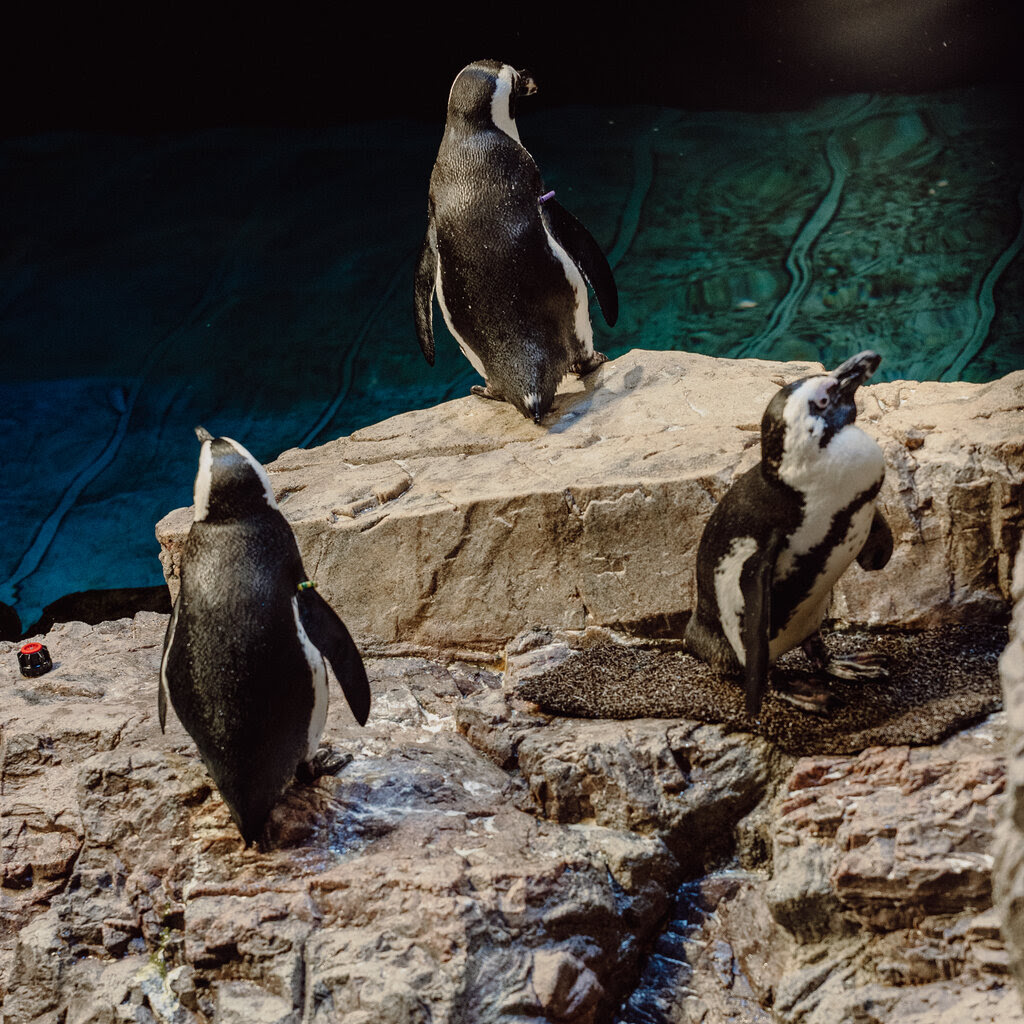
Photograph by Cody O’Loughlin
This morning’s NY Times Morning feed carried an article about a group of penguins who are receiving special treatment at the New England Aquarium in Boston. Six seabirds were moved to the island for “retired” penguins that opened in February. The birds were relocated to address the large number of penguins at the aquarium who are living well beyond the age they would be expected to reach in the wild. The residents of this “country club for older animals” are sectioned off from three other islands inhabited by penguins via a mesh gate in the water. “They all get a good opportunity to eat and take their time and not feel rushed, not get pushed off the island by another animal that’s anxious to eat,” said Kristen McMahon, the aquarium’s curator of pinnipeds and penguins. About half of the aquarium’s 40 African penguins are older than the bird’s life expectancy of 10 to 15 years, and some have doubled it.
When I looked online, I found the African penguin (Spheniscus demersus), also known as the Cape penguin or South African penguin, is a species of penguin confined to southern African waters and is the only penguin found in the Old World. All penguins are flightless and have a streamlined body and wings stiffened and flattened into flippers for a marine habitat. Adults weigh an average of 4.9 to 7.7 pounds (2.2 to 3.5 kg) and are 24 to 28 inches (60 to 70 cm) tall. The upper parts of the body are black and are sharply delineated from the white underparts (counter shading), which are spotted and marked with a black band. The African has distinctive pink patches of skin above the eyes and a black facial mask. The birds are pursuit divers that feed primarily on fish and squid. Wild penguins are found in the coastal waters of South Africa and Namibia, where they face threats that include the depletion of food from overfishing, climate change, and pollution. Once extremely numerous, they are now the rarest species of penguin.
The geriatric penguins at the aquarium are mostly in their 30’s and receive close monitoring for ailments like cataracts and arthritis. They are fed fish injected with extra water to promote kidney health, and they get treatments such as eye drops and physical therapy. Some even get acupuncture. McMahan said, “We wanted a space that was a little bit lower paced and more easily observed by the veterinarian team and our training team on a daily basis.” The life expectancy for a wild African penguin likely does not reflect the reality for the species today, said Christina Hagen, the Pamela Isdell Fellow of Penguin Conservation at the organization BirdLife South Africa, a group who are attempting to establish an African penguin colony in the wild. The aquarium’s penguins can live longer because they do not face the same threats as wild birds and receive specialized care. The African penguin is classified as a critically endangered species, and conservationists say that they could become extinct in the wild by 2035.
THOUGHTS: The aquarium’s oldest African penguin, Good Hope (35), and his mate St. Croix (23), are set to move to the retirement island soon. McMahan said the aquarium does not have plans to move in other birds and will instead let this group “live in harmony”. Human retirement homes in the US range from independent living to assisted living to skilled nursing care, and the costs vary greatly depending on location and level of care needed. While independent living costs vary widely based on location and specific community, the national median monthly cost for assisted living is around $5,676, a semi-private room in a skilled nursing facility is around $8,669, and a private room is $9,733. As of Mar 7, 2025, the average annual pay for a Retirement Community in the United States is $62,680 a year. Being able to live in harmony is not cheap. As our population ages new innovations are needed to provide housing. Act for all. Change is coming and it starts with you.
 A travelers odyssey