
October 22, 2025
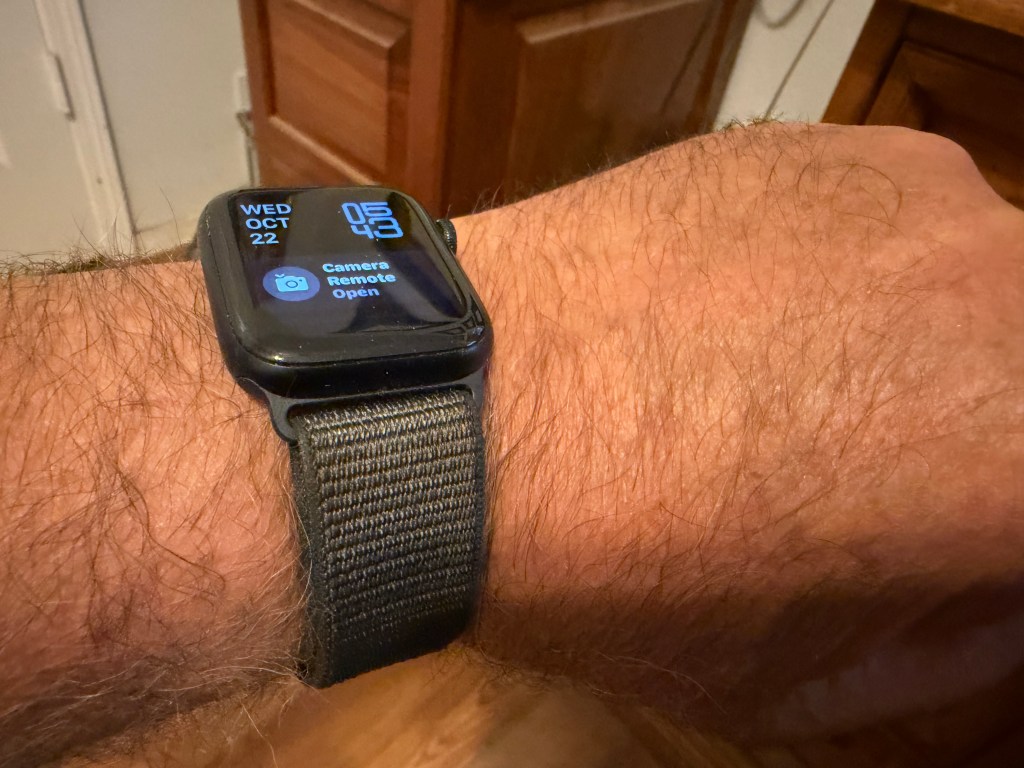
Earlier this week I saw the dogs both laying on their beds asleep and I decided it was time to create some mischief by getting down on their beds between them. While I do rough house with them, it is generally while I am sitting on the edge of my chair. Zena plays by turning back and forth while pressing her side against my legs. She will also use the “power paw” (if you have a dog, you know what this whack is) to get my attention. Loki’s go-to is to turn his back to me and slam his rear into my legs. At times he does this so hard it can begin to hurt. This time I got on the floor and started to roughly play with the two of them. They got all worked up and began to bark and prance around, Zena pushing in with her side and Loki slamming me with his rear. That is when I decided to use his tactics against him. I lowered my head and started head butting him like he did me. I had been doing this for less than a minute when the AI fall alert went off on my watch.
When I went online, I found AI fall alert systems use technologies like radar, cameras, and sensors to detect falls in real-time and can also predict a person’s fall risk. Implementation in the US was envisioned in 1973 by Andrew Dibner, a psychologist on leave from Boston University studying personality in advanced age. Also, in the early 1970’s in Germany, Wilhelm Hormann thought about developing a comprehensive structure for ambulatory and non-ambulatory care for the sick, the elderly, those who live alone, and people with disabilities. These systems are designed to send immediate alerts to caregivers, family, or emergency services. Some can even analyze movement patterns to help prevent future falls. Privacy is often maintained using non-wearable sensors that convert human figures into abstract data. Vision-based alert systems examine real-time video feeds to recognize fall events. Radar and sensor-based systems (like my watch) track changes in height and sudden movement (like when a person falls out of bed or to the floor). When a fall is detected a notice can be sent to the person to confirm or send alerts to pre-determined contacts. The alerts can be sent via text, email, or to a dedicated app. In high-risk environments, the system can immediately contact first responders.
Medical fall alert devices can be a pendant around the neck, a wristband, or a smart watch. Monitors, motion detectors, or radar-based detectors can also be placed in the home. Active systems require the user to take some action to trigger an alarm condition, while passive systems monitor the user and raise an alarm based on an algorithm (a fall or lack of activity). Alert systems can analyze patterns in movement, gait, and activity to identify individuals at higher risk of falling before an incident occurs, allowing for more proactive intervention and personalized prevention plans. A weakness of active devices is that the user must be conscious to trigger the alarm. Both passive and active devices require that the user wear the device. Installed systems can be expensive and difficult to deploy. My watch alert system detected that I had dropped to the floor (loss in height) and then forcibly hit another object (Loki).
THOUGHTS: My watch fall alert was an alarm and (thankfully) asked if I had fallen and needed assistance. This reminded me of the 1989 catchphrase of LifeCall Medical Alert System’s television commercial, “I’ve fallen and I can’t get up!” The unintentional humor in the commercial made it a frequent punchline. My watch had the option of having an SOS sent to EMT services or to decline assistance. This was a timed alert and if I did not respond it would act automatically. The alert surprised me but seemed like a good idea if it was required. I never thought I would be the one who had fallen and could not get up. Human and AI monitoring should be interchangeable to protect those with a possibility of a fall. Act for all. Change is coming and it starts with you.
 A travelers odyssey