
November 24, 2025
Melissa and I both finally got to sleep last night and woke ready to see some sights of Budapest. We checked with the concierge at the front desk about what to see and were given a map which he marked with possible locations. The first thing I wanted to do was check the location of our tour line’s port. We have heard at times there may be more than one point of embarkation. We set out using my phone map app knowing it was only 650 feet (198 m) to our location. We got closer and then the distance began to increase as I had made a wrong turn. It turned out it will be an easy trip tomorrow, but I am glad I checked before dragging our luggage around Budapest. I made several purchases last night using Euros and received sighs, and calculators, so I decided I should convert some of my US$ to Forint, the official currency of Hungry.
When I went online, I found the forint’s name comes from the city of Florence, where gold coins called fiorino d’oro were minted from 1252. In Hungary, the florentinus (later Forint), also a gold-based currency, was used from 1325 under Charles Robert, with several other countries following Hungary’s example. Between 1868 and 1892, the Forint was the name used in Hungarian for the currency of the Austro-Hungarian Empire, known in German as the Gulden. It was subdivided into 100 krajczár. The introduction of the forint on 1 August 1946 was a crucial step in the post-World War II stabilization of the Hungarian economy and remained relatively stable until the 1980’s. Transition to a market economy in the early 1990’s resulted in inflation, which peaked at 35% in 1991. Between 2001 and 2022, inflation was in single digits, and the Forint has been declared fully convertible. In May 2022, inflation reached 10.7% amid the Russian invasion of Ukraine and economic uncertainty. As a member of the European Union, the long-term aim of the Hungarian government may be to replace the forint with the euro, although under the current government there is no target date for adopting the euro. Currently 1 Euro equals 382.45 Hungarian Forint.
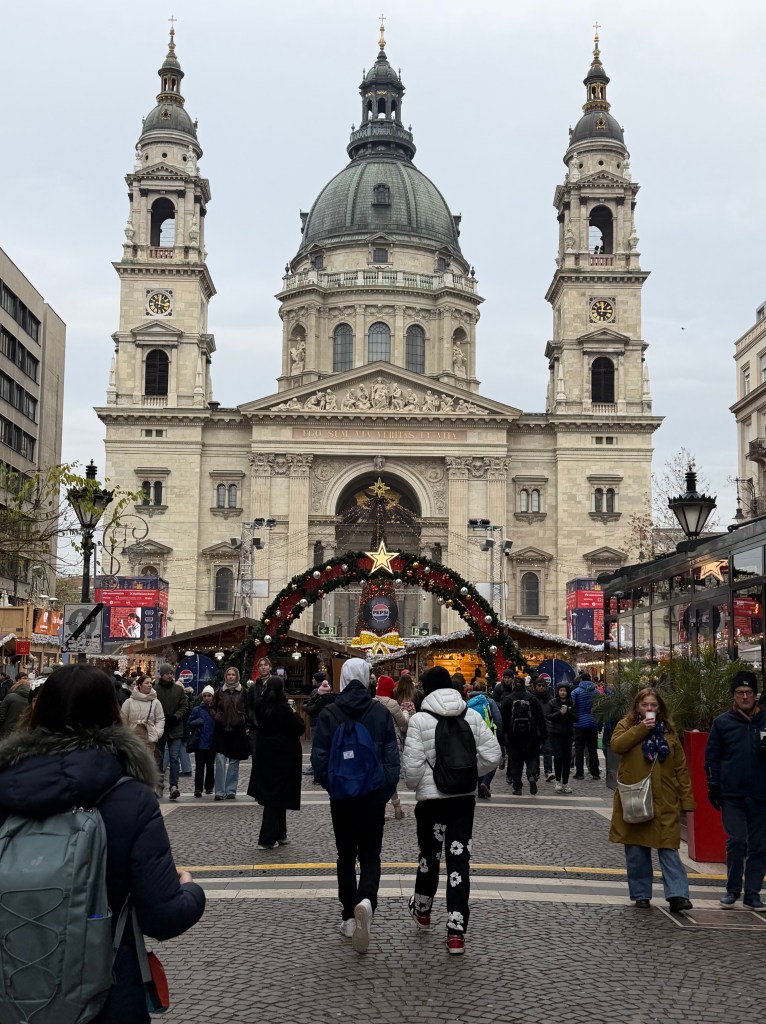
When I checked with the concierge desk I was told to go to a bank or exchange station to convert my currency to forint. We had decided to go to St. Stephen’s Basilica which was only a few blocks farther and (sort of) in the direction of the cruise dock. As we approached, we saw a Christmas market in full swing on the streets surrounding the church. We knew there would be shops, and after last night’s experience I wanted at least some forint for a purchase. We found an exchange shop not far from the market. It turned out they did not know how to convert US$ into Forint (?) but it was easy to convert with Euros. We had prepared our credit card with our trip as they accepted foreign exchanges (no fee). Armed with nearly 17,000 Forint (50 Euro) we were ready to face the markets. We browsed the shop and food venders on our way to the basilica, deciding what to eat on our return. When we arrived at St. Stephens, we were both cold and decided to see the exterior rather than the tour. We then stopped for a large Hungarian sausage, potato cake, and stuffed cabbage. None of the shops took cash, so we used our credit card. Now what to do with 17,000 Forint.
THOUGHTS: After we got back to the hotel with my Forint in hand (and tons of food) we laid down for a rest before taking off again. This time it was my foot that woke me up in pain. I decided to go back to the shop I visited last night and buy some Gatorade (or facsimile) with my forint. I bought 3 Gatorades, orange juice, and a bag of chips for 4500 Forint. When we went to Greece we came home with 450 Euros. We did not mind as we knew the Danube trip ended in Germany so it would be spent. We still have another day and a half to spend our Hungarian forint. Many charities, airports, and airlines collect leftover currency for donations. I saw a donation bin in Munich but did not understand what it was for, until now. Act for all. Change is coming and it starts with you.
 A travelers odyssey