Limits

September 15, 2020

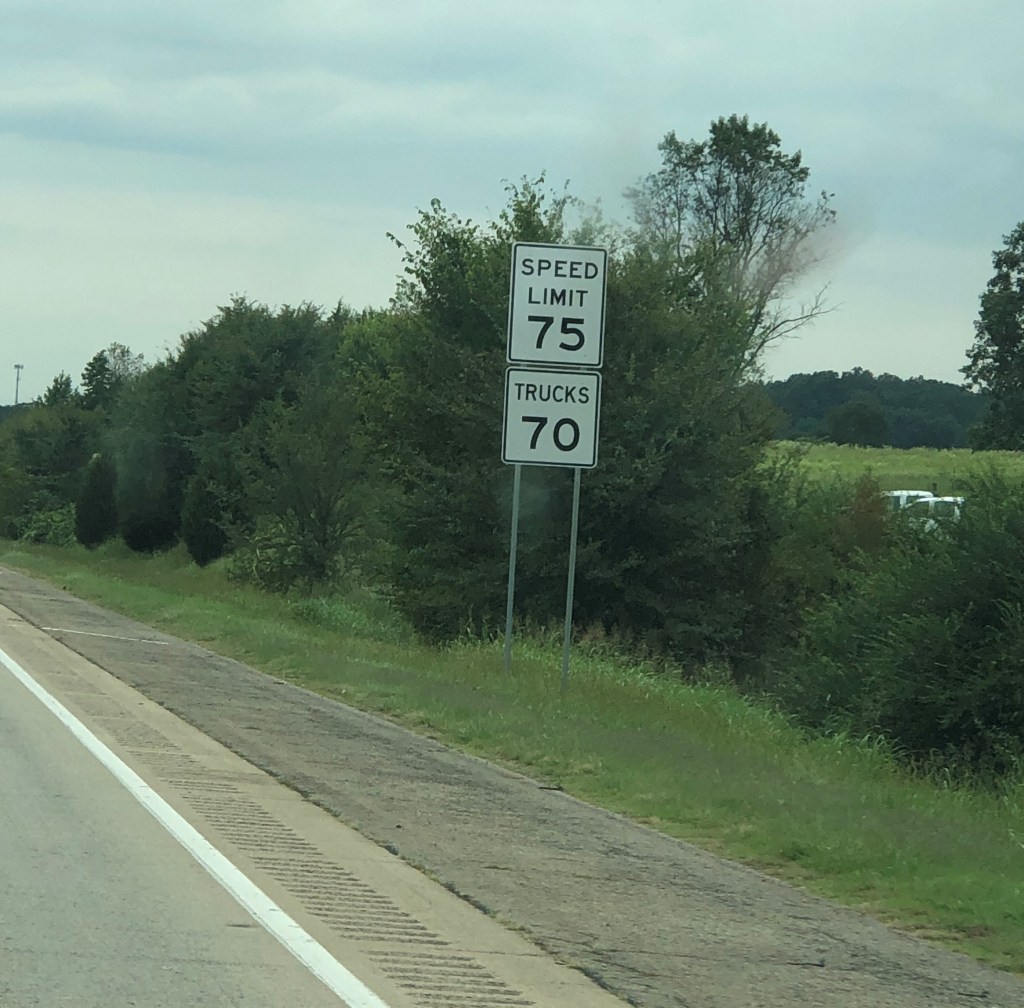
In June, the Arkansas State Highway Commission approved increasing the speed limit from 70 to 75 mph on rural interstates and from 60 to 65 mph on urban interstates.  Although the commission authorized the change in 2017, this did not go into effect until the signs were changed.  That finally happened last week on the stretch going north on I-49.  A spokesperson said, “From an engineering standpoint the highways can handle it, but from a human behavior standpoint, we can’t legislate that, so we’re going to watch this very carefully. If we do see a spike in serious crashes, serious injury crashes, or fatalities we have the authority to go back in and do a study and lower those speed limits again.”  The change of speed limit signs and implementing the project will cost about $350,000.

This reminds me of the 80 mph speed limits Kansas used to have on I-70 during the late 1960’s.  This is the stretch of highway that runs from Kansas City (Missouri boarder) to Denver (Colorado boarder).  This was lowered to 75 mph in 1970.  While the stated reason was to save lives, the rumor was the higher speed enabled drivers to wake up in Missouri and easily drive to Denver, missing a stay in Kansas entirely.  The oil crisis of 1973 prompted the National Maximum Speed Law across the nation.  This set the maximum speed at 55 mph, where it remained until 1995.  Speed limits are now again under the authority of the individual states.

After the National Maximum Speed Limit was repealed, Kansas raised its general interstate speed limit to 70 mph.  A study found “no statistically significant increases in crash, fatal crash and fatality rates were noted during the after period on either rural or urban interstate highway networks. On the other hand, statistically significant increases in crash, fatal crash and fatality rates were observed on the 2-lane rural highway network.”.  Arkansas did not complete a study prior to raising the speed limits but would require a study to be able to lower the rates.  I now happily obey the higher speeds.

THOUGHTS:  I find Arkansas’ traffic study requirements revealing.  It is not needed unless you take away my right to speed.  The roads open to the higher speeds are some of the most beautiful in the state.  This is the southern tip of the Ozark Mountains and the deciduous trees have gorgeous displays of color every fall.  These are also the three population centers of the state, Little Rock, Fort Smith, and the corridor of cities in Northwest Arkansas.  Kansas tried to slow drivers down to force a meal or stay in one of the larger towns along the Interstate.  Arkansas instead is speeding drivers up to get to those same destinations.  In both respects, the underserved communities and small merchants that used to supply the lifeblood for America are being excluded.  Limited TV and cell service, closed groceries and gas stations, and an absence of medical care cause a growing rural abandonment.  Is it any wonder there is a belief no one cares?  Change is coming and it starts with you.
Locusts

September 14, 2020

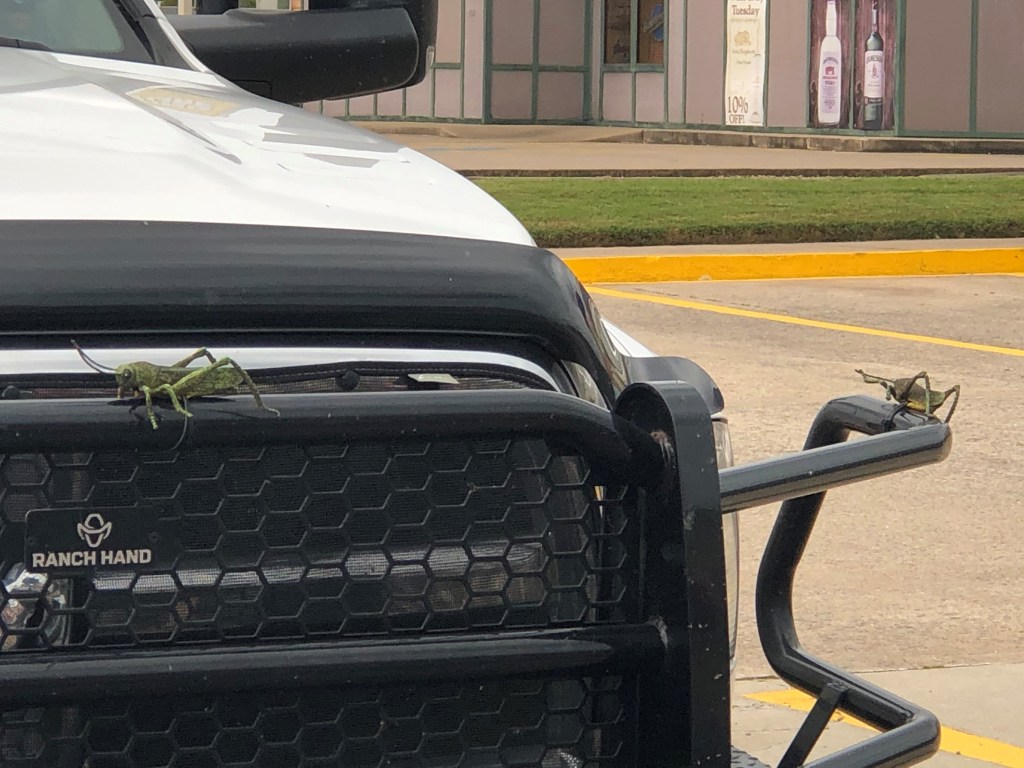
We stopped at one of Melissa’s favorite fast food places on our way home yesterday for lunch.  I do not like cold fries, and we were still 20 minutes from home, so we decided to eat inside.  As we were leaving, I noticed a huge locust sitting on the grille guards of a pickup truck parked in the next lot.  It was about four inches long and about two inches in diameter.  I was amazed at how large it was.  As I looked closer, I noticed there was not one, but three, and all were equally spaced on separate parts of the guard (social distanced?).  That was when I realized they were plastic.

I recall hearing about the billions of locusts which had swarmed during May of this year in Africa.  Locusts and grasshoppers are the same in appearance, but locusts can exist in two different behavioral states (solitary and gregarious), whereas most grasshoppers do not. When the population density is low, locusts behave as individuals, much like grasshoppers. However, when locust population density is high, individuals undergo physiological and behavioral changes, known as phase polytheism, and they form gregariously behaving bands of nymphs or swarms of adults.  The distinction between locusts and grasshoppers is often not clear-cut, and some species that are called grasshoppers, such as Austroicetes cruciata, Oedaleus australis and Peakesia spp. can form loose swarms at high densities, but do not generally migrate the long distances as locusts do.

Despite the size, it was the color of the locust that threw me off.  I have seen three to four-inch locust in the Utah desert, but this one was a pale green, more like a grasshopper.  Like their African cousins, the Utah locusts also swarm.  This happened in 1848 when the early pioneers were preparing to bring in their first crop in the Salt Lake Valley.  Just when all seemed to be lost a flock of sea gulls swooped in and began to gorge themselves on the insects and the crop was saved.  This miraculous occurrence is why the sea gull is Utah’s state bird.

THOUGHTS:  While the pioneers saw the locust as a plague, the indigenous populations believed them to be a boom.  The locust fell into the Salt Lake, drowned and were salted, then dried along the shore, and were eaten as a welcomed snack.  A friend of mine is an ethnoarchaeologist and studied the kilo-calorie return on locust. What he found was to get a similar return from a buffalo it would need to fall from the sky, land on a spit and be roasted over the fire without any energy expended by the person.  The locust still offered more energy.  It seems one person’s boon is another’s boom.  It all comes down to your attitude.  Change is coming and it starts with you.
Flotsam

September 12, 2020

I have been looking for a way to get my sow bugs in the water for the last week.  I have gone out several times, but the locations have been adverse for fly fishing.  This time I decide to try the Arkansas River near me.  The river is high, but not nearly the record flood stage of last year.  The Kansas and Tulsa rains that filled the reservoirs upstream have not been as dramatic and the Corps has been able to lessen the flow that brought our damage.  We have received quite a bit of rain this year, but that only causes short-lived flash flooding and problems for downstream and not us (lucky downstream, right?).  I drove into a park that had been under water much of last summer and found what looked like the perfect spot.  The minnows were schooling on the surface and the shad were rising.  I fished for an hour and got no bites.  I did not bother to try my sow bug.

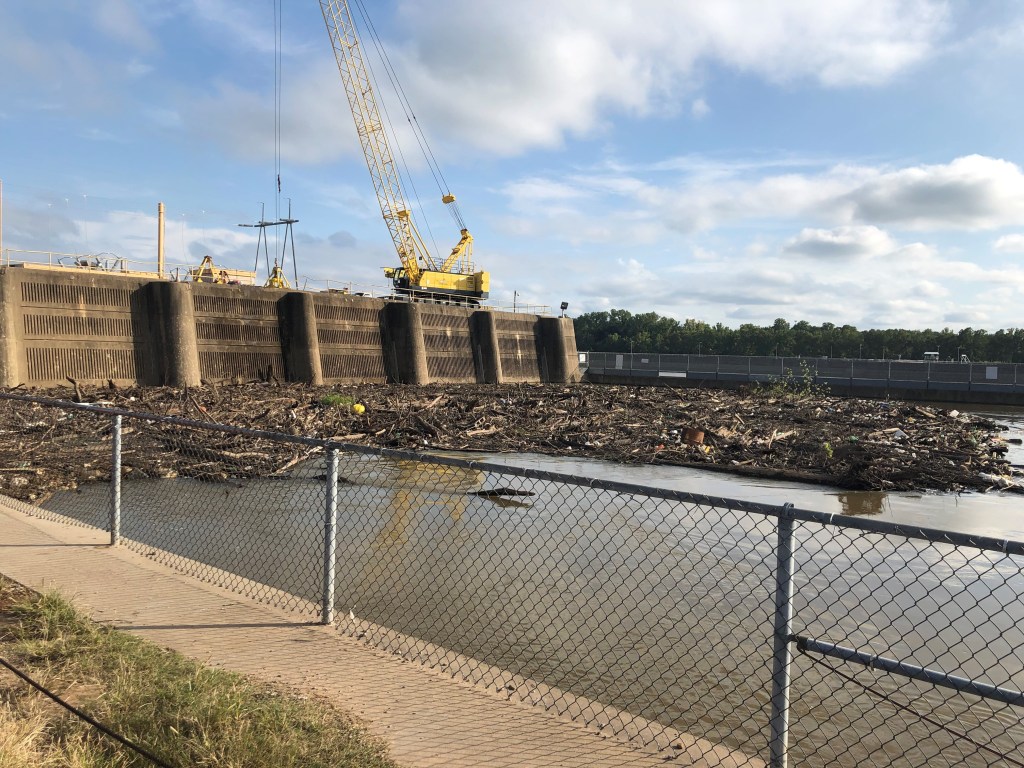
I had read an article in the newspaper about the log jam that had formed at the hydroelectric plant across from the park.  One of the secondary effects from last year’s floods was it killed a lot of trees.  When the waters rose again this year it washed the dead trees into the river.  Just like the barges that broke away from their moorings last year, the trees flowed downstream until something stopped them.  In this case, it was the hydroelectric dam.  The article mentioned they were using a giant crane to scoop the logs out of the water, they hauled them a short distance, and burned them beside the river.   They had been working on this project for a week and estimated it would take at least two more weeks to clear the debris.  I stopped to watch.  This truly was an impressive operation.

As I was leaving the park, I noticed a small pond I had not noticed before.  This was not the impressive Arkansas, and it did not even look that deep, but I figured what did I have to lose?  I put out my cat pole and my bobber, intending to set up my fly rod while I waited.  I never got the chance.  I got a bite and quickly had six bluegills.  While not huge, they were a nice size.  This was my chance to try my new flies.  I brought in my bobber (it was taking all my time) and replaced it with the flies.  The bluegill loved the worms, the sow bugs, not so much.  Still I had caught fish.

THOUGHTS:  Throughout history life along the river has always been tenuous.  This began with the first cities built along the Tigris and Euphrates in Iran 5000 years ago.  When it floods, it can wash crops, and you, away.  If it does not flood, the silt that nourished the fields is not deposited.  Flooding picks up anything unlucky enough to be in its path.  This resulting flotsam is carried along creating further hazards.  Flotsam it a good way to consider much of what flows through the river of our life.  It may have been good at one time but can pile up when we try to stop life from going forward.  We cannot wish our troubles away or hope for them to disappear.  Like the crane operator we need to take as long as it needs to do the work to remove the hindrance.  Follow the science.  Do the work.  Change is coming and it starts with you.

Virtual

September 11, 2020

My niece has taught at one of the local learning centers for the last several years.  She graduated with a degree in Chemistry, so fits well with the STEM (science, technology, engineering, mathematics) emphasis of these centers.  Another emphasis is coding, or what old timers like me refer to as programing language.  She told me she was fascinated by the new virtual learning process incorporated by our area schools.  I had substitute taught last year, and my role was to watch students interact with online lessons and try to keep them on track.  I assumed virtual school would provide something similar, but that is not the case.

Our district uses two different tracks for students who have opted to learn virtually.  The district website says K-9 students use PEAK.  This is a full-time virtual experience for students through the Peak Innovation Center. A virtual student takes all classes through Peak online and at home and only comes to campus for approved activities. Virtual students are supervised by a Peak coordinator.  The K-6 learners are virtual online only but may access home campus for some services.  The 7-9 learners can participate in AAA activities but require enrollment and on-campus attendance for that class.  All students are provided a Chromebook and need to have efficient home internet.  The district is working with families who choose a virtual option, so students are not excluded solely on access to technology.

The two High Schools have taken another approach, offering either virtual or a blended approach using the Schoology format.  A virtual student takes all classes online and at home and only comes to campus for approved activities. These students are supervised by the district’s schoolteachers.  The virtual learners can participate in AAA activities which require enrollment and attendance for the activity on-campus.   Students who are not in 100% online classes can participate in blended learning. These students have access to the coursework for their classes in a traditional on-site classroom, or through lessons uploaded by their instructors in Schoology.  Assessments, such as end-of-unit exams, are taken in class and are supervised by the district teacher.  All students are again issued a Chromebook and need adequate technology.

THOUGHTS:  The online option for school has been around for almost 30 years.  The daughter of a friend finished High School in the Bay Area virtually in the mid-1990’s.  One part of what I did during the late 1990’s was to set up virtual classrooms at my graduate school and I taught a virtual class.  Technology has come a long way since those early attempts.  Faster speeds and more efficient search engines can create a virtual experience that rivals an on-site experience.  Zoom and similar formats provide a group experience and not just one-on-one.  Now we need to make reliable, fast internet available for all.  Without this, the underserved will continue to be left behind.  Technology does not work if you have no access.  Follow the science.  Do the work.  Change is coming and it starts with you.
Etiquette

September 10, 2020

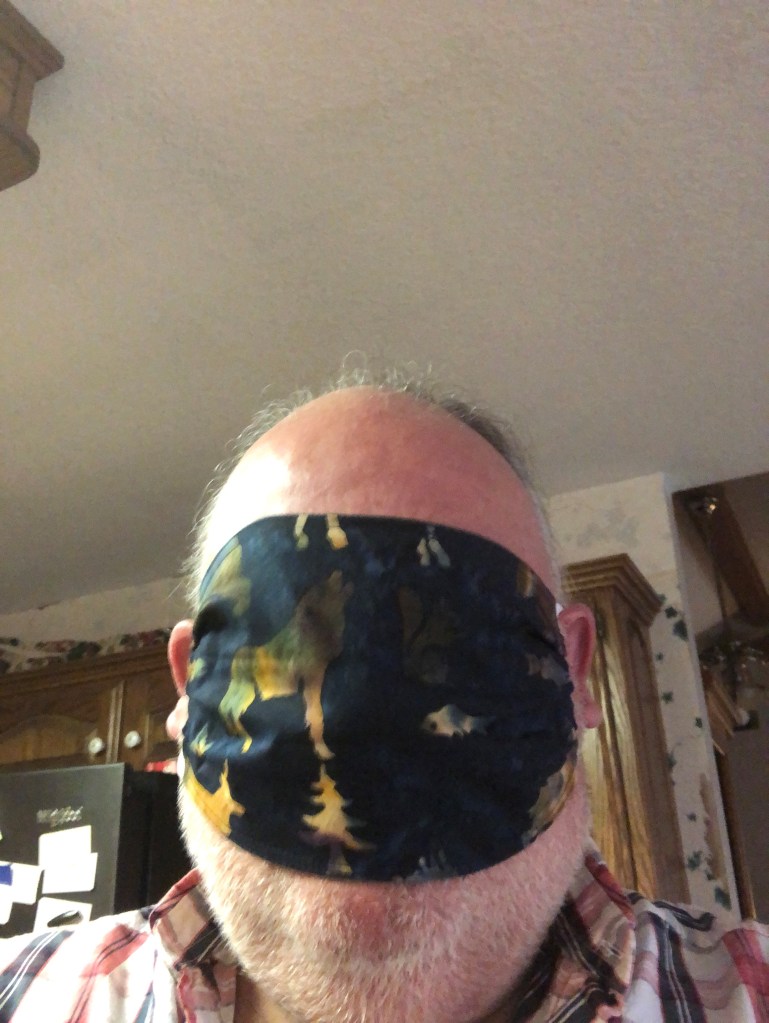
It amazes me that with all the directions posted at stores on how to properly wear a mask there are still some that just do not get it.  I have mentioned that my sister has been making masks for all her friends and friends of friends.  When she sent our first set, she also sent a video of herself showing the proper way to put on, wear, and take off a mask.  While this was both thoughtful and helpful, it prompted the attached picture response from me.

When my brothers and me were in grade school my older sister became appalled by our table manners.  It came to the point where she had mom make us wait to eat until we had received a course on etiquette led by my sister.  I believe this started with the proper silverware to use with each course (What?  Three forks??).  Next was a lesson on how to pass food.  It seems food is always passed to the right, is accepted by the right hand, shifted to the left hand, and then passed to the next person.  You can imagine the response she got from us.  Each move was greatly exaggerated and accompanied by repeating her instructions aloud.  I am not sure she hit us, but I am sure she wanted to!

There are a variety of ways I have seen masks being worn.  One is the Hanger.  This is when you droop the mask over one ear and let it dangle uselessly to the side of your face.  I generally see this when people speak at meetings.  It is a way to say, “I am conforming to the law, just not in a way that does any good.”  Another form is what I call the Letter of the Law.  Yes, a mask is worn, and it is over your ears, but it is no where near your mouth or nose.  Sometimes this is around your neck, and at times it even climbs all the way up to your chin.  This is a passive aggressive way of say, “I will conform to your stupid law, but not without a show of my defiance.”  Finally, you have the “Noser.”  This is when you put the mask over your mouth, but leave your nose uncovered.  After all, what droplets could come out of your nose?

THOUGHTS:  After I sent the picture to my sister, she Informed me that I was not the only one who had this reaction.  Both her grandson and her husband reacted in the same way, by placing the mask over their eyes.  Maybe this is just a guy thing, or maybe this is just a way to tease my sister about etiquette.  Doing something for someone else appears to be hard in our “me” culture.  We practice table etiquette to reduce the transfer of germs from one person to the next.  Why are we unable to learn mask etiquette?  Follow the science.  Do the work.  Change is coming and it starts with you.
Closure

September 9, 2020

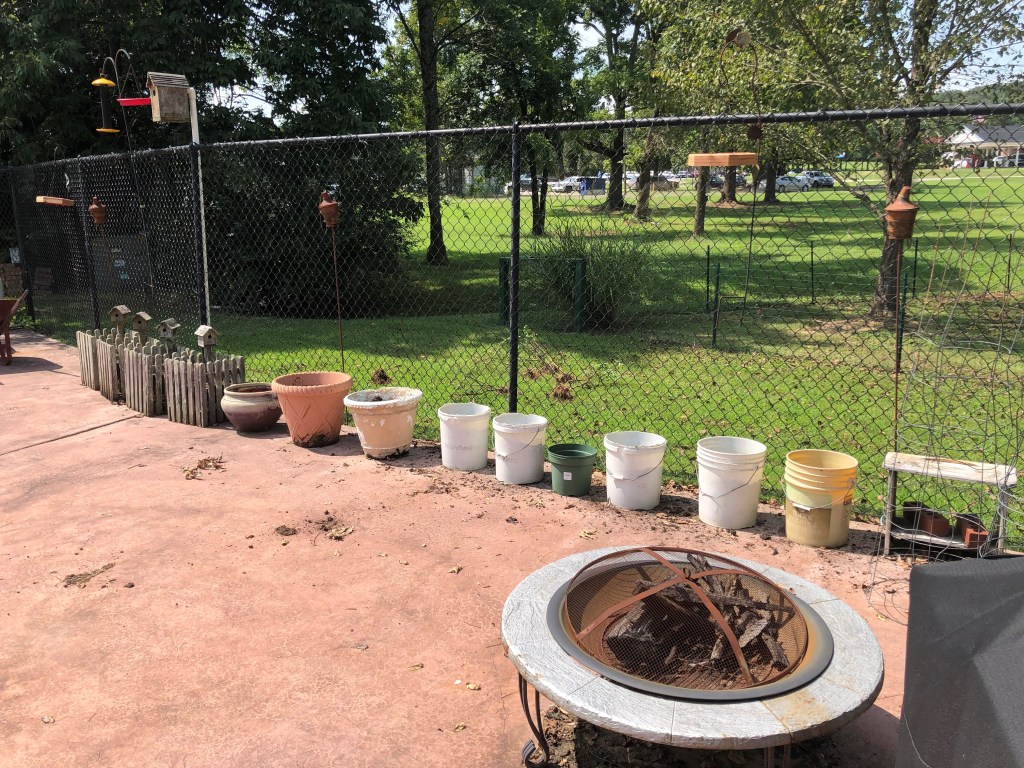
I suffered a touch of withdrawal after my closure today.  I have been actively working my garden since April.  For the most part, it is now gone.  I had removed the stocks from the pea and bean containers last month and had given up on my peppers a couple of weeks ago.  I finally resigned myself that there were not going to be any more tomatoes and removed those stocks today (even though I did have one flower left).  The good thing about removal is there is a 10’ swath of grass behind the patio so I have been able to just throw the plants on that area.  I have done the same when I weed the planters.  Then I run over them with my mulching mower and I am done.  I am not sure what that does to the grass, but it does not seem to be adversely affected. 

I preformed another act of closure today.  Melissa’s dad had move to an assisted living apartment and then into a nursing home before he died last year.  That meant most of his personal items had either been donated or given away.  We still had one large suitcase with his clothes.  I had been ready to take those to Goodwill at the first of the year, but then they stopped accepting donations.  They have been open for donations now for several months, but I just never got around to it.  This had been in our back bedroom taking up space.  I decided it was time and dropped them at the store.

The final closure came with Bella’s pet care items.  Some were stored in our bathroom and others in the same back bedroom as the suitcase.  Most of the other items we had either given to a shelter or were on the top of our pantry shelf.  I gathered up her dog beds and rugs, the toys she had left, put her shampoos in a plastic bag to keep them from leaking, and put them in a box with her name on it.  I put our green eggs and ham glasses in with her Dr. Seuss jacket.  It would not be the same without the puppy. 

THOUGHTS:  We have lost so much this year.  It is more than just the time spent indoors.  We have lost a year with family and friends.  Some have lost loved ones.  I know that closure needs to come.  It is part of the grieving process.  But it is hard.  I also know closure does not mean to forget.  We have the memories.  Some good and others not so much.  We have the joy in the eyes of a child who understands why she is wearing a mask, along with the tears of another when they learned their school would not be open.  We have given up so much to get to where we are.  Do not throw it all away.  Follow the science.  Do the work.  Change is coming and it starts with you.
Casserole

September 8, 2020

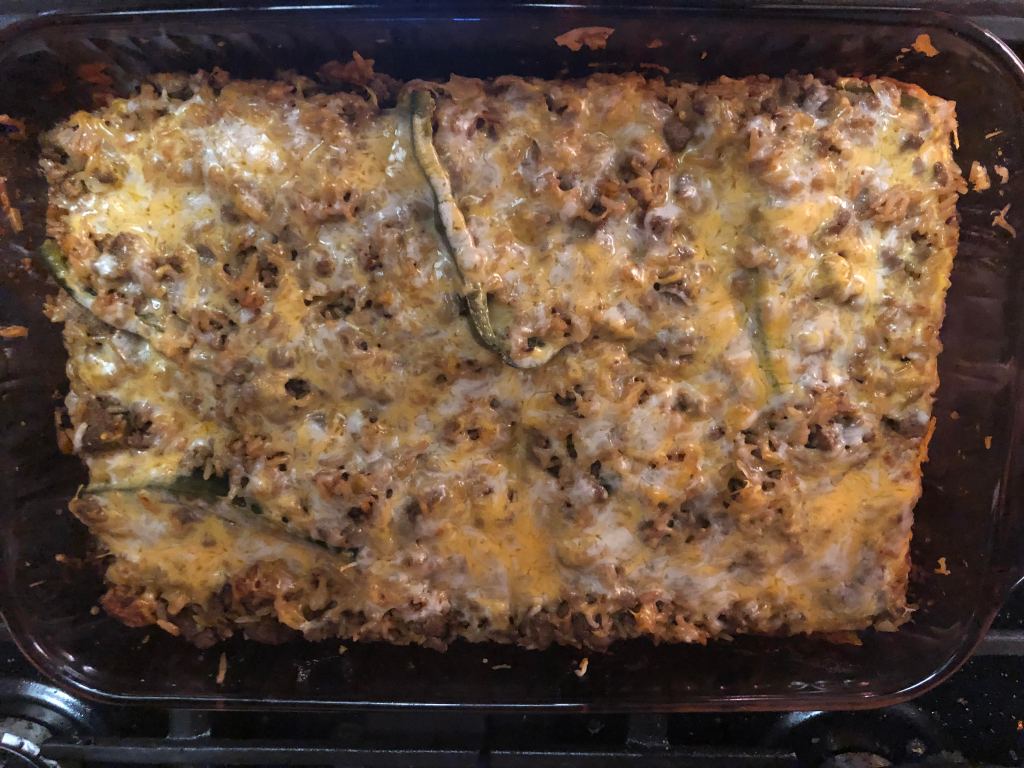
I made my “famous” stuffed poblano pepper casserole last night for dinner.  It came out just as good this time as it did the first time, albeit slightly different.  I have made stuffed green peppers many times and stuffed poblano peppers on occasion.  These are both made using different stuffing.  The green peppers use a mixture of hamburger and rice that is topped with small amounts of tomato sauce and cheese.  The poblano peppers are stuffed with cheese (preferably feta).  Both are then baked.  I have learned lately it is better to blanch the peppers for five minutes prior to baking to ensure they cook well.  I guess cookbooks are good for some things.

I learned our gardener friend was using the last of her home grown poblano peppers this weekend.  Melissa told me she was making a poblano cream sauce to pour over baked salmon.   This sounded great.  I need to spruce up the dish when I make salmon.  Melissa is not much of a fish eater except for fried catfish (she is southern after all).  I have been weaning her over by putting creative sauces on top of the fish to give it an alternative taste.  So far, she has always eaten my sauces and said they were good.  I am sure she would like the poblano cream sauce.  I bet I could find it in a cookbook, or I could just wing it.

I came up with the poblano casserole because I did not have the right ingredients for making stuffed peppers.  I have substituted an Italian cheese mix (store bought) before, but the taste and texture were not what I was hoping to find.  By making this as a casserole I had no preconceived ideas about what it was supposed to taste like.  I sliced the six peppers in half vertically, blanched them, and then layered them in the bottom of the pan.  This time I poured leftover enchilada sauce over the peppers and sprinkled shredded mozzarella cheese over them.  Next came a mixture of a pound of turkey sausage, a small onion, and two packets of 90 second Spanish rice.  This was topped with shredded fiesta style cheese, covered, and baked for thirty minutes at 400 degrees.  It tastes great.

THOUGHTS:  I tried to give enough direction to let you make this dish yourself.  It is simple and I would suggest you even try variations if you do not have the suggested ingredients.  That is what I have done the two times I made the dish.  I do have a disclaimer.  Although the poblano peppers are not spicy hot, I have found the oil on the skin to put out enough heat to leave my hands burning after preparing the dish (and do not rub your eyes!).  I find much of life is like my baking.  Rarely do I find I have the right ingredients.  That means I need to either go get what is needed or improvise.  There are advantages to either approach, but the important thing is to begin.  We need to begin the work of anti-racism or it will not be done, and this is a job for everyone, and not just a few.  Do the work.  Change is coming and it starts with you.
Packaging

September 7, 2020

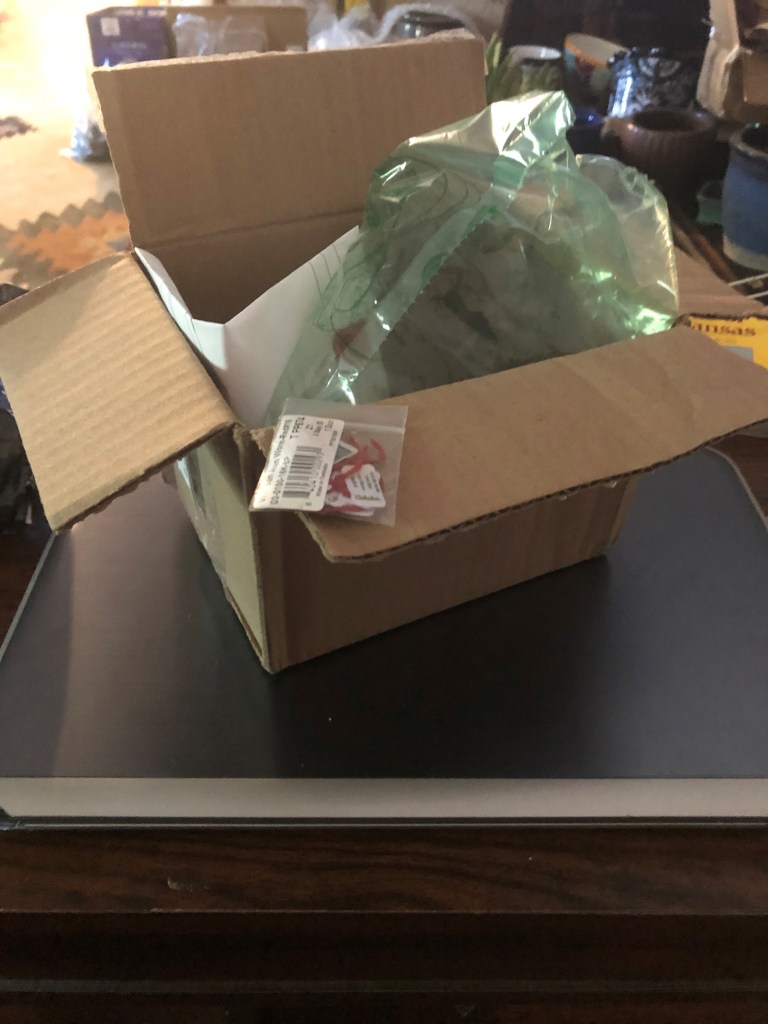
When I received my shipment of San Juan Worms, I was amazed by the packaging the order came in.  Admittedly, I did order a dozen of these flies but let me be honest, they were all on a #16 hook.  That means the whole lot slipped into a plastic baggie that was 1 1/2” by 2 ½”, and about a ¼” deep.  Even with in this small bag, over half was filled with air.  What surprised me was the box the worms shipped in.  This was a standard small shipping box that measured 8” by 6” x 6”.  The inside was packed with wadded paper and an air-filled plastic bag.  I guess this was necessary to keep the flies from bouncing around.  I doubted they would have broken.

Earlier this year the American Sustainable Business Council put out a post decrying the excessive use of packaging in America. While America has around 5% of the world’s population, we generate 40% of its packaging waste, and much of this is plastic.  In 2018 the European Union banned many single-use plastics, something the U.S has resisted. The exponential growth of online product sales has accelerated the production of direct-ship-to-user packaging waste. Incineration is a toxic solution, landfills are limited, and foreign countries are reluctant to accept our waste.  Recycling is not an option for all materials and is not widely used when it is an option.  That is for plastic and does not address the wasted cardboard surrounding my order.

I know there are some shipped products that need to be protected.  Melissa’s succulents come wrapped in gauze or paper towels and are placed in Styrofoam peanuts or other cushioning material to protect the delicate plants from the rough treatment they receive in transport.  I do not know how many of her boxes clearly marked “fragile” have arrived partially crushed.  Luckily, the interior packaging has saved the plants from destruction.  Most shipments do not need this special care.  It seems merchandisers are relying on one size fits all packaging to cut costs and to speed delivery.  My flies could have been mailed in a small envelope, with room to spare. 

THOUGHTS:  We are living in a time when our resources are being stretched to the limit.  The cardboard represents millions of trees cut down.  The single use plastics go into landfills and oceans and last for thousands of years.  When they begin to breakdown, they become even more toxic as micro-plastics chocking out animal life.  How we use packaging materials needs to be a conscious choice.  We cannot waste precious resources for a quick dollar or to shave seconds off delivery times.  Not being “business as usual” could be positive.  However, we need to rethink and retrain our old response.  This is true for packaging, but also for our treatment of others.  We need to do the work.  Change is coming and it starts with you.
Anomalies

September 5, 2020

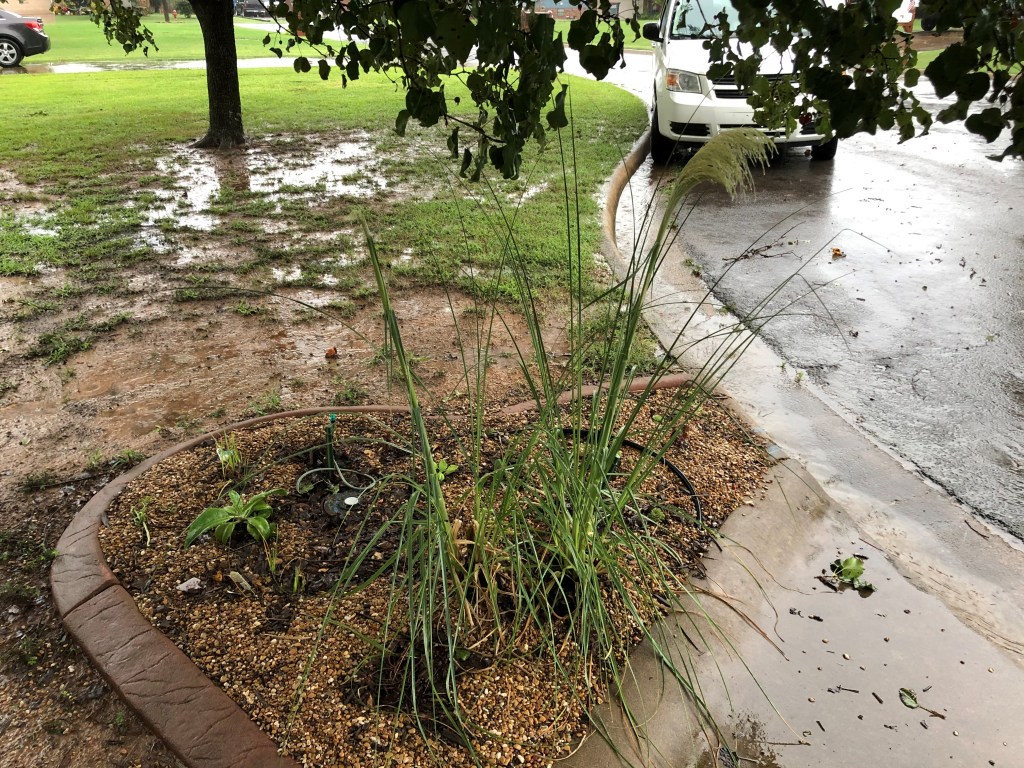
Melissa has had Pampas Grass (Cortaderia selloana), planted in one of her driveway planters for several decades.  Although she moved to Kansas with me for an eight-year stretch, she cannot ever remember it blooming.  The plant bloomed this week and I wondered why it was blooming now when it never had before.  When I checked online, I read that Pampas Grass is native to southern South America, including the Pampas region from which it is named.  While it is used as on ornamental plant in America, it has been banned in Hawaii and New Zealand because of its ability to outgrow and displace native plants. The site mentioned the plant prefers full sun, which probably explains why it does not bloom very often.  We have it planted under a shade tree.

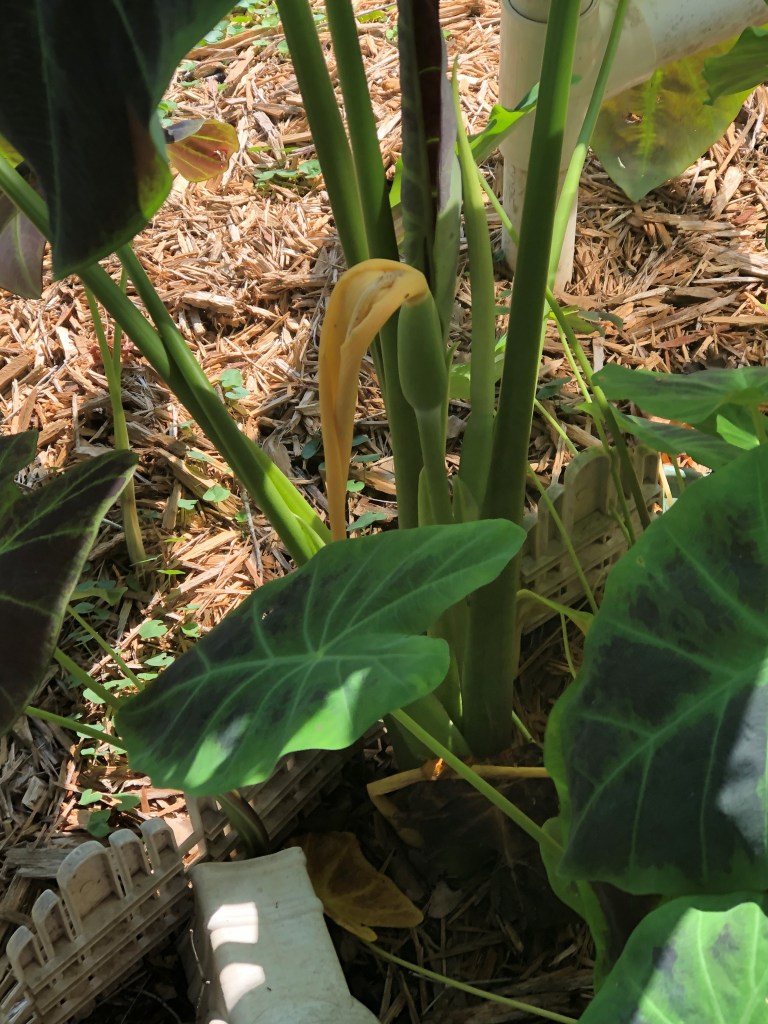
Along with the Pampas Grass we got another surprise from our Elephant Ears (Colocasia formosana). These are planted in the full sun along the front of the house and have probably been there as long as the Pampas.  They provide a tropical effect in their setting and are mixed in the bed with several Naked Ladies.  These plants have large foliage, which is reminiscent of elephant ears (hence the name). When I looked today there were several blooms sprouting among the leaves.  Again, in the decades these have been in the bed they had never bloomed.  Here was another anomaly

I texted a picture to Melissa and asked if she knew this plant bloomed.  Neither she nor her gardener friend had ever seen a bloom, but there it was.  I went online and found that while they can bloom, this is not common in climate Zone 7 in which we live.  The site said about the bloom, “The inflorescences are the typical aroid type with a white to yellow or light green spathe surrounding the spadix (What?).  They can be large, fragrant, and attractive.”  While these are usually hidden underneath the foliage, our flowers are visible.  The fruits produced are globular green or yellow berries that contain several seeds.  I hope we will get these as well.

THOUGHTS:  The Pampas Grass is an anomaly because it has not bloomed.  It is known to be prolific, but Melissa has struggled to keep it alive.  Two small plants we established last year did not make it through the winter.  The Elephant Ears are an anomaly because they have produced a rare bloom.   The Ears themselves have always grown well, and after dying back in the hot summer and cooler winter, always return.  I do not know if you can rack these two anomalies up to climate change or not, but the odd weather patterns we are experiencing this year have made a difference on our yard.  I used to pay no attention to these patterns, but now I do.  Perhaps we should pay attention to the other shifting patterns that have coalesced this summer.  We cannot allow the realizations gained to be written off as anomalies.  We need to do the work.  Change is coming and it starts with you.
Squirrel

September 4, 2020

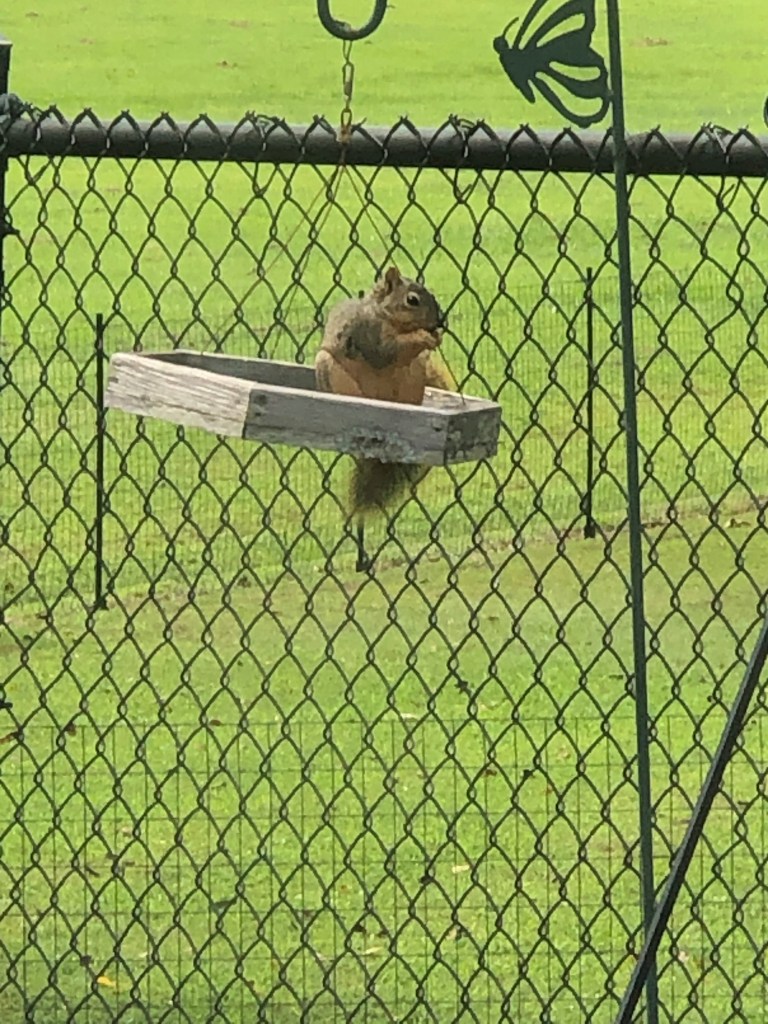
I watched as our local squirrel climbed the fence and sat above the bird feeder.  He has been raiding my feeders all summer.  I have given up trying to keep him out and have instead become resigned to letting him have his due.  The problem he faced today was of his own making.  I had converted an aluminum pie pan into a feeder by attaching wires from an old hanging flower basket.  It stood just off the fence and the squirrel had taken to jumping into the plate.  Half of the time when he did this it would rip the plate away from the wires and the whole thing would come down.  This was fine with the squirrel, as the nuts and seed reserved for the Cardinals fell to the ground and he could eat at his leisure.

Last week, one of our windstorms blew the feeder away.  This had happened before, but I always found it lying on the deck.  This time it was nowhere to be seen.  Not only was the pan gone, the wires were as well.  I looked on our porch where we keep extra parts and there were no more suitable wires.  Rather than leaving the space empty, I moved the Finch feeder to where the nuts had been.  The squirrel was perched on the fence chattering and his tail was whipping back and forth.  He was mad!  Even though his constant attack on the plate weakened it and led to its disappearance, he obviously believed it was his right to be fed.  Now his food was gone.

I did not feel too sorry for the squirrel.  He has been raiding my bird feeders all summer, often taking more than the birds themselves.  I also knew there was another feeder.  I have seen him sitting in this feeder munching away, even when my flimsy feeder was present.  Although I did not feel sorry for the squirrel, I did know that every time he raided the bird feeders there was no more food for the birds.  I believe I have finally found a way to thwart his raids.  I went to the store and bought a squirrel feeder and a special “squirrel mix” of corn and seeds.  These are larger pieces and I hope he will love them.  When I got up this morning there were three birds fighting over the feeder with the squirrel mix.  Turnabout is fair play.

THOUGHTS:  If I could anthropomorphize my squirrel, I would say he did not understand why I did not like him.  He was acting no different than the birds.  Both were just trying to get along in my yard and to understand the odd-looking animal that patrolled it.  The only real difference between their foraging habits was they looked different.  I finally realized I was the one who needed to change.  This same idea seems to guide our nation.  Genetically there is less than 1% difference in all human DNA.  Sometimes we look different, act different, and sound different, but we are all just trying to get along in this big yard we call America.  Change is coming and it starts with you.