AMOC

February 12, 2024

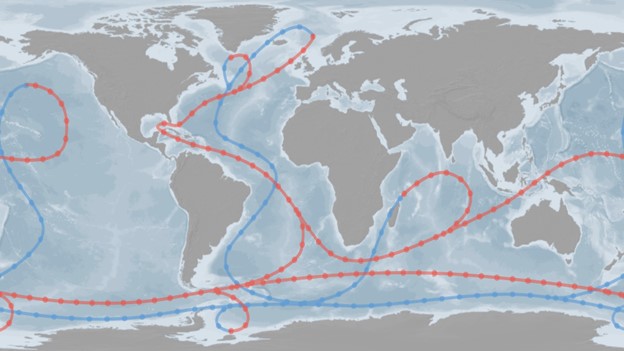
Inside the back section of my local newspaper, I came across a USA Today article on a pair of studies that show climate change is melting ice at an alarming rate.  One study found fresh water from Greenland’s melted ice could upset a delicate balance that fuels weather for millions of people bordering the Atlantic Ocean.  Scientists for the other study reported new fears about how quickly ice in Antarctica could melt causing a potential for dramatic and rapid rise in sea levels.  Both studies warn that the melting glacier ice in both hemispheres has potentially dire consequences.  The southern study published this week warns of how suddenly ice can melt in Antarctica, which can lead to dramatic and devastating sea-level rise worldwide.  The northern study is based on a computer model simulation and renews fears about the stability of the critical current that powers weather and climate patterns in the US, Europe, and Africa.  The study was published in the journal Science Advances.  Previous studies have found that a collapse of the current is possible at some point this century.  The ocean current in the Atlantic Ocean is called the Atlantic Meridional Overturning Circulation.

When I went online, I found the Atlantic Meridional Overturning Circulation (AMOC) is a system of surface-level and deep currents in the Atlantic Ocean which are driven by changes in atmospheric weather and ocean circulation driven by changes in temperature and salinity.  These Atlantic currents make up one half of the global thermohaline circulation that encompasses the flow of major ocean currents.  The other half is the of thermohaline circulation is the Southern Ocean overturning circulation, and both play critical roles in the climate system.  The AMOC is characterized by a northward flow of warm, salty water in the upper layers of the Atlantic, and a southward flow of colder, deep waters.  These currents are linked by regions of overturning in the Nordic and Labrador Seas and the Southern Ocean around the Antarctic.  Climate change has the potential to weaken the AMOC through increases in ocean heat content and elevated freshwater flows from the melting ice.

Collapse of the AMOC would result from too much fresh water from the melting of the Greenland ice sheet and sea ice, combined with increased precipitation and river runoff.  The AMOC collapse is a well-known climate tipping factor in climate change.  To conduct the simulation, researcher René van Westen and colleagues at Utrecht University in the Netherlands simulated a gradual increase in freshwater input to the North Atlantic over the course of 2,200 years, which they said triggered an abrupt AMOC tipping event.   The authors said they cannot even begin to estimate when it will collapse.  “We can only say something about the direction to which AMOC is heading to. The physics-based indicator suggests that we are moving towards the tipping point.”  Additional simulations and studies could provide details on how (and when?) the AMOC tips under climate change.  If it were to collapse, it could bring about an ice age in Europe and sea-level rise in cities like Boston and New York, as well as more potent storms and hurricanes along the East Coast.

THOUGHTS:  Shifts in the AMOC are at the heart of the fictional “Day After Tomorrow” climate change disaster movie from 2004.  While the movie and the results depicted from the collapse are scientifically inaccurate, the flooding and storms predicted by the model are not.  If we continue to raise global temperatures and melt fresh water glacial ice, there will be a future collapse.  Being warned is not the same as doing something.  Act for all.  Change is coming and it starts with you.
Escape

February 11, 2024

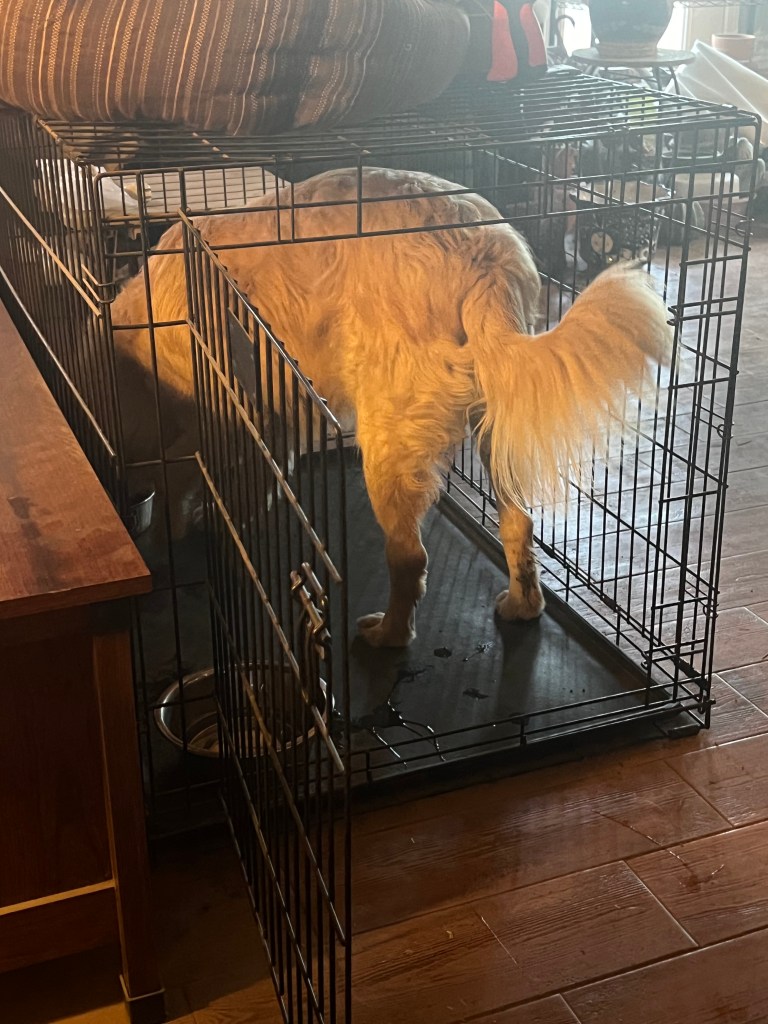
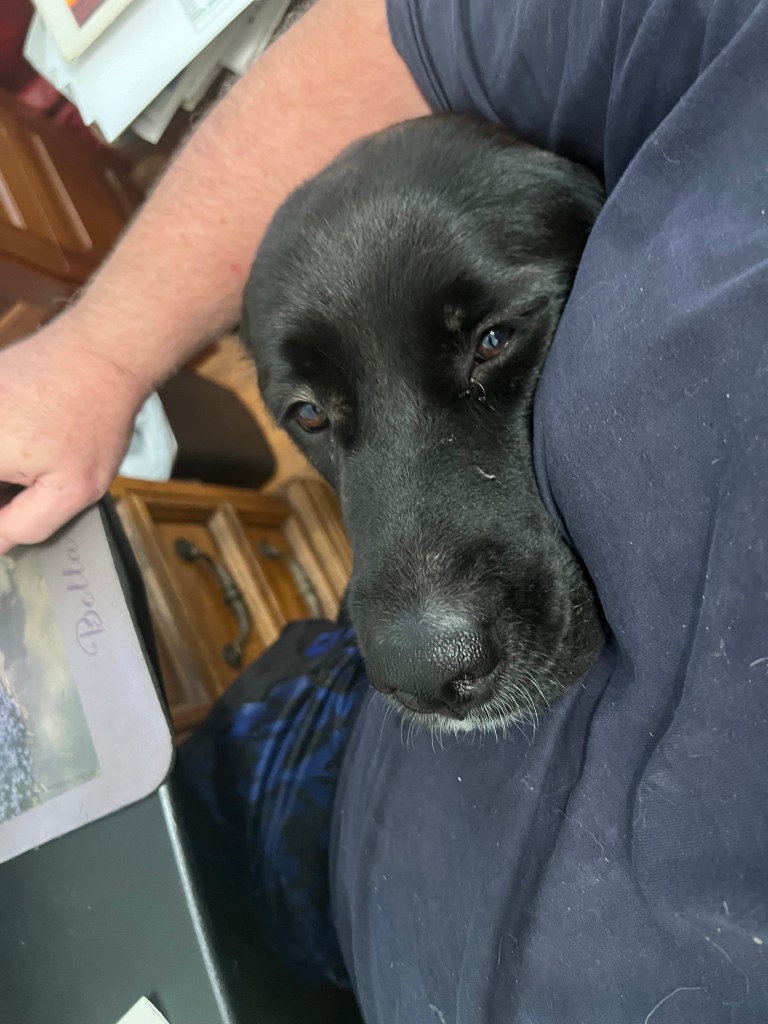
Yesterday Melissa let the dogs into the yard and came in to my office to talk.  After leaving I heard her call, “I can’t find the dogs!”  They were in the fenced yard and now were gone.  Since the gate was closed and locked, we could not figure out what had happened.  I looked through the house to make sure they were not just hiding, and then went to look at the fence.  Although the gate was locked, the latch had been pushed slightly to the side.  Zena had bulled her way out the bottom of the gate.  I would not have believed such a big dog could get through such a small opening if I had not seen her squirm under the fence at the dog park.  We called for both dogs with no response, then got in the car to cruise the neighborhood.  It was the kids’ version of The Great Escape.

When I went online, it said losing your dog can be a terrifying experience (it was), especially if they ran away on purpose.  If your dog runs away repeatedly, it is important to understand why and find a way to stop it.  The first step to correcting this behavior problem is to find why they ran away.  There are four main reasons your dog will escape.  The number one reason is dogs get bored.  If left alone with nothing to do, they may escape and explore the neighborhood.  You resolve this by supervising your dog, giving them proper exercise, and mental stimulation.  Another reason is your dog may be looking for a mate.  Unaltered males are mainly guilty of wandering the neighborhood looking for love, but neutering your dog or getting a female will not necessarily prevent your dog from escape.  Dogs will also escape the yard to chase potential prey, like a rabbit or a squirrel.  This is especially common in prey-driven breeds, but most dogs instinctively enjoy chasing small animals.  Again, supervising your dog, giving them something better to do, and improving your fencing can all help prevent your dog’s escape.  Finally, dogs may try to escape if they are scared. This is especially common during summer thunderstorms or fireworks when the loud booms can send them into a panicked frenzy.  Keep your dog inside and do your best to soothe their fears of loud noises with calming treats, white noise, and pressure wraps.

Pressure wraps are designed to help dogs deal with their anxiety over fireworks and loud noises.  They work along the same principle of swaddling an infant to calm its’ fears.  There are existing theories to explain the effectiveness of maintained body pressure in treating a dog’s noise anxiety, but there are not yet any existing studies specifically examining this treatment in this specific context.  The wrap is the same mechanism that allows pressure to treat forms of anxiety in humans and other animals.  One example of successful treatment of anxiety through constant body pressure applied by a wrap is Temple Grandin’s “hug machine”.  Grandin saw how cattle would calm down while being put into a squeeze chute to receive their shots and developed a machine based on the same principle to treat the anxiety resulting from her own autism.  The “hug machines” function by maintaining a constant pressure on the body, leading to a reduction in anxiety.  It seems to work.

THOUGHTS:  We looked for the kids for 20 minutes and drove all over the neighborhood.  One man washing his car said he had seen them go by but did not know where they went.  We decided to make one more trip down the road into the next subdivision and saw them loping along on their way back home.  I drove up, opened the door, and they jumped right in.  I got a small bike chain to wrap the bottom of the gate.  My dogs are much like me when I was a boy.  I was good most of the time, but the exceptions came when I was not supervised and bored.  As Benjamine Franklin said, “Idle hands are the devil’s playthings.”  That is why afterschool activities and programs like Big Brothers and Big Sisters are so important.  Act for all.  Change is coming and it starts with you.
Citrus

February 08, 2024

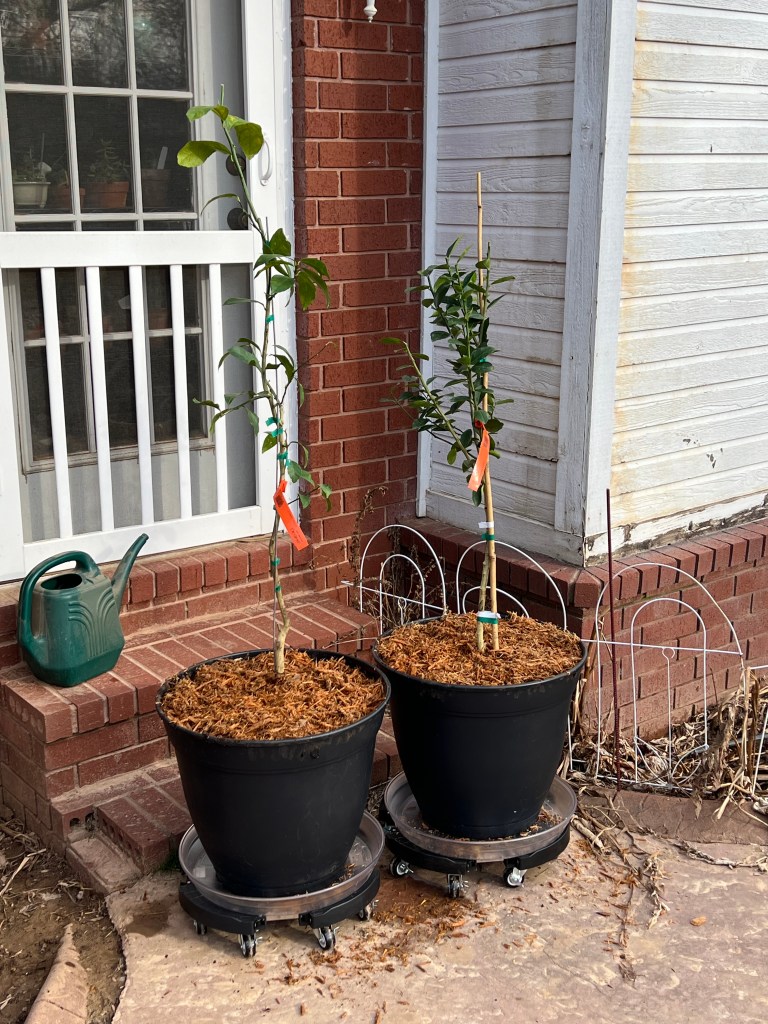
Getting my first seeds in the seed pots inspired me to plant several fruit trees as well.  I first tried to find a nursery near me where I could purchase the trees and found it was too early in the year for them to be in stock.  We are in growth zone 7 and our last frost is predicted for April 15.  That means any local trees would still be dormant and may be problematic to plant and ensure they would survive.  I am planting the trees in containers to allow me to bring them in at night when the temperatures drop much below freezing (28F/-2.2C) to protect the trees.  That also means I needed to focus on dwarf trees that could be contained in pots set on heavy duty plant caddies.  I ordered the plant caddies and got them put together over the weekend.  I ordered the two trees from an online nursery.  I had trouble ordering at first, as my virtual private network (VPN) is set to show trackers I live in an area which grows citrus, and the nursery would not ship the trees to that state.  I got a work-around for that problem and ordered my two citrus trees.  They arrived on Monday.

When I went online, I found citrus is a genus of flowering trees and shrubs in the rue family (Rutaceae).  Plants in the genus produce citrus fruits, including important crops such as oranges, lemons, grapefruits, pomelos, and limes. The genus Citrus is native to South Asia, Southeast Asia, East Asia, Melanesia, and Australia and various species have been used and domesticated by the indigenous cultures since ancient times.  Citrus cultivation spread into Micronesia and Polynesia from Taiwan by migration (the Austronesian expansion – c. 3000 to 1500 BCE).  Citrus spread to the Middle East and Mediterranean (c. 1200 BCE) along the incense trade route, and from there to Europe and the Americas.  While citrus trees can grow from seed, the most common method is grafting onto rootstocks.  This is physically joining part of a shoot of a desired species onto the roots of a different but closely related species, so the two parts grow as one plant.  Grafting is a preferred method because it propagates a new plant of the desired citrus but confers the extra advantages from the characteristics of the rootstocks, such as their vigor of growth, hardiness, and soil tolerance.

The citrus fruits I use most are lemons and limes, so these are the two trees I ordered.  The nursery site had a single tree that had been grafted to produce both fruits from a single bush, but I decided to buy separate trees.  I figured that if one died, I still might be able to save the other.  I decided on a Meyer Lemon (Citrus meyeri) tree and a Key Lime (Citrus aurantiifolia) tree.  I checked with the nursery’s Chat feature and was assured these were both dwarf varieties (6 to 8 feet/1.8 to 2.4 meters) and that I could keep them smaller by planting the trees in containers and pruning.  I purchased the pots I needed locally after receiving the citrus trees and then researched how to plant the trees.  A YouTube video suggested I put the root ball on compost, but I decided to use potting soil to avoid the possibility of burning the roots.  I bought root starter and citrus kits (nutrients) from the nursery to augment growth.  The nursery site suggests I might get “some fruit” in the first year.  We will see.

THOUGHTS:  Growing citrus trees is an iffy business where I live in Arkansas.  Zone 7 is on the cusp of the growth range for outside trees as temperatures occasionally drop below 20F (-6.6C).  We already have a ramp leading to the new windowed porch so the plant caddies should allow me to wheel the trees inside on bitter nights (if they do not get too big), or I could always get smudge pots to keep them warm.  This is yet another experiment in sustainability.  The more I try and provide for myself, the more it impresses me how most of the world does not get to “play” at sustainability.  You grow or catch what you want (or can), or you do not eat.  I still have the luxury of a supermarket.  Act for all.  Change is coming and it starts with you.

Flaco

February 07, 2024

David Barrett

A side feed on my NY Times browser reported on the one-year antics of a runaway owl from the Central Park Zoo.  Although the owl has a primary perch in Central Park, the bird has been seen all around New York City making it an international celebrity with a legion of admirers and fans.  The apex predator slipped through an opening cut by vandals in the steel mesh enclosure at the Central Park Zoo on February 2, 2023, and flew into the wilds of America’s largest city, testing the limits of his six-foot wingspan for the first time.  The Eurasian eagle-owl has been given the name Flaco.

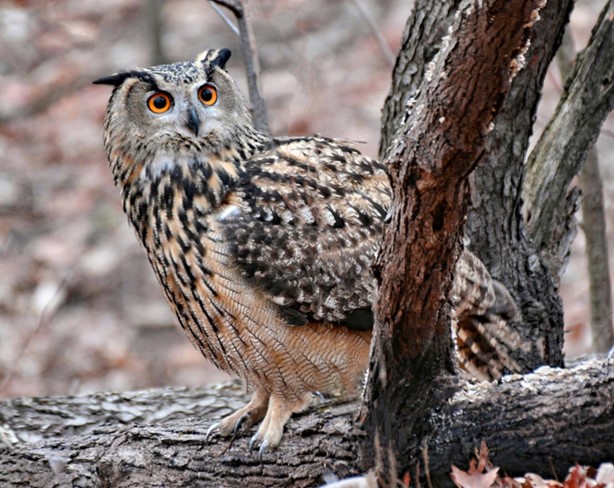
When I went online, I found The Eurasian eagle-owl (Bubo bubo), also called the Uhu, is a species of bird that resides in much of Eurasia.  It is one of the largest species of owl, and females can grow to 30 inches (75 cm) in length, with a wingspan of 6 feet 2 inches (188 cm).  There is little sexual dimorphism, but males are smaller.  The eagle-owl has distinctive ear tufts, with upper parts that are mottled with darker blackish coloring and tawny.  The wings and tail are barred while the underparts are a variably hued buff, streaked with darker coloring.  The facial disc is not very defined, but the orange eyes are distinctive.  Eagle-owls are found in many habitats but are mostly in mountainous regions or rocky areas near varied woodland edge and shrubby areas with openings or wetlands to hunt most of their prey.  They are occasionally found in farmland and park settings in European cities, and rarely in busier urban areas (like NYC).  The eagle-owl is a nocturnal predator which hunts a range of prey but predominantly small mammals such as rodents and rabbits.  They also prey on larger mammals and birds of varying sizes.  Secondary prey can include reptiles, amphibians, fish, large insects, and assorted invertebrates.  The species typically breeds on cliff ledges, in gullies, among rocks, or in other concealed locations.  The nest is a scrape containing a clutch of 2 to 4 eggs which are laid at intervals and hatch at different times.  The female incubates the eggs and broods the young while the male provides food for her and later for the nestlings.  Parental care is provided by both adults for about five months.  At least 12 subspecies of the Eurasian eagle-owl are described.

Flaco is not the only bird to inhabit NYC and the city is home to a large birding community and a diverse range of birds.  Despite being the most populated (8,804,190 people) and most densely populated (29,303.2 people per square mile) city in the US (according to the 2020 census), NYC is home to a range of ecological habitats and is situated along the Atlantic Flyway, a major route for migrating birds.  Birders have recorded more than 400 species in the city, and their concentration in the city’s urban parks, forests, marshes, and beaches has made birding a popular activity, especially since the beginning of the pandemic in 2020.  New York City has 30,000 acres of parkland and 578 miles of coastline.  Neither is Flaco the only eagle-owl to gain fame.  In June 2007, an eagle-owl nicknamed ‘Bubi’ landed in the Helsinki Olympic Stadium during the European Championship qualifying match between Finland and Belgium, interrupting the game for six minutes.  After Jonathan Johansson’s opening goal for Finland, the bird left.  Finland’s national football team have had the nickname Huuhkajat (Finnish for “Eurasian eagle-owls”) ever since.  The owl was named “Helsinki Citizen of the Year” in December 2007.

THOUGHTS:  Science writer Jennifer Ackerman released her 2023 New York Times bestseller, “What an Owl Knows: The New Science of the World’s Most Enigmatic Birds”, just as Flaco escaped.  The vandals have yet to be caught.  With the preponderance of conspiracy theories in the US, it will not be long until someone claims a connection between the events.  Being absurd does not make a theory wrong, but you do need to question the motives of the theorist.  Act for all.  Change is coming and it starts with you.
Exoplanet

February 06, 2024

Inside the front section of today’s local newspaper was a USA Today article on NASA’s January 31st release about detection of a “super-Earth” that has the potential temperature and conditions to sustain life.  This new planet was said to be “fairly close to us” at only 137 light-years away (a short hop) and orbits within a zone capable of having liquid water.  The planet (TOI-715 b) is about one and a half times the width of Earth and orbits a small, reddish star.  The same system might harbor a second Earth-sized planet, which if confirmed, “would become the smallest habitable-zone planet discovered by the Transiting Exoplanet Survey Satellite (TESS) so far.  NASA said the red dwarf is smaller and cooler than our Earth’s sun, and because of the short distance of the super-Earth orbit a “year” for the planet is equal to 19 Earth days.  When detected these worlds are called an exoplanet.

When I went online, I found an exoplanet or extrasolar planet is a planet outside our Solar System. The first possible evidence of an exoplanet was noted in 1917 but it was not identified as one until confirmation in 1992.  Another planet was initially detected in 1988 but was not confirmed until 2003.  As of February 1, 2024, there are 5,606 confirmed exoplanets in 4,136 planetary systems, with 889 systems having more than one planet.  The James Webb Space Telescope (JWST) is expected to discover more exoplanets, and determine more about them, including composition, environmental conditions, and potential for life.  While there are various methods for detecting exoplanets, transit photometry and Doppler spectroscopy have found the most.  These methods suffer from observation bias favoring the detection of planets near the star.  Of the exoplanets detected 85% are where one of the objects reaches a state where there is no longer any net change in its rotation rate over the course of a complete orbit (tidal locking).  About 1 in 5 Sun-like stars have an “Earth-sized” planet in the range that may support liquid water (habitable zone).  Assuming there are 200 billion stars in the Milky Way (our galaxy), it can be hypothesized that there are 11 billion potentially habitable Earth-sized planets.  The number rises to 40 billion if planets orbiting numerous red dwarfs are included.

Since its launch on April 18, 2018, TESS has been adding to the stockpile of habitable-zone exoplanets that could then be more closely scrutinized by NASA’s JWST telescope.  The first light image from TESS was taken on August 7, 2018, and released publicly September 17, 2018.  NASA says the Webb telescope is designed to not only detect exoplanets but “explore the composition of their atmospheres, which could offer clues to the possible presence of life.”  The super-Earth research and discovery was led by Georgina Dransfield at the University of Birmingham in the UK and published in the Monthly Notices of the Royal Astronomical Society journal in January.  These findings mark another step toward understanding the atmospheric conditions needed to sustain life and further explore the characteristics of exoplanets beyond our solar system.

THOUGHTS:  For a short while in grad school, I dreamed of exploring the billions of exoplanets in search of life.  I was already studying the origin of (human) civilization and thought combining that with a degree in astrophysics could boost my chances of catching an exploratory ship.  Added to this was a degree in theology as any discovery would raise immediate questions about the human role in the universe.  Not only did I not obtain these degrees, but humans have also not been able to set foot on the closest planet in our own solar system, Mars.  It was still a good dream.  Dreams to explore took humanity around the world, beneath the ocean, and to the moon.  None of those explorations were possible without cooperation.  We are stronger when we work together.  Act for all.  Change is coming and it starts with you.
Bay Window

February 05, 2024

We finally got our bay window installed at our house.  This process began last October when we checked the cost for installation of the windows on our screened porch.  It was just starting to get cold, and I knew I needed to either get windows or put the “greenhouse” plastic up for another winter.  The cost seemed reasonable, so we decided to also replace the kitchen window while we were at it.  The four weeks until installation we were promised drug into 2-1/2 months before the porch window system was installed.  When we asked about the kitchen windows, we were told they were “not on the truck” (contractor for, “Oops! I forgot to order them”).  Now nearly a month since the porch was installed, the kitchen bay window was replaced this morning.

When I went online, I found a bay window is a window space projecting outward from the main walls of a building and forming a bay in a room.  This is a generic term for all protruding window constructions, regardless of whether they are curved or angular, or run over one or multiple stories.  The bay typically consists of a central windowpane (fixed sash) flanked by two or more smaller (casement or double-hung) windows.  A bay window can make a room appear larger and provide views of the outside which would be unavailable with an ordinary flat window.  This creates a panoramic view of the outside, allows more natural light to enter the room, and provides additional space within the room.  Bay windows are often designed to extend beyond the exterior wall, forming a small nook or seating area inside, which can be used for various purposes such as reading, display, or simply enjoying the view.  Bay windows in residential buildings are often found in living rooms, dining areas (like our breakfast nook), or bedrooms.  Bay windows are also found in commercial and public structures.

Melissa had our house built in a new subdivision in 1995.  It is not surprising that 29 years later there are things that have begun to wear out.  Since moving back to Arkansas, we have had to replace the roof and the heating and cooling system (HVAC).  The bay window in the breakfast nook is another example of age.  The original window had a large center window with a double-hung window on either side and all three contained window grills (fake panes).  These were energy efficient (at the time) double pane windows, but over the years the moisture seal had been compromised.  That meant temperature changes would cause condensation inside the glass.  The new bay window has a large picture window in the center, flanked by double-hung windows (and no grills).  Both the porch and the bay windows meet new higher standards for energy efficiency.  Whether or not this helps our energy costs, the view without the grill frames makes an incredible difference in our view.

THOUGHTS:  While we are far short of creating a green building, the improvements we have made are bringing us closer to being environmentally responsible.  Green building refers to the maximum saving of resources, including energy saving, land saving, water saving, and material saving during the whole life cycle of the building.  This is also protecting the environment, reducing pollution, and providing people with healthy, comfortable, and efficient use of space in harmony with nature.  The architect Frank Lloyd Wright created buildings that succeed aesthetically but ultimately ended up failing to keep out the weather (leaky roofs), and this was true for other innovative architects.  It has been said that while the use of cutting-edge materials in new forms leads to progress, it also invites trouble.  Pushing the envelope always entails risk, whether it is architecture, technology, or changing societal norms.  That does not imply we should stop striving for innovative change, only that we take time to learn to adapt to the changes.  Act for all.  Change is coming and it starts with you.
Bedding

February 01, 2024

Now that we have installed our fence on the north side of our property the kids have been having a blast playing in the expanded space.  The problem we ran into was the amount of rain we have received over the last week.  Several times we have let the dogs out and they have come back caked in mud, especially their feet.  We reached our limit after toweling them down and then later having to take them again to the shower to wash.  I decided to close off the yard and keep them (supervised) on the patio.  We did this for two days hoping the yard would dry out.  When it did, I let them back out and watched to see where they were getting the mud.  Sure enough, it did not take long before Loki’s feet were covered in mud.  When I went to check the yard, I found that while there were still some damp spots on the high ground, the kids had churned a muddy path along the fence where they interact with the dogs next door.  I called them back inside and cleaned them off one more time.  I wondered if a type of mulch or bedding would work to keep them from creating future mud holes.

When I went online, I found when referring to animal husbandry, bedding is usually organic material used by animals to support their bodies when resting or otherwise stationary.  The bedding reduces pressure on skin, heat loss, and contamination by waste produced by an animal or those it shares living space with.  While straw is a commonly used bedding material there are others.  Wood shavings (pine, cedar, and aspen) are absorbent and have good odor control and can be cut into different textures (fine cut, soft shreds, or thick cut) for use by different animals.  Wood shavings can be dusty and contain aromatic oils that can cause health problems in some animals.  Aspen and kiln-dried wood shavings tend to be less dusty, plus the oils are removed (the kind I bought).  Many animals benefit from bedding, including livestock, poultry, rodents, and reptiles, and in the simplest context, bedding can provide comfort for these animals.  Bedding also creates an environment of moisture retention and assists in keeping the cage dry.  A drier cage promotes air flow which decreases harmful levels of environmental pathogens.  A dryer yard was just what I needed.

Melissa and I both started searching the internet to see what we could use to lessen the mud.  We were obviously not the only ones with this problem as we both found numerous videos on how to control the mud your dog creates in a yard.  We thought about cedar mulch but worried it would push into the mud when it was stepped on and it would have been expensive to cover the large area we had sufficiently.  I found a deal on artificial grass at a local store, but again wondered if Loki would just chew it up as he did the tarp over the pool.  Then Milissa found a video where a dog owner used horse bedding (shaved pine) to cover the yard.  He wondered if his grass would grow back after the winter, but the chips solved the problem.  Like the video, we did not care if the grass did not come back.  This has always been a problem area where I got stuck once or twice every mowing season.  I went to the farm supply store and purchased five bags of pine chips at a reasonable price and then spread them across the muddy lawn.  So far, both the dogs and I are happy with this arraignment. 

THOUGHTS:  The reason for installing the fence was an effort to keep the dogs happy and healthy.  They love the extra space to run and tumble together.  While the mud did not bother either of them, it caused havoc in our house and was unhealthy for them.  On the eve of the annual weather prediction by Punxsutawney Phil, People for the Ethical Treatment of Animals (PETA) is calling for him to retire saying, “It’s no kind of life”.  In the wild, groundhogs live 2 to 3 years and can live up to six years.  In captivity, groundhogs live up to 14 years.  According to the Punxsutawney Groundhog Club, Phil (the same groundhog) has been predicting the weather since 1886 (136 years).  Long life come from a secret elixir drank every summer.  Act for all.  Change is coming and it starts with you.
Grow Lights

January 31, 2024

Most of my supplies came in this week and I have been busy setting the stage.  I had augmented the soil and placed fencing around the two potato beds I plan to use again this year, but I put fencing around the heirloom flower bed.  We plan to transplant the rest of the bulbs within this fence to keep Loki from digging them (and eating them).  I put together two of the raised beds that I got for Christmas.  That helped me decide on the configuration I liked (one will need to be rebuilt) and to know how much room they will require in the yard.  The hardest step was deciding what would be planted in the four raised beds I have.  Some of the seeds could be planted directly into the soil, but others recommended transplanting seedlings.  These will need to be grown indoors from 8 to 4 weeks prior to our last frost (April 15th).  When I researched growing seedlings, they all recommended at least a sunny window (all taken by succulents) and preferably warming mats and grow lights.       

When I went online, I found a grow light is an electric light to help plants grow by providing a light spectrum like that of the sun, or to provide a spectrum that is more tailored to the needs of the plants being cultivated.  This light is typically a varying combination of red and blue light, which appears pink to purple to the human eye.  Grow lights are used for horticulture, indoor gardening, plant propagation, and food production, including indoor hydroponics and aquatic plants.  A range of bulb types can be used as grow lights, such as incandescent, fluorescent lights, high-intensity discharge lamps (HID), and light-emitting diodes (LED).  The most widely used lights today for professional use are HIDs and fluorescents.  Indoor flower and vegetable growers typically use metal halide (MH) HID and high-pressure sodium (HPS/SON) lights, but fluorescents and LEDs are replacing metal halides due to their efficiency and economy.  Although most grow lights are used on an industrial level, they can also be used in households (like mine).

Last winter Melissa had researched and purchased a variety of grow lights to use with her succulents but ran into some logistical issues and they were never deployed.  I researched my own grow lights to use with my starter seedlings and had settled on a four-shelf integrated light stand I found online.  I decided to run it by Melissa before purchase since she had already researched and purchased grow lights.  Her immediate question was, “Why don’t you use the ones we have?”  I will only use them as seed starters and then they will be set up for her the rest of the year (a win/win?).  I bought a rolling four-tier shelf and attached a clip on lamp to each of the shelves.  I also purchased four seedling heat mats to keep the seeds warm along with a five-pack of starter trays with 40 pod cells.  I put the rack in the back corner (to give the succulents access to the sunny windows) and then set up my system.  The first set of seeds are now germinating in the peat pellet pods.    

THOUGHTS:  Using the grow lights to plant my garden from seed this year has been both exciting and overwhelming.  I have had gardens for the last three summers but always purchased seedlings from a nursery.  These have worked variously well (and at times not at all), but at least I knew there was an established plant to place in the ground.  Now I am relying on my own expertise (the exciting part) to build the planters, grow the seedlings, transplant them into the ground, and tend them until I have a harvestable crop.  The seeds Melissa gave me are all heirloom varieties (not hybrid) and that means I can harvest seeds for planting next year.  This goes a long way toward creating a sustainable garden.  It also sounds like a lot of work (the overwhelming part).  Now that I have my eight week seedlings under the grow lights, I have time to get the other aspects in place before the four week rush.  Like most of life, it is a matter of planning ahead and following the advice of others who have already traveled the road (experienced/experts).  Act for all.  Change is coming and it starts with you.
Three Sisters

January 27, 2024

I have been getting notifications from my gardening sites that January is the time to get your seeds started indoors so they will be ready to transplant after the last frost in mid-April (zone 7).  That has caused me to pour over my seeds and YouTube sites to determine what I am going to plant.  I have watched videos on the 10 best vegetables to plant in hot weather, the ten best vegetables to plant in cold weather, the 20 hardiest vegetables, and the best vegetables to plant if you are in a survival situation.  Since I am trying to build my garden to subsistence agriculture this includes me (the survival sites noted we are all in a survival situation).  I gleaned what I could from all the sites and came up with a good idea of what I would like to plant this year.  All the sites said you could use combinations of plants by growing things like carrots and onions as filler crops beneath taller plants.  Another plant combination I came across was called the “three sisters”.

When I went online, I found the Three Sisters are the main agricultural crops of various indigenous peoples of Central and North America and include maize/corn (Zea mays), pole beans (Phaseolus vulgaris), and squash (genus, Cucurbita).  Using a technique known as companion planting, the maize and beans were planted together in mounds formed by hilling soil around the base of the plants, and squash is planted between the mounds.  This allows the cornstalk to serve as a trellis for climbing beans.  The beans then fix nitrogen in their root nodules and stabilize the maize in high winds.  The wide leaves of the squash plant shade the ground, keeping the soil moist and helping prevent weeds.  The Farmer’s Almanac notes this was the practice favored by the Iroquois for centuries before the European settlers arrived in the 1600’s.  The Almanac also says according to legend, “the plants were a gift from the gods, always to be grown together, eaten together, and celebrated together.”

Cornell University offers guidelines for raising the three sisters.  Plant the corn when the ground has warmed and is no longer cold and wet (Iroquois tradition holds to plant when the dogwood leaves are the size of a squirrel’s ear).  Soak corn seeds for several hours, but not more than eight hours, before planting and keep them well watered for the first weeks if the soil is not kept moist by rain.  Prepare low hills that are 3 to 4 feet (0.9 to 1.2 m) apart within and between the rows and place five to seven corn seeds, evenly spaced to a depth of 1 to 1-1/2 inches (2.5 to 3.75 cm) and cover with soil.  You can plant any of the corn varieties, but dent, flint, and flour corns are especially suited to this system (I am trying sweet corn).  If you follow the Iroquois tradition, you should plant the seeds with kind thoughts three days before the full moon.  When the corn plants are about six inches (15 cm) high, plant pole beans and pumpkins (the Iroquois used winter squash) or other summer squash around them.  The “three sisters” seeds can be sowed during the spring or summer.  I might try this in the front bed where I intended to plant black oil sunflower (Helianthus annuus) for the birds.

THOUGHTS:  I first heard of the three sisters when I was studying archeology at the University of Utah.  The Anasazi who lived in the four corners (the states of New Mexico, Colorado, Utah, and Arizona all meet) area of the southwest grew a popcorn variety of maize until more productive varieties of the three sisters were introduced from Mesoamerica and cultivated.  Human’s have long used a combination of experimentation and borrowing to improve both food sources and technology, and this continues today.  That means we rely on each other to survive, even if we sometimes fight.  The trick is to have more cooperation than conflict.  Act for all.  Change is coming and it starts with you.

Cicada

January 26, 2024

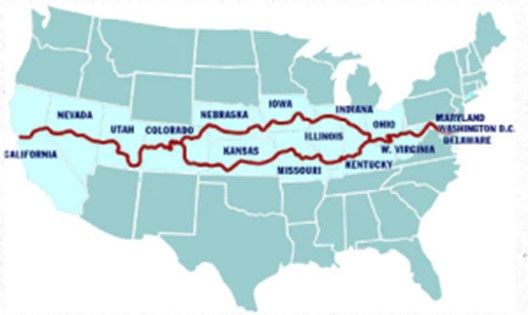
Several years ago (2021) I blogged on how a pizza restaurant in Ohio was using the surplus of Brood X cicadas to offer a Spicy Thai Cicada Pie.  At the time I mentioned cicadas living in the southern states (and Arkansas) are defined as Brood XIX.  This is a 13-year emerging Brood prepared to emerge in April 2024.  While I am still skeptical of trying a cicada pie, the emergence is going to be momentous as two different broods with trillions of periodical cicadas emerge simultaneously this year.  The two broods represent 13-year and 17-year periodical cicadas which will reach their mating cycle at the same time.  While they will emerge at the same time, most will still be geographically separated.  Brood XIX (13 year cycle) will emerge in 14 states across America’s Midwest and Southeast, while Brood XIII (17 year cycle) will appear in five states in the Midwest.  The last time this phenomenon occurred was 221 years ago (1803) and it will not happen again until 2245.  Only Illinois and Indiana will experience the double emergence of these cicada broods. 

When I went online, I found cicadas are a superfamily (Cicadoidea) of insects in the order Hemiptera (true bugs).  The superfamily is divided into two families, the Tettigarctidae with two species in Australia, and the Cicadidae with more than 3,000 species described from around the world.  One exclusively North American genus, Magicicada (the periodical cicadas), spend most of their lives as underground nymphs then emerge in predictable intervals of 13 or 17 years, depending on the species and the location.   The cicada species that emerge together in the same year are collectively called a brood and are labeled with Roman numerals.  Broods are complex groups of different species that emerge in different parts of the country at the same time.  Across the US, there are 12 broods of 17-year cicada, and three broods of 13-year cicada.  Why the broods emerge together is still the subject of scientific debate.  Some hypothesize their life cycles are an evolutionary response for avoiding predators’ life cycles and a way to protect against brood hybridization.

Of the more than 3,390 species of cicada around the world, only seven in North America are known to be periodical.  The rest emerge annually.  Many of the periodical cicadas can interbreed and produce hybrids.  Where the broods cross over this year, three species of Brood XIII cicadas will have the opportunity to interbreed with four species of Brood XIX cicadas.   When periodical cicadas emerge, they bring great benefits to the environment. The nymphs aerate the soil as they tunnel to the surface, improving water infiltration and encouraging root growth.  When they die and decompose, they add nutrients to the soil.  The cicadas’ behaviors are changing.  They are emerging earlier in the spring than they did a century ago and there have been more broods emerging four years ahead of schedule according to Gene Kristky, entomologist at Mount St. Joseph University.  Destruction of forests also threatens populations.  In 1954 the entirety of Brood XI went extinct because of forest clearing for agriculture and urbanization.  Michael Raupp, an entomologist at the University of Maryland, says the emergence is like nature putting on a show, “It is a wicked cool and interesting event that happens nowhere else on Earth.”

THOUGHTS:  The assorted species of Magicicada cicada have earned themselves a world-wide following due to their emergence in tremendous numbers, but not everyone enjoys it.  Homeowners complain about the mess of tiny corpses on their lawns and driveways, and they can produce calls of up to 75 decibels (think vacuum cleaner or hair dryer).  A cicada does not bite, sting, or carry diseases.  Neither are they effectively controlled by pesticides.  Maybe eating them on pizza is the best way to deal with them after all (?).  Act for all.  Change is coming and it starts with you.