
Wood Sorrel

December 29, 2023

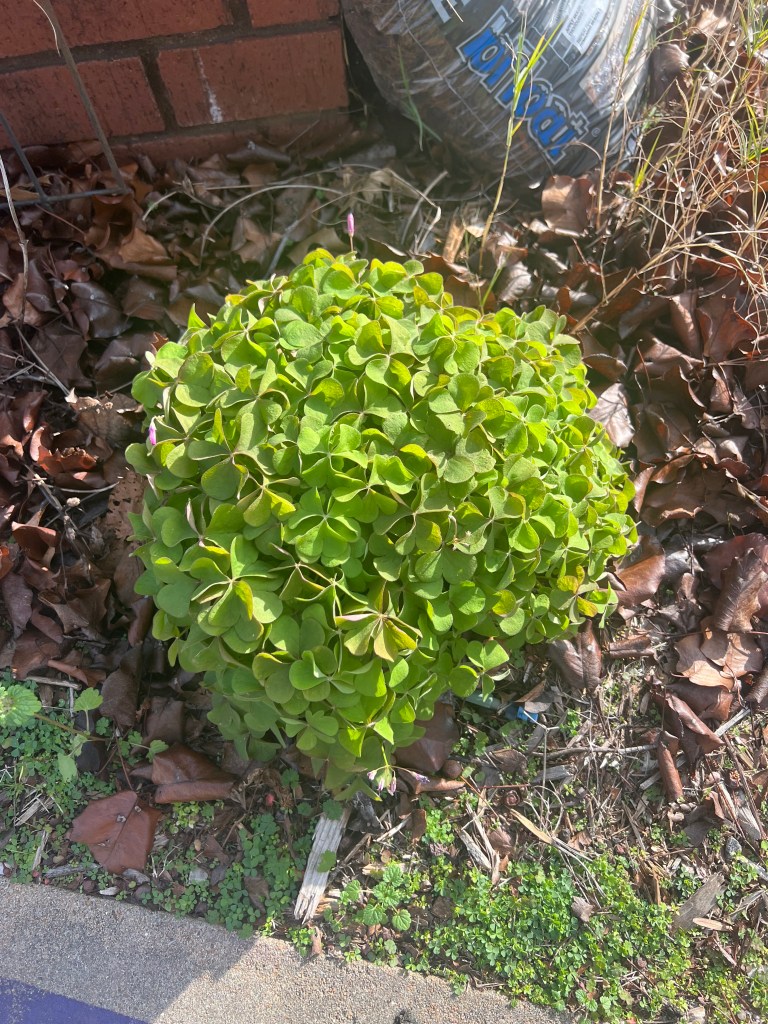
For the last five years we have lived in Arkansas I have been amazed by the resiliency of the clover-like plant that thrives in the mailbox flower bed.  It seems to flourish early in the spring and then it blooms and dies back in the summer.  I have considered this a weed and tend to rip out the dead foliage, only to be surprised when the plant returns in the fall.  This year we had cold weather interspersed by unusually warm days in the 60+F (15.5+C) range and the plant has again grown into a bulbous circle of leaves.  This morning I also noticed small pink flowers that were tightly closed.  I assumed they had withered from the freezing cold we had last night but they still seemed viable.  I finally realized this was neither clover nor a weed but something else.  It was pink wood sorrel.

When I checked online, I found pink wood sorrel (Oxalis debilis) is a perennial deciduous plant and herb in the family Oxalidaceae.  The plant is indigenous to South America, but it has become a cosmopolitan species that occurs in all continents except Antarctica.  The species is also found in both temperate and tropical areas.  Wood Sorrel grows from bulbs but has a modified subterranean plant stem that also sends out roots and shoots from its nodes (a rhizome).  This creates a dense and mounded cluster that grows up to 1 foot (30 cm) tall.  The flowers bloom once in the spring and again in the fall and may be partially concealed by the four leaved foliage that resembles large clover (genus Trifolium).  The flowers and leaves both fold at night.  The fruit is a dry capsule that contains projected seeds which have an elastic outer layer (integument).  In Europe the plant is sterile and can only be propagated by bulbs.  This is not well-loved in the UK, and the Royal Horticultural Society advises pink wood sorrel can be a weed.

Wood sorrel may go dormant in dry, hot summers (as mine frequently does) if it is not watered.  The flowers, roots and leaves of wood sorrel are all edible, and the leaves have what many describe as “a zesty lemony flavor”.  There is some concern that the plant should only be consumed in small amounts as the leaves contain oxalic acid that is classified as poisonous and can cause calcium deficiency if eaten in larger amounts.  Recent studies have shown this fear is exaggerated as the effects are local and not systemic or internal.  Sorrel is tolerant of full sun to partial shade and although it prefers moist, well-drained soil and while it will tolerate dry soil it will go dormant.  It is almost impossible to kill sorrel and it is easily propagated by division of the bulb-like rhizomes in the fall or spring.  Pink wood sorrel is commonly used as an indoor potted plant as well as a border perennial.  It is well suited to my mailbox.

Thoughts:  I am constantly intrigued by the change in attitude toward a plant or animal when I learn more about its nature.  Over the last five years I basically ignored the pink wood sorrel that grew in the planter.  It grew on its own without attention, so I mostly left it alone.  Now I know this is a decorative herb that was purposely planted by my mother-in-law, and this gives the plant new meaning.  Rather than a weed to be tolerated it is part of the ground cover that adds color to our yard during different times of the year.  A similar effect happens when we take the time to learn about the nature of people we do not know and rarely interact with.  We generally ignore them unless their actions force us to take notice.  Our first response is often to get rid of them (or keep them from coming) because they are just “weeds” in our carefully tended lawn (country).  Getting to know others as individuals rather than categories opens us to change our attitudes.  Act for all.  Change is coming and it starts with you.

Tamales

December 28, 2023

Hidden in the back of the Christmas Eve edition of my local newspaper was a “feel good story” about how a group of nuns started a holiday tradition in El Paso, Texas.  The article recalls how the culture of the Texas Borderland is tightly wrapped with Mexico and the tamal tradition begins with the cold weather and accelerates during the holiday celebrations known as “Guadalupe-Reyes”, or the Catholic holy days from December 12th(Day of the Virgin of Guadalupe) to January 6th (Day of Los Reyes Magos, or Three Kings Day).  At Food City, operated by the Santos family, they make and sell 36,000 tamales in December.   It is not a family recipe that keeps customers coming back.  The original recipe belongs to Dominican nuns from Mexico who needed money for their convent.  A group of nuns set out in the early 1980’s on a tour of US cities to raise money to build a chapel where they could pray.  The trip was supposed to take the women to Los Angeles, Dallas, and Chicago.  No one was willing to help in Los Angeles or at their stop in Dallas.  However, they had stopped in El Paso enroute, and something drew them back.  That is where they met José “Joe” Santos who had opened Food City in downtown El Paso.  The women ended up making tamales in his kitchen which they sold out of the store.

When I checked online, I found tamales (Spanish, tamal) are a traditional Mesoamerican dish made of masa, a dough made from dried corn kernels mixed with an alkali solution (nixtamalization) steamed in a corn husk or banana leaves.  Tamales originated in Mesoamerica as early as 8000 to 5000 BCE and the preparation of tamales likely spread from the indigenous cultures in Guatemala and Mexico to the rest of Latin America.  Archaeologists Karl Taube, William Saturno, and David Stuart found tamales in pictorial references in the Mural of San Bartolo, in Petén, Guatemala dating from around 100 CE.  The Aztec and Maya civilizations (and Olmec and Toltec before them), used tamales as easily portable food for hunting trips, traveling large distances, and nourishing their armies.  Tamales were considered sacred and were seen as the food of the gods.  All four of these indigenous peoples considered corn a central part of their cultural identity and tamales played a large part in their rituals and festivals. 

Many families in El Paso spend the holidays together preparing tamales for Christmas Eve.  “People, when they think back to memories of their families, a lot of it’s centered around food,” said Melissa Santos of Food City. “Memories about food, how this tasted or the smell of this.  So, whether they’re buying the ingredients from us, or they’re buying the readymade food, you know their tradition started here.”  The process takes hours, even with many hands at work.  It requires mixing the corn masa by hand with pork lard, preparing the savory or sweet fillings, soaking the corn husks, spreading a layer of masa on an open husk, spooning in filling, then carefully folding each tamal like a gift.  The lot is placed in concentric circles in a large pot to steam-cook.  In El Paso, the flavors are almost always the same: pork with red chiles, chicken with green chiles, cheese with green chiles, and sweet tamales studded with raisins.  When the first hint of cold weather hits the Texas desert, a collective craving sets in and El Pasoans head to their favorite bakery or grocery to buy tamales by the dozen.

Thoughts:  The story began saying the El Paso Times had omitted including the Food City tamales in their story on the “best tamales in town”.  Melissa Santos took a bag of two dozen tamales to the newspaper and told them the story.  The nuns built their chapel and saved the floundering family business.  Now people come from all over El Paso to buy their tamales.   How Food City tamales stack up against others is not the point.  The shoppers who line up for their two dozen tamales all have their own reasons.  This could be a craving, a convenience, or a fond memory of the recipe handed down by nuns.  Act for all.  Change is coming and it starts with you.

Mistletoe Cactus

December 27, 2023

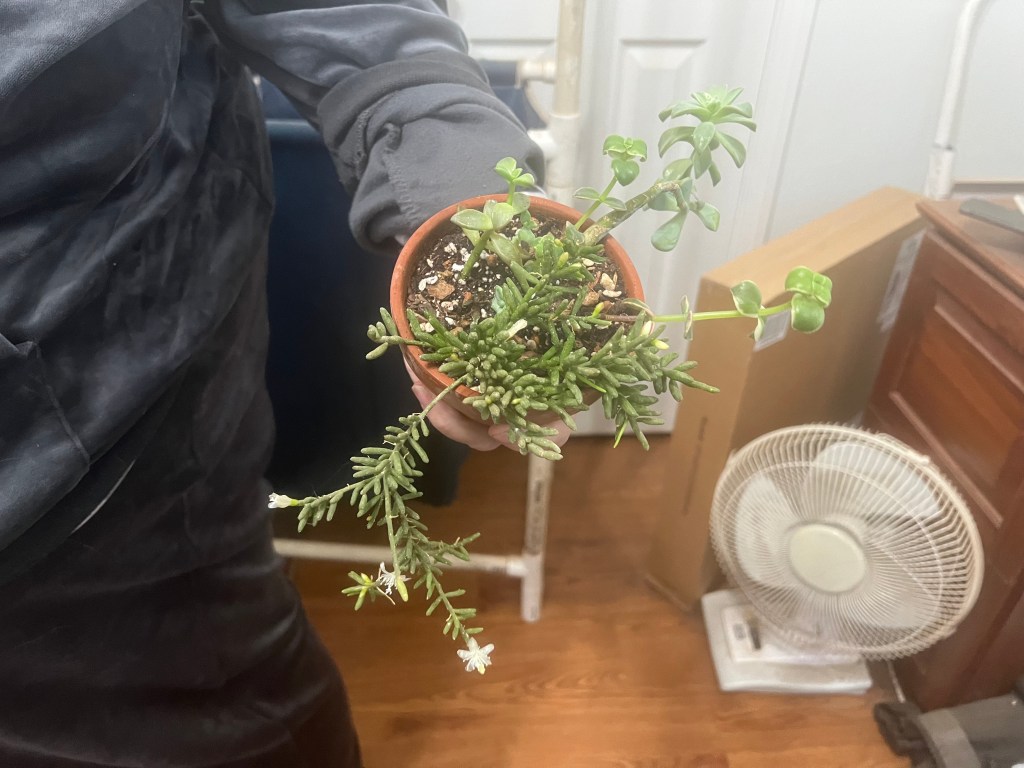
Melissa had taken a quick break from work and used the time to water a few of her winter growing cacti.  I have mentioned the holiday cacti of the genus Schlumbergera are often referred to by the times they bloom (Christmas and Thanksgiving) while the Easter cactus (Rhipsalidopsis gaertneri) bloom later in the spring.  She noticed another of her plants of the same tribe (Rhipsalideae) was also now in bloom and she brought it into my office to show it off.  The flowering plant was small, so Melissa had used the pot to try and resuscitate several other “cuttings” (knocked off by activity) which were also beginning to take hold.  Melissa told me the flowing plant was called a Mistletoe cactus as it resembles the Mistletoe plant (Phoradendron leucarpum) native to North America and blooms around the same time.

When I checked online, I found the mistletoe cactus (Rhipsalis baccifera) is an epiphytic cactus native to the rainforests and originates from Central and South America, the Caribbean, and Florida.  Epiphytic plants grow upon another plant or object for physical support and derive their moisture and nutrients from the air, rain (or water for marine species), or debris accumulating around it.  Mistletoe cactus is also found throughout the tropics of Africa and into Sri Lanka (known as “nawahandi”) and is the only species of cactus naturally occurring outside the Americas.  One hypothesis is that the cactus was introduced to the Old World by migratory birds, and this occurred long enough ago for the Old World populations to be regarded as distinct subspecies.  An alternative hypothesis is that the species crossed the Atlantic Ocean on European trading ships between South America and Africa and was then spread more widely by birds.  The species shows considerable polymorphism and can be divided into numerous subspecies.  Mesoamerican specimens usually have four homologous sets of chromosomes (tetraploid) and South American specimens have two homologous sets of chromosomes (diploid).  The genera currently assigned to the tribe Rhipsalideae were subject to considerable confusion and disagreement prior to the clarification by Wilhelm Barthlott and Nigel Taylor in 1995.

Sophia Lee is a self-described cacti aficionado and extols the virtues of the Mistletoe cactus.  Lee says the cactus is also known as the wickerwork cactus, small-seeded mistletoe, or spaghetti cactus, and each of these common names carry a unique story that hints at the distinctive characteristics of the plant.  Rhipsalis Baccifera’s common name (Mistletoe cactus) reflects more than the small white flowers that resemble mistletoe berries.  Like the mistletoe that people hang during the holidays, these cacti and their mistletoe-like white flowers “capture hearts and transcend boundaries”.  Their delicate stems reach out like interconnecting lives and reflect the creation of a tapestry of relationships.  Resilient yet tender, the Mistletoe cactus seems to whisper tales of unity and love, all in the language of botanical beauty.  Lee goes on to say each subspecies of the cacti has their own allure.  “For real cacti enthusiasts, the Rhipsalis genus is a treasure trove of wonder, a genuine nexus of botanical delight” that brings her to awe.  While Lee’s description may seem a bit flowery or even anthropomorphic (reflecting human characteristics), like Melissa, she obviously enjoys her plants.

Thoughts:  Both Lee and Melissa have mentioned they use the care and nurturing of their plants to relax and destress from the tedium of other work.  Events like the blooms on the Holiday and Mistletoe cacti then become a bright spot to further enhance the experience.  One of the downsides of retirement for many is that their “work” has defined who they are for the last 50 years.  If we are unable to redefine who we are and reevaluate our self-worth based on that new image we can quickly sink into depression or worse.  You are not defined by your job, or the labels given to you by others.  We need to find our own self-worth and live it proudly.  Act for all.  Change is coming and it starts with you.
Raised

December 26, 2023

I had a quiet and relaxing Christmas (hope those who celebrate did as well).  We are usually away at someone or another’s house but none of that worked out this year and this is the first time in four years I was not working.  I instead sat around and watched football, with several games on each of the last five days.  I did not think it could happen, but I found out there is too much of a good thing, even though most of the games were fun to watch.  On Christmas morning Melissa and I took our time getting up and going (MUCH different without human kids) and then made breakfast of link sausage and French toast.  Luckily, we had leftover French bread (unsliced) from the night before that allowed me to cut thick slices for the toast.  Now that it is just the two of us, we like to have scavenger hunts for the other to find their present.  While my hunt took Melissa all over the house, her presents for me were too big to move around.  Instead, my brother had drafted riddles for me to figure out and then Melissa would bring out the boxes.  I have been researching raised beds prior to setting on the grow bags I used last year.  The bags had worked great, but after the season they became a tasty snack for Loki.  Since my gift was raised beds made of steel, I do not think Loki will be able to dismantle them.

When I checked online, I found Raised bed gardening is a form where the soil is raised above ground and enclosed in some way.  The Raised bed can be made of wood, rock, concrete, or other materials, and formed into any size or shape.  The soil is usually enriched with compost and other amendments.  A raised bed can contain flowers, but they are most often used to grow vegetables in patterns that allow the plants to be closer together than conventional row gardening.  The spacing allows the mature vegetable leaves to barely touch each other.  This creates a microclimate where weed growth is suppressed and moisture is conserved.  Raised beds can be effectively used to control erosion and recycle and conserve water and nutrients if built along the contour lines on slopes.  Raised beds are compatible with square foot gardening (dividing the growing area into small square sections, typically 1 foot (30 cm) on a side) and companion planting (planting different crops in proximity).

Untreated lumber is the most common material for making raised beds.  If treated lumber is used it is recommended to use a plastic liner to avoid the chromated copper arsenate (CCA) common in the US and Europe since 2004.  Railroad ties (sleepers) are also used with steel rods to hold them in place.  Concrete blocks are less aesthetic but are inexpensive and easy to use.  Prefab raised beds are becoming popular and are made from polyethylene that is UV stabilized and food grade so it will not leach toxic chemicals and a double skinned wall provides insulation to minimize temperature fluxes and drying out the soil.  Raised beds can be covered with clear plastic to protect the crops from wind and strong rains.  Manufactured raised beds can also be made of wood, metal, stone, and plastic.  Regardless of material, raised beds have the benefit of extending the planting season, reducing weeds (done properly), ensuring the quality of soil, and since the soil is not compacted by the gardener the roots grow easier.

Thoughts:  Melissa gave me two types of raised beds.  One was 17 inches (43 cm) and the other 32 inches (81 cm) tall.  It said on the website the taller raised bed “enables the elderly and physically disabled to grow vegetables without having to bend over to tend them”.  I had to wonder where I fit into that depiction.  I see raised beds as the next step toward building a sustainable garden.  Unlike my grow bags, once I get my raised beds in place, they should last several decades and will not be moving.  I hope the next owner likes to garden.  Act for all.  Change is coming and it starts with you.

Creekmore

December 22, 2023

Last night Melissa and I went out to eat at one of our favorite Italian restaurants.  This was one of our go-to spots when we were dating and after we were married, we would generally take her parents out for a meal when we were back in town.  When we moved back to Arkansas this continued to be a date night destination until everything closed during the pandemic.  Now we have gotten out of the habit, but still manage to eat there several times a year.  When we arrived last night, I was disappointed to find they had removed my favorite entrée, chicken carbonara.  When we asked our waitress about this, she said she did not know why the owner had removed the dish, and that this was her favorite as well.  I reluctantly ordered a spaghetti and lasagna combination (it was wonderful).  After the meal we decided to participate in another holiday tradition of ours and went to see the lights at Creekmore Park. 

When I checked online, I found that Creekmore Park is one of Fort Smith’s four community parks.  The park’s unique set of amenities provides an opportunity to enjoy the park in all seasons.  The Creekmore pool is open May 27th to July 29th and is the region’s only Olympic-size outdoor lap pool.  There is also a diving facility and a large community swimming pool.  Amenities at the pool include a shallow-depth splash area for smaller children, inflatable obstacles, public bathrooms, and lifeguards for safety.  Other Creekmore Park features include an 18-hole Miniature Golf Course, Tennis Courts and Center, a fitness trail, community center, playground equipment, and the Creekmore Express Train.  The train is free to ride but donations are encouraged.  From November 27th to December 23rd the miniature train becomes the Creekmore Holiday Express that takes visitors on a journey through thousands of holiday lights adorning the park.

Some miniature trains (like the Creekmore Express) are considered amusement rides and are found in amusement parks and municipal parks, while others are sold to be used as backyard railroads.  Ridable miniature railways run on tracks and the trains may be exact scale models, including a live steam locomotive.  Other train rides are kiddie rides which may use simple, colorful equipment that has the driving mechanism hidden under vacuum-formed plastic covers.  Trackless trains do not use tracks and usually consist of railroad-like cars towed behind an ordinary, or modified motor vehicle.  These rides are often used for sightseeing tours.  Some roller coasters like the Big Thunder Mountain Railroad attractions in several Disney parks also resemble train rides.  Paul Allen Sturtevant was a sales rep and then manufacturer of the torque wrench developed by Walter Percy Chrysler for Chrysler Corporation.  Sturtevant patented the torque wrench in 1938 and became the first individual to sell torque wrenches.  During the 1930’s Sturtevant was also an early maker of miniature train rides for children.  This began as a hobby, but Sturtevant later made them for rental to department stores, and eventually produced them in a plant in Addison, Illinois.  Sturtevant stopped making miniature trains when World War II shifted production away from consumer goods.

Thoughts:  When Melissa and I were dating we rode the Creekmore Holiday Express (once).  It struck me as something to do on a date, or with kids, but was not exactly a “thrill ride”.  Stopping the Creekmore Express during the pandemic and the manufacture of miniature trains in World War II illustrates how social attitudes affect individual activity.  What was once considered right or acceptable can lose favor and become out-of-step or objectionable.  While we may not be responsible for the actions of the past, we will be held accountable for our response today.  Act for all.  Change is coming and it starts with you.
Amend

December 21, 2023

You may recall that in September after my poor potato harvest, I started researching how to amend my three vegetable beds to increase their yield next year.  I had removed the tops of the plants and then did little else until October, when the smartweed began to take hold.  Loki had also begun to dig holes in the beds, so I put up small fencing as a deterrent and cleared away the brush from along the back of the house.  In November I purchased taller fencing as I found Loki was merely jumping over the top and still digging in the beds.  I also purchased three bags of a compost and cow manure mixture (two of the ingredients recommended to amend the beds) and planned to put one bag on each area.  These sat on the patio until Loki decided to “open” one of the bags for me.  That meant last week I finally got around to amending the soil in one of the beds and getting the taller fencing up on another. 

When I checked online, I found that most garden soils are imperfect and can benefit from adding organic fertilizers or compost mixes.  However, if you want to amend your soil the right way you will need to understand what your soil either lacks or has too much of.  While you can sprinkle a random fertilizer into your garden, you will have better results if you take time to study your soil and come up with a plan for how to improve it.  Good garden soil is the basis of your garden because it provides the nutritional foundation for your plants.  You also need to consider the structure of your soil.  The first thing to consider is how acidic or alkaline your soil is (soil pH).  This is essential and allows you to understand what kinds of plants will grow best in your garden and which will not grow well.  You can amend the soil by adding lime to increase the pH or sulfur to lower it.  The soil structure is also called the soil composition and describes the size of your soil particles and how much space (for air and movement) is in between those particles.  Structure also describes how easily (or not) water gets absorbed into the soil. Soil structure is generally sand, clay, silt, or some combination of the three.  The ideal structure is called “loam” which is a perfect balance of all three soil types.

This morning I woke to a text from Melissa that Zena had gotten her collar tangled in the fencing and had freaked out as it dragged along behind her as she tried to get back into the house.  I had visions of the new fencing strewn across the back patio as I got dressed and came to see the damage.  Melissa told me Zena appeared to be fine (just shaken).  As I looked outside, I noticed it was not my new fencing that had come down, but the shorter fencing I had placed around the grow bags was gone and now lay in a pile on the patio.  Seeing the taller fencing had worked (at least so far) inspired me to finish the amend on the second bed and to shore up the fence.  While I had planned on finishing the third bed with an amend and taller fencing it began to sprinkle.  We are scheduled for a major rainstorm so instead I cleaned up the destroyed fencing, blew off the patio to clear the debris, and reset one of the gutter spouts so it would drain away from the bed.  Loki loves to play in mud puddles.

Thoughts:  As I thought about my long journey from research to action concerning wanting to amend my garden beds, I knew it was a matter of procrastination.  While I do not consider myself to be a procrastinator, it can happen when the task is something I am unsure of how to complete.  Habitual procrastinators represent approximately 20% of the population, and “I do not feel like it” can take precedence over their goals or responsibilities.  Psychologists have identified various drivers of procrastination, from low self-confidence, anxiety, a lack of structure, or an inability to motivate oneself to complete unpleasant tasks.  When we procrastinate, we can become fixated on negative thoughts and changing habits requires even greater effort than completing the task.  What the world needs is people willing to “get ‘er done”.  Act for all.  Change is coming and it starts with you.

Remembrance

December 20, 2023

National Homeless Persons’ Remembrance Day is commemorated each year in the US on December 21st (tomorrow), the winter solstice in the Northern Hemisphere and the longest night of the year.  This remembrance began in 1990 and the National Coalition for the Homeless and the National Health Care for the Homeless Council have sponsored this day to call attention to the plight of America’s homeless population.  This is also a day to encourage the public to act on behalf of homeless people.

When I went online, I found the origin of homelessness in America can be traced back to colonial times.  As early as 1640 English “vagrants” were listed as outcast individuals and subject to arrest.  King Philip’s War (1675-1676) against the indigenous people resulted in homelessness as colonists were driven out of their homes to seek shelter in the forests or coastal areas.  Many remained idle until a law was enacted to prevent “idleness” in the cities, and idle people were made to be servants or indentured servants.  Homeless people were called “Sturdy beggars” in the mid-18th century and were found in every colonial town.  During the American Revolution homelessness increased and after the war many were forced into homelessness due to insufficient means.  By the depression of 1857, most American cities were full of homeless people with no government effort to intervene.  Private charities and organizations like the “Western Soup Society” in Philadelphia organized to help people with food, but without government funding.  The outbreak of the Civil War made conditions worse as war veterans remained unemployed and others lost their property to war and natural catastrophes.  Later events like The Great Depression and World War II again increased the number of homeless in the US.  Remembrance of the legacy of homelessness is acute, as many pass their homelessness to the next generation.

In the 1980’s, the US government began to acknowledge homelessness as a national problem.  The Homeless Survival Act (1986) provided emergency relief and long-term solutions to homelessness and the Homeless Eligibility Clarification Act (1986) ended the problems associated with a permanent address and other social barriers.  This led to the introduction of food stamps benefits, Medicaid, and other benefits.  In the US today individuals make up 66.7% of the total homeless population, while families make up the remaining 33.3%.  Homelessness has increased nationally by almost 1% in recent years.  Homelessness is not the same for everyone and is often broken into three categories.  Transitional Homelessness is most common where a person is homeless for a short period due to a crisis.  Chronic Homelessness is when someone has been homeless for more than a year or has had frequent episodes of homelessness within the last two years.  Episodic Homelessness happens when a person has been homeless three times or more within the last year or when someone has periods of homelessness on-and-off in their life.  A Day of Remembrance honors the fact that all need a safe place to live.

Thoughts:  There are actions you can take to observe Remembrance Day (as well as on other days).  You could ask your community for the number of homeless people who died in the previous year and then hold a tribute to remember them.  The tribute could be a candlelight march, a religious service, or even a simple performance.  Ideally, these should be performed outdoors to share a little of the experience of the homeless population.  You could volunteer at a homeless shelter by serving meals, helping with kids, or organizing donation drives.  Local shelters serve a variety of people and need help in whatever skills you may offer.  Homeless organizations usually operate under strict budgets or depend on donations and your financial gift may go a long way in helping provide for the needs of homeless individuals.  Most important, see homeless people as human beings and act toward them as you would like to be treated.  It is not about a handout, but a hand up.  Act for all.  Change is coming and it starts with you.
Rankings

December 19, 2023

I have mentioned how even though I switched my local newspaper to a digital format it is still being delivered.  I have yet to find out how to cancel something I never ordered.  I was surprised this morning when I went out to retrieve my “digital” newspaper to see our free hometown weekly had also been delivered, as this paper is delivered on Wednesday.  As I poured over the local coverage, I noticed the banner date was, “Wednesday, December 18, 2023”.  This threw me at first because the paper had been delivered on Monday, December 18th and Wednesday is going to be the 20th.  The front page lead was a story congratulating the town’s high school football team for winning the 6A State Championship (with a full page of pictures on the back) and being on top of the State’s rankings.  While it was a nice gesture, the game took place on December 1st, or three editions (weeks) ago.  I guess things do move slower in a small town. 

When I went online, I found the Greenwood Bulldogs were crowned 6A state champions after beating Little Rock Christian Academy, 41-23.  This is not the first championship for the varsity team.  Since 1996 the Bulldogs have appeared in 17 state finals under 3 different head coaches and won the championship for the 11th time in school history.  Greenwood’s rise as a football power began under former head coach Ronnie Peacock, who took two teams to the state finals (1996, 2000) and won in 2000.  Legendary Head Coach Rick Jones took the Bulldogs to 11 state finals and won eight titles (2005-07, 2010-12, 2017-18).  Chris Young was elevated to head coach when Jones left for an advisory position with the University of Missouri Tigers in 2020 and promptly led the Bulldogs to a 10th state title during the difficulties of the pandemic.  That team was perfect (14-0) as was this year’s squad (13-0).  Young and his staff have taken the Bulldogs to the finals all four years of his tenure, losing in the championship in the intervening years to El Dorado and Pulaski Academy, respectively.  Young was also named Conference 6A West’s Coach of the Year.  The win catapulted the Bulldogs from 3rd to 1st in Arkansas’ overall 2023 football rankings. 

According to MaxPreps the Bulldogs have never been ranked in the top 25 High School Football teams nationally.  Bishop Gorman (Las Vegas) began the season at No. 2 and ascended to the top spot after St. John Bosco (Bellflower, California) posted a 28-0 shutout win over then-No. 1 Mater Dei (Santa Ana, California) on Oct. 13.  The Gaels held the top spot over the final two months of the season, capping a 12-0 campaign with a dominant 56-11 win against Liberty (Henderson) in the Nevada Class 5A Division I state championship.  This is the second national championship for Bishop Gorman in the last eight years.  Bishop Gorman joins Southlake Carroll (Southlake, Texas), Don Bosco Prep (Ramsey, N.J.), Mater Dei, and St. John Bosco as the only two-time MaxPreps National Champions.  MaxPreps was founded in August 2002 by Andy Beal and in 2007 was acquired by CBS Interactive.  The company professes the goal of covering, “Every team, every game, and every player in High School Sports.”  As of 2017, MaxPreps covered a total of 29 sports categorized into one of three categories: Boys, Girls, and Co-Ed.

Thoughts:  While national rankings were not considered when my brother was in High School, he did play on a football team that sported three High School All Americans.  Now, every year MaxPreps awards an American high school the MaxPreps Cup signifying they are the #1 Athletic Program in the Nation across all sports.  With all the pressure now to be “the best”, many of the top ranked teams seem to be Academies or Christian schools which give them the advantage of “recruiting”.  Bentonville High School is a public school in Arkansas that won the award in consecutive years (2013 – 2014, 2014 – 2015).  In most competitions it usually comes down to creating a winning culture.  That is true in sports, in academia, and in life.  Act for all.  Change is coming and it starts with you.

Bluetail

December 18, 2023

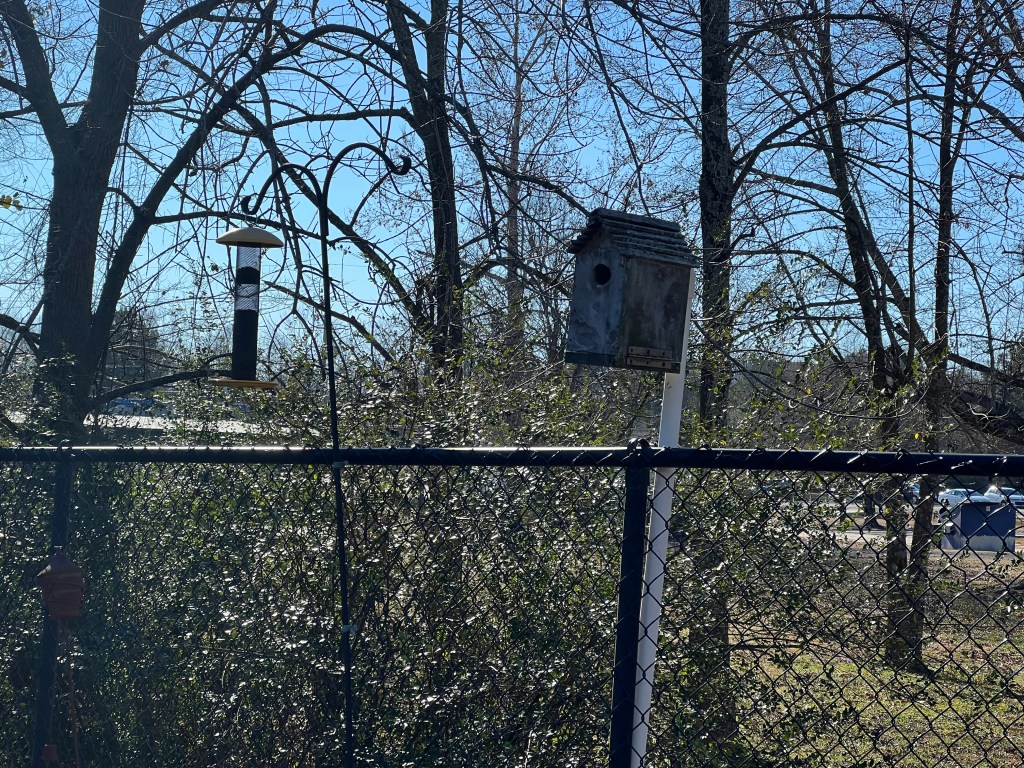
Tucked into the back section of my local newspaper was a USA Today article on the appearance of a new bird along the eastern coast of the US.  The rare bird popped up in the feeders outside of birder Harry Riker’s house in Ocean County, New Jersey.  Riker did not recognize the species, but took a photograph and had no luck finding it on his birding app.  When he posted to his local bird watching community on Facebook one of the members identified the bird as a red-flanked bluetail.  Cornell Lab of Ornithology says the birds are typically found in northern Europe and Asia.  Only a few confirmed reports of the bird have been made within the US, and those were all in the western half of the country.  Jenna Curtis, a bird expert for Cornell’s eBird.org website, confirmed Riker’s photographs marked “the first-ever confirmed red-flanked bluetail in the eastern US. . . The next nearest report was a bird in Laramie, Wyoming in November 2019.”  Since the appearance of the bluetail outside of Riker’s house, bird lovers have flocked to his community from across the country to catch a glimpse.

When I went online, I found the red-flanked bluetail (Tarsiger cyanurus), also known as the orange-flanked bush-robin, is a small passerine (Order of perching birds) bird that was formerly classed as a member of the thrush family (Turdidae) but is now classified as an Old World flycatcher (Muscicapidae).  The genus name (Tarsiger) is from Ancient Greek tarsos (“flat of the foot”) and Latin gerere (“to carry”).  The species name (cyanurus) is derived from Greek kuanos (‘dark-blue”) and oura (“tail”).  The small bird is from 5 to 5 1/2 inches (13–14 cm) long and .35 to .63 ounces (10–18 g) in weight, or just slightly smaller than the European robin (Erithacus rubecula).  Both sexes have a blue tail and rump, and orange-red flanks, along with a white throat and greyish-white underparts.  The adult male has additional dark blue upperparts, while females and immature males are plain brown above apart from the blue rump and tail and have dusky breasts.  Bluetail are insectivores, flying from perch to perch and catching insects in the air or on the ground.   

The red-flanked bluetail is a migratory species breeding in mixed coniferous forests with undergrowth in northern Asia and northeastern Europe, from Finland east across Siberia to Kamchatka, and south to Japan.  It mainly winters in southeastern Asia, in the Indian Subcontinent, the Himalayas, Taiwan, and northern Indochina.  The breeding range is slowly expanding westwards through Finland, and it is a rare but increasing vagrant to Great Britain.  There have been a few sighted in North America, mostly in western Alaska as well as one on San Clemente Island off the southern California coast, even one overwintering on the Central California coast in Santa Cruz, California, in 2023.  Sightings now include the one spotted in New Jersey this December.  According to the American Birding Association, it may be impossible to determine which direction the bird in Rikers’ yard came from, “as the species is a rare but increasing vagrant to western Europe with several records now in Iceland, including two earlier this fall.”  Apparently, this bird species likes to get around.

Thoughts:  I was amused by Riker’s saying bird lovers are now flocking to his community to try and catch a glimpse of the rare red-flanked bluetail and are all over the neighborhood.  “We’re all retired and we’re really enjoying it. … This is good excitement.”  Over the holidays it is easy to get caught up in the hustle and bustle and forget to take time to step back and enjoy the changing season.  Pleasure can be found most anywhere, from the birders watching the birds to the people watching the birders.  Take time to enjoy your surroundings.  Act for all.  Change is coming and it starts with you.

Fritta

December 17, 2023

Most days I practice intermittent fasting and skip eating until afternoon.  The idea is to designate 16 hours of fast followed by an 8 hour eating window.  This worked initially as a diet method, but I have not continued to lose weight.  I have continued the practice regardless and after three years it is now part of my daily habit.  The only problem I have with this routine is the foods generally served at breakfast are some of my favorite dishes.  I have compromised and sometimes make a breakfast entrée for lunch (or dinner).  Saturdays are the exception, and I generally fix a mid-morning breakfast.  I was sidetracked yesterday and around noon Melissa said she was going to reheat the chicken enchiladas I had made the night before.  I said OK but had been thinking about making another breakfast meal.  When I began putting the dish together Melissa changed her mind and decided she would also like to eat my frittata.

When I went online, I found Frittata is an egg-based Italian dish like an omelet, a crustless quiche, or even scrambled eggs that is enhanced with additional ingredients such as meats, cheeses, or vegetables.  Frittata is derived from the Italian word friggere and roughly means “fried”.  This was originally a general term for cooking eggs in a frying pan (skillet) and referred to anything from a fried egg to a conventional omelet to an Italian version of the Spanish omelet that was made with fried potato.  Outside Italy, frittata was the equivalent to “omelet” until at least the mid-1950s.  While British chef Delia Smith describes the frittata as “Italy’s version of an open-face omelet”, there are four key differences.  Additional ingredients are added to the beaten egg mixture while the eggs are still raw and not laid over the mostly cooked eggs which are then folded.  The eggs are often beaten vigorously to incorporate more air and create a fluffier result.  The mixture is cooked over a very low heat for at least 5 minutes (typically 15) to allow the underside to set up but the top to still be runny.  Finally, the partially cooked frittata is not folded like an omelet but is instead either turned over in full or briefly set under a grill or baked for 5 minutes.

While that may be the Italian way to make a frittata, it is not how I prepare the dish (surprised?).  I do not fry my dish at all, and instead bake it in the oven.  I am not alone in this method as many of the frittata recipes in the US use a similar process.  My frittata started with a base of shredded potatoes in a casserole dish.  I then diced onions and peppers and scattered them over the potatoes.  The egg mixture is scrambled along with the preferred meat (crumbled bacon or ham) and pored over vegetables.  A layer of cheese completes the dish, which is baked in the oven at 350 degrees for an hour.  This cooks the potatoes while the cheese protects the eggs from drying out.  While this is different than the recipes I have found, it tastes great.  The Pioneer Woman website states, “Use any ingredients you want!  Mushrooms, leeks, different cheeses, tomatoes, zucchini, squash, bell peppers.  Have fun!”  I will admit, what goes into my frittata often depends on what is available.

Thoughts:  The first frittata I made was for brunch served to 75 alums prior to a graduation ceremony.  I was the director’s assistant, and the school did not have money for catering.  I used a recipe supplied by my boss that had breadcrumbs for the base rather than shredded potatoes.  This egg casserole became the basis for what I now call frittata.  Frittata is not the only US dish that has been changed from its traditional recipe.   Most commercially prepared “traditional” dishes are altered to adhere to the US palate and “ethnic food” in America can be unrecognizable to native diners.  Our favorite Chinese restaurant has two menus, one for Americans and an authentic menu.  This includes many of the same dishes, but they are prepared differently.  We prefer to order from the authentic version.  Act for all.  Change is coming and it starts with you.