Dapperling

September 28, 2023

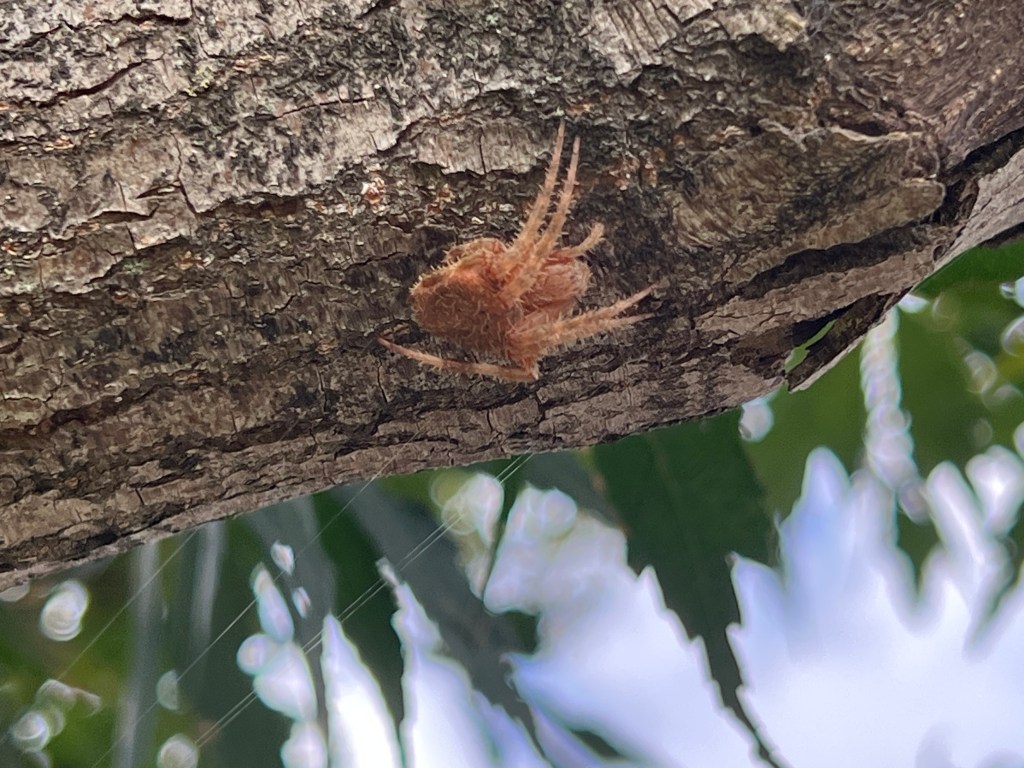
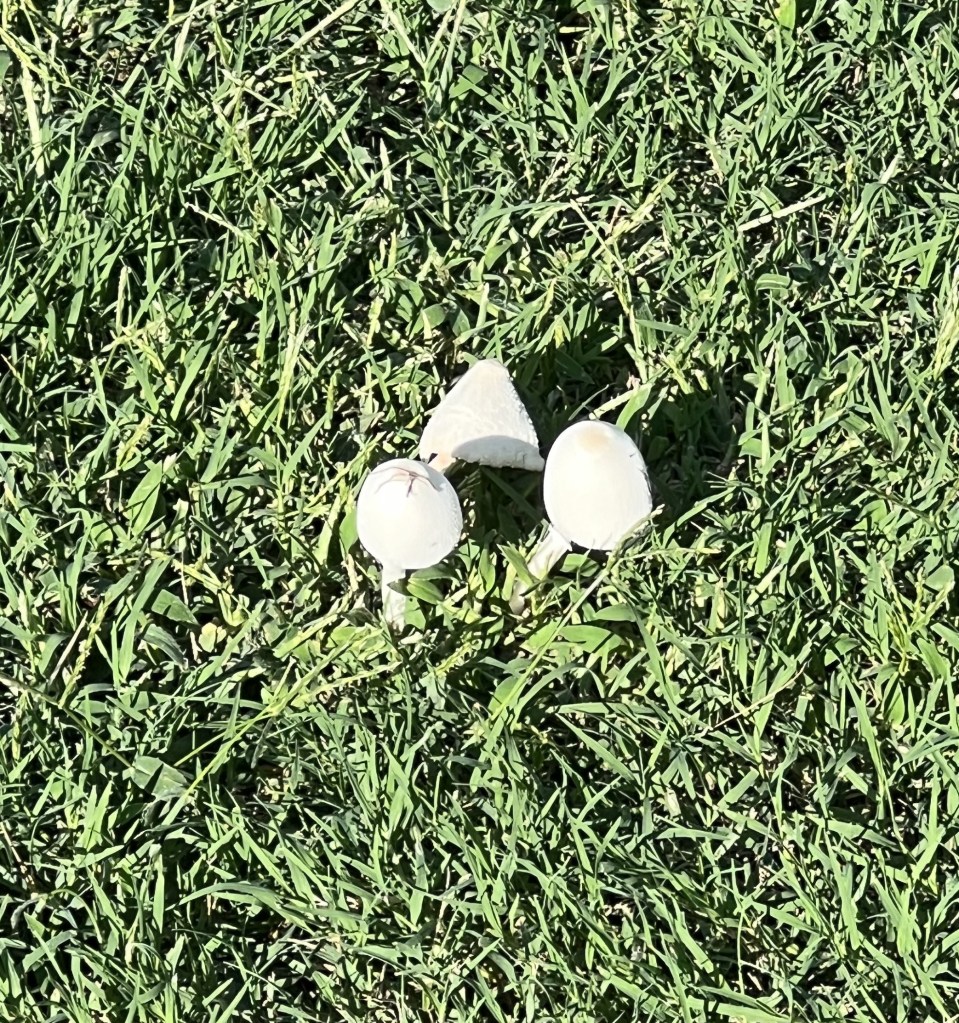
I have mentioned how when I take my dogs for a walk, I need to take each dog separately.  While Loki is used to his harness and even excitedly “helps” me get it on, he has not mastered the art of walking.  He strains at the leash or will stop to investigate some smell and then run full bore back to the end of the leash.  I tried earlier to take both dogs, but Loki spent more time roughing with Zena than walking.  This makes it a concentrated effort to train Loki to walk as we patrol the neighborhood.  Zena instead likes to go to the park where she can see the sights, sniff the smells, and do her business (yes, I bring bags).  After the rains and cooler temperatures last week, I noticed several sections of the park were sporting white dapperling mushrooms.

When I looked online, I found the white dapperling lawn mushroom (Leucoagaricus leucothites), is commonly known as the smooth parasol, woman on motorcycle, or white agaricus mushroom, and is a species of agaric (mushroom or toadstool) fungus.  Archaically, agaric meant ‘tree-fungus’ (Latin; agaricum) but that classification changed with the Linnaean interpretation in 1753 when Linnaeus used the generic name Agaricus for gilled mushrooms.  The species was originally described as Agaricus leucothites by Carlo Vittadini in 1835 and bears a similarity to species of that genus.  Solomon Wasser transferred it to Leucoagaricus in 1977.  The mushroom’s cap is 1 1/2 to 5 1/4 inches (4 to 15 cm) wide, granular, usually white, or grayish brown in color, but sometimes gray or pink.  The flesh may bruise yellow and the gills red.  The stipe (stem) is 2 to 4 1/2 inches (5 to 12 cm) long, commonly with a wide base, and bruising yellow or brown.  A ring is usually present on the stem.  The spores are white, smooth, and elliptical.  The dapperling generally appears in human made areas such as gardens and parks but may sometimes be found in forests.  The dapperling I saw were in a park.

There are many types of mushrooms that look similar to the dapperling, with white domed caps, brown or white gills, and grow in small groups in your lawn.  Types of common garden mushrooms include the false parasol mushroom (Chlorophyllum molybdites), field mushrooms (Agaricus campestris), giant puffball mushroom (Calvatia gigantea), and white dunce caps (Conocybe apala).  Other varieties of mushrooms that grow on lawns are orange, tan, or brown.  This includes the fairy ring mushrooms, weeping widow mushrooms (Lacrymaria velutina), Agaricus placomyces, and scruffy twiglets (Tubaria furfuracea).  While the dapperling is sometimes regarded as edible, the species is suspected of being poisonous due to gastric-upset-causing toxins.  It may also be confused with the deadly death angel mushroom (Amanita ocreata).  Correctly identifying species of mushrooms in your yard is vital as some types of mushrooms in gardens are highly poisonous and can cause severe health consequences.  Never eat any type of mushroom from your garden without identifying the species with 100 percent certainty.

Thoughts:  Mushrooms like the dapperling appear in your yard in late summer or early fall and usually along with plenty of rain, high humidity, warm weather, and shaded conditions.  Yard mushrooms are a sign of decomposing organic matter in the soil and boost the nutrient content of your lawn.  You can leave them, run over them with the mower, or throw them in the compost pile.  One house I lived in in California had a leaky roof in the closet dormer.  During a rainy period, I found a large mass of Chicken of the Woods Mushrooms (Laetiporus sulphureus) had taken over a damp spot on the rotting floor.  This species emits a strong earthy aroma (let alone it was inside my house!), so I removed them.  While mushrooms indicate the healthiness of your lawn soil, these are not good conditions inside your house.  I left the mushrooms outside alone.  Act for all.  Change is coming and it starts with you.

Beekeepers

September 27, 2023

One of the side stories in my New York Times feed addressed the widespread belief that honeybees are in danger.  Even though the honeybee is not on the endangered list, many are under the impression they will soon go extinct.  Since the honeybee (and other bee species) is known for its role in agriculture, the blame for Colony Collapse Disorder (CCD) is often placed on the agriculture industry and the use of pesticides.  An analysis by The Washington Post (published in 2017) showed bee numbers are sitting at close to historical highs.  The research showed that since CCD was identified the number of honeybee colonies has risen from 2.4 million to 2.7 million between 2006 and 2014.  The Post’s report came after another major announcement that the rate of loss among honeybee colonies due to CCD had reached its lowest point in years.  While some loss in individual bee numbers over the winter months is expected, beekeepers are not seeing the dramatic loss of hives that were suggested.

When I looked online, I found beekeepers are also called honey farmers, apiarists, or less commonly, apiculturists (Latin apis, bee; compare apiary).  The term beekeeper refers to a person who owns hives, or boxes and associated equipment for the honeybees but does not control the bees.  The bees are free to forage or leave (swarm) as they desire.  Bees will usually return to the beekeeper’s hive as this provides a clean, dark, sheltered home.  Honeybees produce honey, beeswax, pollen, propolis, and royal jelly which can all be sold.  Some beekeepers also raise queens and other bees to sell to other farmers.  These honeybees provide pollination services to fruit and vegetable growers.  Many people keep bees as a hobby while others keep them for income either as a sideline or as a commercial operator.  All these factors can affect the number of colonies maintained by beekeepers.

Sideline beekeepers attempt to make a profit keeping bees but rely on another source of income.  A sideliner may operate up to 300 colonies of bees, producing 10–20 metric tons of honey worth tens of thousands of US dollars each year.  Commercial beekeepers control hundreds or thousands of colonies of bees.  The most extensive operations own and manage up to 50,000 colonies of bees and produce millions of pounds of honey.  The first major commercial beekeeper was Petro Prokopovych from Ukraine who operated 6600 colonies in the early 19th century.  Moses Quinby was the first commercial beekeeper in the US, with 1200 colonies by the 1840’s.  During the 1960’s and 1970’s, Jim Powers of Idaho had 30,000 honey producing hives.  Miel Carlota operated by partners Arturo Wulfrath and Juan Speck of Mexico operated over 50,000 hives of honeybees from 1920 to 1960.  Today, Adee Honey Farm in South Dakota operates 80,000 colonies and Comvita in New Zealand operates over 30,000 colonies, making them among the world’s largest beekeepers.  Commercial beekeepers only number about 5% of the individuals with bees but produce about 60% of the world’s honey crop.  Despite the reports, commercial beekeepers are on the rise, especially in high-value markets such as pollination in North America and New Zealand.

Thoughts:  Honeybees are not native to the Americas, so beekeepers and farmers help preserve the honeybee population, despite other wild bee species experiencing loss.  My son considered putting several hives in his back yard.  While this was admirable, I cautioned him as he had two small children.  A friend kept hives and while this may not be the norm, I was stung every time I was there.  You can also grow native plants to attract many species of bees, butterflies, and other pollinators and you should monitor your insecticide use closely and follow all label instructions.  Most of all, educate children (and others) about the importance of bees and other pollinators to make better stewards of the next generation.  Act for all.  Change is coming and it starts with you.
Yucca

September 26, 2023

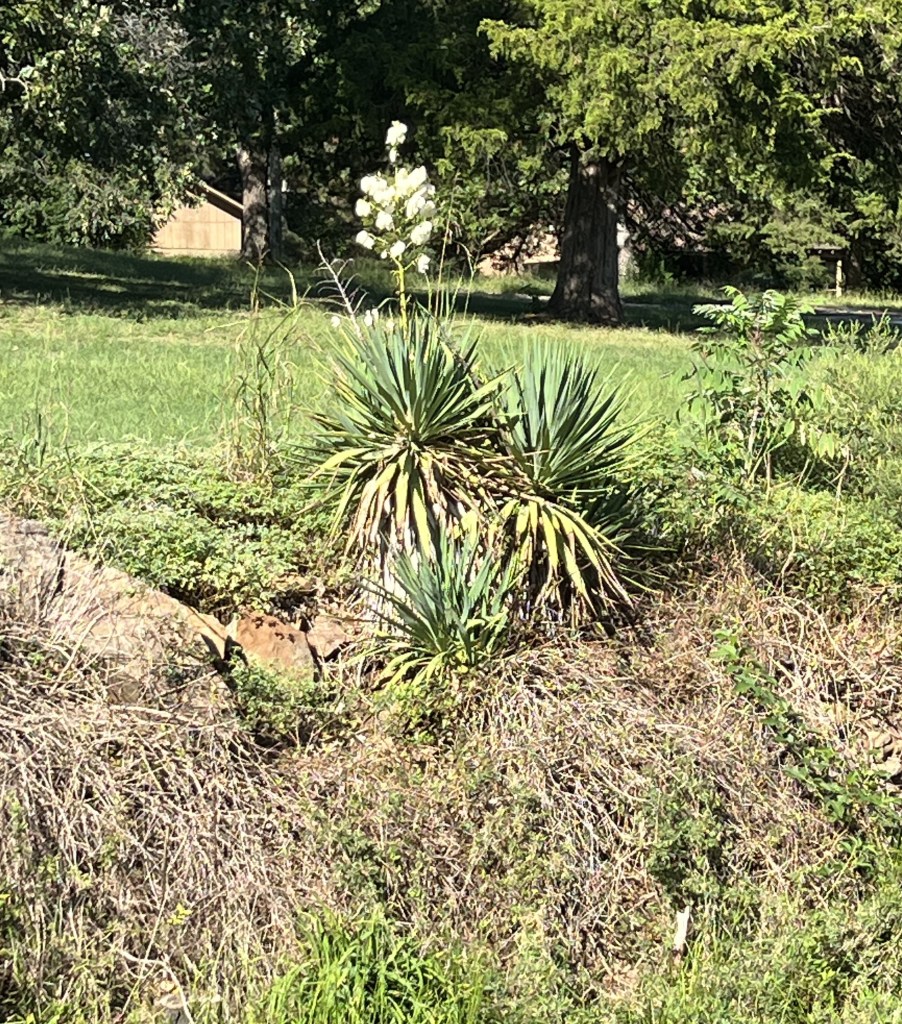
I have been researching how to amend my garden beds in preparation for winter.  In the past I have basically pulled the dead plants and let the ground fallow until the following spring.  I have begun to think this is why (in part) I am getting decreasing yields.  I watched several YouTube videos explaining what I needed to do and why.  They all began saying I needed to get my soil tested at the local county extension to tell me if I needed more lime (alkaline) or sulfur (acid) in my soil, and whether to add more nutrients.  I was not worried about my containers as I had filled them with new potting soil earlier in the spring.  I decided I needed to amend the ground soil with vermiculite (soil conditioner to allow air channels so the soil can breathe), compost (improve the soil fertility), and peat moss (improve soil capacity to withhold water).  I went to both a plant nursery and our local box market and neither had any of this in stock.  I had seen all three earlier at the hardware store but since I bought food at the market I decided to go home.  As I was driving home, I noticed a large yacca plant in full bloom.        

When I looked online, I found the Yucca gloriosa, commonly known as the Spanish-dagger, is a species of flowering plant in the Asparagaceae family native to the southeastern US.  Yucca can grow to 8 feet (2.5 m) tall and is categorized as an evergreen shrub.  Yucca gloriosa has a well-developed stem above ground (caulescent), usually with several stems arising from the base.  The base will thicken in adult specimens.  The cluster of flowers are arranged on a stem composed of a main branch (inflorescence) that is up to 8 feet (2.5 m) long.  The bell-shaped flowers are white, but sometimes tinged purple or red.  The fruit is a leathery, elongated berry up to 3 inches (8 cm) long.  The long narrow leaves are straight and very stiff, growing to 12 to 20 inches (30 to 50 cm) long and 3⁄4 to 1+1⁄2 inches (2 to 3.5 cm) wide.  The leaves are dark green with entire margins, smooth, rarely finely denticulate, acuminate, with a sharp brown terminal spine.  Yucca gloriosa has been known to cause skin irritation and even allergic reactions upon contact and the leaf points are sharp enough to break the skin.  Hence the name dagger. 

The Yucca plant is widely cultivated in warm temperate and subtropical climates and is valued as an architectural focal point.  Yucca requires little maintenance other than the removal of dead leaves when the shrub nears its ultimate height.  The plant is very hardy and sustains temperatures of -4F (-20C) without leaf damage (except ours which all rotted and died) and can handle brief snow and freezing temperatures, as well as long periods of drought.  The species has reportedly escaped from cultivation and naturalized in Italy, Turkey, Mauritius, Réunion, Guam, the Northern Mariana Islands, Puerto Rico, Argentina, Chile, and Uruguay (yet it will not escape into our front bed).  Yucca gloriosa and several cultivars (‘Variegata’ and ‘Bright Star‘) have gained the Royal Horticultural Society’s Award of Garden Merit.

Thoughts:  I found it interesting after having lost two successive years of the yucca Melissa planted in our front bed to read about the plant’s durability and resistance to cold.  We had covered the plants to protect them and yet seven different plants of varying size all appeared to freeze over the winter.  In contrast, the large yucca I saw was completely exposed on a rocky bank next to the road.  The yucca appears to be like most other cacti and succulents which adhere to the adage, “leave it alone and it will thrive.”  My covering the plants may have provided too much humidity which led to their demise.  Just as (I say . . .) I have given up on planting onions, Melissa says the same of outdoor yucca.  Humans may give up on trying to manipulate the environment when faced with failure.  Nature keeps trying and allows the species to eventually thrive on their own.  Perhaps we could learn something from nature’s example.  Act for all.  Change is coming and it starts with you.

Mate

September 25, 2023

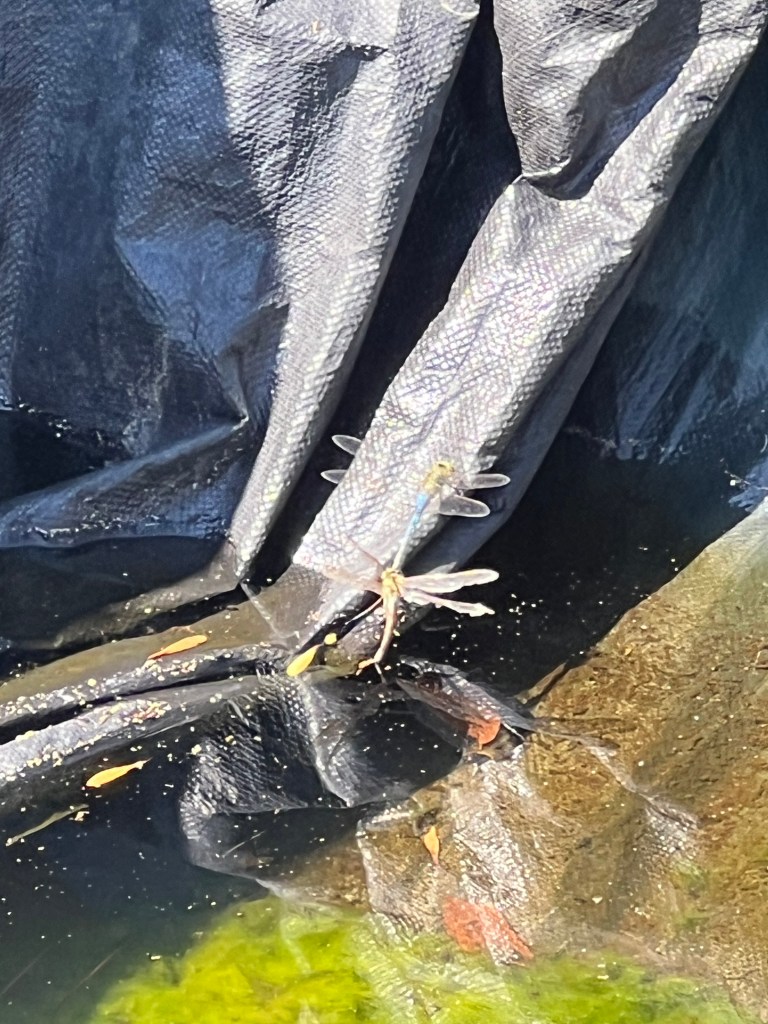
When I took the kids outside for a break over the weekend, we witnessed the mating ritual of three large dragonflies (2 males and 1 female).  The pair had already coupled and were flying around our pool/pond while the other male was circling and darting around the mated pair.  All three seemed disturbed by my presence (or perhaps more so Loki’s) and skittered around, diving back and forth above the water.  I decided to back away from the pond to see what would happen.  When I moved back, the mated pair settled on the tarp just above the water line.  The female then proceeded to dip her tail into the water, apparently laying one egg after another.  The two stayed together until the female completed laying her eggs.  The second suiter had continued to harass the original male hoping to dislodge it from the female but when the mated pair landed near the water he flew off.  He had lost his chance, and no doubt went off in search of another mate.

When I looked online, I found the common green darner (Anax junius) is a species of dragonfly in the family Aeshnidae.  The dragonfly gets its common name from its resemblance to a darning needle.  Both sexes have unmarked green thoraces, bull’s eye marks on their faces, and clear wings that often become amber-tinted with age.  Males have bluish-purple abdomens with a black stripe down the middle while females may appear like the males or have reddish-brown abdomens (as mine did).  The darner is one of the largest extant dragonflies and males grow to 3 inches (76 mm) in length with a wingspan up to 3.1 inches (80 mm).  Females use a tube-like organ to lay eggs beneath the surface of the water (oviposit) in aquatic vegetation.  The nymphs (naiads) are aquatic carnivores, feeding on insects, tadpoles, and small fish.  Adult darners catch insects on the wing, including ant alates, moths, mosquitoes, and flies.  The species is well known for its great migration distance from the northern US and south into Texas and Mexico.  The species also occurs in the Caribbean, Tahiti, and Asia from Japan to mainland China.  It is the official insect for the state of Washington in the US and is a common dragonfly to Arkansas.

Unlike many dragonflies, some populations of Common Green Darners migrate and during winter may fly as far south as Panama.  Darner migration is complex and challenging to study.  Researchers suspect a full migration takes place over at least three generations.  The first generation emerges in spring in the southern part of the range and travels north in the summer to mate.  The second generation emerges in the northern part of their range in summer and migrates south during the fall to mate.  The third generation emerges in the southern part of the range during the winter and does not migrate but will mate.  The cycle begins again with the next generation.  When researchers equipped the green darners with micro radio transmitters (one tiny transmitter), they found that the dragonflies traveled about 10 miles (16 km) per hour and up to 87 miles (140 km) in a single day.

Thoughts:  Not all dragonflies stay connected after they mate.  In some other species another male will capture the female and scoop out the deposit by a previous male to ensure their own progeny.  That is why the darners stay coupled until the eggs have been laid.  Francis Bacon has one of the earliest references to the name ‘dragonfly’ in Naturall Historie: In Ten Centuries.  It is widely believed Bacon picked up the name from folklore of the time where it was believed the insects were once dragons shrunk in size.  This may have been aided by the voracious appetite of both nymphs and adults and their darting movement as they hunt winged prey.  Folklore also associated these tiny dragons with the devil.  While they are not harmful to humans, this association made many wary of their presence.  What we call animals (and people) does have an impact on have we see and treat them.  Act for all.  Change is coming and it starts with you.

Move

September 22, 2023

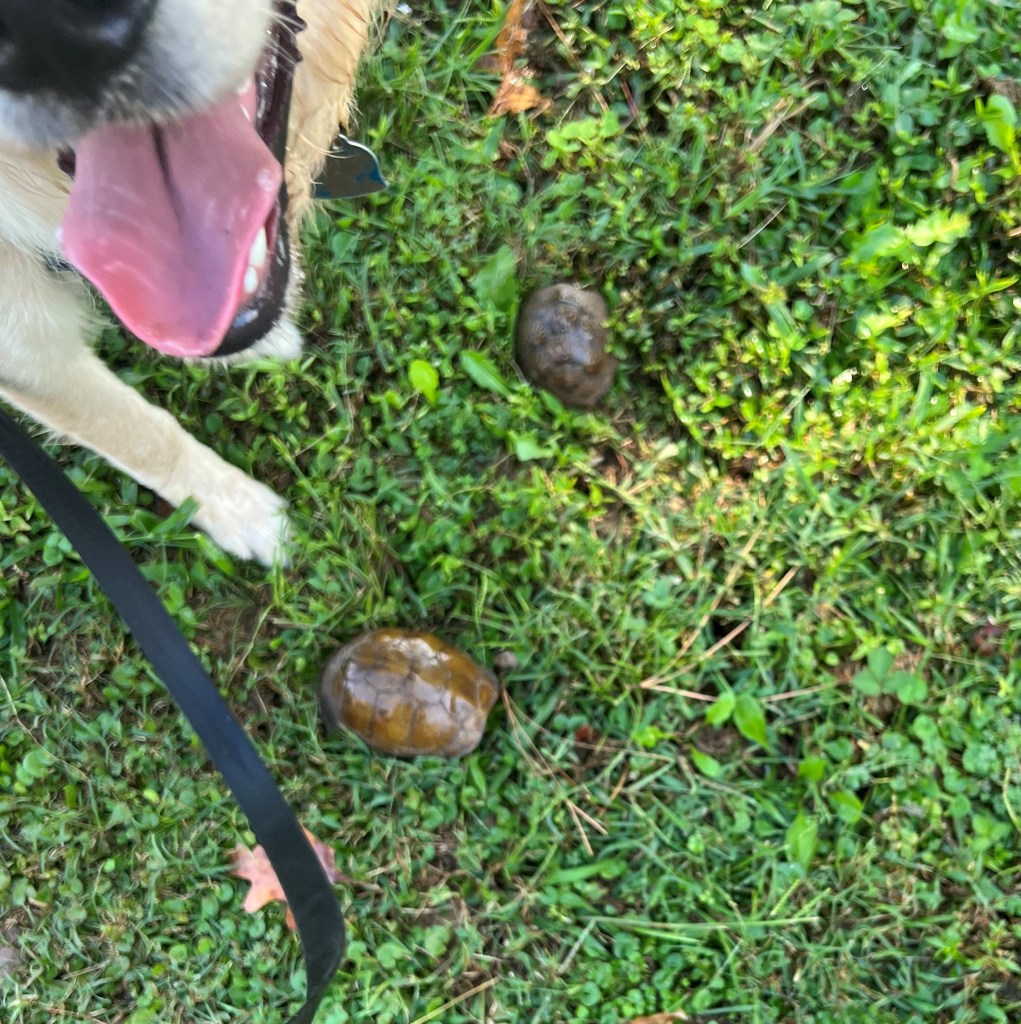
I have been trying to train Loki to take a walk.  We have gotten beyond biting the leash and even to the point where he will excitedly stand and wait for me to put his harness on him.  Once he gets outside however, it is jump and strain.  That means I take Zena for a walk at the city park and when we return, I harness Loki and take a shorter walk through the neighborhood.  Most of this loop is on streets but the last two blocks cut through a green space that comes out behind our house.  While we were walking through this grassy tree-lined section we came across what looked like two rocks.  Loki was interested so I took another look and realized these were two small turtles that had tightly closed their shells.  The weather has been cool, and damp and I was not surprised to see the two in the grass.  This is a prime time for box turtles to be on the move.

When I looked online, I found the three-toed box turtle (Terrapene triunguis) is a species within the genus of hinge-shelled turtles commonly referred to as box turtles.  The species is native to the south-central part of the United States and is the official state reptile of Missouri.  Three-toed box turtles got their name from the number of toes on their back feet.  Some think there are four-toed examples, but others speculate the four-toed individuals are eastern box turtle (Terrapene carolina carolina)/three-toed box turtle hybrids.  The three-toed have a domed shell which grows to 5 to 7inches (13 to 18 cm) in length and the highest part of its upper shell (carapace) is more posteriorly positioned than in any of the other box turtle subspecies. The dorsal and limb coloration is often completely absent, although some dark blotches are common in adults.  These areas are more often a uniform olive green or tan color (like my turtles) but sometimes, faint yellow dots or lines are visible in the center of each large bony external plate (scute: Latin “shield”).  In the males, the head and throat often display yellow, red, or orange spots.[6][8] Frequently, the bottom shell (plastron) is a yellow straw color and has far fewer dark markings than the plastrons of the other subspecies.  The species mates in the spring as they come out of hibernation and are on the move.

Three-toed box turtles are known to move and migrate seasonally to maintain their preferred humidity level.  In Arkansas, three-toed box turtles were observed in grasslands in late spring, while in early spring, summer, and late fall they were found in forested areas.  During dry times, they dig shallow burrows into leaf litter to conserve moisture.  When water is available, these turtles soak for longer periods of time than any of the other subspecies.  Three-toed box turtles are popular in the pet trade and are commonly moved outside their home range and released but it is not known whether these released captives have an impact on the local species.  The species is highly adaptive and is possibly the only box turtle who can live happily in an indoor enclosure.  Three-toed are omnivores (eat plants and meat) and their diet varies with availability of food sources and the seasons.  Box turtles prefer live foods to vegetation and their diet should consist of 50% plants and 50% animal protein.  They can be shy about being watched while eating and may stop and stare motionless when this happens.  With good care, three-toed box turtles can live at least 50 years.

Thoughts:  We almost missed the turtles on our walk as they were closed and did not move.  What gave them away was one had flipped over, exposing its yellow plastron.  I flipped the turtle right-side-up and we watched for a bit.  The turtles both remained tightly closed and did not want to play.  After a few sniffs, we left them alone.  Staying closed off is a good way to keep protected, but it comes at the expense of being able to eat or move.  When we isolate ourselves from the surrounding culture, we miss the diversity and joy that comes with being alive.  Act for all.  Change is coming and it starts with you.
Jalapeños

September 22, 2023

When I returned from my trip to Seattle, I was met with a profusion of jalapeños on my two vines.  Many of the pepper pods were ripe when I was leaving but I had no time to process them and decided to leave them on the vine.  On my return many of the peppers had turned bright crimson, indicating they were not only ripe, but had matured to the hot pepper stage.  I harvested the red peppers but left a few of the green jalapeños on the vine.  Along with the peppers I had previously picked I now had 30 jalapeños that needed to be processed.  When I chopped and froze my peppers last year, I made two mistakes.  I cut the peppers into large pieces, forcing me to re-cut them to use in food (defeating the process).  I had used latex gloves, but the number of peppers processed allowed the oil to get through the gloves and my hands burned for days.  This time I used two pairs of gloves to be safe.

When I looked online, I found jalapeños (Capsicum annuum) are a medium-sized pod type chili pepper cultivar.  Jalapeños are variously named huachinango (ripe red jalapeños) and chile gordo (“fat chili pepper”), also known as cuaresmeño.  The mature chili is 2 to 4 inches (5–10 cm) long and 1 to 1 1⁄2 inches (25 to 38 mm) wide.  Different jalapeños can range in pungency, with Scoville heat units of 4,000 to 8,500.  The fruit is commonly picked and eaten while green, but it is occasionally allowed to fully ripen and turns orange, yellow, or red (like mine).  The name jalapeño is Spanish for “from Xalapa” (the capital of Veracruz, Mexico), the area where pepper was traditionally cultivated.  Xalapa itself is of Nahuatl (Aztec language) origin, formed from roots xālli (“sand”) and āpan (“water place”).  Genetic analysis places jalapeños as a distinct genetic clade with no close relatives not directly derived from jalapeños.  The Aztecs’ use of jalapeños dates back thousands of years, including smoking some varieties to preserve them.  In Mexico, jalapeños are used in many forms such as in salsa, pico de gallo, or grilled jalapeños.  Jalapeños were included as food on the Space Shuttle as early as 1982. 

Compared with other chilies, the jalapeño heat level varies from mild to hot depending on cultivation and preparation and can have from a few thousand to over 10,000 Scoville heat units.  As the peppers ripen their heat increases, making red jalapeños hotter than green jalapeños, at least of the same variety.  If the plants are stressed (erratic watering and heat, i.e., me) it will increase their heat.  The number of scars on the pepper (brown lines called ‘corking’) have a positive correlation with heat level, as the growing conditions that increase heat cause the pepper to form scars.  US consumer markets find corking unattractive, but it is a favored trait in other markets, particularly in pickled or oil-preserved jalapeños.  The chemical irritants (capsaicin and related compounds) produce a sensation of burning in any tissue it contacts and these are concentrated in vesicles of the placenta membrane surrounding the seeds.  People who are sensitive to capsaicin will wear latex or vinyl gloves while handling the peppers.  When preparing jalapeños, it is recommended your hands not contact your eyes as “this leads to burning and irritation” (ya think?).

Thoughts:  Wearing double gloves kept me from the heat of the jalapeños, but Melissa was not so lucky.  I touched several items that Melissa later picked up and the oil moved from her hands to her eyes.  I was protecting myself and never considered the larger effect of the jalapeños.  Jalapeños are a Mexican chili but were designated by the Texas Legislature as the official “State Pepper of Texas” in 1995.  Texas seems to take the opposite view toward embracing other immigrants.  The oil on my jalapeños and the US attitude toward immigrants both caused us to make changes in our practices.  When we only think of our protection and concerns it has the potential to cause unintended and lasting effects on others.  Act for all.  Change is coming and it starts with you.

Appointment

September 20, 2023

The parameters for my recent trip to see my son’s family were set in part by my dentist appointment.  These dates are set at the time of the earlier appointment six months ago.  The hygienist is always polite and asks the question, “Is (date) good for you?”.  I invariably say “yes” as I rarely know what I am going to be doing six months in advance.  The only real choice I have is whether to make the appointment in the morning or the afternoon.  When I decided to go to Seattle I called to see if I could reschedule for a later date and was told that was no problem.  The next available appointment was January 2024, or time for my next regular appointment.  I kept the date and set my plane fare to allow me to get back to my brother’s house in Wichita the day before so I could drive to Arkansas (5 hours) for my appointment.  I guess it was lucky I had scheduled my appointment in the afternoon.  I scheduled an appointment with another health care provider and was informed if I was more than 15 minutes late, they would cancel my appointment and charge me for the visit.  I sat in their office for 25 minutes past the scheduled time.

When I looked online, I found patients are often frustrated when they make an appointment for a certain time, arrive on time, and are then kept sitting in the waiting room for a long period before they see the healthcare provider.  The reason we lose patience is because we believe appointments have not been scheduled well.  However, healthcare providers may not be sure what services they will provide for individual patients, and some patients require more time for their services than others.  An acceptable amount of time to wait will vary by healthcare provider and the type of practice they run.  Basically, the more specialized the healthcare provider, the more patient you may need to be.  The fewer healthcare providers in any specialty who practice in your geographical area will also cause you to wait more time.  If you are waiting on a dentist who consistently makes you wait for an hour you may want to find another dentist.  If your brain surgeon makes you wait an hour, that might seem more manageable.

Another way to make the wait for your appointment tolerable is to ask the person at the check-in desk how long they think you will be waiting and decide if you want to wait that long and if not, reschedule.  If you are told the wait will be 15 minutes, ask again at minute 16.  You do not have to be loud or rude but politely ask about the hold up and how much longer you will need to wait, and again decide whether the wait is acceptable.  This is possible for a primary healthcare provider or a specialist you see on a regular basis for a long-term or chronic condition, but it may not be possible for a sub-specialist or a healthcare provider who is in great demand.  If you know there will be a wait for the appointment there are things to make the wait less stressful.  Leave yourself plenty of time so this will not impact another appointment on your schedule.  Take a good book, knitting, or an entertaining phone app (earbuds).  If the time is shorter, you will be pleasantly surprised.  If it is longer, it will not be so frustrating to wait.

Thoughts:  When the hygienist called my name (10 minutes late for my appointment) I dutifully followed them back and sat in the chair.  Her first words were, “So, we are here for two fillings today?”  I was not sure if “we” meant she was going to have the fillings, but I knew I was there for a cleaning and checkup.  The hygienist rechecked my name and found I had answered the wrong call.  I was happy to wait for my appointment as I made my way back to the waiting room.  The result of waiting for an appointment can change based on the expectations and the attitude you bring.  That is true for most aspects of life.  We may not be able to change others, we can adjust our response.  Act for all.  Change is coming and it starts with you.
Humble

September 19, 2023

I was excited to finally get to see the grandkids after a long absence.  I was scheduled to catch a ride at the airport to get to their house, but as I turned my phone on after landing, I saw my son was coming to pick me up.  When I asked, Alex said he had decided to make the trek against traffic to give us some time to catch up on the drive back to the house.  Even though we had been talking and having Facetime sessions, it was nice to be able to talk in person.  When I arrived, everyone was glad to see me.  I was able to help take the kids to school the next day and their teachers told me the grands were excited and had been telling everyone I was coming.  When I went to both of their sports practices, they proudly introduced me to their friends as their Papa.  I was starting to get an ego, but Amelia kept me humble.  Amelia is a small terrier chihuahua mix who believes it is her job to keep people straight at the house.  Every time she saw me for the first three days she went into a barking fit.  I was a stranger and I needed to be humble and remember that fact.

When I looked online, I found the definition of humble is having or showing a modest or low estimate of one’s own importance.  Most scholarly discussions of humility provide descriptions of humble people, and many suggest humble people have an accurate view of themselves.  That means humble people acknowledge their mistakes and limitations, are open to other viewpoints and ideas, keep their accomplishments and abilities in perspective, have a low self-focus, and appreciate the value of all things, including other people.  One site offered a list of traits shared by humble people.  Foremost, they control their ego.  We all have brushes with others at some point, but a humble person will not let their ego take control.  A humble person puts a lot of effort into making sure people around them are happy and comfortable and will apologize if there is anything they say or do unintentionally hurts someone.  Humble people value their own self-worth and do not waste time comparing themselves to others.  A humble person is confident, and their confidence will even allow them to question themselves or their motives.  Lastly, a humble person does not take others for granted and avoids using stereotypes when talking about others.  Being humble is not easy and requires a person to go inward and learn how to treat others from the ground up.

While this is a good summary of what a humble person is, it does not get to the psychological core of being humble.  Being humble entails the belief that no matter how great one’s accomplishments or positive characteristics may be, they do not entitle one to special treatment as a person. This contrasts with areas of life where exceptional characteristics deserve special attention and even privilege.  Expecting to receive special treatment equal to one’s accomplishments is irrelevant to humility and even humble people think they deserve a promotion when they are an exceptional employee.  Humble people do not downplay their accomplishments or characteristics; they just do not think they should be treated specially because of them.

Thoughts:  While Amelia may have been trying her best to keep me humble, I received the opposite reaction from my own pups when I returned from my weeklong absence.  Both dogs were immediately all over me and would not leave me alone until they had given me the love that they felt I deserved.  Whether this adoration comes from a pet or another human, it will make you feel humble.  Act for all.  Change is coming and it starts with you.
Box

September 16, 2023

As I boarded the Alaska Air flight to Seattle I was asked if I would like “a water”.  It was a 4-hour flight, and I knew I would be thirsty at some point (even though not at the time), so I said yes and I was handed a small white box.  I was surprised as water is usually dispersed in single serving plastic bottles.  I was intrigued and began to read the information about the water on the box.  The box contained the usual info required by the Food and Drug Administration (FDA) along with the warning labels that are also required.  I have always thought the user should be aware that if you swallow the box top it could cause choking, but I realize if you do not put this on the box someone will say their own ineptitude (or lack of attention to their child) was the fault of the manufacturer.  The packaging went on to explain why this water was different than other containers of water.  The box contained renewable material (even the cap) and the water was purified.  The other difference was if you posted an image of the carton with #betterplanet the company would plant two trees in a national forest.  

When I looked online, I found the idea for boxed water began in 2009, when the company was the first manufacturer to offer a sustainable alternative to plastic water bottles, creating a new category of packaging and changing the way water is shipped, sold, and enjoyed.  The website suggests consumers use tap water whenever possible (preferably filtered), but if you cannot do so you should reach for their 92% plant-based box.  This percentage makes their product the most renewable package in the water aisle.  The water is also sourced close to where it is distributed to reduce the carbon footprint (instead of exotic and distant locations for water).  All the cartons are 100% recyclable, refillable, and BPA free.  The carton can be refilled and reused but the website stressed “standard warnings” apply.  Only refill the box with clean drinking water.  Be sure to thoroughly clean the box before each reuse to avoid accumulation of germs and bacteria over time.  Finally, watch for wear and tear on the packaging as it will deteriorate and break down over time (good for the environment but not your water).

Alaska Airlines became the first national airline to give up plastic water bottles in 2018 when they announced they were switching to Boxed Water™ cartons for their inflight service.  Alaska has since been flooded with social media posts from passengers who are delighted by the idea of a cleaner, less polluted planet.  The partnership has a three-fold focus.  First, they are removing 1.8 million pounds of single-use plastics from the waste stream.  Second, since the box is reusable, it can be refilled for later use.  Third, when you post a photo with a Boxed Water carton and #BetterPlanet two trees are planted in your honor.  That has already accounted for over 1.2 million trees with the NFF.  The belief is that small changes can make a lasting impact on our planet.  That same year Alaska became the first US airline to eliminate plastic straws and stir sticks from flights and lounges.  Alaska’s “Green Team” is dedicated to improving the environment through in-flight recycling and trash sorting programs that help reduce the amount of waste per guest that ends up in landfills.  Alaska is also strategically updating their fleet in hopes of achieving a goal of net-zero carbon emissions by 2040.  Replacing plastic bottles in their in-flight water service will effectively remove 22 million plastic cups and 32 million plastic bottles per year from Alaska flights, or the equivalent of eighteen 737 Boeing aircrafts.

Thoughts:  I am constantly amazed by the innovative ways being devised to address a reduced carbon footprint.  While governments bicker over issues of responsibility and payment, corporations (and some cities/states) are moving ahead on their own.  While this may be good for public relations, it is even better for the planet.  Reducing our carbon footprint is not waiting for governments to take the lead, but each person or entity taking small individual steps.  Act for all.  Change is coming and it starts with you.
Pumpkins

September 15, 2023

One of the first things I did when I arrived at my son’s house was to check out his garden.  He had placed three 48 x 18 x 24 inch (122 x 45.5 x 61 cm) galvanized containers in a mulched area behind his house.  He had holes drilled to allow the water to drain and the mulch kept the containers cool and not allowing the weeds (or grass) to grow around them.  The containers had been planted with red onions (Allium cepa), carrots (Daucus carota), cucumbers (Cucumis sativus), kale (Brassica oleracea), and two types of lettuce (Lactuca sativa), butter and romaine.  Most fared well, but as with any new venture, Alex found out the hard way that cucumber vines will take over everything in their path and lettuce easily wilts in the sun.  In another section of his yard, Alex had planted two pumpkin vines which were doing very well.  There were 6 or 7 pumpkins around 8 inches (20 cm) in diameter and one that had grown to 15 inches (38 cm).  It reminded me of my one 4-inch (10 cm) watermelon on my vine at home.  I think I need to give it more room next year if I want it to rival his pumpkins.     

When I looked online, I found pumpkin is a vernacular term for winter squash of species and varieties in the genus Cucurbita.  These pumpkins had culinary and cultural significance, but no agreed botanical or scientific meaning.  The term pumpkin is used interchangeably with “squash” or “winter squash” and is commonly used for cultivars of cushaw squash and silver-seed gourd (Cucurbita argyrosperma), Asian pumpkin or black seed squash (Cucurbita ficifolia), hubbard or delicious squash (Cucurbita maxima), winter crookneck squashes (Cucurbita moschata), and summer squash (Cucurbita pepo).  The pepo is native to northeastern Mexico and southern US and are one of the oldest domesticated plants in the world.  Today, a variety of pumpkins are grown for food, aesthetic, and recreational use.  Pumpkins have a thick shell and contain edible seeds and pulp.  The pepo pumpkin is a traditional part of Thanksgiving in the US and Canada as pie and are carved as Halloween jack-o’-lanterns.  Canned pumpkin purée and pie fillings are usually made of different varieties (sweet pumpkins) from those used for jack-o’-lanterns.

Cucurbita pepo is one of the oldest, if not the oldest domesticated species, with origins in southern Mexico in Oaxaca (8,000 to 10,000 BP) and Ocampo, Tamaulipas, Mexico (7,000 BP).  Pumpkins of both Cucurbita pepo and Cucurbita moschata had been carried throughout North America (where they could grow) long before the arrival of Europeans.  The ancient territory of C. pepo extended north into Texas and up the Greater Mississippi River Valley into Illinois and east to Florida, and possibly even to Maine.  It is one of several plants cultivated in prehistoric North America as part of the Eastern Agricultural Complex (focused on corn, beans, and squash).  Pepo is known to have appeared in Missouri at least 4,000 years ago (BP).  Some varieties grow in arid regions and some in moist regions.  Many of these Indigenous peoples, particularly in the west, still grow a diversity of hardy squashes and pumpkins not found in commercial markets.  Neither C. pepo nor C. moschata had been carried into South America along with beans, although all originated in the same general region.

Thoughts:  The Eastern Agricultural Complex refers to one of about 10 independent centers of plant domestication in eastern North America dating back to 5300 BCE.  By 1800 BCE woodlands people were cultivating several species of plants allowing them to transition from hunter-gatherers to agriculture.  Maize (Zea mays) was introduced from Mexico in 200 BCE and the eastern peoples slowly moved from indigenous plants to a maize-based agricultural.  The cultivation of local plants (except pumpkins and sunflower) was abandoned, and the formerly domesticated plants returned to wild forms.  This is another example saying when we leave nature alone, it will recreate itself to better serve the local ecosystem rather than humans.  Act for all.  Change is coming and it starts with you.