Storm

November 19, 2022

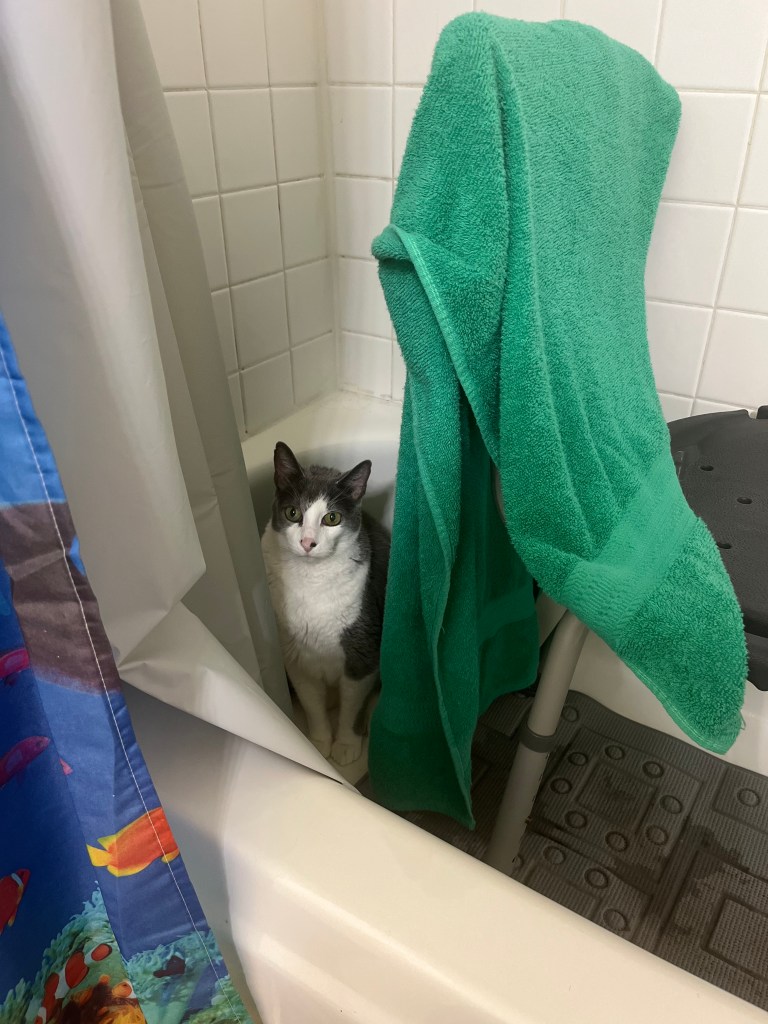
I have mentioned how my response to bad weather tends to be to go outside and watch.  A storm rolling across the unbroken prairie was one of the things I missed when I moved from Kansas, and something I looked forward to seeing when I visited.  I always found the power of a thunderstorm exhilarating.  I also tend to look outside during a tornado siren to see what is happening (kids, do not do this at home!) even though we are warned to “shelter in place”.  When the sirens went off several weeks ago, I did what I usually do and went out to the back patio.  Zena was a little skittish at first as this was her first experience with a bad storm but seemed to settle down once she saw my reaction.  Later, my niece visited and when I mentioned this, she showed me a picture of her cat during the storm.  Chandler had paid attention to the forecasters and crawled into the bathtub in an interior room like he was supposed to do.

When I looked online, I did not find a reference for cats, but I did find an explanation for why dogs freak during thunderstorms.  Humans (at least most of us) realize thunder is just the loud rumbling noise that occurs after the lightning strike, and it is the strike that is potentially harmful.  The strike also charges the air with electric particles which land on the fur of the dog and cause static build-up.  Often, dogs do not know what to make of the way their coat suddenly feels, and in some cases the static build-up gives the dog an electric shock.  This is accompanied by changes in air pressure and the dark and foreboding skies.  These weather changes are ominous and can put the dog on edge.  Some dogs may even develop storm phobias, especially if they are shy or nervous by nature.  I would assume the same may be said for cats.

Storm phobia is a condition where the dog becomes irrationally afraid of any signs of a coming storm, including thunder.  Their reaction can be excessive and may put themselves or those around them in danger.  Dogs that spend a lot of time outdoors are more likely to fear thunder than those who are sheltered from these natural phenomena.  Hounds, sheepdogs, and other working dogs are more likely to develop storm phobia and to have a profound fear of thunder than other breeds.  They spend more time outdoors which exposes them to the forces of the storm.  Puppies are also more prone to fearing thunder.  Any loud noise makes a puppy anxious, and they scurry to find safety and a place to hide.  Breeds with double coats struggle most with thunderstorms. German Shepherds, Golden Retrievers, Australian Shepherds, Siberian Huskies, Bernese Mountain Dogs, and Border Collies are some of the breeds whose thick coats become a major liability as static increases in a thunderstorm.  The same goes for dogs who do not socialize much as well as rescue dogs who might have had traumatic events leaving them jittery and susceptible to phobias.

THOUGHTS:  Humans can also suffer from storm phobia.  Phobias are persistent, intense, and unrealistic fears, and specific phobias are related to certain objects and situations.  These typically involve fears related to animals, natural environments, medical issues, or specific situations.  While phobias can be extremely uncomfortable and challenging, therapy and medication can help.  During the first year of the pandemic there was a 25% increase worldwide in anxiety and depression, and 90% of countries surveyed by the WHO chose to include mental health and psychosocial support in their response plans.  Unrealistic fears around the pandemic continue to persist, along with a lack of regard by others.  Both responses need to be overcome for our world to safely move forward.  Act for all.  Change is coming and it starts with you.

SLS

November 17, 2022

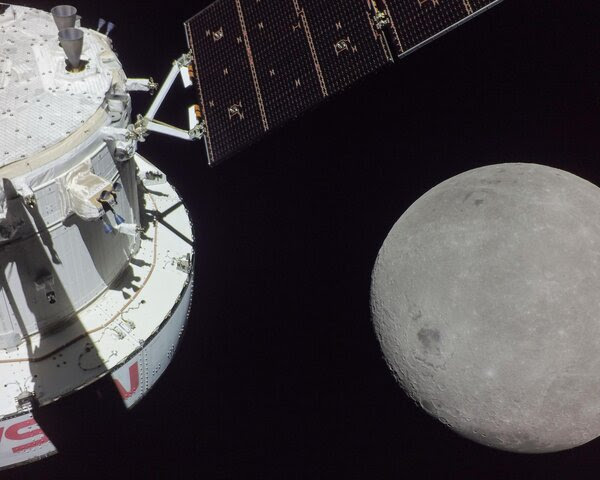
The Nation & World section of today’s local newspaper declared that after several high-profile delays over more than a month the Artemis I blasted off from Florida’s Kennedy Space Center on Wednesday.  The launch marks the first leg of the mission, during which the Orion capsule will travel around 40,000 miles, taking it beyond the moon and returning to Earth over the course of 26 days.  NASA’s Bill Nelson said the mission will help NASA prepare for future human exploration on the moon and Mars, although noting that “things will go wrong” during the demo.  The primary goal of Artemis I is to test the integrated systems before crewed missions.  The Artemis program is scheduled to land the first woman and the first person of color on the surface of the moon.   At 1:47 am EST the four main engines and two solid rocket boosters of the Space Launch System (SLS) ignited with an 8.8 million pounds of thrust.  This is the most powerful rocket in operation and marked the first SLS launch (and third attempt) for NASA’s Artemis program.

When I looked online, I found the Space Launch System (SLS) is an American super heavy-lift expendable launch vehicle developed by NASA starting in 2011.  The SLS is the successor to the retired Space Shuttle, and the primary launch vehicle of NASA’s deep space exploration plans through the 2020’s.  The SLS has the highest payload capacity of any current launch vehicle and the third-highest capacity of any rocket ever to reach orbit, trailing only the Energia (Soviet Buran program) and Saturn V (US Apollo program) rockets.  Crewed lunar flights are planned as part of the Artemis program, leading to a possible human mission to Mars.  The SLS is being developed in three major phases with increasing capabilities: Block 1, Block 1B, and Block 2.  As of August 2019, SLS Block 1 launch vehicles are to launch the first three Artemis missions and the five subsequent SLS flights are planned to use Block 1B.  All later flights are expected to use the Block 2 rocket.

The SLS was explicitly designed to launch the deep space Orion spacecraft and make use of the ground operations and launch facilities at NASA’s Kennedy Space Center in Florida.  Artemis is projected to use at most one SLS each year until at least 2030.  The SLS is launched exclusively from LC-39B at the Kennedy Space Center.  After reaching initial orbit, Orion deployed its solar arrays and engineers began to perform checkouts of the spacecraft’s systems.  Orion separated from its upper stage, and science investigations and technology demonstrations (CubeSats) were deployed from a ring connected to the upper stage to the spacecraft.  Eight hours after launch, Orion’s service module preformed a series of burns to keep it on course.  Orion will fly by the moon on November 21, inspecting its surface.  If all goes well, Orion will return to Earth, splashing down in the Pacific Ocean in December.  The rocket was supposed to have made its dry run by 2017 but met with both technical and weather delays.  Government watchdogs estimate NASA will have spent $93 billion on the Artemis project by 2025.

THOUGHTS:  I have vague memories of watching liftoff of Alan Shephard while crowded around our small black and white TV as the US launched the Mercury capsule, Freedom 7.  This occurred on May 5, 1961, which was a school day.  My father kept us home from school to watch this historic event.  Family lore says he was later called into the principal and asked why he had kept us out of school “for no good reason”.  What would happen if everyone had kept their children home?  His purported response was, “I guess more children would have seen the launch.”  Historic events that can change the world’s perspective happen constantly.  Some discount these events as being “for no good reason”.  We need to learn to integrate different perspectives to determine our response.  Act for all.  Change is coming and it starts with you.

Seamount

November 14, 2022

Hidden in the back section of today’s local newspaper was a story of the likely eruption of a volcano deep beneath the Pacific Ocean in the US Commonwealth of the Northern Mariana Islands.  The Northern Marianas are about 3,800 miles (6,115 km) west of Honolulu.  This is “likely” as scientists do not know for sure as the area is so inaccessible.  All indications are the Ahyi Seamount began erupting in mid-October, the US Geological Survey said Monday.  Ahyi seamount is a large conical submarine volcano.  Its highest point is 259 feet (79 m) below the surface of the ocean.  It is located about 11 miles (18 km) southeast of the island of Farallon de Pajaros, known as Uracas.  Scientists are checking satellite data to see if there’s discolored water, which could suggest material is coming out of the volcano, or if the activity is just shallow earthquakes.  Matt Haney, a USGS research geophysicist, said, “There’s nothing right now that suggests that this eruption will intensify and become a large eruption.  Still, mariners would want to avoid the immediate area.”  Ya think?   

When I looked online, I found a seamount is a large geologic landform that rises from the ocean floor but does not reach the water’s surface (sea level).  It is not an island, islet, or cliff-rock.  Seamounts are typically formed by extinct volcanoes that rise from the seafloor to 3,300–13,100 feet (1,000–4,000 m) in height.  They are defined by oceanographers as “independent features that rise to at least 3,281 feet (1,000 m) above the seafloor” and are characteristically of conical form.  The peaks are often hundreds to thousands of meters below the surface and are considered within the deep sea.  When forming the largest seamounts may breach the surface where wave action erodes the summit to form a flat surface.  After they subside below the surface these flat-top seamounts are called “guyots” or “tablemounts”.  The Earth’s oceans contain more than 14,500 identified seamounts of which 9,951 seamounts and 283 guyots have been mapped, but only a few have been studied in detail.  Seamounts are most abundant in the North Pacific Ocean and follow an evolutionary pattern of eruption, build-up, subsidence, and erosion.  In recent years, several active seamounts have been observed, including Kamaʻehuakanaloa (formerly Lōʻihi) in the Hawaiian Islands.

Seamounts are one of the most common marine ecosystems in the world.  Interaction between the seamount and underwater currents and their elevated position in the water attract plankton, corals, fish, and marine mammals.  Their attraction has been noted by the commercial fishing industry, and many seamounts support extensive fisheries.  There are ongoing concerns on the negative impact of fishing on seamount ecosystems, and well-documented cases of fish stock decline, for example with the orange roughy (Hoplostethus atlanticus).  Most (95%) ecological damage is done by bottom trawling, which scrapes whole ecosystems off the seamount and weakens the formation.  While naval vessels have collided with uncharted seamounts, the greatest danger is from flank collapse.  As the seamount gets older, outside material can seep into the seamount and put pressure on the sides, eventually causing a landslide with the potential to generate a massive tsunami. 

THOUGHTS:  I recall driving across the Bay Bridge and then along the Bay Causeway as a predicted tsunami was scheduled to arrive.  I did not pay too much attention, until I realized I had several miles of flat coast to drive before any possibility of exit.  While the predicted wave did not arrive, others have not been so fortunate.  The 100 foot (30 m) high tsunami wave that hit the Indian Ocean in 2004 killed an estimated 227,898 people in 14 countries and prompted a humanitarian response totaling more than US$14 billion.  When we identify and map a seamount, we can predict future problems.  When we destroy the ecosystems they create, we make the seamount weaker and risk greater damage.  Act for all.  Change is coming and it starts with you.

Egress

November 14, 2022

The house where I lived in Wichita contained a remodeled basement that was an obvious Do It Yourself (DIY).  The basement had a dividing wall down the middle and then the west three-quarters of the space was a Den/utility room, and the east quarter was a bedroom/bath.  The owner had not bothered to build an egress window to provide access in case of fire, so this was not included as a third bedroom on the specs.  Rather than jacking up the concrete floor in the bath area, the DIY owner had set the pipes on the floor and built a riser over them, making the small space smaller by raising the floor in the bathroom.  This compressed corner held both the stool and what appeared to be a camper shower.  When I first saw it, I joked I would need to attach a washcloth to the wall to soaps up, and hopefully I would never drop the soap as you could not bend over without opening the shower door.  The final aggravation was the shower door leaked and every time I took a shower it got water all over the raised floor.  I did not use the basement bedroom often, and especially the shower.

When I looked online, I found the International Residential Code (IRC 2021) pertains to all single and two family homes.  The intent of the code is to keep homeowners safe by requiring a means of egress (exit) in basement level living spaces.  The reason for an egress is twofold; to allow for an exit in case of an emergency, and to provide access for a firefighter to gain entrance.  Egress windows (or doors) are required in every habitable space, and any room used for sleeping requires its own egress window.  The code requires that you install an egress window to serve these spaces.  If you have a basement that has a bedroom, recreation room, den, family room, media room, office, or home gym, all these rooms are required to have a means of egress.  Egress window wells are required where the bottom of the egress window is below ground level.  The egress well must not interfere with the egress window fully opening, the distance from the egress window to the back of the egress well must be at least 36 inches (91.5 cm), and the minimum area of the egress well must be 9 square feet.  The alternative is to do like my DIYer and not get caught until foreclosure.

The memory of my room without an egress was sparked by the shower I encountered while in The Hague, Netherlands.  This was a US brand hotel, and the bathroom was spacious.  When I went to take a shower the next morning I was dismayed.  The large tub was obviously designed as a soaker, and I found it hard to crawl into.  There was an articulated hose on the wall as well as a tap on the tub.  What I thought was the shower door was the glass door to the bathroom itself, and there was no curtain for the shower.  I chalked this up to “a European thing” and went ahead and took my shower.  When I finished, I noticed I had flooded the entire bathroom floor.  I threw down towels to soak up the water and complained to Melissa.  That was when she pointed out the enclosed standup shower on the other side of the soaker tub.  I guess it was not “a European thing” after all.  I just needed to be smarter than the bathtub.

THOUGHTS:  While building codes are different depending on the country, state, and even city, the IRC is uniform across boundaries.  While egress codes are designed to keep people safe, they can become problematic with historic buildings.  Some exceptions may be allowed depending on building use and to maintain the historic nature of the building.  Lack of egress during fires like the Triangle Shirtwaist Factory fire in New York City (March 25, 1911) resulted in the deadliest industrial disaster in the history of the city and caused the deaths of 146 garment workers who died from the fire, smoke inhalation, or falling or jumping to their deaths.  Egress became an international responsibility.  Act for all.  Change is coming and it starts with you.
Production

November 12, 2022

I have been complaining about the low rate of production my tomato plants have seen throughout the season.  I planted 14 plants from five different varieties and had the worst production in the three years of growing my container garden here in Arkansas.  I cannot even blame my containers as half of the plants were placed in ground.  Since misery loves company, at least I was not alone.  My gardening group all complained about the money spent and low production of their tomatoes as well.  The plants grew tall, but the lower stems all wilted, and only a few flowers took hold to produce fruit.  I finally gave up on the plants as I was preparing for our three weeks away, figuring they would die anyway.  Imagine my surprise when I found green tomatoes on two of the plants that had not had any production all summer long.  I removed the other dead plants but left these two hoping the green fruit might still ripen.

When I looked online, I found tomato woes plagued the Plains states from the start of the season.  Mid-May through early June brought a chilly and wet start to the growing season, and tomatoes are a warm-season crop.  Soil temperatures lower than 65F (18C) reduce root development and early root development gives the plants the support needed for summer growth and fruiting.  The slow start to the season was followed by a flash drought.  A flash draught is a rapid change to below-normal rainfall combined with abnormally high temperatures.  This further intensified the stress on plants.  The slow cool spring start had not allowed the plants to develop a strong root system to support the top growth, causing plants to wilt in the heat of the day, further slowing growth and reducing flower bud development.  This was a good description of what happened on my patio.

We have been back from our trip for two weeks and I kept waiting for the green tomatoes to ripen on the vine.  The vines themselves were dying from the bottom up, but the leaves and stems around the tomatoes were still green and full.  With the cold front predicted for this weekend (it is here) I knew the fruit would freeze if I left it outside.  I harvested the green tomatoes and removed the last two of my plants from the ground.  The 9 tomatoes were my biggest production of the year, and they were still not ripe.  Left on my own I would have thrown them to the birds and written this off as one last failure.  Luckily, Melissa loves fried green tomatoes.  I always thought that was just a movie.

THOUGHTS:  I found it interesting that after removing the last of the plants from my patio my thoughts immediately turned to next year’s production.  I have tried several approaches to gain more vegetables, and none has done well.  I seem to be better able to grow the flowers planted by my mother-in-law and the wheat seed scattered by the birds than to get any production from the plants I purchase.  I am nowhere near growing anything from seed even though I did buy a seed starter kit.  Regardless, I found myself checking out larger containers and contemplating building raised beds as I perused the box hardware store this last week.  Just like with my Royals baseball team, there is always next year.  Act for all.  Change is coming and it starts with you.

Cold Front

November 10, 2022

I always find it interesting how excited weather people get about inclement weather.  They will occasionally become animated when we are in a long stretch or either cold or hot weather, but the real joy seems to shine when they expect the weather to be bad.  We are at the end of meteorological fall, and it has mostly been mild in our area.  That changed with the four tornados that touched down during last week’s storm.  Two of the forecasters teamed up to explain the nuances of the storm (with coats off and sleeves rolled up) and continued well after any threat was still apparent.  This week it got better for the forecasters as the first cold front is prepared to roll in along with predicted freezing temperatures.  They have been warning us of the impending peril all week, even though the front will not arrive until tomorrow night.  Perhaps it was a good thing to have so much time to prepare.  I need to get the greenhouse set up before the cold front moves in.

I knew the first thing I needed to check was the condition of the vinal panels.  All but one of the seven panels were still in good condition, although there were a few places where the Velcro had come unattached.  Melissa checked online and found while we could have new Velcro shipped, it would take a minimum of five days for it to arrive, even with our overnight service.  I took off to the big box hardware store since I have struggled to find Velcro in bulk locally.  “Since I was going”, Melissa suggested I pick up a few other items we needed.  I easily found most of the items but forgot the spray bottles Melissa had asked me to buy (along with sending a picture and aisle location).  This just gives me an excuse to go back this weekend.  I was not surprised to find most of the garden supplies I was looking for had been replaced with Christmas displays and rows of lights waiting to be unboxed.  The store must have heard the cold front was coming.

I had been surprised how easily the greenhouse panels had gone up last year.  The panels had stored well, and the Velcro was in good shape.  Melissa helped guide the panels into place and the entire job took about an hour.  Melissa was trapped in Zoom conversations for work this year, but I figured I could do it myself.  I had been wise enough to mark the panels when I originally took them down to know how to put them up.  Some of the Velcro had come loose and had stuck the panels together and it was much slower work than it had been last year, but I was able to complete most of the job.  I still have the door panel and need to recut one of the larger panels that had torn.  I also decided to sweep out the porch and refasten several of the screens that had come loose.  Last year’s hour managed to drag into most of the afternoon.  Melissa will be able to help tomorrow, which should make finishing quick.  It should be done well before the predicted cold front.  The succulents will be happy.

THOUGHTS:  Deciding when to set up and take down the greenhouse panels is predicated both on the first cold front, and on finding time to accomplish the task.  The panels had gone up quickly with Melissa’s help, but I had struggled to set the oversized panels in place by myself.  As I slowly went about rehanging the panels, I thought about how hard jobs can often be made easier when we work with others.  This is one of the advantages still displayed in hunter-gatherer societies.  Everyone has a role and works together to ensure the various tasks are completed.  This is also true for more complex societies but is often ignored.  Act for all.  Change is coming and it starts with you.

Midterm

November 09, 2022

Ned Gerard / Hearst Connecticut Media

Last night Melissa and I set up in front of the TV to watch the results of the midterm elections.  Melissa prefers one of the news channels so this was the venue chosen to view the returns.  While the in depth coverage provides insights, the main information comes as the various polls close (mostly on the hour) across the nation.  We started watching at 6 pm CST, which is after the first polls closed in two states but as all the polls closed in seven states.  Three more states closed at 6:30 pm CST and by 7:00 pm CST, two states had initial closes and 17 more had their final close.  Our own state polls closed at 7:30 pm CST and 15 others had their final close by 8:00 pm CST.  By 9:00 pm CST three more states had closed, and another had an initial closing.  After three hours of listening to pundits (mostly repeating the same thing), Melissa had enough and went to bed.  That left the last 5 states to close their polls, with Alaska being the last to close at 12:00 am CST.  I switched to a rival news channel to get another perspective and then to our local news at 10 pm CST to hear local results.

When I looked online, I found the midterm election refers to a type of election where the people can elect their representatives and other subnational officeholders (i.e., governor, state congress, and members of local councils) in the middle of the term of the presidential executive.  In the US, the president and vice president are elected every four years in indirect (electoral college) presidential elections.  National races in the US are for the Senate (six-year terms) and House of Representatives (two year-terms).  The Senate has one third of its members up for election every two years while the House has all its members elected every two years.  For elections to the Congress, the midterm is a reference is the president’s term.  There are three classes of US senators, and each election replaces one class.  A “midterm election” appears as one third through the term of one class and two thirds through the other, while still midway the term of a president.  In addition to federal legislative bodies, governors of 36 states and three territories are also up for election during a midterm.

Democrats were facing historic headwinds entering the midterm elections, as the party that wins the White House traditionally suffers major setbacks in the ensuing election.  This was compounded by a rough political climate fueled by record inflation, soaring crime, and a crisis at the nation’s southern border, and heightened by the President’s low approval ratings and a Republican jump in opinion polls heading into the midterm.  The expected Red Wave failed to materialize.  Initial reports indicate Democrats defied expectations, and potentially defended enough seats to maintain control of the Senate, although likely not enough to keep Republicans from taking the House.  As is also often the case, the battle for power in Congress stood too close to call this morning.  We may not know who won the Senate for some time, as Georgia’s contest appears headed to a runoff election to be held in December.  Nothing like Democracy to build expectation.

THOUGHTS:  It was suggested the true winner in the 2022 midterm election is democracy itself.  Despite early claims (and lawsuits) of fraud and miscounts, more than 40.7 million people voted early in the 2022 general election.  Turnout on election day is likely to be on par with 2018 midterm turnout, which broke records previously set more than a century earlier.  Even as 345 candidates across the US are asserting the 2020 presidential election was “stolen” and that American elections are deeply flawed; voters still decided to cast votes.  Now we need to wait for the inevitable delays to make sure those votes are being counted.  Act for all.  Change is coming and it starts with you.
Bite

November 08, 2022

I was working in my office this morning when Melissa called me to come and take care of Zena.  Melissa has the habit of letting Zena out on the back patio in the mornings to play.  The dogs next door often come out during this time and usually bark at Zena (especially the small one).  While Zena will respond at times, she generally just sits at the fence quietly watching them.  Her dog buddies were not out this morning and Zena was forced to find her own fun.  Like small children, puppies are inquisitive and tend to get into mischief when left to their own devices.  A good rule of thumb for both is, “If it suddenly gets quiet, you had better go check on them.”  I have mentioned how Zena likes to haul and throw the split wood kept on the patio for our fire pit.  Apparently, today that was not enough.  Melissa watched as Zena put a bite on the wooden planter I was repairing (it could happen) and literally ripped a wood slat off the frame and threw it across the yard.

When I looked online, I found the bite force of the Great Pyrenees (Zena) is from 500 to 650 PSI, putting it on par with members of the Mastiff family and a few livestock guardian dogs.  Bite force or pressure is expressed in pounds of force per square inch (PSI).  Since experts measure pressure in Newtons, it is interesting that canine experts convert these numbers into PSI for their lists of strong bite forces.  While it is more accurate to measure an animal’s bite force through pound-force in Newtons, PSI conversions put the numbers in a format that people better understand.  A Newton is only a fifth of a pound, and problems arise when laypeople make uninformed calculations or assume Newtons and PSI are the same, leading to gross exaggerations of the bite force for breeds of dogs already struggling with bad publicity.  A dog’s bite force is determined by body mass, jaw muscles, and head structure.  However, at 100-plus pounds (45-plus kg) the Great Pyrenees is strong beyond its jaws.  Its wedge-shaped head and relatively long jawline give it the leverage it needs to bite with incredible pressure.  Or apparently, to also rip slats of wood off my planter.

Several statistics put the Great Pyrenees’ bite force into perspective.  Humans have an average bite force of 120 to 150 PSI.  Toy dogs have bite forces from 90 PSI to 170 PSI.  It takes over 1400 Newtons (about 285 PSI) to fracture your finger.  The largest bone in your leg, the femur, requires about 800 PSI to fracture.  When strong dogs attack, the most punishing damage is a crushing injury to soft tissues.  Dogs that attack often grip and shake whatever they bite, causing tearing as well as bruising.  Fatalities do not occur from broken bones but from the dog’s attacking the face, head, and neck.  These areas are much more vulnerable to the bite ranges of large dogs, which are between 200 and 300 PSI.  A dog intent on causing bodily harm (rare) bites people on the lower limbs to bring them to the ground.  They also attack other dogs in this manner if they cannot readily access the throat.  Luckily, Great Pyrenees are usually gentle with young kids, even if the same cannot be said for planters.

THOUGHTS:  Years ago, I was bitten by a cat.  I thought it was nothing and ignored the bite until several days later when the bite became infected.  Sitting in the emergency room, I noticed signs on the walls declaring a dog bite must be reported to the police.  The irony was not lost.  When I thought about this, I realized dogs tend to bite other people.  Cats tend to bite their owners (as mine did) and will not allow perceived threats near them.  An old maxim tells us, “Their bark is worse than their bite,” and often refers to a cantankerous older person.  It seems lately people are allowing their social media “bark” (words) to serve as a precursor to an eventual “bite” (action).  We need to reign in both to find any unity.  Act for all.  Change is coming and it starts with you.

DST

November 05, 2022

Tomorrow morning, we will witness (if you are awake) the progress of another piece of legislation.  Daylight Saving Time (DST) 2022 ends this Sunday, November 6, at 2 am.  While I bemoan the loss of an hour’s sleep in March (I could go to bed earlier, but why?), I never seem to make up that hour in November.  By November the memory is long gone and all I can think of is how to fritter away the extra hour I have been given.  I must not be the only one, as I generally find someone arriving an hour late to Sunday morning appointments, but rarely have anyone arrive an hour early.  Somehow, gaining an extra hour is easier to remember than losing one.

When I looked online, I found Daylight Saving Time (DST), begins on the second Sunday in March and ends on the first Sunday of November.  Clocks are on “standard time” the rest of the year.  This time change, also referred to as daylight savings time or simply daylight time (US, Canada, and Australia), and summer time (United Kingdom, European Union, and others), is the practice of advancing clocks (typically by one hour) during warmer months so that darkness falls at a later clock time.  The typical implementation of DST is to set clocks forward by one hour in the spring (“spring forward”), and to set clocks back by one hour in autumn (“fall back”) to return to standard time.  As a result, there is one 23-hour day in late winter or early spring and one 25-hour day in autumn. 

The idea of aligning waking hours to daylight hours to conserve candles was first proposed in 1784 by Benjamin Franklin.  In a satirical letter to the editor of The Journal of Paris, Franklin suggested waking up earlier in the summer would economize on candle usage, and he even calculated the considerable savings.  In 1895, New Zealand entomologist and astronomer George Hudson proposed the idea of changing clocks by two hours every spring to the Wellington Philosophical Society.  In 1907, British resident William Willett presented the idea to save energy.  After serious consideration, it was not implemented.  In 1908, Port Arthur in Ontario, Canada, started using DST.  Starting on April 30, 1916, the German Empire and Austria-Hungary each organized the first nationwide implementation of DST and many countries have used DST at various times since.  DST is generally not observed near the Equator, where sunrise and sunset times do not vary enough to justify it.  The US observes DST, except for the states of Hawaii and Arizona (within the latter, however, the Navajo Nation does observe it, conforming to federal practice).  Only a minority of the world’s population uses DST, and Asia, Africa, and Latin America, and the Caribbean generally do not.

THOUGHTS:  In March, the US Senate approved a bill known as the Sunshine Protection Act to make DST permanent nationwide.  The legislation stalled in the House, which has not yet scheduled a debate.  “I can’t say it’s a priority,” Rep. Frank Pallone Jr. (D-N.J.), the chairman of the House Energy and Commerce Committee, told The Hill earlier this year. “We have so many other priorities, but it doesn’t mean because it’s not a priority that we’re not trying to work on it.  We are.”  The end of daylight saving time is not the most pressing problem in the US.  Still, it is something to talk about, complain about, and must generally deal with.  Scott Prunty of Clyde, Ohio, provided the most sensible advice, “Accept that it’s out of your control and move along.”  This could be said for many of life’s “thorny problems”.  Act for all.  Change is coming and it starts with you.
Jade

November 04, 2022

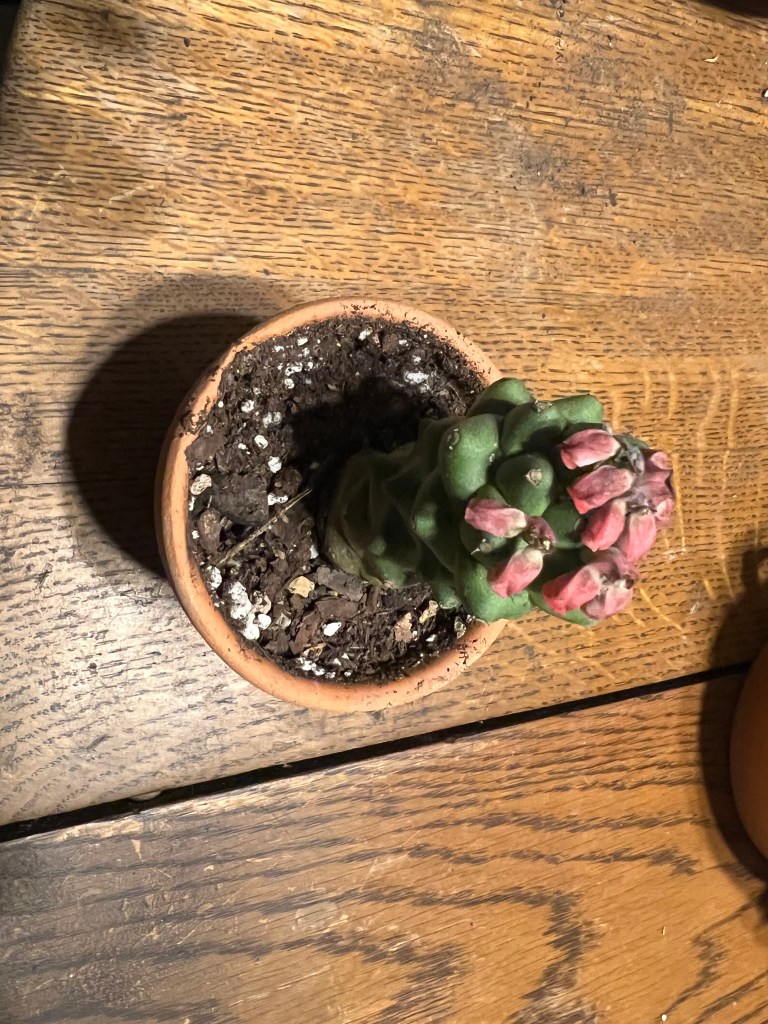
Prior to taking our trip Melissa had taken painstaking care to lightly water the succulents that were coming out of dormancy as they prepared for winter.  She has been cultivating many of these plants for the last two years and there has been little activity from most of them.  When we returned after three weeks, Melissa was surprised to see how many of these succulents had begun to flower while we were away.  This once more proved the adage, “The best thing you can do for your succulents is to leave them alone.”  The plant I found most interesting was the ripple jade.  A tiny (1/3 inch/0.85 cm) white flower had sprouted on what I thought was a dead leaf.

When I looked online, I found ripple jade (Crassula arborescens ssp. undulatifolia), also known as curly jade or silver jade, is a perennial evergreen succulent native to South Africa.  This shrub has rippled or twisted blue-green leaves that are fleshy in texture, sprouting from woody stems emerging from a central trunk.  The species has a compact growth habit and can reach up to four feet tall.  The plant prefers full sun and can bloom pink, star-shaped flowers in warm outdoor conditions.  When grown indoors they thrive in dry, warm climates and are not frost-tender.  They thrive best in USDA Hardiness Zones 10 through 12.  We are zone 8 and the ripple jade is kept on our greenhouse porch.  Like other jade plants, the ripple is somewhat toxic and can cause digestive issues in humans and pets if consumed.  Melissa has placed it on a higher shelf to keep it away from Zena.

Jade plants are often called the “friendship plant” or the “money tree” and is a staple in many Asian households.  The meaning of the jade plant is prosperity.  Jade plants are used in the practice of Feng Shui to attract the flow of money.  Feng Shui is the Chinese art of creating balance and harmony of energies within a space.  Practitioners believe that the “money tree” brings balance to the southeast corner of a home, and the jade plant is one of the plants used in this way.  A jade plant is often placed near a cash register in Chinese tradition to attract prosperity.  While I have often seen jade plants next to cash registers in restaurants, I never knew the cultural significance.

THOUGHTS:  Jade (the gem) is highly valued in Chinese culture and Confucius described it as a metaphor for Heaven and Earth.  Jade is believed to possess the power to avert evil and bad luck while fostering health and good fortune.  Jade (the plant) is called a money tree because it brings good fortune and luck.  Feng shui says the plant brings positive chi (energy) which is good for you and your family, encourages you to achieve your goals, and brings great health and good partner relationships.  Jade plants will die from overwatering and the leaves will burn from overexposure to light, which can cause death in jade plants.  This seems to be another metaphor.  The “good luck” we find in life is best achieved through work, not by our expectations it will “just happen”.  Act for all.  Change is coming and it starts with you.